9 Storytelling Openers For Instagram Captions
Nine story-driven Instagram caption openers that stop the scroll and drive comments, saves, and replies.
Nine story-driven Instagram caption openers that stop the scroll and drive comments, saves, and replies.
4.98 /5 - from 58k reviews
Trusted by 50,000+ creators — get real engagement delivered to your profile in minutes, not days.
If people only see your first line, that line has to do one job: make them tap “more.” On Instagram, captions often cut off at about 125 characters, so I’d treat the opener as the part that decides whether the rest gets read.
Here’s the short version: storytelling openers work because they put you into a moment, a problem, or a clear payoff right away. This article breaks that into 9 opener types I can use based on my goal:
One stat stands out: story replies are up 88% year over year, even while reach and impressions have slipped. That tells me one thing: posts that make people respond matter more than posts people just glance at.
The main takeaway: I should match my opener to the result I want - comments, trust, proof, or clicks - and keep the first line short, specific, and unfinished enough to make people keep reading.
| Opener Type | Best For | What It does in the first line |
|---|---|---|
| Question-led | Comments, feedback | Gets the reader to answer in their head |
| Moment-based | BTS, recaps, stories | Drops the reader into a scene |
| Conflict-led | Problem/solution posts | Starts with friction |
| Memory-led | Origin stories, milestones | Brings up a past moment people feel |
| Surprise-led | Data posts, case studies | Shows an outcome people didn’t expect |
| Opinion-led | Strong takes, debate | Gives a clear point of view |
| Dialogue-led | Story posts, client moments | Starts with someone speaking |
| Transformation-led | Before/after, proof | Shows change fast |
| Promise-led | Education, systems, tips | Leads with the result |
If I want better Instagram captions, I don’t need a longer intro. I need a better first sentence.
A storytelling opener works because it drops the reader into a moment that feels unfinished. People want to know what happened next. That answers the big question fast: why should I keep reading? Before they scroll away, you’ve already given them a reason to stay.
A line like "I almost quit last Tuesday." lands harder than a long intro because it feels real, specific, and unresolved. It gets to the point. And that tension - the small gap between what happened and what comes next - is what makes people stop.
Story-led captions also tend to do more than generic posts. They can drive replies and shares, not just likes. Instagram story engagement has increased 88% year over year, even as general impressions and reach have declined. That matters because replies show active interest, not passive views. This shift is a core part of modern Instagram growth strategies that prioritize connection over reach. Each opener type below uses that same curiosity in a slightly different way for the first line.
A question-led opener kicks off the story by nudging the reader to answer it in their head. The second they read it, their mind starts searching for a response. That pull gets them into the caption fast. Why does it work? A good question sparks curiosity right away. So the first line doesn’t have to be hard: just ask one sharp question.
Keep it short, specific, and personal. Use “you” or “your” so it feels direct. A vague line like “What do you think?” makes people work too hard. But something like “Have you ever posted something great and gotten 3 likes?” hits home. It points to a real, annoying moment many people have lived through.
Here’s what that can look like:
Use this kind of opener when you want comments and back-and-forth. This is a key way to improve your Instagram metrics organically. If a question feels a bit too on-the-nose, the next opener starts with a scene instead.
If question-led openers pull readers in, moment-based openers put them right inside a scene. You start with a specific moment - a time, a place, or one physical detail - before you spell out why it matters.
That specific detail makes the scene feel immediate. "It was 6:41 a.m. when I realized my content plan was completely backward" hits a lot harder than "I had a rough morning." The basic format is simple: [time/place] + [detail] + [tension]. One strong detail is usually enough. Add more only if it still feels natural.
Here’s how different audiences can use it:
This opener works well for BTS posts, transformations, testimonials, case studies, and event recaps. For a performance story, you could say: At 11:26 p.m., our follower count jumped 3,000 - without a giveaway.
Next: a hook that starts with friction instead of scenery.
A conflict-led opener starts with a clear problem, obstacle, or point of tension right away. It gives the reader a reason to keep going because the issue feels immediate and familiar. When someone feels the problem in the first line, they’re more likely to stick around for the answer. The best conflict openers make the issue obvious before the reader scrolls past, which is a key part of how to curate and share content on Instagram effectively.
The basic format is simple: lead with the problem, then reveal the payoff.
Keep the problem clear and the line short.
If conflict creates tension, memory creates recognition.
If conflict builds tension, memory builds recognition. A memory-led opener starts with a remembered moment and then links it to the present. When a reader sees a line that feels close to something they’ve lived through, they pause and lean in.
Nostalgia can increase social connectedness and shared identity, and emotion-led content tends to stay in memory longer.
The trick is specificity over sentiment. A line like Back in 2019, I almost deleted my account for good does more work than I used to struggle with this. The first line hints at stakes and opens a curiosity gap. People want to know what came next. Keep it to one tight sentence, then tie it to the present.
Here’s how different account types can use it:
Memory-led openers fit best in origin stories, milestones, turning points, and lessons learned. They’re a poor fit for flash sales or quick announcements, where speed matters more.
If memory creates recognition, surprise creates disruption.
A surprise-led opener begins with something the reader doesn't see coming in the very first line. It could be an odd result, a sharp twist, or an outcome that goes against what most people would expect. That gap between expectation and reality pulls people in fast. They keep reading because they want the answer.
This works a bit differently from a memory-based opener. Memory leans on recognition. Surprise leans on contrast.
The key is to make the surprise specific and true. Skip fuzzy lines like You won't believe what happened. That kind of setup sounds generic and doesn't give the reader much to grab onto. A line like Our lowest-budget video outperformed every high-production shoot this year works better because it spells out the unexpected result right away. It also creates a natural follow-up question: why? That question is what moves the reader into the rest of the caption.
The rest of the caption needs to answer that question fast. If the opener sets up surprise, the next few lines need to pay it off.
This type of opener works best for:
It's less useful for plain date or time announcements. Still, even those can sometimes work if you frame them from an unexpected angle.
Here’s how different account types can use it:
Use this approach sparingly. If every post tries to shock the reader, the effect wears off fast. And if surprise feels too blunt for the moment, the next opener starts with a clear opinion.
An opinion-led opener leads with the takeaway, not the backstory. You put your point of view in the first line and give people something to agree with, argue with, or think about.
That’s what makes this opener work. It feels direct. It shows confidence. And it gives the reader a reason to keep going.
Use it when you want attention and replies. Start with your take, then use the rest of the caption to back it up. A line like "This feature is overrated. Here's why." works because it’s short, clear, and sets up a natural next thought: why? That small bit of tension pulls the reader into the rest of the caption.
Keep the opinion tight. Stick to one clear claim in the opener. If you soften it too much or pile on extra context in the first line, the hook loses its bite.
If that kind of direct take feels a little too blunt, the next opener begins with dialogue.
If opinion-led openers say the point right away, dialogue-led openers let someone else say it first.
A dialogue-led opener drops the reader straight into speech. That creates an instant scene and gives people a reason to keep going. No setup. No scene-setting paragraph. Just one line of dialogue, and you're in.
Dialogue works because most captions begin with explanation, not speech. That contrast is the hook.
Use one short line of dialogue, then follow it with two or three lines of context. The line should do at least one job:
If it does none of those, it's just decoration.
Here's how each audience can use it:
One practical tip: read the opener out loud before you post it. If it sounds like Instagram ad copy instead of something a real person would say, rewrite it. Natural cadence makes dialogue feel real, not staged.
If the line needs a visible before-and-after, use the transformation-led opener next.
When your story is about change, start with the before and after.
A transformation-led opener shows that shift in a single line. That contrast pulls people in fast. They can see that something changed, and they want to know what happened in the middle.
Show both sides right away so the reader knows where the post is headed. A simple format works well: "I used to ___, now I ___." The key is to make the contrast specific and easy to picture. If people can see the difference, the result feels more believable. Then tie that contrast to the outcome you want to highlight.
This works best for posts built around clear change, like tutorials, milestones, case studies, and before-and-after stories. Using these Instagram growth tips can help you refine your storytelling further.
Skip broad claims like "my whole life changed." Go with a before-and-after people can actually picture.
A promise-led opener puts the payoff right up front. Start with the result: a shortcut, outcome, or framework the reader gets if they keep going. You're setting the direction of the story from line one, so the first sentence does the selling and the rest of the caption backs it up.
Use this when you want the opening line to do the heavy lifting, then let the story prove the point.
The catch? You have to deliver on the promise. If the caption doesn't follow through, the opener loses trust fast. This style works best for educational posts, how-tos, and case studies - any post where the reader leaves with something concrete—use an Instagram post checklist to ensure you hit every mark. It's not as strong for aesthetic or mood-based posts where there's no clear takeaway to promise.
Here's how each audience can use it:
A simple first-line format to adapt: Here's the exact [system/routine/script] I use to [result] - and the story behind it. Change the audience, outcome, and pain point to fit the post. Keep it short enough to land before the More cutoff.
Next, use the at-a-glance guide to match each opener to the right goal.
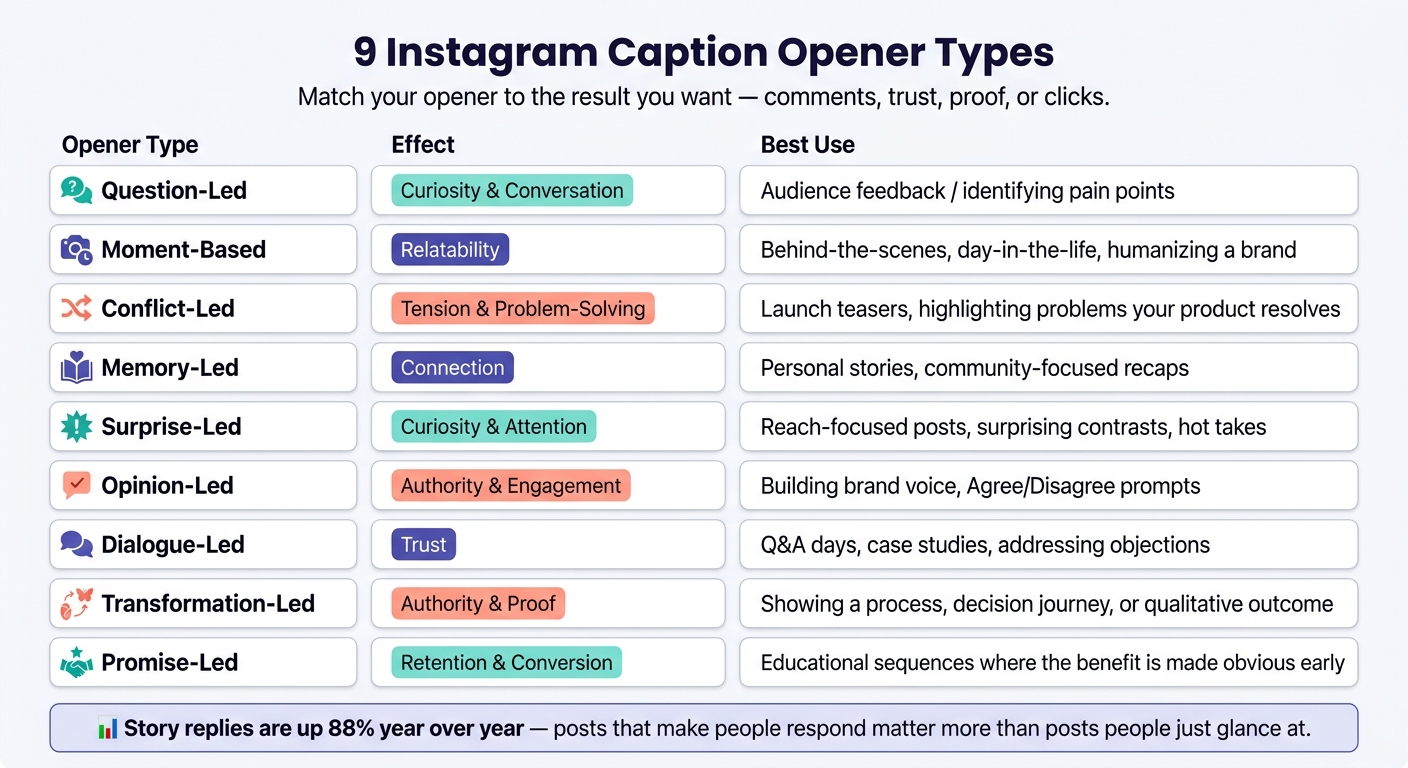
9 Instagram Caption Opener Types: Goals, Effects & Best Uses
Not all openers do the same thing. Some spark curiosity. Some build trust. Others create tension or make the post feel more personal. If you match the opener to the result you want, writing the rest of the caption gets a lot easier.
Use this table to pair the opener with your goal:
| Opener Type | Effect | Best Use |
|---|---|---|
| Question-Led | Curiosity & conversation | When seeking specific audience feedback or identifying customer pain points |
| Moment-Based | Relatability | Behind-the-scenes content; day-in-the-life updates; humanizing a brand on Instagram |
| Conflict-Led | Tension & problem-solving | Launch teasers; highlighting a clear problem or objection your product or service resolves |
| Memory-Led | Connection | Personal stories; community-focused recaps |
| Surprise-Led | Curiosity & attention | Reach-focused posts; surprising contrasts; hot takes |
| Opinion-Led | Authority & engagement | Building brand voice; "Agree/Disagree" prompts |
| Dialogue-Led | Trust | Q&A days; case studies; addressing customer objections |
| Transformation-Led | Authority & proof | Showing a process, decision-making journey, or qualitative outcome |
| Promise-Led | Retention & conversion | Educational sequences where the benefit of the destination is made obvious early |
The key is simple: pick the opener based on the action you want the reader to take. Once that first line is doing the right job, the rest of the caption has a much easier path. Start with the goal, then choose the opener that fits. This approach is a cornerstone of effective marketing on Instagram.
The best opener should fit the emotional center of the story and the voice of your account. A burnout post might call for a raw moment. A tutorial usually works better with a clear promise.
Each type of opener leads to a different kind of response, so test them on similar posts. Try a few opener styles across posts with the same angle, then track comments, saves, and taps on More.
Once you compare the results, stick with the opener that earns the next line. Keep that first line short, specific, and built around one clear idea. "Yesterday, I almost walked away from this project" earns the next line. "Something big happened recently" does not. Specific details pull people forward.
The goal is simple: make the first line earn the next one.
Match your hook to your post’s goal and content type. Also, keep that first line short and punchy, ideally within the first 125 characters.
Use curiosity-driven questions or bold statements when you want to pull people in. For teaching posts, lead with a problem-solution hook. For storytelling, go with a memory-led or conflict-led opening.
Then A/B test your hooks and keep a swipe file of the ones that perform best for future posts.
Keep your Instagram caption opener short and engaging. Instagram often cuts off captions after about 125 characters, so that first line needs to pull its weight. Think of it like a headline: it should give people a clear reason to tap “more.”
For Reels, go shorter. Aim for 5 to 8 words, or keep it under 100 to 125 characters.
Use A/B testing and change only the first line. Keep the visual, posting time, and body copy the same so the opener is the only variable.
Run the test for 7 to 30 days and aim for 1,000 to 5,000 impressions per version. Then compare 3-second view retention for Reels or engagement rate and comment quality for feed posts to see which hook stops the scroll best.