
Instagram Reels vs TikTok: Algorithm Signals
Compare how Reels and TikTok use watch time, shares, and metadata to rank videos and how testing edits drives follower growth.
Compare how Reels and TikTok use watch time, shares, and metadata to rank videos and how testing edits drives follower growth.
4.98 /5 - from 58k reviews
Trusted by 50,000+ creators — get real engagement delivered to your profile in minutes, not days.

I focus on attention and shares for both platforms - but I don’t assume they rank videos the same way. My starting point: show the payoff early, cut slow intros, and use clear topic wording. Then test 1 change at a time across several posts.
Instagram documents predictions such as finishing and resharing a Reel. TikTok lists watch time, skips, and video information, including captions, sounds, and hashtags. Neither publishes fixed signal weights, so I treat editing advice as a test - not a promise of reach.
Quick Comparison
| Criteria | Instagram Reels | TikTok |
|---|---|---|
| Viewing | Completion predictions; no fixed replay weight | Watch time, skips, and completion; no fixed replay weight |
| Interactions | Reshares and likes | Shares, likes, comments, and follows |
| Topic and audio | Audio-page visits; no published keyword formula | Captions, sounds, and hashtags |
| Audience context | Past viewer activity and creator interactions | Viewer interactions, follows, searches, and regional content |
| Recommendation access | Eligibility rules can limit recommendations | Ranking signals don’t guarantee reach |
| Measurement | Watch time, shares, follower/non-follower reach, and attributed follows | Watch time, full-watch rate, traffic sources, and attributed followers |
My goal is <u>the right viewers and more follows - not views alone</u>. I compare posts at the same age, test best day and time to post on Instagram without assuming a “best” schedule, and use native analytics for video results. For overall Instagram follower growth, I can track UpGrow alongside Instagram Insights.
Instagram ranks Feed, Stories, Explore, Reels, and Search separately. For Reels, it predicts whether viewers will reshare, watch to the end, like, or visit the audio page. A viewer’s past interactions with a creator also help shape recommendations.
| Signal | What it may indicate | What to do |
|---|---|---|
| Watch time/completion | Attention that lasts through the end | Open with the payoff and keep pacing tight |
| Replays | Repeat interest; no fixed weight is published | Add a useful detail or a smooth loop |
| Shares, including direct-message sends | Personal, practical, emotional, or social value | Make the takeaway worth sending |
| Likes | A simple sign of approval; a documented Reels prediction | Make the benefit or emotional payoff clear |
| Audio | Audio-page visits are a documented Reels prediction | Choose relevant audio you have the rights to use |
| Keywords | Clear topic wording can support search and relevance; no fixed keyword weight is published | Use natural topic wording in speech, text, captions, and relevant hashtags |
Eligibility is separate from ranking. Publishing a Reel doesn’t mean Instagram will recommend it broadly. Content that conflicts with its recommendation rules - or includes low-quality, reused, or otherwise restricted material - may not qualify. Originality and policy compliance affect eligibility, not just ranking.
TikTok uses similar attention signals, but it more explicitly identifies topic language and video metadata as ranking inputs.
TikTok combines viewer behavior with content metadata to judge relevance. It weighs watch time, skips, shares, likes, comments, and follows, along with captions, sounds, and hashtags.
| Signal | What it may indicate | What to do |
|---|---|---|
| Watch time | Interest in the subject and presentation | Hook viewers early and keep each segment relevant |
| Completion | Watching a longer video in full is a strong interest signal. | Match the length to the explanation |
| Replays | Renewed interest; no universal replay multiplier is disclosed | Make repeat viewing useful, not necessary |
| Shares | Content worth passing along; a documented interaction | Give viewers a useful takeaway |
| Likes | Positive preference alongside other interactions | Make the value clear |
| Captions, sounds, and hashtags | Documented relevance inputs; advice about speech and on-screen wording is an interpretation of that guidance. | Use consistent topic wording and relevant sounds |
Documented ranking signals aren’t the same as content advice. Neither platform publishes fixed signal weights. Here’s where they overlap and where marketers may need a different approach.
| Signal | Instagram Reels | TikTok | What marketers can do |
|---|---|---|---|
| Watch time/completion | Predicts whether viewers will finish a Reel. | Uses watch time; watching longer videos in full is a strong interest signal. | Open with a clear payoff and hold attention |
| Replays | No fixed replay weight is published | No universal replay multiplier is disclosed | Use loops only when they improve viewing |
| Shares | Predicts whether viewers will share the Reel. | Includes shares among recommendation interactions. | Give viewers a specific reason to send the video |
| Keywords and metadata | Cited guidance gives no fixed keyword formula; audio-page visits are a Reels prediction. | Explicitly identifies captions, sounds, and hashtags as relevance inputs. | Keep topic wording accurate and audio relevant |
| Account context | Viewer activity and creator interaction history shape recommendations. | Recommendations reflect interactions, follows, searches, and regional content. | On Instagram, build on audience relationships; on TikTok, make topic and audience relevance clear |
Hypothetical example: Sweet Layers Bakery tests two edits of the same vintage heart cake video to compare opening, pacing, and payoff. Treat them as test options, not platform rules.
Use each platform’s signals to guide your opening seconds, pacing, and payoff.
| Production choice | Instagram Reels edit | TikTok edit |
|---|---|---|
| Opening | Show the finished cake or a dramatic transformation first so viewers know the payoff. | Start with a specific problem: piping clean vintage shells without tearing the frosting. |
| Pacing | Test clear cuts from the finished cake to key steps and the final reveal. Remove setup, then compare completion and shares. | Test a faster tutorial, a spoken walkthrough, or a slightly longer step-by-step edit. Give viewers an honest reason to keep watching. |
| Payoff | Show the finished cake and include a practical detail worth saving or sharing. | Solve the opening problem with a close-up demonstration and the completed cake. Include details worth replaying. |
| Topic language | Use natural topic words in the hook, captions, and on-screen text. | Keep spoken words, on-screen text, captions, and hashtags focused on the topic. Choose sounds that fit without making narration hard to hear. |
| Measurement | Compare watch time, completion rate, shares, saves, and follower vs. nonfollower reach. | Compare watch time, completion rate, shares, comments, and For You traffic. |
The next two examples show how to turn those signals into editing choices.
Lead with the finished cake, then cut anything that doesn't support the payoff. Give the opening one useful promise. Test a practical closing detail, such as how to maintain consistent piping pressure. A relevant sharing prompt can invite viewers to send the demonstration to a friend who bakes birthday cakes.
Use Instagram Insights to compare retention, shares, saves, and follower reach. These are performance metrics - not proof of ranking.
Name the topic right away, then give viewers a reason to stay with a clear demonstration. Show the piping correction without holding back the answer. Include a close-up viewers can study, and test the pacing options above. Accurate captions, relevant hashtags, and sound that keeps narration easy to hear help make the topic clear.
Read watch time alongside completion rate: longer videos can get more watch time but fewer finishes. Check comments for instructions viewers find unclear and For You traffic for discovery. If replays spike, inspect that part of the clip before repeating it.
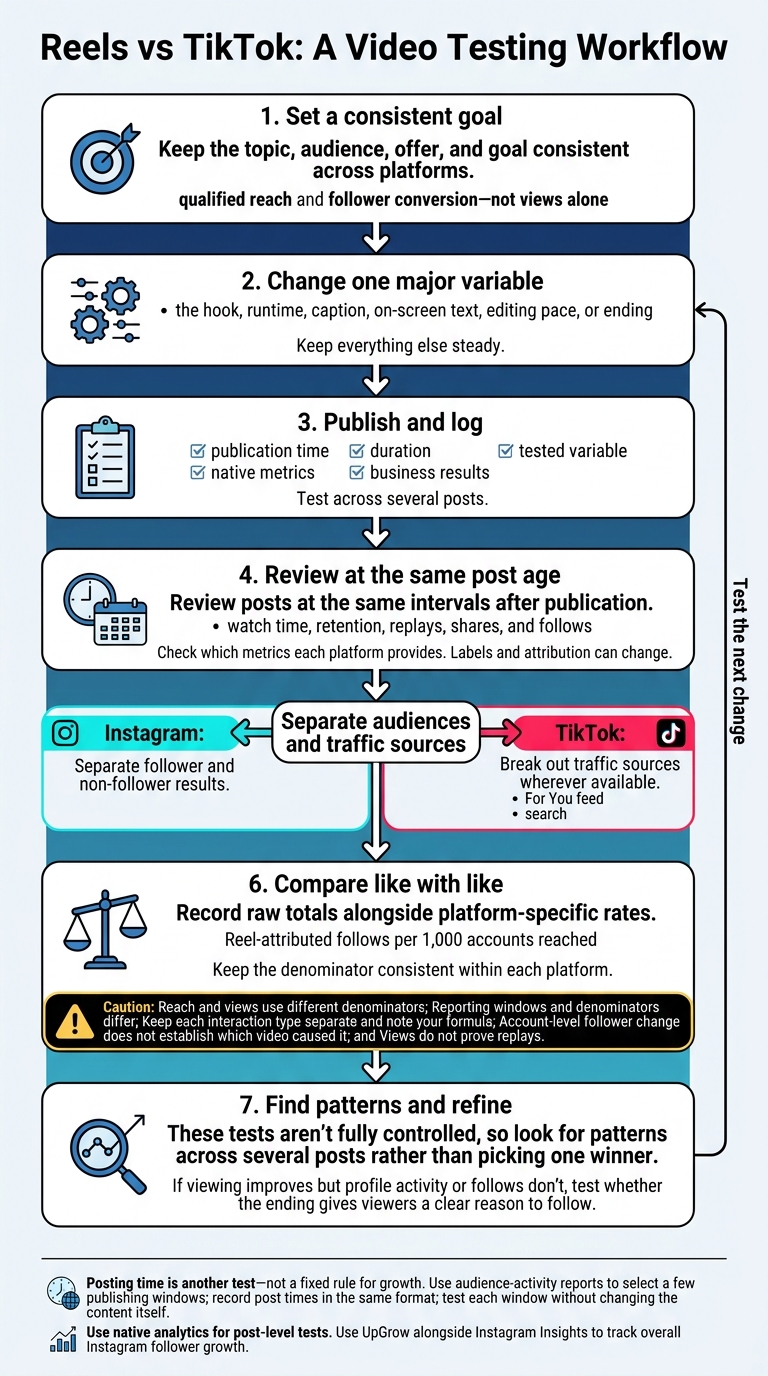
Reels vs TikTok: A Video Testing Workflow
After publishing, check whether your signal-driven edits improved reach and follows. Keep the topic, audience, offer, and goal consistent across platforms. Look at whether each post reached the right viewers and turned views into follows.
Track the signals you optimized for: watch time, retention, replays, shares, and follows. Before testing, check which metrics each platform provides. Labels and attribution can change.
| Measurement | Instagram source or definition | TikTok source or definition | Comparison limitation |
|---|---|---|---|
| Discovery | Accounts reached; follower/non-follower split when available | Video views and available traffic sources, including For You feed and search | Reach and views use different denominators. |
| Viewing | Total and average watch time; retention indicators when shown | Total play time, average watch time, and full-watch rate when shown | Reporting windows and denominators differ. |
| Interactions | Likes, comments, shares, and saves | Likes, comments, shares, and favorites when reported | Keep each interaction type separate and note your formula. |
| Follower conversion | Reel-attributed follows and profile activity when available | Video-attributed followers and profile activity when available | Account-level follower change does not establish which video caused it. |
| Replays | Replay-specific metric, if available | Repeat-view metric, if available | Views do not prove replays. |
Use these metrics to compare one change at a time.
Change one major variable: the hook, runtime, caption, on-screen text, editing pace, or ending. Keep everything else steady so you can see which signal moved.
Log each post’s publication time, duration, tested variable, native metrics, and business results. Review posts at the same intervals after publication. These tests aren’t fully controlled, so look for patterns across several posts rather than picking one winner.
Separate Instagram follower and non-follower results, and break out TikTok traffic sources wherever available. Record raw totals alongside platform-specific rates, such as Reel-attributed follows per 1,000 accounts reached. Keep the denominator consistent within each platform.
If viewing improves but profile activity or follows don’t, test whether the ending gives viewers a clear reason to follow.
Treat posting time as another test - not a fixed rule for growth. Use available audience-activity reports to select a few publishing windows. TikTok Studio provides audience activity data.
Record post times in the same format, and test each window without changing the content itself. Choose a posting pace that leaves room for quality production and replies to viewers. Regular publishing gives you more chances to test.
Use native Instagram analytics for post-level tests, then track overall Instagram growth in UpGrow.
Use UpGrow’s live dashboard alongside Instagram Insights to track overall follower growth.
Instagram puts more weight on watch-through and reshares; TikTok puts more weight on watch time and video metadata. Both platforms use overlapping signals, but weigh them differently. That affects how you open, pace, and label each video.
Let those signals guide how quickly you get to the point, how long you hold attention, and what you ask viewers to do next. For Reels, start strong and give people a reason to share or save. For TikTok, make the topic clear right away through speech, on-screen text, captions, and hashtags.
Publish original videos with clear audio and a useful takeaway. Maintain that quality on a schedule you can keep up with. Measure each post and use what you learn to refine the next edit. Track qualified reach and follower conversion - not views alone - to turn platform signals into repeatable growth.
Yes, but avoid videos with watermarks from other apps - Instagram suppresses them. Before posting, use AI tools to adjust aspect ratios or tweak text overlays to keep your content original and support performance.
Results can vary. Each platform - and each content surface within it - uses different AI models and ranking signals based on its entertainment or discovery goals.
Your content can hold attention without building a relationship. High watch time and completion rates tell the algorithm that viewers are engaged. But engagement doesn’t automatically translate into follows.
Give viewers a reason to stick around. Write a clear bio and pin posts that show what you offer. Let your content nudge people toward your profile instead of asking them directly to follow. These implied calls to action often perform much better.
Test one variable at a time - not an entire content concept. To test a new hook, change only the first two seconds and track performance over 5 to 7 days. Before changing your overall strategy, post 3 to 5 Reels each week for at least 20 weeks to see a marked increase in engagement.
If attention, resonance, or discovery metrics stay weak, adjust your opening or format rather than drop your strategy too soon.


