Instagram vs TikTok: Content Lifespan Data 2026
Compare how long content performs on Instagram vs TikTok - Day 1 spikes on TikTok, longer tails on Instagram Reels, and Stories' 24-hour limit.
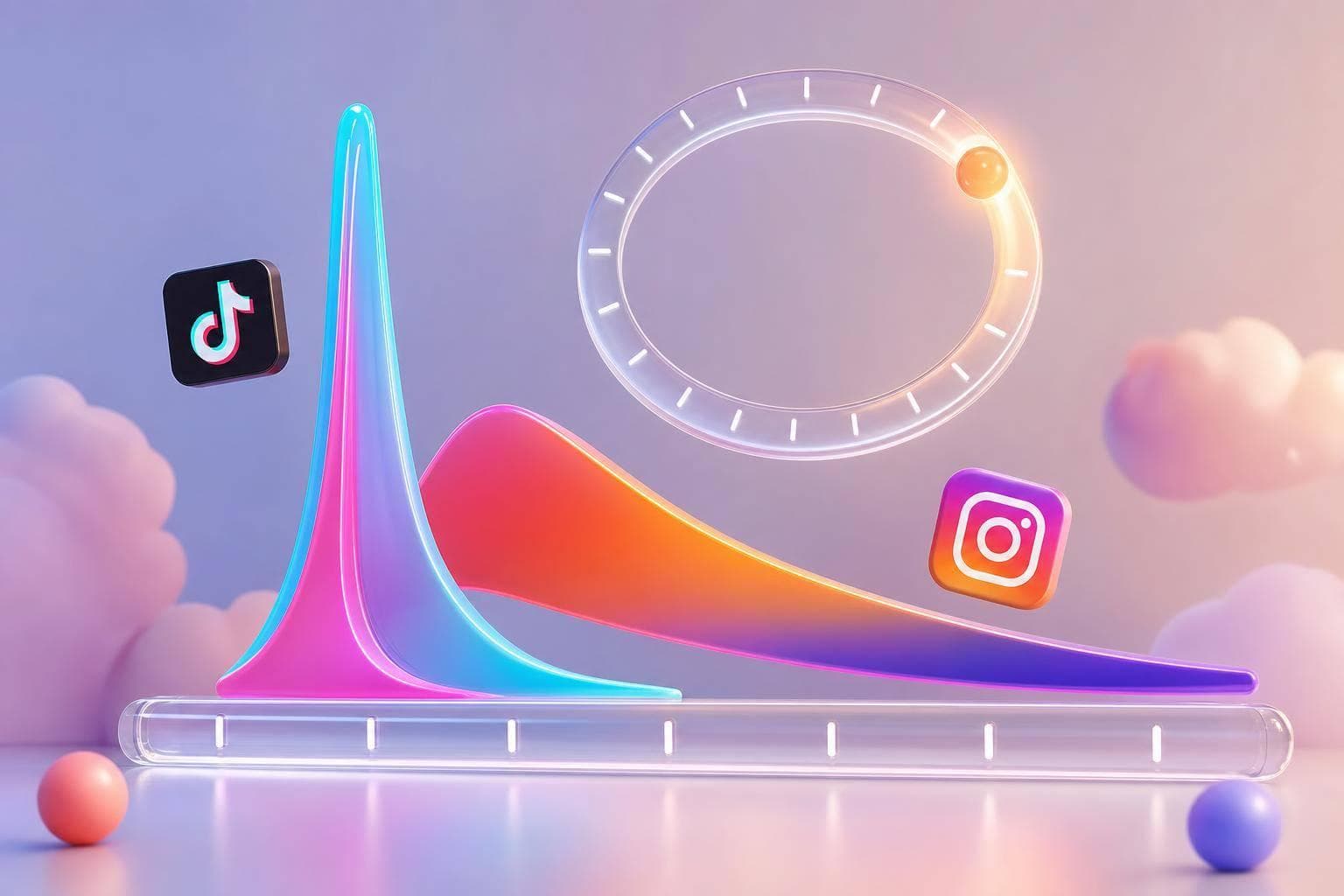
If I want content that hits hard on day one, I look at TikTok. If I want content that keeps working for days or months, I look at Instagram.
Here’s the short version:
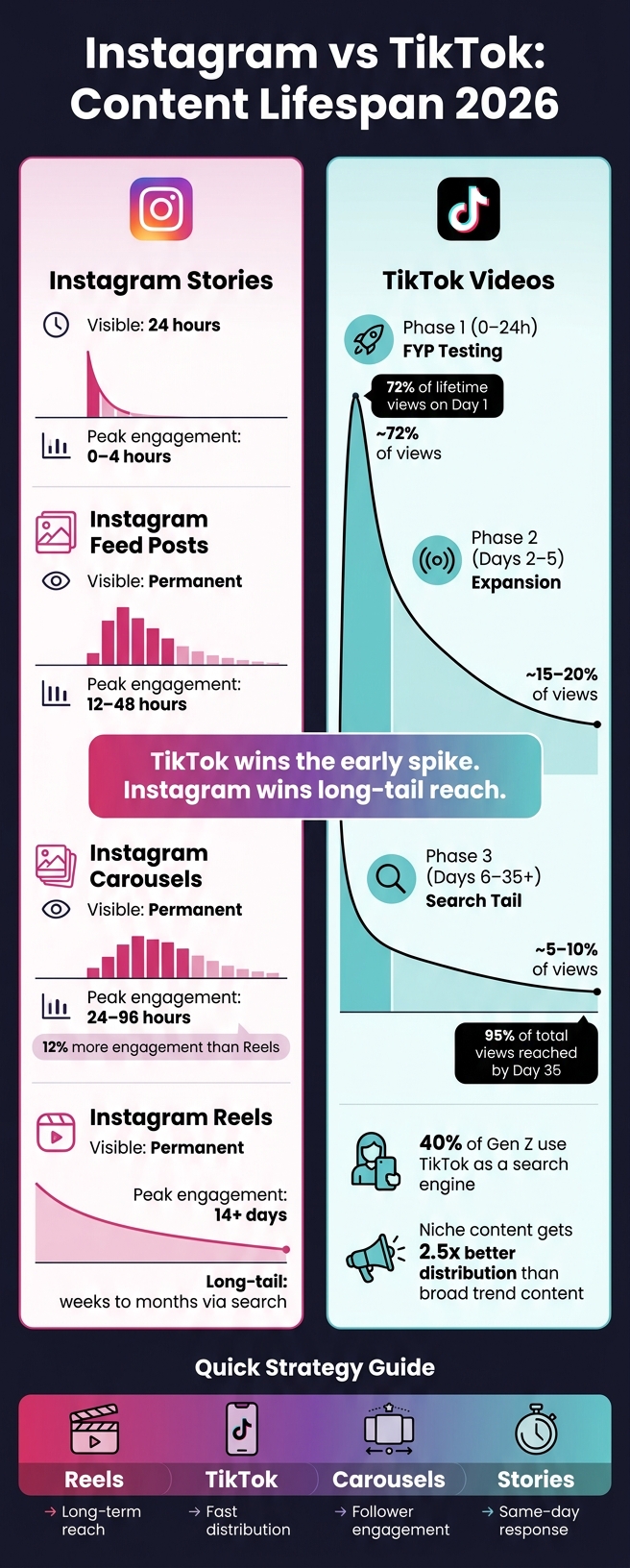
- TikTok is front-loaded: about 72% of lifetime views happen on Day 1
- Instagram Reels usually have a longer tail: many keep getting views for 14+ days, and some stay findable for weeks or months
- Stories expire in 24 hours and get most action in the first 1 to 4 hours
- Feed posts fade fast, with most comments and interaction landing in 24 to 48 hours
- Carousels last longer than single-image posts and often get more interaction
If you want the plain answer, it’s this: TikTok wins the early spike, while Instagram gives more room for long-tail reach. That makes TikTok better for fast exposure and Instagram better for posts that can keep pulling in saves, shares, and search traffic over time.
Instagram vs TikTok Content Lifespan 2026
Quick Comparison
| Format | Main peak | How long it keeps working |
|---|---|---|
| TikTok video | First 24 hours | Most views arrive within about 35 days |
| Instagram Reel | First 12 to 24 hours | Can keep going for 14+ days or longer |
| Instagram carousel | First 24 hours | Often lasts 2 to 4 days |
| Instagram feed post | First 12 to 24 hours | Usually fades within 48 hours |
| Instagram Story | First 1 to 4 hours | Ends after 24 hours |
I’d use this data in a simple way: post Reels for longer reach, use TikTok for fast distribution, use carousels for follower engagement, and use Stories for same-day response.
Instagram Content Lifespan by Format
Instagram content doesn't age at the same pace across formats. A Reel can keep pulling views long after a feed post has cooled off, while Stories live on the shortest clock of all.
Reels: How Long Views and Engagement Last
Reels have the longest tail on Instagram. Most Reel views come in during the first 12 to 24 hours, but strong posts can keep pulling views for 14+ days.
Not all engagement signals carry the same weight, either. Saves and shares tend to matter longer than likes and comments. In 2026, Instagram also treats saves and shares as stronger visibility signals than likes.
| Metric | Peak Window | Long-Tail Duration |
|---|---|---|
| Views | First 12–24 hours | 14+ days |
| Likes | First 24 hours | 7–10 days |
| Comments | First 48 hours | 5–7 days |
| Saves | First 48 hours | 14+ days |
| Shares | First 12–48 hours | 10+ days |
That early window still matters a lot. Try to drive engagement in the first two hours after posting. Those first interactions tell the algorithm the Reel is worth showing to more people, which shapes how far Instagram redistributes it later.
Feed Posts and Carousels: Early Engagement and Shorter Windows
Feed posts move much faster. About 75% of total comments arrive within the first 48 hours, and most traction happens even sooner, between the time you post and the 12-hour mark.
Carousels tend to beat static photos because swipes add another layer of interaction. They also drive about 12% more engagement than Reels and about twice as much as single-image posts. That gap shows up clearly in how long each format keeps attention:
| Format | Half-Life (50% of engagement) | Time to 95% of Lifetime Views (Est.) |
|---|---|---|
| Static Photo | ~12 hours | 48 hours |
| Carousel | ~24 hours | 72–96 hours |
| Reel | ~72 hours | 14+ days |
For feed photos and carousels, timing matters more than it does for Reels. Posting on weekdays between 10 a.m. and 2 p.m. gives you a better shot at building early momentum.
Stories: 24-Hour Visibility and Immediate Engagement
Stories are the most time-bound format on Instagram. They disappear after 24 hours, and most views, taps, replies, and sticker interactions happen in the first one to four hours.
What makes Stories work is private interaction. Poll votes, quiz taps, emoji slider reactions, and direct replies may seem small, but they still signal value to Instagram. In plain English, they tell the platform your account is worth showing to followers.
Highlights are the one exception. When you save Stories to Highlights, they can stay visible with no time limit. That said, Highlights don't drive the same immediate response as a live Story.
TikTok follows a different pattern: faster early reach, then a sharper fade.
TikTok Video Lifespan and Discovery Windows
TikTok is front-loaded. Most of a video's reach shows up in the first 48 hours, then a smaller tail can keep going for weeks. So yes, the first day matters a lot. But it isn't the whole story.
TikTok Videos: First-Day Spike and Rapid Drop-Off
About 72% of a TikTok video's total lifetime views happen on Day 1. TikTok usually starts by testing a new video with a small group of around 200–500 users. If that first response looks strong, the platform pushes the video to more people.
After that first burst, growth tends to slow fast. Videos average about 9,400 views in the first 5 days, and most hit 95% of their total lifetime views in about 35 days. In plain English: TikTok moves fast, and most videos do most of their work early.
Saves and shares matter a lot if you want a video to keep moving. They tell TikTok that the post is useful, not just briefly interesting, and that can help it reach more viewers.
| Phase | Time Range | Approximate Share of Total Views |
|---|---|---|
| Initial Spike (For You Page Testing) | 0–24 hours | ~72% |
| Acceleration & Expansion | Days 2–5 | ~15–20% |
| Search Tail | Days 6–35+ | ~5–10% |
Replays are another big signal here. TikTok currently puts more weight on replays than on likes or comments. That makes sense when you think about it: if people watch again, the platform reads that as a stronger sign that the video held their attention.
Search-Driven Discovery After the Initial Spike
Once the first spike fades, search can give the right video a second life. TikTok has grown into a search tool, with 40% of Gen Z users now using it to search instead of Google. That opens up another discovery window that can last for weeks or even months after posting.
Keywords in spoken audio, on-screen text, and captions can keep bringing in views long after For You Page reach starts to dry up. This long-tail stretch makes up about 5–10% of total views from days 6 through 35, but for the right post, those views can keep stacking up at a steady pace.
A good clue that a video is entering this stage is when saves and shares keep coming in even after new views start to slow. That's often a sign the video is still useful in search or getting picked up in recommendations.
Niche content tends to do best here. Micro-niche content gets 2.5x better distribution than broad trend content, which gives it a better shot at finding a second audience through search and recommendations.
Next, compare those windows directly against Instagram's Reels, feed posts, and Stories. Understanding these differences is key to learning how to get more followers on Instagram organically.
sbb-itb-3c55afb
Instagram vs TikTok: Which Platform Keeps Content Alive Longer?
TikTok wins the first-day sprint. Instagram usually gives content a longer shelf life.
Here’s the plain-English version by format.
TikTok is built for speed. 72% of a video's total lifetime views land on Day 1, and it reaches 95% of total views in about 35 days. Instagram Reels move differently. They often start by testing with your current followers before pushing farther out. Reels also act more like a search-friendly format, which means people can still find them through keywords, locations, and trending searches for weeks or even months after you post. That’s a big reason Reels tend to outlast feed posts.
Reels vs TikTok Videos: Views, Likes, Comments, Saves, and Shares Side by Side
The main gap between these formats isn’t just speed. It’s the type of engagement that helps push reach.
TikTok tends to reward strong watch time and fast early engagement. Instagram Reels, on the other hand, often get more mileage from saves and shares, which help content keep circulating over time.
| Metric | Instagram Reels Lifespan | TikTok Video Lifespan |
|---|---|---|
| Primary reach window | Slower start; tests with existing followers first | Front-loaded; 72% of views on Day 1 |
| Discovery method | Search-friendly via keywords and location tags | Interest-based recommendations and viral spikes |
| Long-tail reach | Extended; stays searchable for months | About 35 days to reach 95% of total views |
| Key engagement signals | Saves and shares drive long-term reach | High-retention views drive early distribution |
All Formats in One Table: Stories, Feed Posts, and TikTok Videos
Across every format, the same pattern shows up: Instagram keeps more content alive longer; TikTok packs more of its reach into the early window. Feed posts, Reels, and TikTok videos all stay available after posting, but the period when they pull in the most engagement fades at different speeds.
Here’s the full lifespan view across the formats that matter most.
| Platform & Format | Visible Duration | Main Engagement Window |
|---|---|---|
| Instagram Stories | 24 hours | First 0–12 hours |
| Instagram Feed Posts | Permanent (grid) | First 24–48 hours, mostly followers |
| Instagram Carousels | Permanent (grid) | 2–3 days, driven by high dwell time |
| Instagram Reels | Permanent | Long-tail; weeks to months via search |
| TikTok Videos | Permanent | About 35 days; 72% of views on Day 1 |
What the Lifespan Data Means for Instagram Growth in 2026
Why Reels Should Lead an Instagram Growth Strategy
The data points to one clear move: lead with Reels.
That lifespan gap changes how you should think about Instagram. Reels have the longest tail on the platform. They can keep showing up in search through keyword-rich captions and Instagram search for weeks or even months after you post them.
For creators and small businesses that want more reach without a big built-in audience, that matters a lot. The goal isn’t just to land one good post. It’s to build discovery over time, piece by piece.
Posting 3–5 Reels per week consistently gives the algorithm more chances to test your content with new people. And the payoff can be huge. Creators who post consistently for 20 or more weeks out of a 26-week period see 450% more engagement per post than sporadic posters. That’s a massive gap.
A simple move that can help right away:
- Reply to every comment within the first three hours of posting
- Put extra focus on content that earns saves and shares, since those signals matter more than likes for longer-term distribution
Using UpGrow to Track and Extend Instagram Performance
If you want to measure that longer tail, you need live performance data.
UpGrow gives you real-time analytics, AI targeting, and Boost™ so you can spot which Reels keep picking up steam and respond faster. Its AI targeting lets you filter by location, age, gender, and language, which helps you reach the audience you want instead of casting a wide net and hoping for the best.
Plans start at $39/month and come with a growth guarantee.
Conclusion: Instagram vs TikTok Lifespan in Plain Terms
In plain terms, this comes down to timing.
TikTok wins on speed. Instagram Reels win on longer-tail discovery. Feed posts mostly serve your current followers, while Stories are a 24-hour format built for in-the-moment engagement.
Choose the format that fits the job.
FAQs
Which format should I post for longer-lasting results?
For longer-lasting results, put more energy into Reels and TikTok videos than content that fades fast. On Instagram, Reels stick around on your profile, while Stories vanish after 24 hours.
Evergreen content also has more staying power. Think tutorials, storytelling, and case studies. Because those formats stay relevant, they can keep picking up views over time.
Do saves and shares matter more than likes now?
Yes. In 2026, saves and shares matter far more than likes on Instagram because the algorithm puts more weight on deeper, high-intent engagement.
DM shares are the strongest signal of trust and relevance. Saves show that a post has lasting value and is worth coming back to. Likes still show sentiment, but they have much less impact on reach and viral distribution.
Can old Reels or TikToks still get views from search?
Yes. Old Reels and TikTok videos can still get views from search long after they’re posted.
On Instagram, content can stay discoverable through Explore. On TikTok, videos may pop back up weeks or months later if they match search queries or start getting new engagement. Using relevant keywords in captions, on-screen text, and hashtags can help your content stay discoverable for longer.