Table of contents
- How Repeated Content Tires Audiences and Weakens Engagement Signals
- Why One Version Does Not Work Across Instagram, TikTok, YouTube Shorts, X, and Facebook
- The Fix: Change Hooks, Formats, Timing, and Captions Without Rebuilding Everything
- Using UpGrow to Spot Content Fatigue and Improve Instagram Performance
- FAQs

If you post the same Reel, caption, and hashtags on every app, people get tired of it fast. I’d fix it by changing the hook, caption, format, and posting time for each platform instead of sending one copy everywhere.
Here’s the short version:
- Same post on 5 apps = more repeat views, not always more reach
- When people see the same clip 2–3 times in one day, they often scroll past
- That can lower watch time, saves, shares, comments, and completion rate
- Lower response usually means less distribution
- The fix is simple: keep the idea, but change the packaging
- I’d also spread posts over 24–72 hours instead of posting all at once
- Watch engagement rate, saves, shares, watch time, and follower growth to spot fatigue early
This comes down to one point: repurposing works; copy-paste posting does not. If I want better Instagram results, I need to make each version feel like it belongs on that app, not like it was dumped there from somewhere else.
How Repeated Content Tires Audiences and Weakens Engagement Signals
When the same post lands on Instagram, TikTok, YouTube Shorts, X, and Facebook, people who follow you in more than one place can get tired of it fast. That slump usually shows up in the data next.
How repeat exposure reduces audience interest
A lot of creators have the same followers across platforms. So when those people see the same clip again, the sense of newness fades fast. If the hook, opening line, and on-screen text don’t change, viewers often spot the post right away and keep scrolling.
Once attention slips, engagement signals tend to slip too.
What lower engagement signals
Watch time, completion, saves, shares, and comments often fall when a post feels reused. And when those signals weaken, reach tends to drop too. The post isn’t being punished just because it was cross-posted. It loses reach because people respond less.
Why identical posts can feel automated
This gets worse when the post looks plainly copied instead of shaped for each platform. Using the same caption, emojis, hashtags, and posting time everywhere can make the content feel like a mass broadcast instead of something made with each audience in mind.
Small details add to that impression. A TikTok watermark left on an Instagram Reel is an obvious one. In areas where personal connection matters, like coaching, lifestyle, and small business, that “set it and blast it” feel can slowly wear down trust. People may leave lower-effort comments, mute Stories, or just drift away.
sbb-itb-3c55afb
Why One Version Does Not Work Across Instagram, TikTok, YouTube Shorts, X, and Facebook
That fatigue gets even worse when you push the same idea into the wrong format for each app. Yes, the idea behind a post can travel. But the packaging? That has to change.
Every platform has its own rhythm, its own pace, and its own small signals that tell people, "This belongs here." One unchanged video usually doesn't hit that mark across all of them.
Planned changes keep the message steady. Straight copy-paste weakens fit and usually hurts performance.
Each platform rewards different hooks and pacing
TikTok needs the fastest hook. Reels tends to work better with a cleaner visual lead. Shorts can often carry a slightly longer setup before the main payoff lands.
X and Facebook play by different rules too. Both lean more heavily on text, so dropping in a video with a vague one-line caption is an easy way to get ignored.
On X, the caption should frame the post with a clear point of view. It needs to stop someone mid-scroll and give them a reason to care right away. On Facebook, especially in groups or page feeds, captions often do better when they spell out who the post is for and why it matters now. A caption copied over from Instagram usually feels flat there.
Format mismatches make copied posts perform worse
Watermarks, awkward text placement, and carryover formatting make reused posts feel obvious. People notice that fast, and retention tends to drop.
The fix is simple in theory: keep the core message, but change the hook, format, timing, and caption for the platform you're posting on.
The Fix: Change Hooks, Formats, Timing, and Captions Without Rebuilding Everything
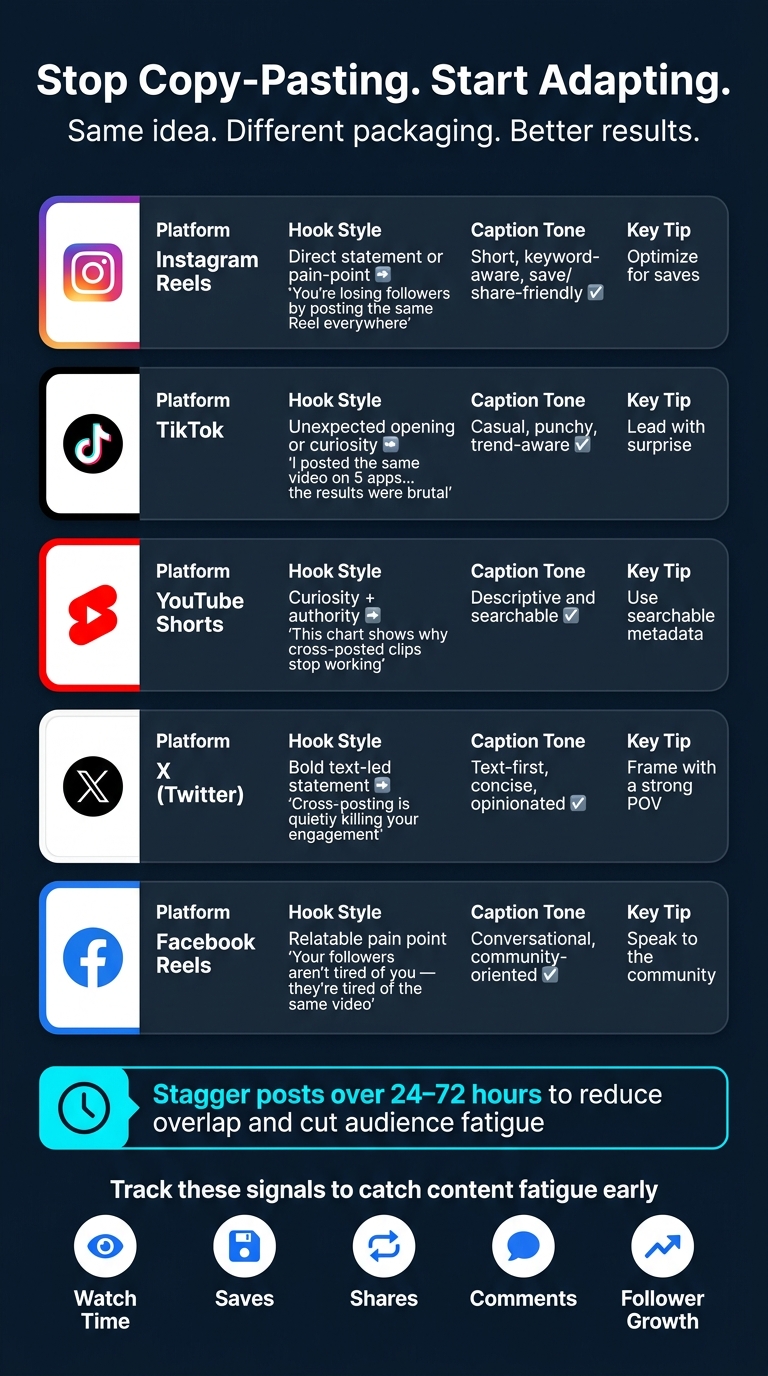
Cross-Posting vs. Platform-Adapted Content: Hook, Format & Caption Guide
Keep the main idea. Just change the hook, caption, and timing for each platform. Those small tweaks help the same idea feel new instead of recycled.
Change the hook, not the core message
The first 1–3 seconds matter most. So the goal isn't to rewrite the whole message. It's to reshape the opening for the way people use each platform.
Four hook types handle most cases. A curiosity hook hints at the result without spelling it out. A pain-point hook names the problem fast. A direct statement hook gets straight to the point. An unexpected opening starts with something that snaps attention into place, like a sharp cut or a visual switch. Same point, different entry.
Here’s a simple platform-by-platform match:
| Platform | Suggested Hook Style | Caption Tone |
|---|---|---|
| Instagram Reels | Direct statement or pain-point ("You're losing followers by posting the same Reel everywhere") | Short, keyword-aware, save/share-friendly |
| TikTok | Unexpected opening or curiosity ("I posted the same video on 5 apps… the results were brutal") | Casual, punchy, trend-aware |
| YouTube Shorts | Curiosity + authority ("This chart shows why cross-posted clips stop working") | Descriptive and searchable |
| X video | Bold text-led statement ("Cross-posting is quietly killing your engagement") | Text-first, concise, opinionated |
| Facebook Reels | Relatable pain point ("Your followers aren't tired of you - they're tired of the same video") | Conversational, community-oriented |
Adjust format and timing by platform
Take off watermarks and post natively. Then use each platform’s own tools, like Instagram stickers, TikTok sounds, YouTube Shorts overlays, and X’s text-first framing. That way, each version feels like it belongs there instead of looking imported from somewhere else.
Timing matters too. Posting the same clip everywhere at once makes repetition way more obvious. If one follower runs into it on Instagram, TikTok, and Facebook before lunch, it starts to feel worn out. A better move is to stagger posts over 24–72 hours. That cuts down overlap and gives you room to tweak the next caption or thumbnail based on early performance. Then you can compare which version keeps attention the longest or create Instagram Reels that go viral by analyzing these metrics.
Rewrite captions and metadata for each platform
Using the same caption on every app stands out almost as fast as using the same video.
Each platform expects the caption to do a different job:
- Instagram: short and saveable
- YouTube Shorts: searchable
- Facebook: conversational
- X: opinion-led
The caption should make the post feel newly packaged, not like a copy of something people already saw. Metadata matters too. Tags and categories should shift by platform. For example, "social media strategy" may fit Shorts better, while "Instagram growth" makes more sense for Reels.
Once the different versions are live, use UpGrow's analytics to see where engagement starts to drop.
Using UpGrow to Spot Content Fatigue and Improve Instagram Performance
How UpGrow helps identify repetitive content patterns
Once you publish a few variations, the next step is simple: watch what keeps attention and what starts to fade. That helps you figure out whether the problem is the content itself or the audience response.
Pay close attention to engagement rate, saves, shares, watch time, and follower growth. Those signals can show fatigue early, before the drop gets worse. Because this data comes from actual Instagram behavior, it gives you a clear read on when people are tuning out. UpGrow shows these shifts in real time, so you can spot the decline before it compounds.
A simple before-and-after snapshot usually tells the story fast: repetitive posts tend to flatten engagement, while updated versions often push it back up.
When fatigue starts to show, use audience data to test the next version with more control. Instead of putting every test in front of your full follower base, you can try new hooks with your most engaged audience segments first. That makes it easier to see what lands before you roll it out more broadly.
Conclusion: Repeat the idea less, adapt it more
The fix is pretty straightforward: treat each platform like a different packaging job, use analytics to see what's working, and adjust from there. Track the drop, change the packaging, and test again.
FAQs
How can I tell if cross-posting is hurting engagement?
Look for a steady drop, especially in non-follower reach.
A few red flags tend to show up early:
- lower engagement across 3 to 5 posts over 7 to 14 days
- non-follower reach below 5% on multiple posts
- share rate below 0.3%
- high exit rates or too many forward taps
Don’t judge one post in isolation. Stack recent results against your 28- to 90-day baseline. If you’re seeing a 20% to 30% drop, cross-posting may be dragging down performance.
Do I need a different video for every platform?
You don’t need to make a brand-new video for every platform. But posting the exact same file everywhere is usually a bad move. Identical posts can cut engagement by 40% to 60%.
A better approach is to reuse your main piece of content and tweak it for each platform. Change the hook, rewrite the caption, and adjust the layout so it fits the way people watch on that app.
Also, remove watermarks before you repost. They can trigger content suppression.
How long should I wait before posting the same idea?
A good rule of thumb is to refresh your creative every 7 to 14 days.
If you repost the exact same content too often, people can get tired of seeing it. And engagement can drop by 40% to 60% when you post it across platforms without making any changes.
So don’t just re-upload the same file. Build a few simple versions of the same core idea instead. You can tweak:
- the hook
- the caption
- the format
For paid or high-volume content, testing new versions every week is standard practice.