
Instagram Username Checker: Ultimate Guide
Learn Instagram username rules, free availability checkers, naming tips, and backup patterns to pick a memorable handle.
Learn Instagram username rules, free availability checkers, naming tips, and backup patterns to pick a memorable handle.
4.98 /5 - from 58k reviews
Trusted by 50,000+ creators — get real engagement delivered to your profile in minutes, not days.
Your Instagram username can help people find you fast - or make your account harder to remember. The smart move is simple: check availability, follow Instagram’s rules, pick a short handle that matches your name or brand, and claim it as soon as you can.
If I were choosing a handle today, I’d focus on four things first:
A checker tool can save time, but I wouldn’t stop there. I’d still do a manual check inside Instagram, test a few backup options, and avoid messy formats like extra underscores or random numbers. If my first choice were taken, I’d try a clean variation with one keyword, a location, or a short prefix/suffix.
A few fast facts matter here:
This guide breaks down the rules, free checker tools, naming tips, backup patterns, and the steps to optimize your profile so I can pick a handle that is easy to keep and easy to find.
Checking availability is the first step in optimizing your Instagram profile for maximum reach.
Before you check availability, it helps to know Instagram’s basic rules. If you skip them, you can spend time chasing a name you can’t even use.
Instagram usernames must be 1–30 characters long. You can use only letters, numbers, periods, and underscores. Usernames are also case-insensitive, so changing capitalization won’t give you a different handle.
Keep symbols to a minimum. Something like _the.real.baker_ may be allowed, but it’s tougher to remember and easier to mistype. Simpler handles are easier to search, and they’re less likely to get messed up when someone tags you in a post.
Your username - the handle that starts with @ - is not the same as your profile name, which appears at the top of your page.
Here’s the simple split:
That difference matters. If your brand name is already taken as a handle, you can still place it in your profile name. Use the profile name to add context and search terms.
Instagram’s rules don’t stop at character limits. A handle might look open and still lead to an account being rejected or removed if it breaks platform guidelines.
Impersonation is the clearest danger. If a handle copies a real person, public figure, or known brand - even with small tweaks like extra letters or underscores - it can break Instagram’s impersonation rules.
Usernames also need to follow community guidelines. That means no impersonation, no offensive language, and no misleading branding.
Once you know what Instagram allows, the next step is checking whether your preferred handle is actually available.
Once you know the rules, the next step is simple: check whether the handle you want is still open. Free username checkers save time because they give you instant feedback instead of forcing you to try names one by one inside Instagram.
Most free checkers don't ask you to log in. That's how it should be. If a tool asks for your Instagram credentials, skip it.
Some free tools focus only on Instagram. They're good for a fast availability check, and a few will offer simple name variations if your first pick is taken.
Instafollowers, InstaUsername, and DNSChecker are made for this job and let you test several handles in a short amount of time. If you're still in idea mode, Randommer can help you come up with more unusual username options.
If you also want the same handle on other social platforms, the next type of tool makes more sense.
If you're building a personal brand or running a small business, checking the same handle across more than one platform matters. It keeps things simple for people. They can find you without having to guess whether your name changes from app to app.
That kind of consistency also makes your brand easier to recognize and remember across Instagram, TikTok, and X.
Once you find a handle that looks open, don't stop there. Make sure it's still clean, easy to read, and worth locking in.
An "available" result is a good sign, but it should be treated as a first check, not the final word. These tools are usually reliable, though some can lag behind Instagram for a few moments or be less accurate when they add extra features. That's why you should always do one last manual check inside Instagram before you commit to a name.
After a tool shows a handle as open, give it a quick stress test:
Most of these tools differ in just a few ways: speed, cross-platform coverage, and how good their suggestions are.
Treat availability as the first filter, not the final choice.
An open handle only helps if it fits your brand and still makes sense later as you grow. Once you find one that's open, the next step is simple: check whether it reads well, feels on-brand, and will still work long term.
Pick a handle that matches your creator name or business name as closely as possible. That clear link makes it easier for people to recognize your brand right away.
Skip long strings of numbers or repeated underscores. They make handles harder to trust, harder to remember, and more annoying to type. For example, @jenna.bakes looks clean. @jenna__bakes__23_ feels messy.
If the plain version is gone, add one relevant keyword instead of stacking symbols.
If your first-choice handle is taken, adding a relevant keyword is often a smart fix. Words like studio, shop, fitness, design, or a location tag like NYC can help with search visibility. If @marinaclark is taken, @marinaclark.studio stays clean and specific.
But there's a line. Keyword stuffing usually hurts more than it helps. A handle like @marinaclark_ceramics_nyc_shop is long, clunky, and hard to remember. On Instagram, space is tight, so each word needs to earn its spot. One keyword that fits your niche is enough.
Say the handle out loud. Then look at how it shows up in Instagram search next to similar handles. That quick check can tell you a lot.
If you have two or three finalists, put them side by side and compare them before you decide. Sometimes the better option is obvious once you see them together.
If none of them feel clean, switch to a backup naming pattern instead of forcing a handle that feels off.
After you choose a handle, UpGrow can help improve the rest of your profile with AI targeting, real-time analytics, and Instagram-compliant growth support.
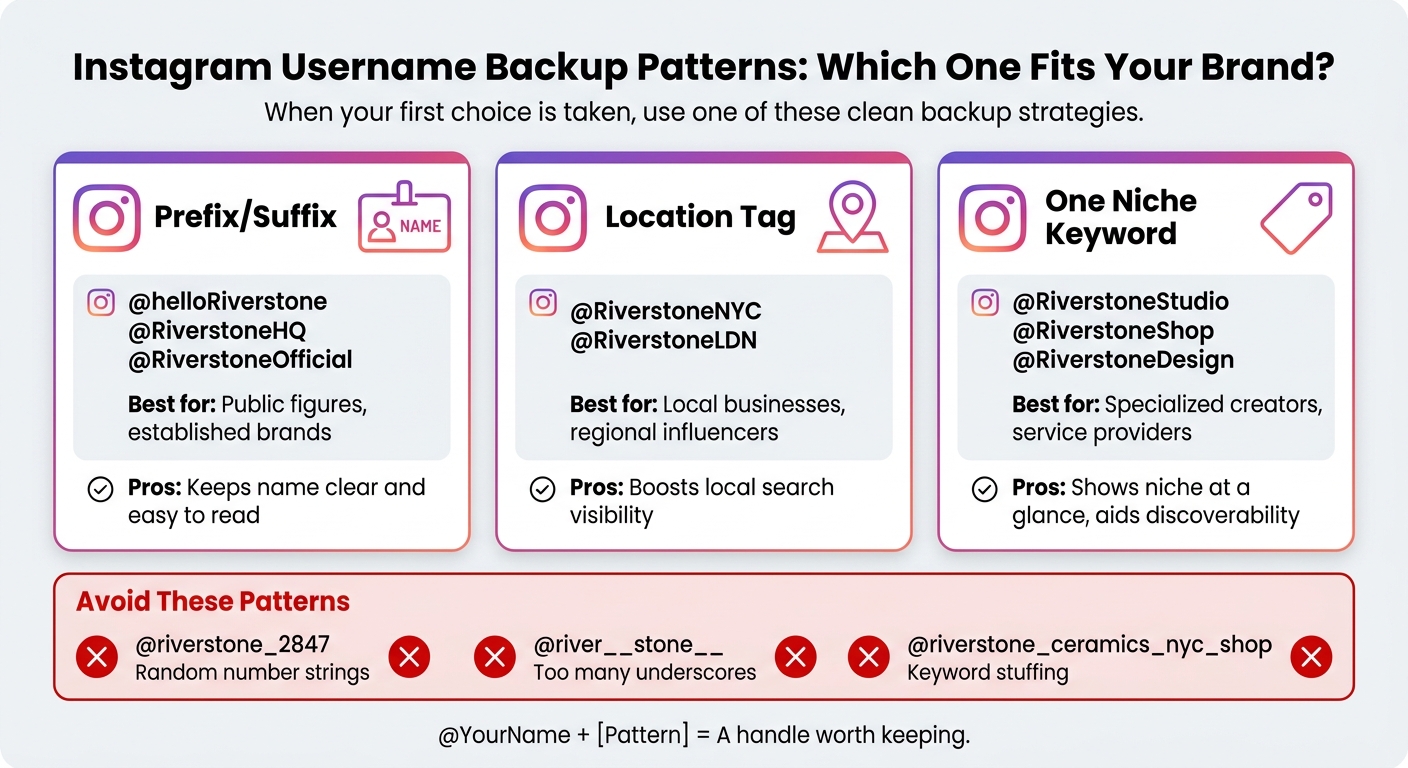
Instagram Username Backup Patterns: Which One Fits Your Brand?
If the checker says your first choice is gone, don't panic. The best backup usernames usually stay close to the original, so people can still recognize you right away.
The cleanest backup options stick with your main name and make only a small change. A prefix like hello, its, or the can keep the handle clear and personal. A suffix like official or HQ can also work if it still feels clean.
Location tags are another good move. If @riverstone is taken, @riverstoneNYC still looks polished and can help with local search relevance on Instagram.
A few backup patterns tend to work best:
helloRiverstone, RiverstoneHQ): Keeps the name clear and easy to read; often a good fit for public figures and established brands.RiverstoneNYC): Helps with local search visibility; often a good fit for local businesses and regional influencers.RiverstoneStudio): Shows what the account is about and can help people find it; often a good fit for specialized creators and service providers.Patterns to avoid entirely: random number strings, too many underscores, and other spammy-looking formats. Those can make a handle seem unprofessional and are often linked to fake accounts.
A variation is worth keeping if it's short, easy to say, easy to spell, and still sounds like your brand. It also helps if the change adds something useful, like a location or industry keyword that improves search visibility.
Keep looking if the handle gets too long, awkward to pronounce, stuffed with punctuation, or hard to find in search results. In most cases, a small change is better than switching to a totally different name across platforms.
Once a variation clears those checks, grab it and move on to the rest of the profile.
Once you find a handle that works, claim it right away. Good usernames don't sit around for long.
After that, line up the rest of the profile with the new handle. Update your profile name, bio, photo, and links. Then track growth in the live dashboard. UpGrow offers a live dashboard for real-time monitoring so you can watch follower growth, engagement trends, and performance metrics as your profile builds momentum.
Learn Instagram's username rules, use free checkers to confirm availability, pick a handle that fits your brand and niche, lock in a backup if your first choice is gone, and then perform an Instagram audit to tighten up the rest of the profile and watch growth. A clean, memorable username only goes so far on its own. What gives it weight is the profile built around it.
The search results don’t say how often Instagram username checker tools show the wrong availability status.
Based on the information available, no error rate or frequency is given.
Yes. Try to keep your Instagram handle the same across your social platforms, or at least use a very close version.
That makes your brand easier to recognize, cuts down on confusion, and helps people find you without extra guesswork. It also pays to pick a handle you can stick with for the long haul. If you change it too often, your brand can start to feel scattered, and followers may not know they’ve found the right account.
Yes - if the new handle is available, you can change your Instagram username later.
That said, changing it too often can confuse followers and make your brand feel less consistent. People may not recognize you right away, especially if they know you by your current handle.
To keep disruption low, pick a username you can stick with for the long haul. Change it only when there’s a clear reason, like a shift in your services, audience, or location. Before and after the switch, keep the rest of your profile the same so people can still tell it’s you.


