15 Reels Hook Formulas That Stop Scroll
15 concise Reels hook formulas, how to use them, and which metrics to test to improve retention and engagement.
15 concise Reels hook formulas, how to use them, and which metrics to test to improve retention and engagement.
4.98 /5 - from 58k reviews
Trusted by 50,000+ creators — get real engagement delivered to your profile in minutes, not days.
Most Reels lose people in the first 3 seconds, so the opening line has one job: make someone pause and keep watching. From what I read, the hooks that work best are short, clear, and built around one of four moves: a pattern break, a curiosity gap, a direct payoff, or a sharp problem callout.
If I had to sum up the whole article in a few lines, it would be this:
The article breaks Reels hooks into 15 formula types:
A few data points stand out. The piece says up to 50% of viewers swipe away in the first 3 seconds. It also notes that 65% of people who watch the first 3 seconds stay for at least 10 seconds, and 45% stay for 30 seconds. So the first line is not a small detail. It shapes the whole Reel.
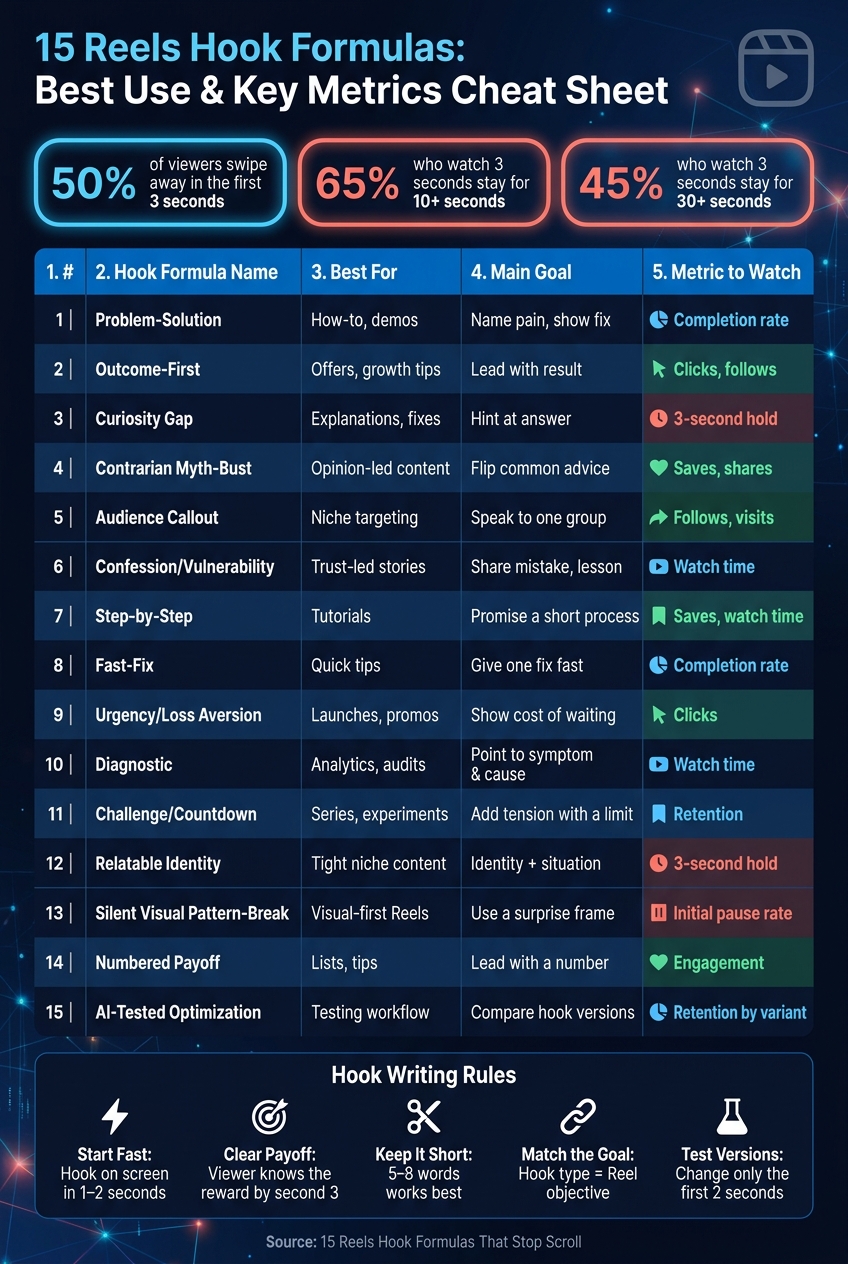
15 Reels Hook Formulas: Best Use & Key Metrics Cheat Sheet
| Hook Formula | Best For | Main Idea | What to Watch |
|---|---|---|---|
| Problem-Solution | How-to, demos | Name pain, show fix | Completion rate |
| Outcome-First | Offers, growth tips | Lead with result | Clicks, follows |
| Curiosity Gap | Explanations, fixes | Hint at answer | 3-second hold |
| Contrarian Myth-Bust | Opinion-led content | Flip common advice | Saves, shares |
| Audience Callout | Niche targeting | Speak to one group | Follows, visits |
| Confession/Vulnerability | Trust-led stories | Share mistake, lesson | Watch time |
| Step-by-Step | Tutorials | Promise a short process | Saves, watch time |
| Fast-Fix | Quick tips | Give one fix fast | Completion rate |
| Urgency/Loss Aversion | Launches, promos | Show cost of waiting | Clicks |
| Diagnostic | Analytics, audits | Point to symptom and cause | Watch time |
| Challenge/Countdown | Series, experiments | Add tension with a limit | Retention |
| Relatable Identity | Tight niche content | Identity + situation | 3-second hold |
| Silent Visual Pattern-Break | Visual-first Reels | Use a surprise frame | Initial pause rate |
| Numbered Payoff | Lists, tips | Lead with a number | Engagement |
| AI-Tested Optimization | Testing workflow | Compare hook versions | Retention by variant |
What I like about this framework is how simple it is: pick one hook type, match it to the Reel goal, calculate your engagement, write 2–5 versions, and let retention data tell you what stays. That is the main takeaway from the article.
Take those ideas and put them to work. Each hook formula below leans on the same four moves: interrupt the feed, spark curiosity, promise a payoff, and get to the point fast. Start with the formula, then plug in a niche-specific pain point, a clear audience, and a payoff people care about.
A line like "You're making this mistake on Instagram" sounds too broad. It doesn't hit hard. Make it specific instead. Name the audience, call out the frustration, and say it in a way that sounds like you.
Three hook placements matter most:
Here’s a quick map for pairing hook types with your Reel goal:
| Reel Goal | Best Hooks | Watch |
|---|---|---|
| Education / How-To | Problem-Solution, Numbered Payoff, Step-by-Step | Saves & Completion Rate |
| Product Demo | Problem-Solution, Fast-Fix, Diagnostic | Likes & Shares |
| Storytelling / BTS | Confession/Vulnerability, Curiosity Gap, Relatable Identity | Playback Retention |
| Launch / Promotion | Urgency/Loss Aversion, Challenge/Countdown | Clicks & Sales |
For each Reel, write 2–3 hook versions. Then use AI to spin up more variations and test them against your 3-second view rate and watch time. That gives you a simple way to choose the right formula in the next section.
Problem-solution hooks work because they point to a pain point and offer relief in the same breath. The structure is simple: name the problem, show the fix, and hint at the payoff. Use this when people already know the pain and want a fast answer.
What makes this kind of hook work? Specificity. A line like If your Reels get 100 views max, you're probably doing this wrong - here's how to fix it feels direct and personal. On the other hand, a broad line like "social media feels impossible" is easy to scroll past.
The first 3 seconds matter most. Meta/Facebook internal data shows that 65% of people who watch the first 3 seconds of a video will watch at least 10 seconds, and 45% will stay for 30 seconds. That means your problem callout has to hit right away.
Once you have the structure, the best hooks sound like a real pain someone has actually felt. For creators, that often means speaking from experience: I posted every day and still couldn't grow - these 2 changes finally worked. For brands, it usually works better to focus on the audience's frustration and position the product as the answer: Spending hours on Instagram with no follower growth? Here's how brands turn views into real followers. Same goal, different angle.
The visual should match the line. Show the exact problem on screen - flat analytics, cluttered drafts, or a frustrated face. That way, the hook makes sense at a glance in the feed. If the problem is already clear from the visual, skip straight to the result. For more ways to optimize your strategy, check out these Instagram growth tips.
Outcome-First: Lead With the Result
Start with the result people want, then show them how to get it. Put the exact payoff in frame one, in the on-screen text, or in the first line you say. Think: more followers, more sales, or less time spent. This works best when you can name the result in one clear line.
A simple formula is: "[Specific outcome] in [clear time frame] without [big objection]." For example: "Get 1,000 engaged followers in 30 days without posting 3x a day" or "Book 3 new clients from Instagram this week using just one DM script." That "without..." part matters. It deals with the viewer's biggest objection before they have a chance to swipe away. Brands can use the same setup: "Cut your cost per lead in half using Reels - even if you have a tiny audience" or "Turn one product demo Reel into a full month of sales content."
This matters because up to 50% of viewers swipe away within the first 3 seconds of an Instagram Reel. So you don't have much time. Outcome-first hooks do their job when people can picture the payoff right away. That's why this formula fits tutorial, strategy, and transformation content so well, especially when the win is clear and measurable.
One warning: don't promise the moon. Safer numbers like "add an extra $500–$2,000/month" or "cut your editing time in half this week" sound more believable. Then prove it inside the Reel with a screenshot, a stat, or a before-and-after. If the result is harder to explain fast, move to a curiosity-led hook.
Curiosity Gap: Tease the Answer, Make Them Stay
Use this when Outcome-First feels too flat or too obvious. If you can’t open with the full result, open with the missing reason instead. A curiosity-gap hook hints at the answer, then holds it back just long enough to keep people watching.
A simple formula is: "You're doing [action] wrong - here's the fix." Here are two plug-and-play examples:
This works best when the payoff is strong but not obvious. In that case, lean into curiosity. Tie the tease to something people can see right away - analytics, a habit, or a before-and-after - so it feels concrete instead of fuzzy.
Keep the hook short: 5–8 words in the top third of the frame. Say those words in the first 1–2 seconds. Then pair them with a visual that backs up the claim.
Don’t drag out the answer. Reveal at least part of it within the first 3–5 seconds. Tease the problem early, then build on the explanation.
Contrarian Myth-Bust: Challenge What Everyone "Knows"
If curiosity hints at an answer, myth-bust goes after a belief. This hook starts with a bold line that pushes back on a rule or tip people in your niche already hear all the time. It works because it bumps into what viewers think they know. And it works best when the myth is familiar enough to spot in a second.
The formula is simple: name the myth, then flip it. A few structures work well across niches:
A marketing creator might say: "Posting daily is why your Reels views are stuck." A brand could go with: "More followers don't automatically mean more revenue - here's what actually moves sales." Those lines land because they push against advice the audience already knows. That's what makes the bust feel relevant, not random.
One guardrail matters here: target the advice, not the audience.
Put the myth clearly on-screen and back it up with a fast visual contrast so the claim is easy to read in the feed. You can also find current Reels trends to see which myths are currently being debated. Use this when your audience already knows the old advice and needs a sharper correction.
Audience Callout: Speak Directly to One Person
Start by challenging a belief, then tighten the focus to ONE viewer. Audience callout hooks do this fast: they name one specific person in the first second. When the right viewer hears that, they stop. The Reel feels like it was made for them.
The formula is simple: "If you're a [specific audience], [clear payoff]."
A creator might say: "If you're a beginner fitness creator with under 10,000 followers, this Reel format is your shortcut to more saves." A brand could open with: "Run a local restaurant? Here's the Reels promo format that fills tables on weeknights." One narrow label. One clear payoff. That's the whole game.
The biggest mistake is going too broad. "Hey, small business owners!" doesn't point to a clear situation. "Freelance designers who hate selling" hits much harder than "creative professionals."
Put the callout in the first 1–3 words, whether it's spoken or shown on-screen. Then make sure the rest of the Reel delivers on that promise. If the hook says one thing and the content goes another way, watch time drops because the promise feels off.
Use this formula when your content solves a problem for a clearly defined group, not everyone. If the hook needs a more personal angle, switch to confession next.
Confession/Vulnerability: Lead with a Real Mistake
Use this when trust matters more than polish. A confession hook cuts against slick, polished intros and makes people pause because it feels unscripted. It sounds like a person talking, not a script being performed.
The formula is: I [mistake] for [time] and it nearly [consequence] - here's what changed. For a creator: I posted Reels daily for a year and my account barely grew - this is the repeat mistake I kept making. For a brand: We ignored customer reviews for months and it almost killed our launch - this is how we turned it around. The mistake needs to be clear before you get into the explanation.
Spell out the mistake, the time frame, and the consequence. A vague line like I used to struggle so much feels flat. A named mistake with a time frame and a real consequence feels more believable. That’s what sets confession apart from other hook types: a personal mistake, a real consequence, and a lesson.
The visual should feel as honest as the line itself. Match the shot to the confession: a plain background, direct eye contact, and bold first-frame text for people watching without sound, so they get it right away as they scroll.
Use this formula when you have a real lesson tied to a real misstep. Start with the mistake, then get to the lesson fast.
Step-by-Step: Promise a Process, Deliver It Fast
Use a step-by-step hook when the process is the main draw. It cuts out guesswork. People know what they’re about to watch and how long it should take.
A simple formula works well here: "Watch me [get the result] in [X steps]" or "Do [goal] in [X steps] - Step 1 starts now." For a creator, that might look like: "Stop wasting time editing - here's my 3-step Reels workflow." For a brand: "Get more bookings this weekend with a 3-step Reels promo." This format fits best when the method matters more than the end claim.
Keep the number of steps small. Three steps is usually the sweet spot for Reels. Once you go past three, the format can start to feel too long for Reels.
Get Step 1 on screen within 3–5 seconds. Don’t burn time on a long intro. Show the process right away. Label each step clearly - like Step 1 - so viewers watching without sound can still follow from the first frame. Up to 50% of viewers swipe away within the first 3 seconds, so the Reel needs to feel in motion almost at once.
This format also does something a fast-fix hook doesn’t: it shows the whole method. That signals more know-how and gives people a reason to save the Reel for later. That’s why it works so well for saveable how-to Reels.
Fast-Fix: One-Fix Hooks
When a full process feels like too much, lead with a single fix. Fast-Fix hooks work because they promise one useful change right away. The core pattern is: Problem + one fix + immediate payoff. A go-to formula is "Stop doing [X]. Do this instead: [fast fix]." For a fitness trainer: "If push-ups hurt your wrists, make this one adjustment." For an e-commerce brand using Reels: "Stop losing customers at checkout. Turn on this one setting."
Put the hook on-screen in bold in the first 1–2 seconds. Keep it to 7–12 words so you can say it fast.
Use this format when the viewer needs one change, not a method. Fast-Fix is one move, not a process. Phrases like "10-second fix" or "simple switch" help the payoff feel real and easy to try.
The biggest mistake is waiting too long to share the fix. If viewers have to sit through too much setup before they get the promised tip, most will drop off. So get to the fix fast.
"You're Losing X Right Now" Hook works by calling out the behavior, pointing to the loss, and giving one fix before the next post.
When speed by itself doesn't do the job, lead with the cost of waiting. People tend to react faster to loss than gain, so the risk needs to be clear in the first frame.
The repeatable format is: "If you [current behavior], you're losing [specific cost] now - here's the fix before [deadline]." Use it for launches, deadlines, and fixes tied to a real cost.
Creator: "If you post Reels without a hook, you're losing viewers in the first 2 seconds."
Brand: "If your Reel skips the offer, you're losing clicks on every post."
Be specific about the loss: reach, time, or ad spend. "Wasting $50/day on Instagram ads if you skip this step" hits harder than "losing reach" because the cost is measurable in USD. Keep the urgency honest. Tie it to Instagram algorithm shifts, wasted ad spend, or missed engagement, not fake scarcity. Use bold on-screen text in the first 1–2 seconds, then give one fix. Match the hook in the caption or on-screen text and get to the payoff fast.
Diagnostic hooks call out one clear analytics signal, then point to the likely cause and the next move. If a Reel needs to explain a performance issue, this format works well. The "If..." line acts like a fast self-check. People spot their own numbers right away and stick around for the answer. Use it when you want viewers to identify the problem fast and trust the advice because it ties back to hard metrics.
The repeatable format is: "If [specific symptom], here's why and what to do next."
Creator: "If your Reels get 10,000 views but only 10 new followers, here's why."
Brand: "If people save your posts but never click, here's the disconnect."
Be specific. Name a metric people can see, not a fuzzy problem. A line like "If your audience retention drops 60% by second 3, here's the #1 hook mistake you're making" lands harder than "if your Reels aren't performing" because it feels concrete and easy to check.
Put that line on-screen in the first frame and say it right away. No warm-up. No extra setup. Then give one sentence on the cause and 1–3 fixes. Keep the Reel short. The hook promises a fast diagnosis, so the payoff needs to come fast too. This format also works well for AI testing, since even small wording shifts can change retention.
Challenge/Countdown hooks stop the scroll because people want to see how it ends. This works best when you want the Reel to feel like a live challenge, not just a one-off tip. A short time limit adds tension and gives viewers a reason to keep watching.
Use this format: "[X-Day / X-Attempt] Challenge: Can we [specific outcome] before [deadline]?"
Creator: "Day 1 of 30: Can I turn my tiny kitchen into a chef's kitchen on a $300 budget?"
Brand: "Attempt 1 of 5: Can we make a viral Reel using only AI B-roll?"
Put "Day 1 of 7" or "Attempt 1 of 5" on frame one. Pair it with a visible counter or progress bar so the challenge makes sense even with the sound off.
Use real limits and numbers people can track. A clear deadline, budget, or attempt count makes the hook feel believable fast. Test the deadline, the number, and the constraint to see which version keeps attention the longest.
When a broad audience callout feels too loose, tighten it with identity + situation. A relatable identity hook answers one thing right away: Is this for me? The right person pauses. Everyone else keeps scrolling.
The formula is simple: "If you're [very specific identity], stop scrolling". Use it in on-screen text in the first frame or as the first spoken line. That’s what sets it apart from a basic audience callout. An audience callout tells people who it’s for. A relatable identity tells people who + context. That extra context is what makes the hook hit. Think of it as role + situation.
A broad line like If you're a business owner is too vague. It doesn’t give the viewer much to grab onto. But If you're a solo founder tired of posting Reels that get 200 views despite using Instagram growth hacks gives you both a role and a clear frustration. That combo is what stops the scroll.
Here’s what that looks like in two niches:
A common mistake is piling on too many identities, like If you're a mom, creator, coach, and side-hustler… That gets muddy fast. Pick one tight identity and pair it with one specific situation. If you're stuck, use an AI Instagram post ideas tool to brainstorm specific scenarios.
Try 2–3 versions by changing the identity, pain point, or wording. Then keep the one with the best 3-second hold. After that, test which identity and pain-point pair keeps attention the longest.
Start with one unexpected frame that works even with the sound off.
When text on screen isn’t enough to stop the scroll, the image has to do the job. This works well for Reels because the hook can land before any voiceover begins. A lot of people watch Reels on mute, so the first frame needs to grab attention by itself.
A simple way to do it is to show three quick cuts of similar images or actions, then on the fourth beat switch to something totally different. That pattern-break hits fast and pulls the eye in during the first second. A creator might open on a messy desk, then cut in one snap to a perfectly organized setup. A brand might show luxury skincare dropped into a toolbox. That visual clash makes people pause.
Keep this part short, around 1–2 seconds, then move into the main content. It works well for transformations, product reveals, before-and-after Reels, and hooks people can understand at a glance. If someone has to figure it out, they’ll keep scrolling.
Start with a number to promise a clear payoff. The viewer gets the scope and the result right away. For list-style Reels, this is one of the fastest ways to stop the scroll.
Numbers make the payoff feel concrete, which is why they pull more attention. Content with specific numbers can drive up to 206% more engagement than vague promises. That same pattern shows up in Reels. A simple formula to use is: [Number] + [items, mistakes, or ways] + that + [specific outcome]. For example: 3 Reels hooks that turned $0 ad spend into 10,000+ organic views or 5 caption tweaks for creators who want more saves, not just likes. The number should make the Reel feel short, specific, and worth watching to the end.
Use odd numbers. Numbers like 3, 5, and 7 usually fit short-form attention spans better than even numbers, which is why they work well for Reels pacing. For quick Reels under 30 seconds, stick with 3 or 5 items. Save 7 or more for longer Reels where the editing is tight enough to hold attention through each point. Tease the last item early to give people a reason to keep watching.
Then use an AI Instagram post optimizer to test which number, angle, and wording hold attention the longest.
Use AI to test hook wording before you post.
Keep the same test setup for each hook type below.
Use AI to compare which hook formula works best. Start with one core hook idea, then generate 3–5 versions. Change one hook variable at a time and keep everything else the same, so the opening line is the only thing in play. Test the opening line first.
AI tools for Instagram marketing can score each version from 0–100 using large-scale performance data. That gives you a fast read on which line is most likely to do well before you post. After publishing, check 3-second view retention, average watch time, and completion rate to see if the hook is actually holding attention.
A simple formula is: "AI-found winning angle" + "specific promise" + "time frame or constraint." For example: "My AI found the one hook that doubled my Reels views in 7 days - here it is." It works because the result is clear, specific, and urgent.
After the test, look at the data, not just the comments. When you spot a winner, feed the best- and worst-performing hooks back into an AI copy assistant. Ask what changed - word choice, emotional tone, or structure - then have it generate another batch of improved versions. UpGrow's analytics and AI targeting can also show which hook angles keep attention by audience segment.
Use these thresholds to choose the next hook:
Then use the winning hook as your default angle and line it up with the Reel's goal.
Once you know the hook formulas, the next move is simple: test which angle wins.
Use AI to come up with 2–3 hook variants, keep the Reel itself the same, and compare how each version performs. That way, you're testing the hook instead of changing a bunch of things at once.
Different hooks win on different signals, so the metric has to match the goal. Use hold rate and watch time to judge the hook, completion rate to judge retention, saves and shares to judge value, and profile visits plus follower growth to judge conversion.
Keep the test clean. Change only the first 2 seconds between variants so the hook is the variable. Check early performance, then confirm the result over 7–14 days.
UpGrow lets you filter tests by U.S. location, age, gender, and language, then track live engagement, profile visits, and follower growth.
Match the hook to the outcome you want, then watch the metric that proves it.
| Hook Formula | Best Use | Track |
|---|---|---|
| Curiosity Gap / Visual Pattern-Break | Initial attention | 3-second hold rate |
| Problem-Solution / Fast-Fix | Initial attention + retention | Completion rate |
| Step-by-Step / Diagnostic | Retention | Average watch time |
| Confession / Contrarian Myth-Bust | Retention + engagement | Saves and shares |
| Outcome-First / Urgency / Audience Callout | Conversions | Profile visits and follower growth |
Strong Reels hooks are short, specific, and tied to the payoff in the first 1–3 seconds. If the opening makes a promise and the video doesn't deliver, people feel it fast. Trust slips. That's why the formula you choose matters more than creativity by itself.
Start with one or two formulas that fit your niche and your Instagram growth strategies. A coach or educator may get more from a Step-by-Step or Diagnostic hook. A brand rolling out a product may do better with Outcome-First or Problem-Solution, depending on whether the goal is awareness, trust, saves, shares, or conversions.
Then test the opening line against retention data. This is a key part of optimizing your profile's reach and visibility. That's where the truth shows up.
Write 3–5 hook versions, run them, and watch early retention. If viewers leave in the first 1–3 seconds, the hook isn't doing its job. That drop-off points to the angle worth keeping and the one to cut.
Build a small hook library over time. Rotate formulas based on the goal, and let performance data - not gut feeling - decide what stays.
Start with an A/B test tied to a clear, measurable hypothesis. For example, compare a direct statement with a curiosity-driven hook.
Instagram tends to reward retention, shares, and saves. So test hooks that promise value or open an immediate knowledge gap first. Good options include:
Change and test your Reels hooks on a regular basis to keep performance strong. The first 1 to 3 seconds are where people decide if they’ll keep watching or scroll away, so check Reels Insights to spot where viewers drop off.
When you test a new hook, give it 5 to 7 days to circulate before you judge it. You can also bring back top-performing content from 90 days ago by recutting it with a new hook.
If your Reel gets views but not followers, the hook is doing its job at the top of the funnel. The problem shows up right after that: people watch, then move on.
A clear CTA can help close that gap. Tell viewers what to do next, like visiting your profile or following your account. Then make sure your profile makes the reason obvious. When someone lands there, they should understand your brand value in seconds.
UpGrow can help you learn more about your audience, sharpen your targeting, and improve your growth strategy.