
Instagram vs TikTok: Audience Age Comparison
Younger audiences favor discovery-focused short video while broader adult users respond more to trust, messaging, and shopping.
Younger audiences favor discovery-focused short video while broader adult users respond more to trust, messaging, and shopping.
4.98 /5 - from 58k reviews
Trusted by 50,000+ creators — get real engagement delivered to your profile in minutes, not days.
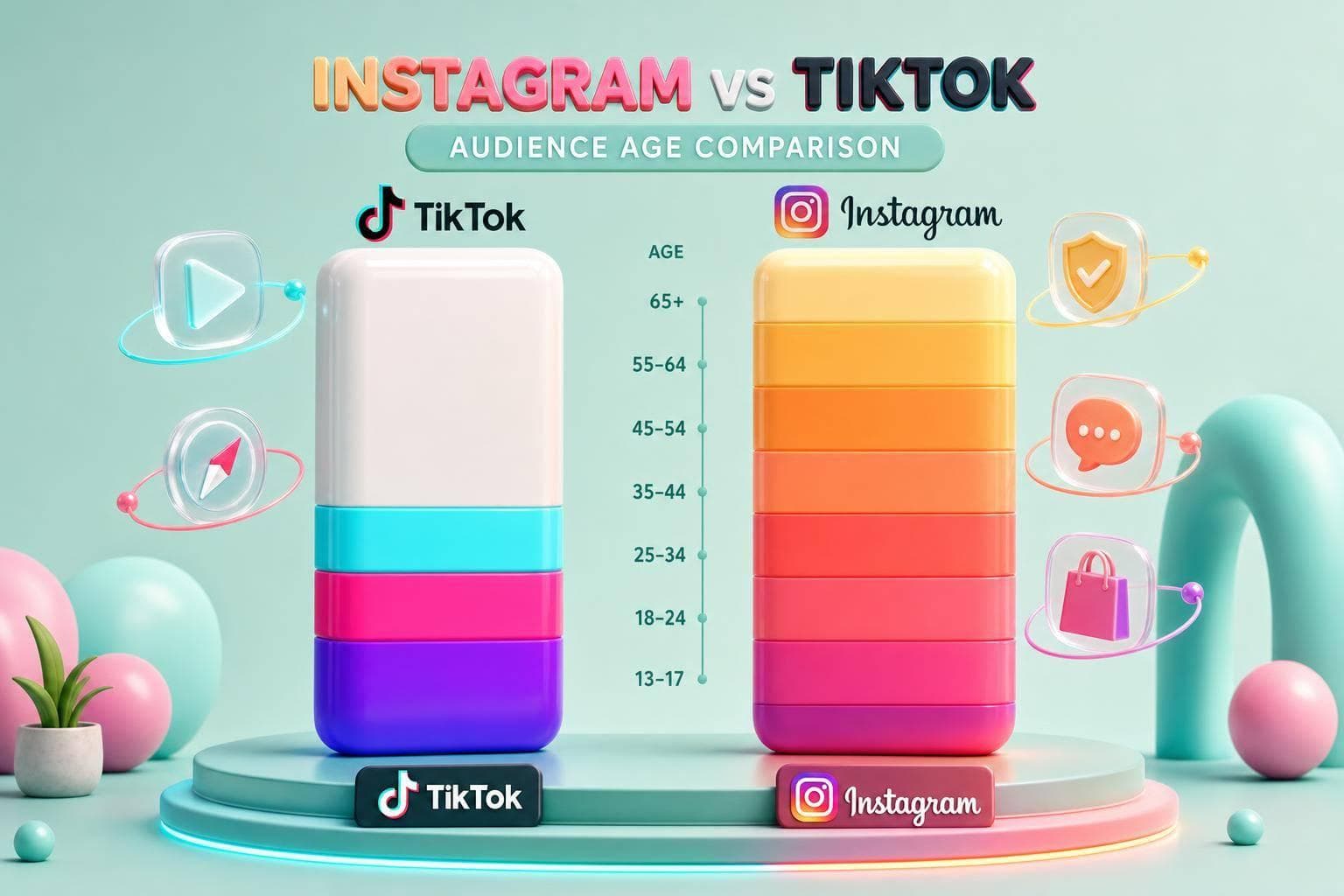
If you want younger attention, TikTok usually leads. If you want a broader adult audience and more purchase intent, Instagram is often the better pick.
I’d sum it up like this: TikTok leans toward Gen Z and younger millennials, while Instagram reaches more age groups across adulthood, making it vital to grow your Instagram followers organically to capture these segments. In the U.S., Instagram reaches 75% of adults ages 18–24, has 158 million U.S. users, and keeps adding users in their 30s and 40s. TikTok users also spend more time in-app - 53.8 minutes per day versus 29.7 minutes on Instagram.
Here’s the short version:
Quick Comparison
| Platform | Main age lean | Best use | Time spent per day | Best fit by age |
|---|---|---|---|---|
| Broader adult mix | Trust, nurture, conversion | 29.7 minutes | 25–54, plus strong 18–24 reach | |
| TikTok | Younger audience | Discovery, reach, early interest | 53.8 minutes | Gen Z and younger millennials |
In other words: if I’m trying to reach teens or people in their early 20s, I’d put more weight on TikTok. If I’m trying to sell to adults in their 30s, 40s, or early 50s, I’d start with Instagram. And if I want both awareness and sales, I’d use both - TikTok first, Instagram next.
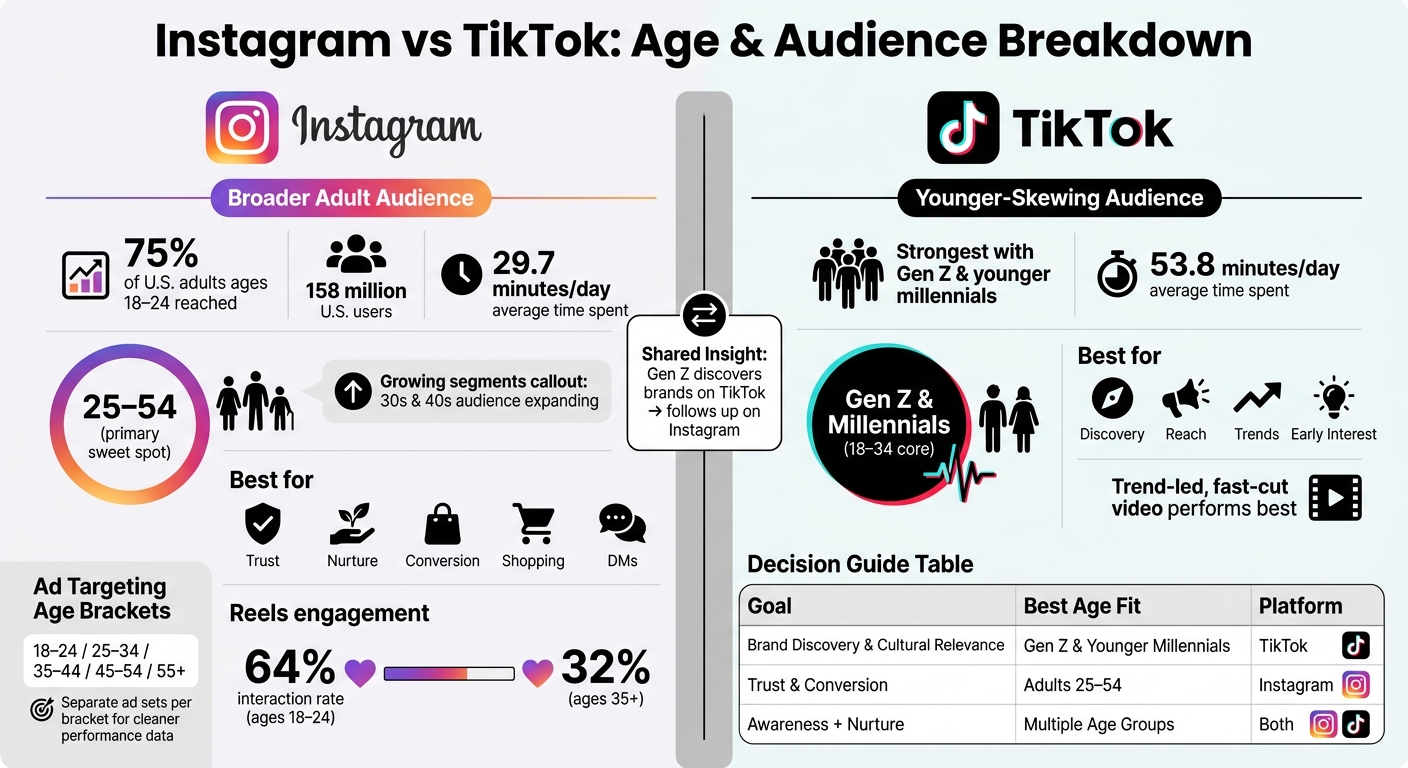
Instagram vs TikTok: Age Audience & Platform Comparison
In the U.S., Instagram reaches people across a broader span of ages, while TikTok leans younger. Both platforms matter for the 18–34 group, but they attract that audience a bit differently. You can see the gap more clearly when you look at Gen Z, millennials, and older users.
Instagram reaches 75% of U.S. adults ages 18–24. That alone makes it a major platform for younger adults. At the same time, it isn’t limited to that age band. The app is also pulling in more people in their 30s and 40s, which gives Instagram a broader age mix overall.
TikTok is more concentrated among younger users. Its strongest hold is with Gen Z and younger millennials, which gives the platform a younger overall age profile in the U.S..
| Age Group | TikTok | |
|---|---|---|
| 18–24 | Reaches 75% of U.S. adults in this bracket | Younger overall |
| 18–34 | Core U.S. audience | Younger overall |
| 30s and 40s | Growing segment as the audience diversifies | - |
Next, this age split starts to show up in how Gen Z, millennials, and older users act on each platform.
Age tells you who's on a platform. Behavior tells you what they do there and where they’re most likely to convert.
Gen Z tends to use TikTok for entertainment and discovery. It’s where they find new creators, brands, and ideas. Instagram plays a different role. That’s where Stories, Direct Messages, and interactive tools like polls, quizzes, and question stickers lead to more direct back-and-forth.
In plain English: TikTok is stronger for the first touch, while Instagram is better for the follow-up. Use TikTok for reach. Use Instagram for retention.
Millennials spend time on both apps, but they don’t use them the same way. TikTok tends to spark discovery and early interest. Instagram helps people keep up with a brand, check it out more closely, and move toward a purchase decision.
A simple way to think about it: use TikTok for interest and Instagram for intent.
For users 35 and up, Instagram still stands out because of its mix of Stories, Reels, DMs, and Instagram shopping tools. Those features help brands stay in touch over time instead of relying on a single view or click.
TikTok can still help with discovery. But Instagram is the better fit for messaging, community, and commerce. If you're trying to drive deeper engagement and conversion, Instagram usually has the edge here.
These behavior patterns should guide your content, ad targeting, and follower-growth choices.
Age data should shape what you post, where you post it, and who you aim it at. If you skip that step, content planning turns into guesswork.
On Instagram, the gap is hard to miss. Users ages 18–24 interact with Reels at a 64% rate, compared with 32% for users 35 and up. That means if your audience leans young, Reels should sit at the center of your content calendar. If your audience trends older, Instagram carousels and educational posts are usually a better match.
TikTok shows a similar split, but in a different way. Gen Z tends to respond to trend-led, fast-cut videos built around sounds and challenges. Users 35 and up, on the other hand, often engage more with practical explainer content: slower-paced videos that open with a problem and then walk through the fix step by step.
Once your content format fits the audience, carry that same age split into your ad sets.
A simple setup works well:
Keeping these age brackets in separate ad sets makes it easier to tailor the creative and the value proposition for each group. A 22-year-old and a 52-year-old may care about the same product for very different reasons. Your ads should reflect that.
This setup also gives you cleaner performance data. When age groups are split out, you can see which bracket drives the lowest cost per result and which one deserves more budget.
For Instagram-first brands, age data shouldn't stop at paid ads. It should also guide how you grow your follower base.
If you're trying to build an audience in a specific age range, tools like UpGrow can apply age, location, language, and gender filters. It also includes live analytics, which helps keep follower growth lined up with the audience you want to reach.
Instagram reaches a broader adult age range, while TikTok is still clustered more tightly around Gen Z and younger millennials. Instagram has solid reach among people ages 25–34 and 35–54. TikTok, meanwhile, skews younger, even though its 35+ audience keeps growing. That age split should shape where you lead, where you build interest, and where you turn attention into sales.
TikTok grabs attention early. Instagram does more of the heavy lifting when it comes to trust, follow-up, and conversion. Brands can streamline this process by using ChatGPT for Instagram to maintain authentic engagement.
Here’s a simple rule of thumb:
| Primary Goal | Best Age Fit | Primary Platform |
|---|---|---|
| Brand discovery, cultural relevance | Gen Z and younger millennials | TikTok |
| Trust and conversion | Adults 25–54 | |
| Both awareness and nurture | Multiple age groups | Both platforms |
If your product is for teens and people in their early 20s, TikTok should get more of your focus. If your buyers are in the 30–54 range, Instagram is the stronger base, supported by free Instagram growth tools. And if your brand serves more than one generation, use TikTok to reach younger audiences first, then use Instagram to build depth, trust, and conversion with a broader adult audience.
Age is a strong signal when you’re choosing a platform. Use TikTok for younger-audience discovery and Instagram for trust and conversion across a broader adult base.
Often, yes. TikTok is great for discovery, viral reach, and testing new ideas. Instagram tends to work better for long-term loyalty, steady engagement, and turning followers into customers.
Using both gives you the best of each platform. You can grab attention on TikTok, then move people to Instagram where it’s easier to build relationships and drive sales.
For Instagram growth, UpGrow helps you target real followers by age, location, and interests without bots.
Instagram is usually the better pick for selling to adults. It reaches more U.S. adults across age groups, and it tends to perform better when the goal is commercial intent, conversions, and long-term brand building.
TikTok stands out for discovery and viral reach, especially with younger users. But when it comes to turning attention into sales, Instagram often delivers higher conversion rates and larger average order values.
Put most of your budget on Instagram for ages 18–34, with extra focus on 25–34. Use TikTok as a separate play for younger, discovery-driven targeting, especially 16–24.
In the U.S., Instagram reaches a broader adult audience, so it works well when you want 18–44 coverage. TikTok is a better fit for Gen Z and younger millennials, especially at the awareness stage.


