
Instagram Loop Giveaway: Steps and Risks
Run Instagram loop giveaways smarter: pick niche partners, post clear rules, track 30-day retention, and avoid spam flags and legal traps.
Run Instagram loop giveaways smarter: pick niche partners, post clear rules, track 30-day retention, and avoid spam flags and legal traps.
4.98 /5 - from 58k reviews
Trusted by 50,000+ creators — get real engagement delivered to your profile in minutes, not days.
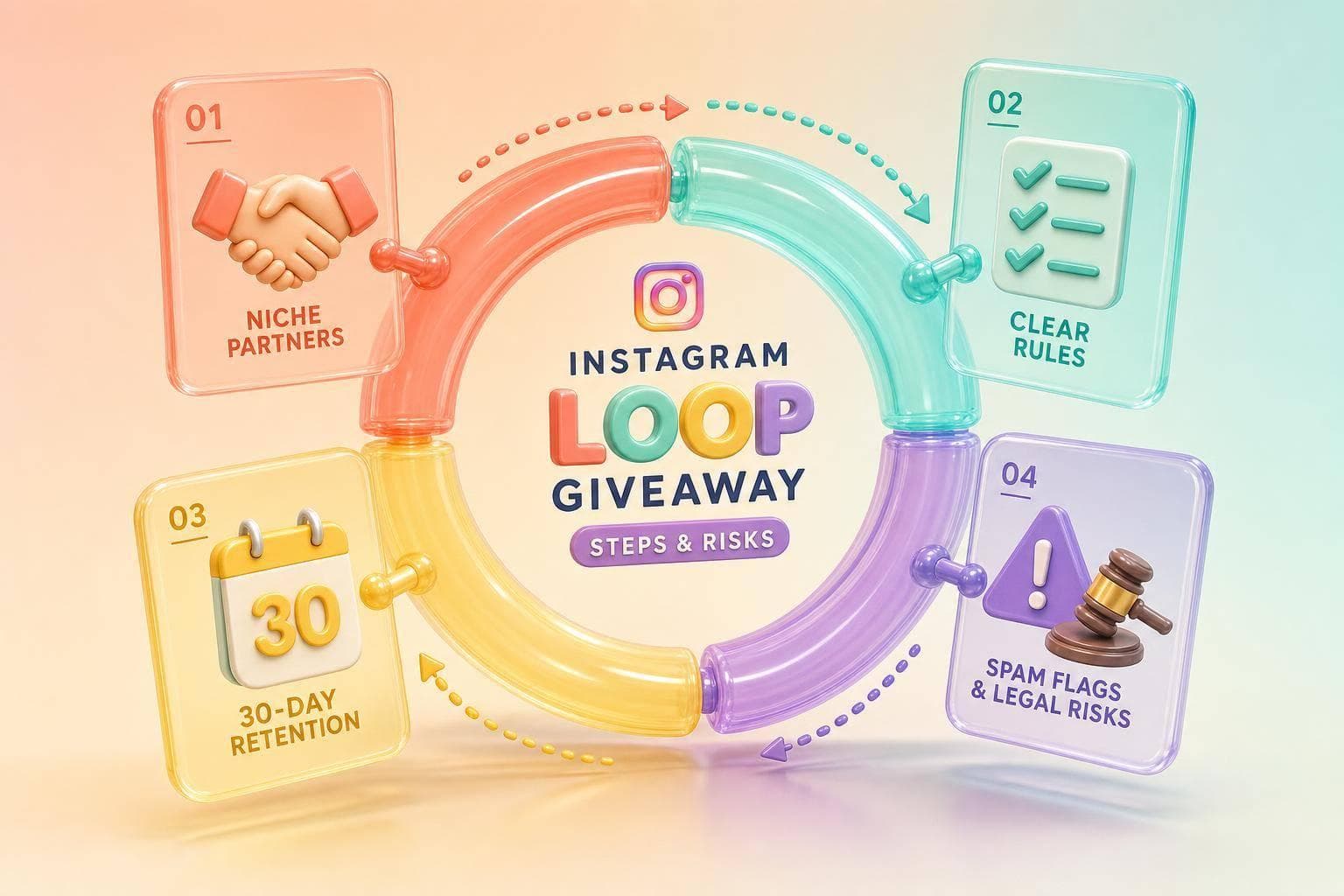
An Instagram loop giveaway can grow followers fast, but it often brings the wrong people, sharp unfollows, spam checks, and U.S. legal issues. If I run one, I need to match partners by niche, use a prize tied to my audience, post clear rules, include a free way to enter, and track follower drop-off for 30 days after the giveaway ends.
Here’s the short version:
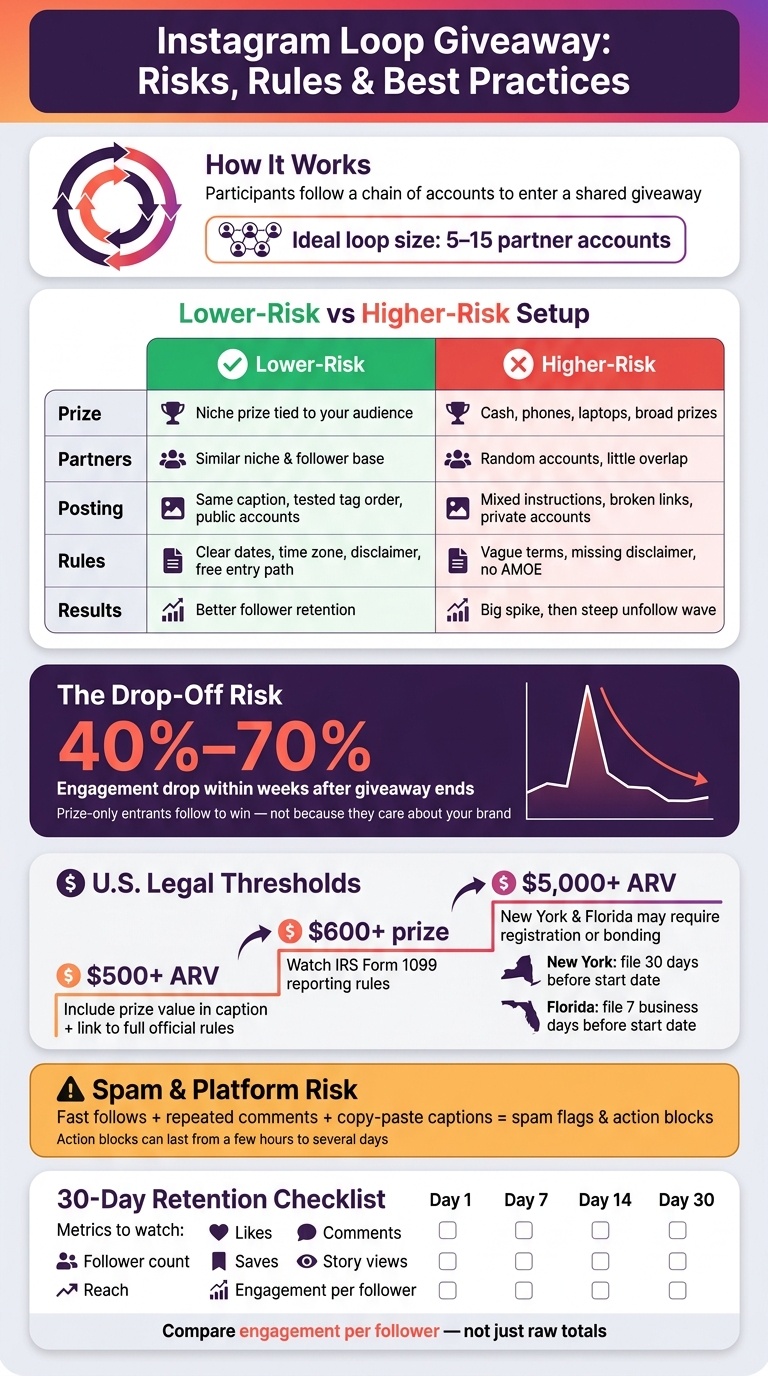
Instagram Loop Giveaway: Lower-Risk vs Higher-Risk Setup at a Glance
| Area | Lower-risk setup | Higher-risk setup |
|---|---|---|
| Prize | Niche prize tied to your audience | Cash, phones, laptops, or other broad prizes |
| Partners | Similar niche, similar followers | Random accounts with little overlap |
| Posting | Same caption, tested tag order, public accounts | Mixed instructions, broken links, private accounts |
| Rules | Clear dates, time zone, disclaimer, free entry path | Vague terms, missing disclaimer, no AMOE |
| Results | Better chance of keeping followers | Big spike, then steep unfollow wave |
My takeaway: a loop giveaway only makes sense if audience fit, rule setup, and post-campaign retention look solid. If the follower spike comes with weak engagement and fast drop-off, the cost is often too high.
Start with one clear goal. That goal should guide the prize, the partner list, and the kind of followers you want to bring in.
Pick a prize your ideal follower would actually care about. Skip broad prizes like phones, laptops, or cash. Those tend to pull in people who want anything free, not people who care about your brand. The result? A spike in entries, then a wave of unfollows later.
After you choose the prize, name one host to manage the giveaway collaboration. The host handles partner outreach, writes the caption, manages timing, and takes care of winner selection. If no one owns the process, small mistakes stack up fast. Keep the loop to 5–15 accounts with audiences that make sense together. Set a firm start and end time in the caption, and include the time zone.
Those early decisions do a lot of heavy lifting. They affect who enters, how smooth the launch feels, and whether new followers stick around.
The shared graphic should make the prize easy to see and include a simple instruction like Follow all accounts in the loop to enter. Every partner should use the same image and the same caption script so the giveaway feels organized instead of messy.
Your caption should spell out the full entry process, plus:
If the ARV is $500 or more, include that in the caption and link to the full official rules on your site.
Put the full tag order in a shared doc. Then test every @handle on mobile and click through the full loop before launch. That part matters more than people think. One bad handle, or one private account, can break the chain and make the whole thing feel sloppy in seconds. Make sure every account in the giveaway is public and has no restrictions in place.
Once the rules and tag order are locked, you're in much better shape to launch on time without scrambling.
Have all partners post within a 30- to 120-minute window. As posts go live, check each one right away. Make sure the caption, tags, and prize details match the agreed template.
During the entry period, stay active in the comments. People will often ask where the next account is, or whether the giveaway is open outside the U.S. If the same question keeps coming up, pin a comment with a clear answer so people don't have to dig for it.
After the closing time, gather all eligible entries and choose one winner at random. Keep a record of how the draw was done, DM the winner, and announce the handle exactly as your rules say. If the prize is worth more than $600, note the IRS Form 1099 reporting rules.
Once the giveaway ends, follower quality matters a lot more than follower count. That’s where the trouble usually starts: right after the spike.
A lot of people join loop giveaways for one reason only: the prize. If the giveaway is built around a broad, mass-appeal item, many entrants will follow every account in the loop because the rules tell them to - not because they care about any one brand.
These are prize-only entrants. They tend to follow lots of giveaway accounts, engage very little, and often disappear once the winner is announced.
That leaves you with an audience that may miss your target on things like location, age, interests, or buying intent. A skincare brand working with two other beauty creators who speak to the same crowd has a better shot at bringing in followers who stick around. A generic loop made up of unrelated accounts - like a travel creator, a pet account, and a home décor page - usually brings in people with only a weak link to the brand.
You’ll usually see that mismatch almost right away. During the campaign, follower count jumps. Then, once the prize is gone and the winner is announced, the drop begins.
Accounts with large numbers of low-interest followers often see engagement rates fall 40–70% within weeks. And the people who stay may still stop interacting: no Story views, no profile visits, no saves.
That matters because Instagram tends to reward posts that get real interaction. So if your audience looks big on paper but doesn’t respond, your future reach can take a hit.
Poor partner fit makes all of this worse. When the accounts in a loop speak to very different groups of people, the giveaway can feel random and too sales-heavy to anyone scrolling past it.
Say a fitness brand, a parenting creator, and a luxury fashion account are all pushed into the same loop. What do they have in common? Usually just the prize. That’s a weak reason to follow, and it rarely leads to long-term interest.
A steep post-campaign follower drop can also send a bad signal to future collaborators. It may suggest that the growth came from low-quality followers or from an audience that never matched in the first place. When the mix of accounts is off, the spike in followers doesn’t turn into steady growth.
Loop giveaways are built to get reach, not fit. And that’s why so many of those new followers don’t stay active.
U.S. loop giveaways need clear rules, proper disclosures, and a free entry path before they go live. If you get this part wrong, the damage doesn’t stop when the giveaway ends. It can affect results and put the account under extra scrutiny later. So before you post anything, make the rules easy to read and hard to misunderstand.
The host is responsible for running a lawful promotion. That means the post needs to spell out who can enter, when it starts and ends, and the standard Instagram disclaimer. Use a clear U.S. date and time format, like 11:59 PM PT on October 30, 2026. Also, don’t require self-tagging or mass-tagging on unrelated posts.
And that’s just the platform side. U.S. sweepstakes law adds another layer, with its own set of rules.
If the giveaway is based on chance, it needs sweepstakes rules that avoid lottery problems. It also needs a no-purchase-required AMOE and clear official terms. Your official rules should include:
Prize value matters too. If the combined ARV is more than $5,000 and the giveaway is open to people in New York or Florida, registration and bonding rules may apply before launch. New York generally requires filing 30 days before the start date. Florida requires 7 business days.
Loop giveaways can trip spam systems because the pattern looks suspicious: fast follows, repeated comments, and pasted captions over and over. When hundreds of people follow a stack of accounts within minutes, automated systems may respond with action blocks that last from a few hours to several days.
Things get worse when partner posts don’t match. If the rules are vague or one post says one thing while another says something else, people get confused. And confused entrants are more likely to report the giveaway as a scam. That adds user reports on top of the automated signals.
For U.S. audiences, this matters a lot. People tend to react fast when giveaway language feels vague, pushy, or too slick. If a loop looks too good to be true, the negative comments and reports can pile up fast.
The safer setup is pretty simple:
High-risk loops usually do the opposite. They lean on vague directions, forced tagging, and repetitive actions that can lead to complaints.
If you still decide to run a loop, lower the risk with tighter targeting and better tracking. A few smart choices at the start around partners, prizes, and measurement can help you avoid the worst outcomes of a weak loop setup.
The prize is the biggest lever here. Pick something your ideal follower would actually care about. If the prize is too broad, you’ll pull in people who want free stuff, not people who want your brand.
Keep your partners close in niche and audience. If you serve people in the U.S., spell out the approximate retail value in USD and list the eligibility rules up front so the promotion reaches the right crowd. Also, check partners for real engagement before you join. A big follower count doesn’t mean much if the comments look fake or the audience doesn’t match yours.
Prize fit shapes who enters. Retention shows whether they were worth keeping.
Don’t stop at the spike. Watch what happens after the giveaway ends.
Set a baseline before the loop starts. Then review follower count, reach, likes, comments, saves, and Story views on Day 1, 7, 14, and 30. Compare engagement per follower before and after, not just raw totals. A bigger audience that interacts less can drag down reach and hurt how the algorithm reads your account.
If your goal is steady follower quality, use Path Social alternatives that show audience fit and engagement trends early. UpGrow supports safer Instagram growth with AI targeting, live analytics, and Instagram-compliant automation, so you can track follower quality and engagement as you grow.
Loop giveaways can move the follower count fast. But that jump can come with a price: low-fit followers, post-campaign drop-off, poor partner fit, spam risk, and sweepstakes compliance rules. Many U.S. brands don’t see the full cost until after they run one.
Long-term growth depends on audience quality, compliance, and retention. Run a loop only if the audience fit, compliance, and retention data support it. If retention and engagement fall apart after the spike, the loop cost too much.
Generally, no. Loop giveaways tend to bring in people who want the prize, not your content. That means those followers are less likely to stay engaged or hang around once the giveaway is over.
That kind of sudden, uneven growth can also look spammy. In some cases, it may hurt your reach or even lead to account restrictions.
A better path is to focus on niche content and AI-driven growth tools to build an audience that’s more likely to care about what you post.
Look past follower counts. High-quality followers are real people who match your niche and engage in a normal, human way. You can usually spot them by looking for complete bios, profile photos, and a posting history that shows they’re active.
A few warning signs tend to stand out fast:
It also helps to watch your growth trends. Organic growth tends to be steady over time. Sudden spikes, paired with drops in likes, comments, shares, or saves, can point to a lower-quality audience.
Skip a loop giveaway if you want a high-quality audience that sticks around.
Here’s why: generic giveaways tend to pull in people who want free stuff, not people who care about your content. That usually means low-fit followers, weak engagement, and a wave of unfollows once the giveaway is over.
There’s another issue too. These campaigns can trip spam flags and cause sudden follower spikes that look a lot like bot activity. That’s not a great signal to send.
If you decide to run one anyway, keep it tightly focused on your niche and connect it directly to your content pillars.


