
How Much Money Can You Make on Instagram in 2026? (Earnings by Follower Count)
Monthly Instagram earnings by follower tier, and why engagement plus multiple income streams matter more than raw follower counts.
Monthly Instagram earnings by follower tier, and why engagement plus multiple income streams matter more than raw follower counts.
4.98 /5 - from 58k reviews
Trusted by 50,000+ creators — get real engagement delivered to your profile in minutes, not days.

Yes, you can make money on Instagram in 2026 without a huge following. From what I see in the article, accounts with 1,000–10,000 followers may bring in about $100–$500 per month, while accounts with 50,000–500,000 followers can make around $2,000–$15,000 per month across more than one income source.
Here’s the simple takeaway: followers help, but engagement and income mix matter more. A focused 10,000-follower account with 3%–6% engagement can often make $500–$1,500 per month through brand deals, affiliate links, UGC, and Instagram features like Subscriptions or Gifts.
What matters most:
Main ways I can earn on Instagram:
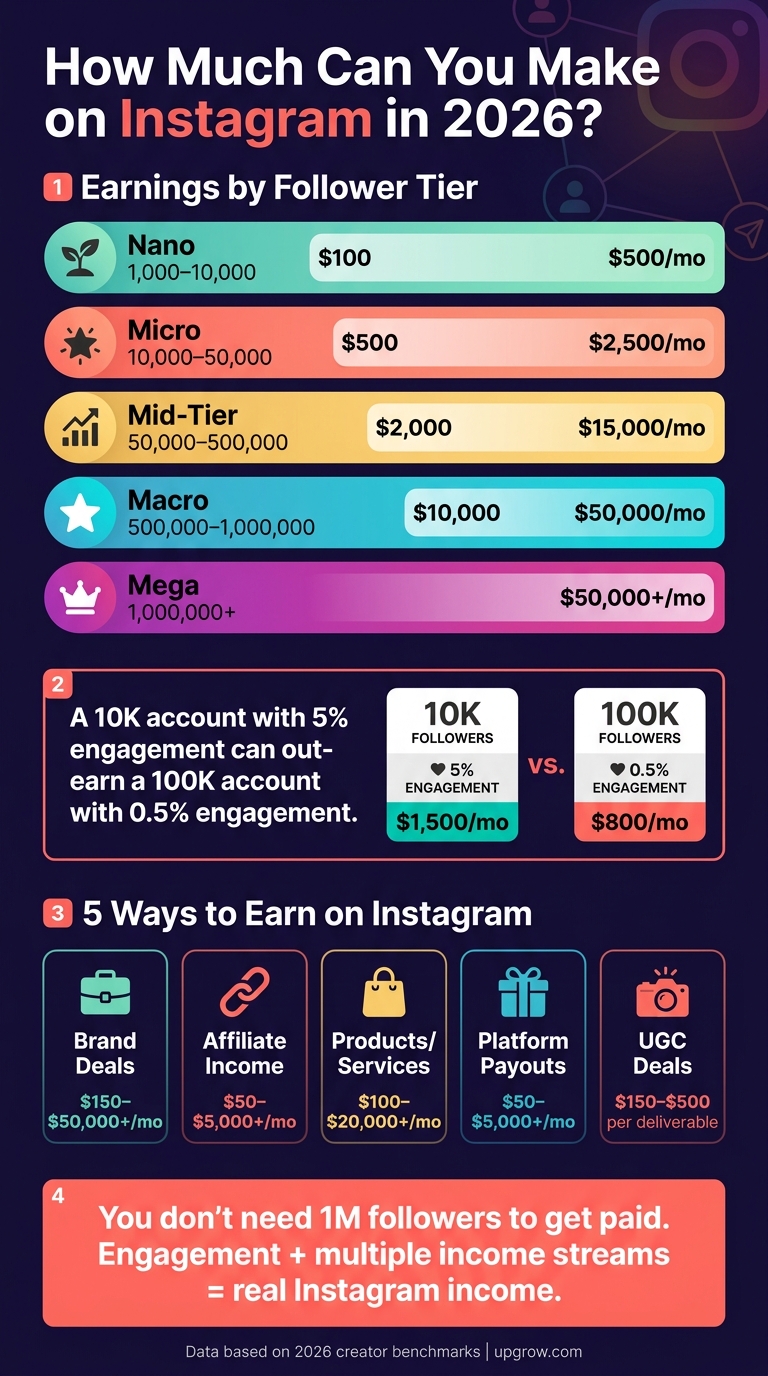
Instagram Earnings by Follower Count in 2026
| Follower tier | Follower count | Monthly income |
|---|---|---|
| Nano | 1,000–10,000 | $100–$500 |
| Micro | 10,000–50,000 | $500–$2,500 |
| Mid-tier | 50,000–500,000 | $2,000–$15,000 |
| Macro | 500,000–1,000,000 | $10,000–$50,000 |
| Mega | 1,000,000+ | $50,000+ |
The article’s main point is simple: I do not need 1 million followers to get paid. If my audience pays attention and I use more than one income source, Instagram can go from a side income to a full-time business. To reach that level, you need to master specific monetization strategies.
You don't need a huge following to start making money on Instagram in 2026. For some income streams, monetization is possible at 1,000 followers, and many creators start earning long before they reach 10,000. What matters most is your account standing, audience authenticity, and engagement rate - not one magic follower number. Those entry thresholds just get you in the door; the next section breaks down what each follower tier can actually earn.
Instagram's built-in monetization features each have their own rules. Instagram Subscriptions require a professional account, either Creator or Business, along with compliance with Meta's Partner Monetization Policies and an active, authentic audience. Gifts, which followers can send during Live broadcasts and Reels, are open to eligible creators whose accounts meet Meta's content and community standards. Bonus programs, when available, are invite-only and usually tied to content performance, not a set follower count. Across all three, the big common factor is account authenticity - both platforms and brands check whether your followers are real and engaged before they grant or keep access.
The 1 million follower benchmark is mostly a myth. Nano-creators with 1,000 to 10,000 followers already land brand deals, affiliate partnerships, and UGC commissions because their audiences are often more focused and more engaged. A 5,000-follower account in a clear niche - fitness, personal finance, or home décor - can earn sponsorship fees and affiliate commissions that a 200,000-follower general-interest account may not. Why? Because the smaller audience often converts better. In plain English, monetization depends more on engagement quality and audience authenticity than on hitting some arbitrary follower mark.
Once you meet the eligibility rules, income comes down to audience size, engagement, and your monetization mix - all of which are broken down in the earnings-by-follower-tier table below.
Once your account can earn, your monthly income usually comes down to three things: follower tier, engagement, and how many income streams you’re using. Across sponsorships, affiliate income, digital products, Instagram payouts, and UGC deals, creators can realistically make anywhere from $100 per month at the nano level to $50,000+ per month at the macro level.
The table below shows realistic monthly earnings across all five revenue streams combined.
| Follower Tier | Followers | Realistic Monthly Income | Primary Revenue Mix | Worked Example |
|---|---|---|---|---|
| Nano | 1K–10K | $100–$500 | Affiliate links, UGC deals, occasional micro-sponsorships | A 5K fitness account earning $150/mo in affiliate commissions + one $200 UGC deal |
| Micro | 10K–50K | $500–$2,500 | Sponsorships, affiliate, Instagram Subscriptions | A 25K beauty account earning $800/mo in brand deals + $300/mo in affiliate + $150/mo in Subscriptions |
| Mid-Tier | 50K–500K | $2,000–$15,000 | Sponsorships, digital products, affiliate, Gifts | A 100K personal finance account earning $5,000/mo across two brand deals, a digital course, and affiliate commissions |
| Macro | 500K–1M | $10,000–$50,000 | Multi-brand sponsorships, own products, affiliate, Subscriptions | A 750K lifestyle account earning $25,000/mo from three brand partnerships and a paid membership |
| Mega | 1M+ | $50,000+ | Premium sponsorships, product lines, licensing, platform payouts | Reported top earners generating six figures monthly from diversified brand and product revenue |
These numbers reflect total monthly income across all active revenue streams, not one brand deal or one payout. If an account is only using one stream, it will usually sit near the lower end of its tier.
A 10,000-follower account is right at the start of the micro tier. For many creators, that’s the first follower milestone where income starts to feel concrete instead of hypothetical.
With a strong niche and a solid engagement rate - typically 3%–6% for this tier, per Influencer Marketing Hub - a 10K account can realistically earn $500–$1,500 per month from a mixed setup.
A realistic mix might look like this:
Put that together, and a well-run, niche-focused 10K account can land in the $600–$1,500/month range without needing a viral post or a huge audience. That’s the part many people miss.
The big swing factor is engagement. A 10K account with a 5% engagement rate will usually get better brand offers and more affiliate conversions than a 50K account sitting at 0.5%.
Engagement rate is the multiplier that decides where an account lands inside its tier’s income range. A 10K account with 5% engagement can beat a 100K account with 0.5% engagement across every income stream that depends on audience action.
That includes:
It makes sense when you think about it. A smaller group of people who pay attention is often worth more than a big crowd that scrolls past everything.
Brands and Instagram’s own monetization tools also audit audience authenticity, so a real, active following isn’t just nice to have. It directly affects income.
Now that the income ranges by follower count are clear, the next step is figuring out where that money comes from. Follower count sets the upper limit. Your revenue mix decides how close you get to it.
In 2026, Instagram creators have five main ways to earn: sponsorships (brand deals), affiliate income, products or services, platform payouts (Subscriptions, Gifts, and Bonuses), and UGC deals. And the pattern is pretty clear: creators who stack a few income streams tend to make more than creators who lean on just one.
| Method | Eligibility | Typical Monthly Payout | Scalability |
|---|---|---|---|
| Sponsorships / Brand Deals | Any size; nano accounts viable with strong niche | $150–$50,000+ depending on tier | High - rates grow with audience and engagement |
| Affiliate Income | Any size; link-in-bio or Stories swipe-up | $50–$5,000+ (commission-based) | Medium - scales with traffic and conversion rate |
| Products / Services | Any size; no platform threshold | $100–$20,000+ depending on offer and audience | Very high - margin stays with the creator |
| Platform Payouts (Subscriptions, Gifts, Bonuses) | Professional account; Meta Partner Monetization Policy compliance | $50–$5,000+ | Medium - tied to platform program availability |
| UGC Deals | No follower minimum; content quality is the qualifier | $150–$500 per deliverable | Medium - volume-dependent |
A quick way to think about it: some income streams pay for attention, while others pay for action. Brand deals usually pay because you have an audience. Affiliate income and product sales pay when that audience clicks, buys, or signs up.
Sponsorships usually pay more upfront and pay faster. One micro-tier brand deal can bring in $300–$800 in a single transaction. That kind of payout is hard to ignore, especially if you want cash flow this month, not six months from now.
Affiliate income works differently. The payout per sale is often smaller, but it can stack over time as posts stay discoverable and link traffic keeps coming in. A Reel, Story sequence, or evergreen post can keep sending clicks long after it goes live.
So which one pays more? It depends on the timeline.
That’s why many steady earners don’t pick one or the other. They use brand deals as the base of monthly income, then layer in affiliate links to keep money coming in between campaigns.
How fast you earn your first dollar depends on which of these streams you can turn on first.
Once you know the ways to make money on Instagram, the next thing you want to know is simple: how long does it take to get paid?
For most creators, the first dollar comes from pairing one engaged audience with one simple way to earn. In many cases, the fastest paths are affiliate links, UGC deals, or a small brand sponsorship. Those options are open well before 10,000 followers, and they don't depend on platform approval.
Here’s how the usual timeline looks:
The big point here is that the fastest first dollar usually comes from the first income stream you can turn on, not from follower count by itself.
Creators who mix sponsorships, affiliate income, products, and Instagram payouts tend to earn their first dollar sooner and build steadier monthly income.
Why? Because one stream can cover for another.
If brand work is slow, affiliate links can still bring in sales. If sponsorships are between campaigns, a UGC deal can help fill the gap. Subscriptions can add recurring income month after month. It’s a bit like not putting all your eggs in one basket. Each stream helps smooth out the dry spells that hit creators who rely on only one source of income.
Instagram income grows fastest when your audience is real, engaged, and monetized across more than one stream. Follower count can open the door, but engagement rate and revenue mix decide how much money comes through it. Build a real audience, turn on the right income streams for your level, and your income can stack over time.
Your earning potential is tied directly to audience quality. Brands check follower quality before they sign deals, and Instagram’s own monetization tools depend on real engagement to stay active. That’s where UpGrow comes in: its AI-powered targeting helps creators build a real, engaged follower base - the kind that helps unlock monetization and keep it running. If you're working toward your first dollar or trying to build steady monthly income, use UpGrow's Instagram money calculator to estimate what your account can earn based on your current follower count and engagement rate.
Last updated: July 2026
There’s no set follower count you need to get paid on Instagram. What matters more is how you make money, how much your audience interacts with your content, and whether your followers are real and active.
So yes, you can start earning well before you hit 1 million followers. Follower count by itself doesn’t decide income.
Instagram does not pay a set amount for every 1,000 followers. What you earn can vary a lot. It depends on things like engagement, audience quality, your niche, and the way you make money from the account.
In plain English: follower count by itself doesn't decide income. So there isn't a standard payout tied to each 1,000 followers.
Yes - you can make money on Instagram with under 10K followers.
You do not need a huge audience to start earning. In many cases, a smaller account with an active, focused following can do better than a big account with low engagement.
The original answer seems off-topic, but the intent behind the question is simple: a large follower count isn't required to make money on Instagram.
The current answer is off-topic. It talks about a May 2026 U.S. policy move tied to missile interceptor deliveries and Saudi airspace access, which has nothing to do with Instagram monetization.
For this FAQ, the answer should be replaced with a direct explanation of the most effective Instagram monetization method.
In most cases, the best method is selling your own product or service. That could be a course, coaching, merch, digital downloads, or a paid offer tied to your niche. Why does this work so well? Because you control the pricing, keep more of the revenue, and don’t have to rely only on brand deals or platform payouts.
Other options like sponsored posts, affiliate marketing, subscriptions, and badges can work too. But if the goal is the most effective path for many creators and small businesses, selling your own offer usually gives you the best return.
A stronger replacement answer would say this clearly and stay focused on Instagram.


&description=Monthly%20Instagram%20earnings%20by%20follower%20tier%2C%20and%20why%20engagement%20plus%20multiple%20income%20streams%20matter%20more%20than%20raw%20follower%20counts.&image=https://www.upgrow.com/blog-images/assets.seobotai.com/cdn-cgi/image/quality=75,w=1536,h=1024/upgrow.com/6a504ad121d1dee3314b9819-1783648339530.jpg)