
Instagram DM Pods: Detection Guide 2026
Spot coordinated Instagram DM pod activity using timing, recurring accounts, comment patterns, outcome checks, AI scoring, and human review.
Spot coordinated Instagram DM pod activity using timing, recurring accounts, comment patterns, outcome checks, AI scoring, and human review.
4.98 /5 - from 58k reviews
Trusted by 50,000+ creators — get real engagement delivered to your profile in minutes, not days.

Most DM pod checks fail for one reason: people rely on one clue instead of a pattern. If I want to judge whether engagement looks coordinated, I need to review 10 to 20 posts, compare timing, repeated accounts, comment text, and business results, then check whether at least two signal types line up.
Here’s the short version:
A good review is plain and repeatable: collect time-stamped records, compare 30 to 90 days of activity, test alternate explanations, and write down what I saw before I say what it means.
If I can’t show repeated behavior across posts, I should not call it a pod.
An Instagram DM pod is a private group where members agree to interact with each other’s posts - likes, comments, saves, shares, or Story reactions - to make engagement look higher than it is. These groups can run inside Instagram DMs or on apps like WhatsApp, Telegram, Discord, or Slack. The app itself doesn’t matter much. What matters is the shared expectation that if someone engages with your post, you’ll do the same for theirs.
That’s what makes a pod different from normal support. A one-off like or comment from a friend can be genuine. A repeated pattern across unrelated posts is where things start to look off.
The flow is usually pretty simple: someone publishes a post or Reel, drops the link or post ID into the pod chat, other members engage within minutes or a few hours, and then the original poster returns the favor later when the next posts go up. Over time, that back-and-forth creates a trail you can measure.
Two patterns show up again and again:
Put those together, and you have a solid reason to take a closer look. They’re the starting signals for an Instagram audit and the scoring process covered later.
Not every pod looks the same, so it helps to know which kind you’re dealing with and what signal each one tends to leave behind.
| Pod Type | Primary Exchange | Detection Focus |
|---|---|---|
| Like pod | Likes only, minimal discussion | Timing clusters, recurring liker pairs |
| Comment pods | Comments with minimum-length rules | Generic or templated text, reciprocal comment pairs |
| Mixed engagement | Likes, comments, saves, shares combined | Multiple interaction types from same accounts |
| Niche pods | Same topic or industry grouping | Contextually relevant but reciprocity-driven activity |
| Relay clusters | Post passed through connected groups | Multiple engagement waves, expanding participant set |
The format may change, but the core problem stays the same: reciprocity dressed up as community support.
Niche pods can be tough to spot because the accounts often share the same topic, so the engagement can look normal at first glance.
That’s why speed or volume alone isn’t enough. A real audience can be fast, loyal, and highly active too. The bigger difference comes down to obligation, repetition, and what happens after the interaction.
Pod activity often shows:
In many cases, accounts will like or comment but won’t do much else. They don’t watch Stories, visit the profile, or follow afterward.
A real community behaves differently. Participation shifts from post to post. People respond when something interests them, not because they owe someone a turn. And you usually see other signals around that engagement too - profile visits, saves, watch time, and conversions. That gap is what the next section turns into detection signals.
Start with the latest posts and check whether the same accounts keep showing up across unrelated content. If they do, widen the sample to 20–30 posts. Once that pattern holds, stop treating it like a hunch and start scoring it in a more structured way.
The clearest signs tend to show up again and again. Look for the same accounts appearing across posts, tight clusters of activity right after publishing, and comments that feel templated or off-topic.
Another sign to watch is the downstream engagement gap. Sometimes a post racks up a lot of likes but leads to little or no profile visits, saves, shares, or meaningful replies. That can point to coordinated activity. But don't judge it against some blanket standard. Compare it with the account's own past performance instead.
Save the raw data before you label anything. That includes:
You should also log the direction of interactions: who engages with whom, and whether that activity goes both ways. Pull Instagram Insights for each post, including reach, likes, comments, saves, shares, profile visits, and follows. Then add any internal context that might explain a spike, like a product launch, a giveaway, a collaboration, paid promotion, or a mention from a large account.
Those records become the input set for AI-assisted detection. Use them for timing, text, and network analysis in the next step.
Use the timing, text, and network data gathered above to score risk before a person steps in. The model’s job is to rank cases and show the evidence behind that ranking. It should not decide the outcome on its own.
A case should move up only when at least two separate signal types line up. For example, that could mean odd timing plus a tight reciprocal network, or repeated text patterns plus weak downstream outcomes. One clue on its own usually isn’t enough.
Different methods pick up different parts of the picture. Some are easy to audit but narrow. Others can combine many weak clues, but they’re harder to explain. The table below shows the most practical options and what each one can and can’t do.
| Method | Interpretability | Data Needs | Strengths | Limitations |
|---|---|---|---|---|
| Rule-based checks | High | Timestamps, interaction counts, thresholds | Easy to audit | Misses varied timing |
| Machine-learning risk scoring | Medium | Historical cases and behavioral features | Combines weak signals at scale | Scores can be hard to explain |
| Keyword matching | High | Captions, comments, text available to the reviewer | Fast and transparent | Misses paraphrases and varied wording |
| Text embeddings | Low to medium | Sufficient text samples and an embedding model | Detects semantic similarity | False positives around common phrases |
| Graph analysis | Medium | Account-to-account interaction edges and timestamps | Reveals clusters and reciprocal engagement | Connected communities may look suspicious |
| Time-series analysis | Medium to high | Repeated observations with reliable timestamps | Detects recurring bursts and baseline shifts | Viral posts or live events produce the same pattern |
| Single-post inspection | High | One post and its visible engagement context | Useful for rapid triage | Not enough to confirm coordination |
Use the model to sort review priority, not to make the last call. In practice, the best setup is a hybrid one: rules and statistical scoring create an explainable priority score, while graph, timing, and text features add separate support. A human reviewer still makes the final decision.
That matches Meta’s description of platform-integrity enforcement as a mix of AI, human review, and user reports, not one automated system acting alone.
Before escalating a case, reviewers should pressure-test the pattern against a normal explanation. Sometimes the simplest answer is the right one. A burst of activity may come from a product launch, a collaboration, a giveaway, a live event, ambassador sharing, or content that just took off.
Before moving a case from monitor to review, document:
Do not escalate based only on a high model score, one repeated phrase, a fast engagement spike, or overlapping followers. Those signals can look suspicious while still being harmless. A high-severity action needs documented corroboration and an independent reviewer. If a legitimate explanation still fits the facts, send the case to human review.
Human review should take the lead when the data is thin, timestamps can’t be trusted, the cluster is niche, or the post is tied to a launch, giveaway, live event, or campaign. The same goes for text similarity that can be explained by supplied campaign copy or common industry wording.
A reviewer should also step in when the model was trained on a different language, region, account size, or content category. And if new evidence cuts against the model’s strongest signal, the person reviewing the case should not just wave that away.
When a reviewer overrides a score, they need to write down whether the case stays open, gets downgraded, is escalated, or is closed, and explain why. That note should name the deciding evidence, the alternatives that were ruled out, the data limits, and the reviewer’s confidence. If overrides happen often, that points to calibration, training, or threshold issues.
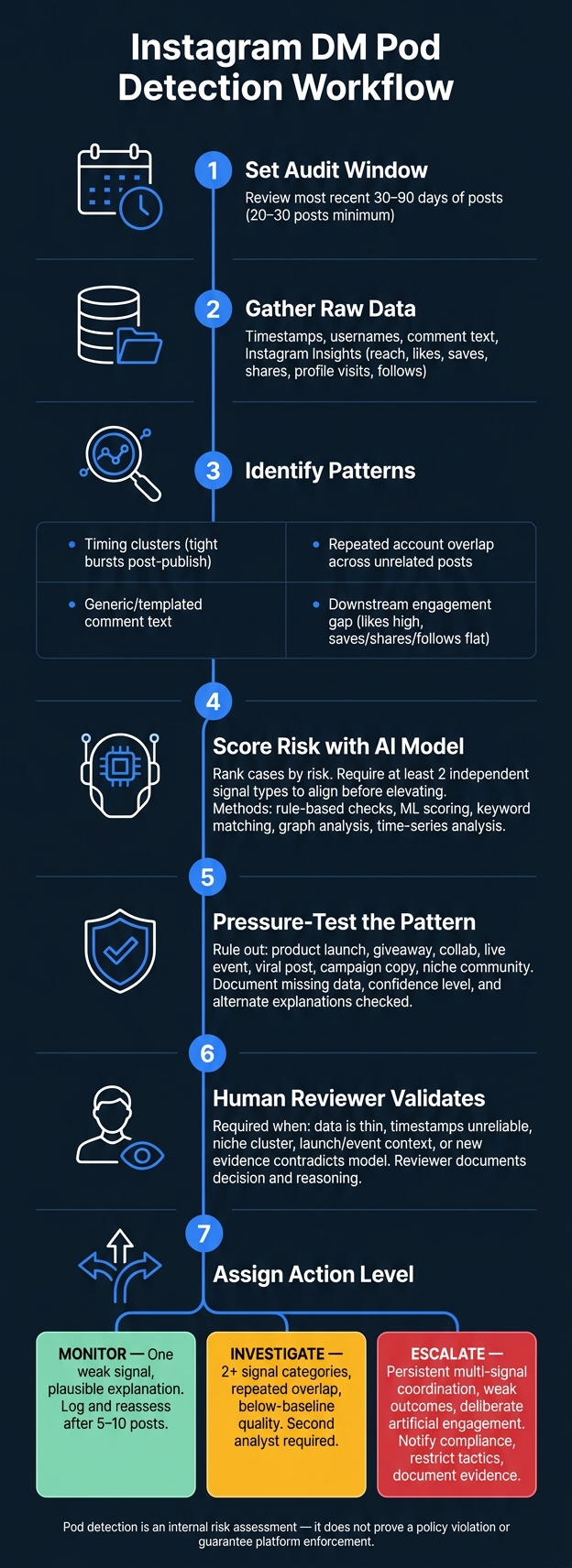
Instagram DM Pod Detection Workflow: From Signals to Final Decision
After you score the signals and weed out false positives, the next step is a repeatable account-health audit. The key is consistency. Run the same sequence every time: define scope, build the dataset, flag clusters, score signals, check business context, review findings, classify risk, and track changes over time.
Set the audit window to the most recent 30–90 days. Before you gather evidence, note the account’s posting context and any known campaigns. That matters. A launch spike, for example, can look suspicious at first glance even when it’s perfectly normal.
Each metric should answer one diagnostic question: does the engagement look coordinated or organic? Not just high or low.
Use the metrics below to test whether engagement is leading to real audience quality instead of surface-level activity.
| Metric | Diagnostic purpose |
|---|---|
| Follower reach | Shows whether existing followers are consistently receiving content |
| Non-follower reach | Indicates discovery beyond the current audience |
| Profile visits | Measures whether content creates enough interest to prompt account exploration |
| Follows from content | Tests whether reach converts into audience growth |
| Saves | Indicates practical or evergreen value; compare against content type |
| Shares or sends | Signals distribution potential and audience-to-audience relevance |
| Meaningful comments | Measures substantive response; review relevance and depth, not count alone |
| Follower growth and unfollows | Shows whether engagement produces durable audience change |
| Audience geography, age, and gender | Tests whether people engaging broadly match the intended audience |
| Repeatability over time | Distinguishes a recurring behavior from a one-off event |
| Risk notes | Records whether tactics create potential platform, client, brand-safety, or disclosure risk |
Look at rates, not just raw counts. For instance, compare profile visits to reach, or saves plus shares to reach. A post with big numbers can still underperform if those numbers don’t lead anywhere.
Performance also changes by format, niche, audience size, and campaign goal. So don’t force every account into the same benchmark. It’s better to compare results against the account’s usual range and its industry context.
Once the metrics are in place, assign one action level for each case. This keeps the review auditable and separates what you saw from what you did.
| Decision | Criteria | Required action |
|---|---|---|
| Monitor | One weak signal, limited recurrence, plausible business explanation, and normal profile visits, follows, saves, shares, or meaningful comments | Log the pattern, keep collecting comparable posts, and reassess after the next 5–10 relevant posts |
| Investigate | Repeated timing or account overlap across multiple posts, two or more independent signal categories, unexplained wording similarity, or engagement quality below the account's normal baseline | Preserve timestamps and examples, document alternative explanations, review campaign history, and have a second analyst validate the finding |
| Escalate | Persistent multi-signal coordination, high engagement with weak outcomes, suspicious activity across campaigns, or evidence of deliberate artificial engagement practices | Notify the account owner or compliance lead, restrict risky growth tactics, document the evidence and uncertainty, and determine whether platform or contractual guidance is required |
If the audit shows weak organic outcomes, shift the growth plan toward measurable audience quality. For teams moving to compliant growth, UpGrow offers AI targeting, real-human support, and live performance monitoring.
Before you close the review, make sure every finding is documented the same way. Your team should confirm the following:
The last check is simple: does the engagement help long-term growth through profile visits, follows, saves, shares, meaningful comments, and relevant audience reach? Instagram’s Insights framework supports that broader review by reporting reach, interactions, audience characteristics, and content-level performance instead of leaning on likes alone. Pod detection is an internal risk assessment - it does not, by itself, prove a policy violation or guarantee platform enforcement.
Start by reviewing the last 20–30 posts. If needed, dig into the comment sections on those posts and look for repeat commenter patterns before you flag a pod.
The key signals are timing, comment quality, and consistency across formats.
Start with timing. If engagement spikes in the first 15 to 30 minutes and then falls off a cliff, that’s a red flag. Natural engagement tends to build and taper. It usually doesn’t look like a short burst and then silence.
Next, look at comment quality. Generic, repetitive comments can be a giveaway. Think short replies that feel copied, vague praise, or the same phrasing from multiple accounts. If the comments look busy but don’t say much, that tells you a lot.
Then compare performance across formats. If feed posts get lots of engagement, but Stories and Reels stay weak, something may be off. Strong audience interest usually shows up in more than one place, not just in the main feed.
It also helps to look at who is commenting. Watch for repeat commenters with incomplete profiles, random usernames, or unusually high following-to-follower ratios. One odd account isn’t much on its own. But when you see the same pattern again and again, it starts to paint a pretty clear picture.
A human override is needed when the AI risk score is inconclusive or when the data needs context an automated model may miss.
Manually review flagged accounts in a high-risk band and look for signs such as:


