
Instagram Bot Detector vs Fake Follower Checker
Learn how bot detectors review a single Instagram profile while fake follower checkers audit audience quality and fraud risk.
Learn how bot detectors review a single Instagram profile while fake follower checkers audit audience quality and fraud risk.
4.98 /5 - from 58k reviews
Trusted by 50,000+ creators — get real engagement delivered to your profile in minutes, not days.

If you want the short answer: a bot detector checks one Instagram account, while a fake follower checker checks that account’s followers.
That difference matters because the risk is often in the audience, not just the profile. Brands lose about $1.3 billion a year to influencer fraud, and campaigns tied to accounts with 30%+ fake followers can see 58% lower conversion rates.
Here’s the simple breakdown:
A bot detector usually looks at things like:
A fake follower checker looks at things like:
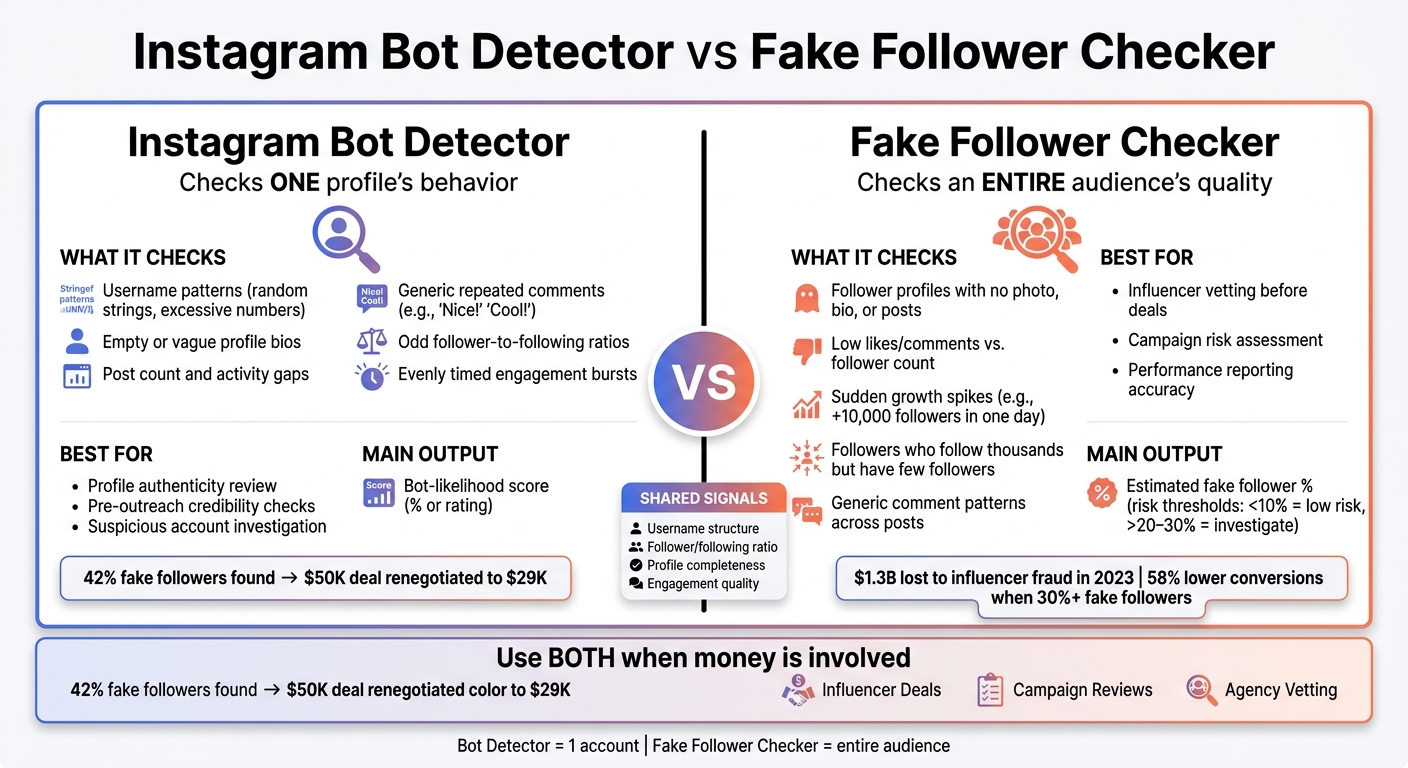
Instagram Bot Detector vs Fake Follower Checker: Side-by-Side Comparison
| Tool | What it checks | Best for | Main output |
|---|---|---|---|
| Instagram bot detector | One profile’s behavior | Profile review, how to tell if an Instagram account is fake | Bot-likelihood score |
| Fake follower checker | An account’s audience quality | Influencer vetting, campaign review | Estimated fake follower % |
My take: if you only check whether a creator’s profile looks normal, you may miss the bigger problem. A clean-looking account can still have a bad follower base. That’s why brands, creators, and agencies need to match the tool to the question they’re asking.
The rest of the article explains where these tools overlap, what signals they share, and when each one makes more sense.
An Instagram bot detector is a profile audit tool. You enter a username, and the tool checks that account’s profile details and activity for signs of automation. The result is usually a bot-likelihood score: a percentage or rating that estimates how automated the profile appears.
Most tools only need a public username. So they’re simple to use for third-party checks. That makes them useful for judging whether a profile acts like a bot, not for grading follower quality.
Real accounts usually show natural variation. Posting pace changes. Comments feel uneven. Follower growth goes up and down. Bots often leave more repeatable patterns behind, and that’s exactly what these tools look for.
Bot detectors look at profile behavior, not audience makeup. They combine several account-level signals and weigh them together. No single signal proves automation. But when a few of them show up at once, the score tends to go higher.
| Detection Signal | Bot-Like Indicator |
|---|---|
| Username | Random strings, excessive numbers, or gibberish |
| Profile Bio | Empty, vague, or repetitive across multiple accounts |
| Activity | 0–10 total posts or long periods of inactivity |
| Comments | Generic phrases like "Cool" or "Nice!" repeated on many posts |
| Follower Ratio | High following count with very few followers |
| Engagement | Evenly timed interaction bursts |
One of the stronger signals is evenly spaced likes, follows, or comments. Human behavior is messy. People scroll, stop, get distracted, and come back later. Bot activity often looks more mechanical, with engagement showing up at oddly regular intervals instead of natural timing.
Bot detectors work best when you’re checking one profile at a time. They’re handy before influencer outreach or when an account throws up red flags and needs a fast credibility check. In one Q1 2024 vetting review, a beauty brand found 42% fake followers and renegotiated a $50,000 deal down to $29,000.
They also help after a sudden follower spike. If an account gains a lot of followers out of nowhere, a scan can help you see whether the profile itself now looks automated. Running these checks monthly can help spot automation early. Audience-level quality is a separate issue, and the next section gets into that.
If a bot detector checks the profile, a fake follower checker checks the audience.
A fake follower checker audits an account’s audience, not the account itself. It scores follower quality using public follower data. In most cases, under 5%–10% means lower risk. Once that number gets above 20%–30%, it’s time for a closer look.
It looks for patterns that hint the follower base is inflated, inactive, or just doesn’t make sense for the account.
| Signal Category | What It Looks For |
|---|---|
| Profile signals | Missing profile picture, no bio, gibberish or number-heavy usernames, zero posts |
| Engagement Correlation | Likes and comments that are far too low relative to total follower count |
| Growth Anomalies | Sudden spikes - like +10,000 followers in a single day - followed by flat growth |
| Follower balance | Accounts following thousands of users but having almost no followers themselves |
| Comment Relevance | Generic, repetitive phrases like "Great pic!" or "Nice!" across multiple posts |
| Audience location match | Audience locations that don't match the creator's content or market |
Some deeper audits also look at actions beyond a simple like, such as story views or profile visits.
Fake follower checkers are made for pre-deal due diligence. Before a brand puts money into an influencer partnership, an audience audit can show whether the follower count points to real reach or just a padded number.
And the money at stake isn’t small. Influencer fraud cost brands an estimated $1.3 billion in wasted ad spend in 2023. On top of that, campaigns aimed at accounts with more than 30% fake followers see 58% lower conversion rates than campaigns with cleaner audiences.
This tool also helps with performance reporting accuracy. If an audience is inflated, engagement-rate benchmarks can get warped fast. The fraud-free median engagement rate for macro-influencers is 1.12%. That’s 33% higher than the full-population average of 0.84% - a difference caused entirely by fake-follower contamination.
For creators, running monthly or quarterly audits can help protect brand credibility and keep performance data honest.
That audience-level view is what sets it apart from a bot detector.
Both tools look at many of the same signals. The difference is how they use them.
A bot detector studies one account up close. A fake follower checker looks across an entire audience. So the same clue might suggest one sketchy profile in one case, or a pattern across thousands of followers in the other.
| Signal | Bot Detector Focus | Fake Follower Checker Focus |
|---|---|---|
| Username structure | Flags random character strings on one profile | Measures how often that pattern appears across an audience |
| Follower/following ratio | Identifies mass-following scripts | Flags ratios that deviate from niche benchmarks |
| Profile completeness | Checks for missing bios or profile pictures | Counts incomplete profiles across a follower list |
| Posting behavior | Detects uniform batch intervals or dormancy | Identifies ghost followers with few posts across the audience |
| Engagement quality | Flags generic or repetitive comments | Compares total likes and comments to follower count to find diluted engagement |
| Growth anomalies | Not a primary focus | Flags sudden spikes as a red flag for artificial growth |
In practice, this comes down to scale. A bot detector zooms in on one profile. A fake follower checker zooms out and studies the full audience.
A single-profile review asks a simple question: is this one account acting like a bot right now? It checks live behavior signals. For example, are likes showing up in neat batches? Are there any story views or profile visits after the interaction? Does the account’s location line up with its activity? Those details work like fingerprints, but they only mean much when you inspect one account at a time.
An audience-level audit asks something else entirely: what share of this account’s followers looks inauthentic? It’s less concerned with proving whether one follower is a bot. Instead, it looks for patterns in the group. That’s why it compares the account with niche peers and flags growth anomalies across the full follower list.
That gap in scale is the main thing to look at when picking the right tool.
The right tool depends on what you're trying to review. It mostly comes down to scale: one profile vs. an entire audience.
If you're checking a single account, a bot detector is the better pick. It looks at activity and behavior on that one profile. If you're reviewing a full audience, a fake follower checker makes more sense because it audits follower quality across the whole follower base.
Here’s the simplest rule:
| Scenario | Right Tool | Why |
|---|---|---|
| Instagram audit for profile authenticity | Bot detector | Checks activity and behavioral signals on a single account |
| Audience quality audit | Fake follower checker | Estimates fake follower % across an entire follower base |
| Influencer vetting | Fake follower checker | Flags growth spikes and weak engagement-to-follower ratio |
| Campaign risk assessment | Both tools together | One checks engagement behavior, the other checks audience quality |
For creators, a bot detector works best when you want to vet suspicious profiles before you engage.
For agencies, a fake follower checker is the better fit before influencer campaigns and when you need to review audience quality ahead of a campaign.
Bot detectors evaluate account behavior. Fake follower checkers estimate audience quality.
They do overlap on some signals, but they answer different questions at different scales.
Put simply: bot detectors judge one account. Fake follower checkers judge an audience. Use the first for profile checks and the second for campaign vetting.
Yes. An account can look real and still have fake followers.
Some fake accounts throw off obvious red flags. Others blend in. They may be run by paid users or come from dormant profiles that once belonged to real people. On the surface, they can seem normal.
But here’s the problem: they don’t care about your content. They’re not there to read, click, comment, or buy. And when that happens, engagement drops. Lower engagement can then hurt your reach.
Use both tools together when you want preventive maintenance and active growth. An AI-powered audit tool can spot bot threats and inflated engagement metrics that need to go.
Once your audience is clean, growth tech can help replace that lost volume with real, high-quality followers through precise targeting. Going back and forth between auditing and growth helps keep engagement rates accurate and your account safer from algorithmic penalties.
Generally, under 5% to 10% is seen as a safe range. Once an account goes over 20% to 25%, the risk jumps fast, and many brands treat that range as an automatic disqualifier for sponsorships.
When fake followers hit 20% to 30%, the account usually needs a deeper audit or a purge of inauthentic accounts.


