Food Influencer Rate Card for Cafe Partnerships
Simple, structured cafe influencer rate card: price posts, Reels, Stories, visits, and licenses with U.S. benchmarks.
Simple, structured cafe influencer rate card: price posts, Reels, Stories, visits, and licenses with U.S. benchmarks.
4.98 /5 - from 58k reviews
Trusted by 50,000+ creators — get real engagement delivered to your profile in minutes, not days.
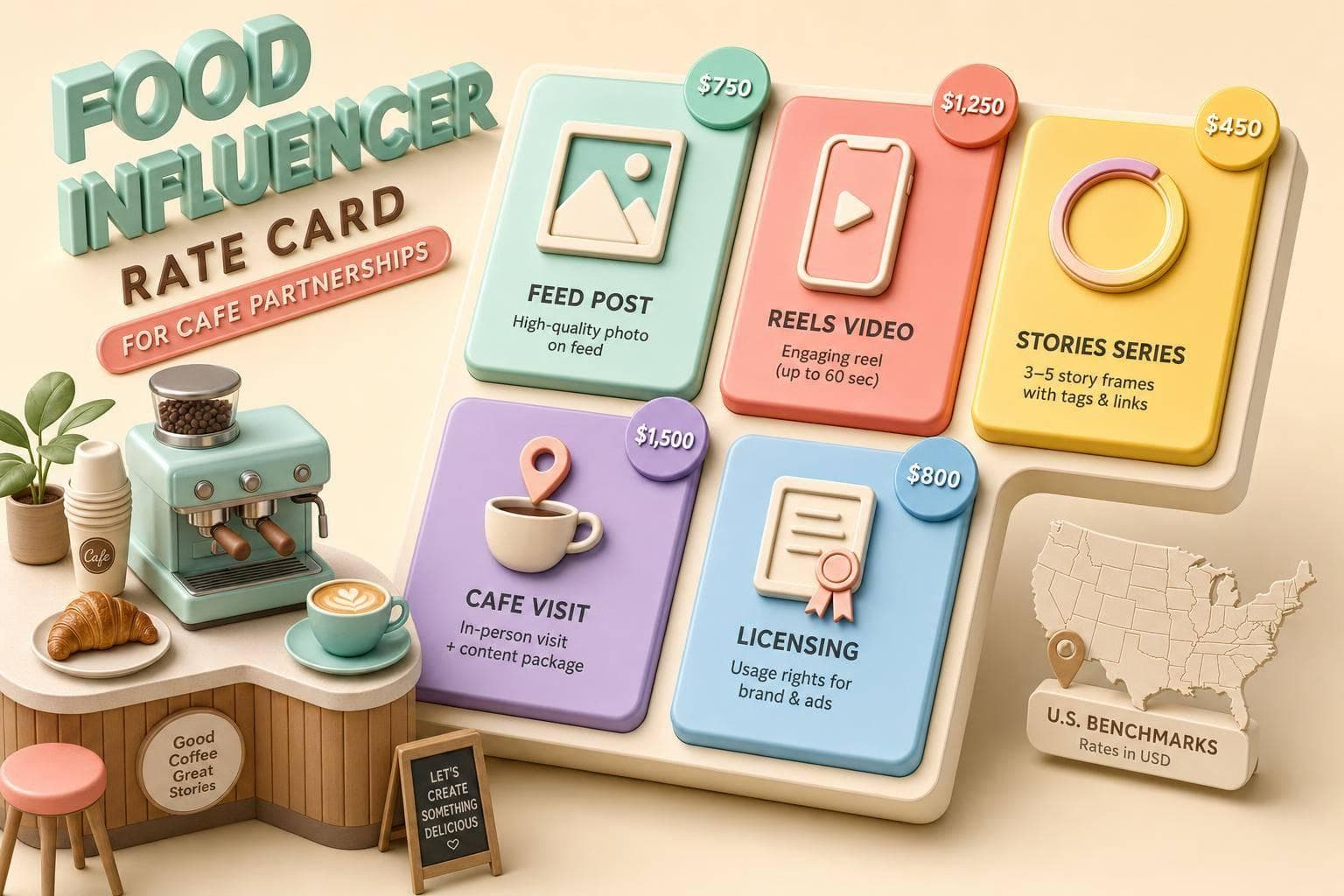
If you run cafe influencer deals in the U.S., the price usually comes down to three things: the creator’s size, the content type, and the usage rights. In most local deals, nano and micro food creators are the best fit, and many offers land somewhere between a comped meal + $50 to $400 or a few hundred dollars for a Reel, carousel, or Story package.
Here’s the short version:
A few numbers stand out fast:
If I were setting a cafe rate card, I’d keep it simple: price the deliverable, price the visit, then price the license. That gives both sides a clean way to see what’s included and what costs extra.
| Area | What matters most |
|---|---|
| Creator tier | Nano, micro, mid-tier, or macro |
| Deliverable | Photo post, carousel, Reel, Stories, UGC |
| Production | On-site time, travel, edits, revisions |
| Rights | Organic reposting, paid ads, whitelisting, buyout |
| Market | NYC and LA often cost more than mid-size cities |
| Deal type | One-off package, meal + cash, or monthly retainer |
Below, I break down the article into the key pricing rules, rate ranges, and deal terms you should pay attention to before sending or accepting a cafe partnership offer.
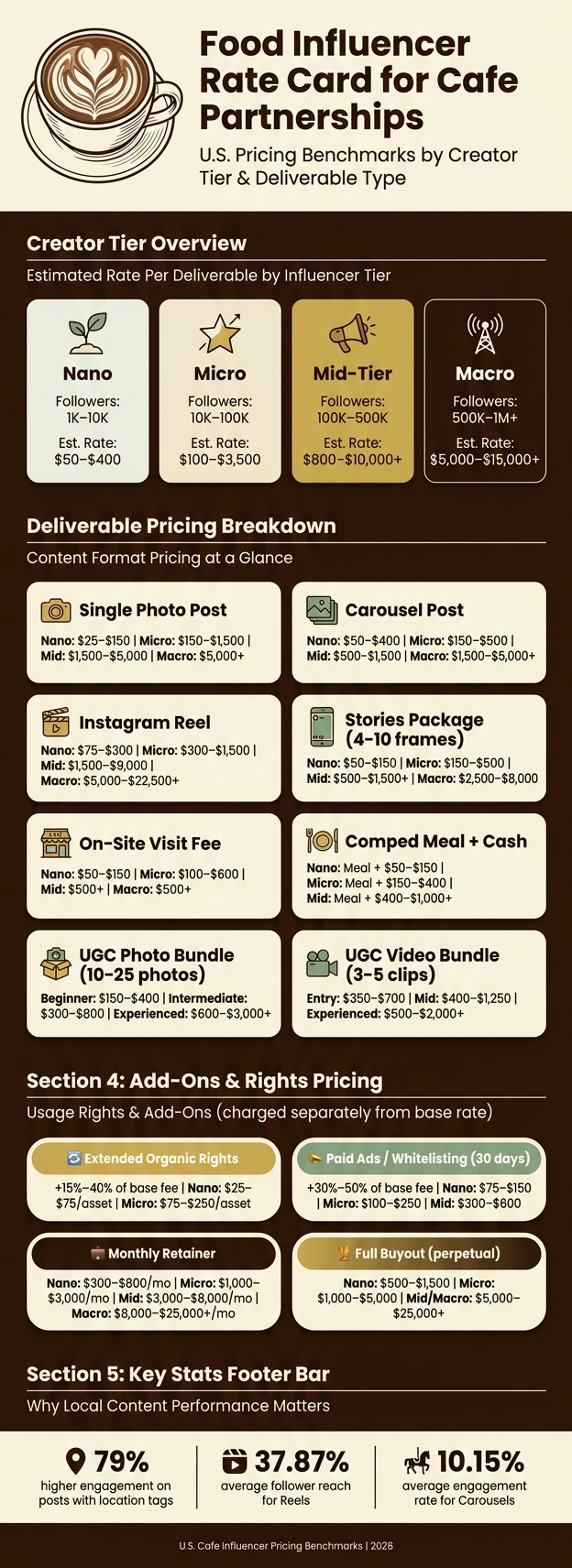
Food Influencer Rate Card for Cafe Partnerships: Pricing by Tier & Deliverable
A solid rate card breaks pricing into three parts: content formats, production effort, and usage rights and add-ons. Keeping those line items separate helps you avoid charging too little. It also makes it much easier for a cafe owner to see what, exactly, they’re paying for.
That split matters because each deliverable takes a different amount of work. A Reel isn’t the same as a single photo post. A Reel usually means shot planning, video editing, text overlays, and audio syncing. A single photo post doesn’t. If both are priced the same, things get messy fast.
Production effort changes the price too. On-site time, travel distance, food styling, editing difficulty, and revision rounds all shape how long the job takes. You can build standard production into each package, or spell out extras like on-site time, travel, and revisions as add-ons.
Usage rights should also stand on their own. The base fee pays for creation, not usage. Organic reposting, paid ad usage, whitelisting, and extended license windows each have a different level of worth, so each one should have its own price. Usage rights usually add 15% to 50% to the base rate, with whitelisting at the high end.
Rates can also move based on a couple of factors, especially Instagram metrics like engagement rate and how local and relevant the audience is. Once that structure is in place, comparing format-by-format pricing gets a lot easier.
Pricing tends to climb as the creator tier goes up. For U.S. cafe partnerships, the tiers above work well as a starting point: nano, micro, mid-tier, and macro. Use those ranges as the base when pricing each type of deliverable below.
Nano food creators usually charge $50–$400 per deliverable, and a lot of local cafe deals land somewhere around a comped meal plus $50–$150 in cash.
Micro food influencers usually charge $100–$1,500 per deliverable, with many cafe packages landing in the $200–$800 range.
Mid-tier and macro creators usually move into the thousands per post, especially when the deal includes multiple deliverables or usage rights. Mid-tier rates often fall between $800 and $10,000+, while macro creators commonly land around $5,000–$15,000+ per post.
| Influencer Tier | Follower Count | Est. Rate per Deliverable |
|---|---|---|
| Nano | 1K–10K | $50–$400 |
| Micro | 10K–100K | $100–$3,500 |
| Mid-Tier | 100K–500K | $800–$10,000+ |
| Macro | 500K–1M+ | $5,000–$15,000+ |
Think of these as benchmarks, not fixed pricing. A cafe in New York City won't always pay like a small-town coffee shop, and two creators with the same follower count can price very differently. Before setting rates for each deliverable below, adjust for engagement, content quality, and market size.
As you grow your Instagram presence, your value to brands increases. Next, break those benchmarks into posts, Reels, Stories, UGC, and add-ons.
Start with the simplest deliverable: a single photo post.
For a cafe deal, this usually means one edited feed image plus the caption, tags, and geo-tag. It’s the most basic Instagram package, which also makes it the easiest place to set a clear rate.
In the U.S. cafe market in 2026, nano creators with 1,000–10,000 followers usually charge $25–$150 per post. Micro creators with 10,000–100,000 followers often fall between $150 and $1,500. Mid-tier creators with 100,000–500,000 followers tend to quote $1,500–$5,000 per post. Macro creators often start at $5,000+ for a single post.
Follower count matters, but it’s not the whole story. Engagement and local audience fit often matter more. A food creator with a 4%–6% engagement rate can charge more than a bigger account whose followers scroll past without doing much. For cafes, that local match can mean more foot traffic than a larger audience that lives somewhere else.
One more thing: usage rights are not part of the base post rate. If a brand wants licensing, add it separately on the rate card. Extended or paid usage usually adds 20% to 50% on top of the base fee.
Instagram carousel posts should cost more than single-image posts because they involve more photos and more editing.
A carousel usually costs more than a single photo post. For a cafe, that can mean a mix of storefront, menu, food, and interior shots all in one post. More slides usually mean more shooting, more planning, and more editing. That’s why carousel pricing sits above single-image pricing.
A common approach is to price a carousel at a 10%–30% premium over a single photo post. In the U.S., cafe carousel rates usually look like this by tier:
| Influencer Tier | Followers | Typical Rate |
|---|---|---|
| Nano | 1K–10K | $50–$400 |
| Micro | 10K–100K | $150–$500 |
| Mid-Tier | 100K–500K | $500–$1,500 |
| Macro | 500K–1M+ | $1,500–$5,000+ |
On your rate card, spell out what’s included:
Keep usage rights, paid ads, and exclusivity priced as separate add-ons.
Reels should cost more than carousels because they add motion, editing, and audio work.
After carousels, Reels are usually the next jump in price. That makes sense. They take more work to make.
You’re filming, trimming clips, adding text on screen, and building a hook that pulls people in within the first few seconds. Because of that extra work, Reels often cost 20%–40% more than a single photo post at the same tier.
For U.S. cafe partnerships, Reel rates usually look like this:
| Influencer Tier | Followers | Typical Reel Rate |
|---|---|---|
| Nano | 1K–10K | $75–$300 |
| Micro | 10K–100K | $300–$1,500 |
| Mid-Tier | 100K–500K | $1,500–$9,000 |
| Macro | 500K–1M+ | $5,000–$22,500+ |
These numbers can shift based on engagement rates, production quality, and how much editing the Reel needs.
If you’re selling a Reel-only package, the base rate should include one edited vertical video between 15 and 60 seconds, plus the caption and cafe tag. Raw footage, paid ad usage, and extra revision rounds should be billed on top of that.
When you build your rate card, set your Reel price 20%–40% above your single photo post rate for the same tier. Also spell out the video length and the number of revision rounds. That keeps scope creep in check and makes proposals easier for cafes to compare side by side.
Food-focused rate guides land in a similar range. Nano food creators usually make $20–$180 per Reel, micro food creators $200–$1,800 per Reel, and mid-tier food creators $1,000–$10,000 per Reel, depending on production quality and market.
After feed posts and Reels, Stories tend to be the lower-cost, faster-turnaround option. They disappear after 24 hours and usually take less time to make, which is why they often land at about 20%–50% of a comparable feed post rate at the same tier.
For cafe partnerships, Stories are usually sold as a package instead of frame by frame. A common setup is 4–10 frames posted in one day. That often includes tags on each frame, one location tag, 1–2 face-to-camera frames, and a link sticker that sends people to ordering, reservations, or the website. Polls or Q&As are usually priced as add-ons.
Use the same tier ladder as feed posts, which you can identify using an Instagram influencer search tool, but keep Story pricing lower because the deliverable is smaller and the production load is lighter:
| Influencer Tier | Followers | Typical Stories Package Rate |
|---|---|---|
| Nano | 1K–10K | $50–$150 |
| Micro | 10K–100K | $150–$500 |
| Mid-Tier | 100K–500K | $500–$1,500+ |
| Macro | 500K–1M | $2,500–$8,000 |
Stories should sit below feed post pricing because they have a shorter shelf life and are usually faster to shoot. It also makes sense to charge more for link stickers and custom CTAs. If a brand needs a trackable link, add about $10–$30 for nano creators and $30–$150 for micro creators per package.
If the creator is spending extra time on-site, split the visit fee from the Stories package. That keeps the base rate clean and makes the extra labor easy to see.
Once you’ve priced the content itself, price the creator’s time on-site as its own line item. Keep it separate from any comped meal.
The on-site visit fee covers travel, time at the cafe, and in-person shooting. Think of it like an appearance fee. A free meal can help offset that cost, but it usually doesn’t replace the fee unless the creator has clearly agreed to a barter deal. That’s what keeps the visit fee separate from the rate for a post, Reel, or Stories package.
On-site work means more labor than remote content delivery. There’s travel, setup, shooting in a live space, and often more back-and-forth on the day itself. Because of that, on-site visits often come with a 15%–25% premium over remote UGC work at the same tier.
Use these numbers for the on-site visit fee, not the content fee:
| Influencer Tier | Typical On-Site Visit Fee | Common Compensation Model |
|---|---|---|
| Nano (1K–10K) | $50–$150 | Comped meal + small flat fee |
| Micro (10K–100K) | $100–$600 | Meal + flat visit fee |
| Mid-Tier (100K–500K) | $500+ | Fee + comp + usage rights |
| Macro (500K+) | $500+ | Fee + comp + usage rights |
Before the visit, spell out the details: visit length, shot count, posting requirement, and whether edits are included.
If the visit involves travel, weekend timing, or filming in more than one area of the cafe, add each one as a separate charge instead of rolling everything into the base rate. That way, the cafe can see exactly what it’s paying for.
When a cafe wants both local visibility and content, split the offer into two parts: the visit and the content.
A comped meal plus cash package gives the creator free food and drinks, plus a flat fee tied to set deliverables. This setup works well for launches, limited-time specials, and repeat local campaigns. List the meal value and the cash fee separately, and price the food based on the average check for the number of guests.
Treat the meal as a marketing cost, not as free inventory.
Here are realistic U.S. starting ranges for these packages:
| Influencer Tier | Meal Value | Cash Fee | Deliverables |
|---|---|---|---|
| Nano (1K–10K) | $25–$40 | $50–$150 | 1 Reel + 3–5 Story frames |
| Micro (10K–100K) | $30–$60 per person | $150–$400 | 1 carousel + 3–5 Story frames |
| Mid-Tier (100K–500K) | $60–$120 (meal for two) | $400–$1,000+ | 1 high-production Reel + Stories sequence |
Example: meal for two up to $40 each plus $250 cash for one Reel and 3 Stories, posted within 7 days.
If a creator has stronger local engagement or a track record of driving foot traffic, bump up the cash fee. And keep usage rights, paid ads, and buyouts separate from the meal-plus-cash fee.
UGC photo bundles are content-only deals. The creator takes and edits photos for the cafe to use on menus, websites, and paid social, but they don't post the content on their own profile.
That usually brings the fee down while still giving the cafe a batch of reusable assets. If the cafe wants motion content too, price short-form video content as a separate line item.
Most UGC photo bundles include 10–25 high-res JPEGs in 9:16, 1:1, and 16:9 formats for feed posts, Stories, and ads. A standard set often includes hero shots, ambience frames, and close-ups. Higher-tier bundles may also include multiple angles, flat lays, and action shots.
Here’s what pricing usually looks like:
| Package Level | Typical Bundle | Rate Range |
|---|---|---|
| Beginner | 8–12 photos | $150–$400 |
| Intermediate | 15–20 photos | $300–$800 |
| Experienced | 20–25 photos | $600–$3,000+ |
A simple way to price these bundles is to start with a per-image base rate, then apply a 15%–25% bundle discount for larger sets. That helps you keep pricing consistent without making each package feel random.
One more thing: base rates usually cover organic use only. If the cafe wants paid ads, whitelisting, or broader licensing, charge those separately.
Video bundles usually cost more than photo bundles. Simple reason: they take more time to shoot, edit, and export.
Short-form UGC also carries a higher price than photo-only work because you're paying for filming, editing, and platform-ready versions. A standard bundle usually includes 3–6 vertical videos in 9:16 format, with each clip running about 9–15 seconds. These are built for short-form platforms and often focus on a hero dish, a signature drink, ambience, staff, or promo-style hooks.
Most bundles also include:
For U.S. cafe partnerships, most creators quote one flat bundle fee instead of charging per clip. Typical rates for 3-video and 5-video bundles are below.
| Creator Tier | 3-Video Bundle | 5-Video Bundle |
|---|---|---|
| Entry-level creators | $350–$450 | $550–$700 |
| Mid-level creators | $400–$750 | $800–$1,250 |
| Experienced food creators | $500–$800+ | $1,000–$2,000+ |
Use these ranges as a starting point when putting together cafe proposals. Per-video pricing tends to come in lower than bundle pricing.
Use a retainer when a cafe wants steady content instead of one-off posts. It’s a fixed monthly fee for recurring work - posts, Reels, Stories, UGC, and cafe visits - so nobody has to renegotiate every single deliverable. That setup works well for cafes that need repeat coverage for product launches, seasonal menus, and day-to-day promotions. It also gives the cafe predictable monthly coverage for launches, specials, and events.
Retainer pricing is usually 10–30% lower per deliverable than one-off rates. A simple way to price it is to map the retainer to monthly deliverables, then match the rate to the creator tier or search for niche influencers to find the right fit.
| Creator Tier | Typical Monthly Deliverables | Monthly Rate Range |
|---|---|---|
| Nano (1K–10K) | 1–2 in-feed posts, 1 Reel, 4–6 Story frames, 5–10 UGC photos | $300–$800 per month |
| Micro (10K–100K) | 2–3 in-feed posts, 2–3 Reels, 8–12 Story frames, 10–20 edited UGC photos, 1 on-site visit | $1,000–$3,000 per month |
| Mid-Tier (100K–500K) | 3–4 Reels, 2–3 photo/carousel posts, weekly Story series (12–20 frames per month), 20–30 UGC photos, 1–2 cafe visits | $3,000–$8,000 per month |
| Macro (500K+) | Custom multi-format packages with heavier video production and monthly planning | $8,000–$25,000+ per month |
Set a minimum 3–6 month term. That gives both sides enough time to see whether the work is moving the needle through foot traffic changes, promo code redemptions, or follower growth on the cafe’s own account.
It also helps to build in a 3-month performance review. That gives you a clean checkpoint to adjust deliverables or pricing based on what’s landing and what isn’t. In the retainer itself, spell out the monthly deliverables, revision limits, and approval rounds so expectations are clear from day one.
Keep licensing and ad usage out of the monthly fee.
Extended organic usage rights let a cafe reuse influencer content on its own unpaid channels after the base posting window ends. This fee is usually charged per asset.
Most deals start with a limited repost window, often 30 to 90 days and usually on social media only. This add-on tends to stretch usage to 6–12 months, open up organic use across approved channels, and allow small edits like cropping, resizing, color correction, or adding a text overlay.
Price this below paid ads, whitelisting, and full buyouts, or use an influencer pricing calculator to benchmark the base fee.
Typical U.S. per-asset fees by creator tier are below.
| Creator Tier | Flat-Fee Range (per asset) |
|---|---|
| Nano (1K–10K) | $25–$75 |
| Micro (10K–100K) | $75–$250 |
| Mid-Tier (100K–500K) | $250–$750+ |
Some creators also price this at 15%–40% of the original content fee.
Be specific in the agreement. Spell out the channels, the term, and what is not included: organic use only, no paid ads, no whitelisting, plus a fixed end date or a renewal clause. Skip vague terms like "ongoing use."
Paid ads and whitelisting should be priced separately.
Paid ads/whitelisting is a separate add-on that lets a cafe run sponsored campaigns through the creator's handle using the influencer's content and identity. On Meta, this is also called Partnership Ads. The ad can show the creator's profile image and name, while the cafe controls targeting, budget, and optimization.
Here’s the simple split: organic licensing covers reposting on the cafe’s own channels, while whitelisting covers paid distribution. That’s why it should be priced on its own, not bundled into the base content fee.
Meta reports stronger click-through and purchase performance for Partnership Ads, which helps justify a higher add-on fee.
In the U.S., food influencers often charge either a flat fee for a 30-day window or a percentage of the base content fee. For cafes, these are common benchmarks:
| Creator Tier | Whitelisting Add-On (30 days) |
|---|---|
| Nano (1K–10K) | $75–$150 |
| Micro (10K–100K) | $100–$250 |
| Mid-Tier (100K–500K) | $300–$600 |
A good rule of thumb: whitelisting usually adds 30%–50% of the base content fee for each 30-day period.
The contract should spell out the usage window and campaign limits. Be specific about:
That way, both sides know exactly what the cafe can run and for how long.
A full content buyout means the cafe purchases full ownership of the influencer’s deliverables: photos, videos, captions, and raw assets. This is different from limited usage rights tied to a set timeframe. With a buyout, the cafe gets perpetual, unrestricted use across all channels and formats, plus the right to edit and repurpose the content. That’s why buyouts usually sit at the top end of a rate card.
Buyouts aren’t common in cafe deals. Still, they can fit well for menu refreshes, seasonal campaigns, and branding across multiple locations.
In the U.S., food influencers often price buyouts at 3–10x their base content creation rate. For cafe campaigns, these are the usual benchmark ranges:
| Creator Tier | Typical Full Buyout Range |
|---|---|
| Nano (1K–10K) | $500–$1,500 per photo-video bundle buyout |
| Micro (10K–100K) | $1,000–$5,000 per package |
| Mid-Tier / Macro (100K+) | $5,000–$25,000+ per campaign assets |
One contract point needs to be crystal clear: perpetual licensing allows indefinite use, while a true buyout transfers ownership.
Next, define the usage terms that apply to every cafe deal.
Once you’ve priced the deliverables, the next step is to define how the cafe can use them. This matters because every item on a cafe rate card is tied to a set scope of use. The creator is licensing the content, not handing over ownership. That keeps the rate card centered on usage scope, not only the work of making the content.
For organic use, the agreement should spell out the exact channels the cafe can use, like the cafe’s Instagram feed or Stories, Facebook page, or website, and it should include a fixed term. A single-location cafe usually needs simpler terms than a regional chain. And if the cafe is a franchise, the contract needs to say whether the rights apply to one location or all locations. That detail can change the deal in a big way depending on the brand’s footprint.
For paid use, whitelisting and paid ads run from the cafe’s account are separate add-ons, and each needs its own terms. The contract should name the platform, the campaign window, the geographic limit, and whether the cafe can test different captions or CTAs. Paid ads and whitelisting should never be assumed under an organic license.
Before signing, every usage clause in the rate card should answer four questions:
The contract should also state what editing is allowed, such as cropping, subtitles, text overlays, or combining the content with other assets. It should also include either a renewal clause or a hard end date instead of open-ended wording.
To ensure you are getting the best value, you can [compare Instagram influencers] (https://www.upgrow.com/free-instagram-tools/instagram-influencer-comparison) to see how their engagement and performance metrics stack up. These terms move next based on market size, creator tier, and local demand.
Use the rates above as your baseline, then adjust for local market pressure. A nano food creator in New York City or Los Angeles will often quote 30%–100% more than a similar creator in a mid-size market like Columbus or Kansas City for the same deliverables. Cities with heavy tourism, such as New Orleans and Las Vegas, can also price more like high-cost markets. The simplest way to handle it: start with the tier benchmarks above, then adjust based on where the cafe operates.
Audience geography matters just as much as follower count in cafe partnerships. A creator whose followers live close to the cafe is often worth more than a national food account with the same reach. Why? Because local followers are far more likely to turn a post into actual foot traffic. That means creators with a concentrated local audience can often charge more.
Deal structure shifts based on market size, creator tier, and where the audience is located. Here’s how the three deal types usually line up:
| Compensation Structure | Typical Creator Tier | When It Makes Sense |
|---|---|---|
| Comped meal only | Nano (under 10K followers) | Test visits, portfolio building, light deliverables |
| Comped meal + $50–$300 | Nano to micro (5K–50K followers) | Standard local cafe promo |
| Cash-heavy deals ($500–$2,000+) | Mid-tier and above, or multi-location groups | Reels, carousels, UGC bundles, broader licensing, and chain or franchise deals |
Independent, single-location cafes usually stay with a comped meal or a modest cash payment for nano and micro creators, especially for seasonal launches or new menu items. Multi-location groups often move toward monthly retainers when they want repeat coverage. Franchise and corporate chains tend to go a step further. They often split influencer budgets by market and may require regional or national usage rights, which can push total packages into the $1,500–$10,000+ range depending on deliverables and whitelisting scope.
Benchmark nearby cafes, then price based on the deliverables and usage rights being purchased. Once local pricing is in place, the next move is strengthening the cafe's Instagram presence so the partnership can grow.
One-off fees can pay the bill. But repeat cafe work does something bigger: it gives you proof you can use to ask for better rates later. It also helps you keep a steady posting rhythm, stay active on Instagram, and show up more often in local discovery.
One habit matters a lot here: location tagging. Posts with a tagged location see 79% higher engagement on average than posts without one. That’s a strong stat to bring into rate talks. It helps you show a cafe that your content doesn’t just get views - it connects with people nearby.
Format mix matters too, not just posting frequency. According to a 2024 Metricool study, Reels reach about 37.87% of followers on average, while carousels get the highest engagement ratio at around 10.15%. So in a long-term cafe partnership, using both formats gives you cleaner data and a better read on what’s working.
That data is where pricing power starts to kick in. If you can show a cafe owner that a past Reel drove strong local reach, high Story completion rates, and trackable local actions, you’re not selling generic exposure anymore. You’re selling proof. And that proof gives you a much stronger case when you send the next quote.
UpGrow can support that process with location targeting, profile optimization, and real-time analytics to help attract local, real followers and give cafes a clearer view of your local audience data.
Once you price posts, Reels, Stories, UGC, and usage rights, the point of a clear structure is hard to miss. A solid cafe rate card takes the guesswork out of pricing by separating the deliverables from the rights to use them.
Use U.S. benchmarks as your starting point, not your final number. Keep organic reposting separate from paid ad usage, whitelisting, and buyouts so each right carries its own price. That’s the difference between a low-priced deal and one that’s scoped the right way. Treat the rate card as a living document, and update it as your audience value, cafe goals, and local market conditions shift. With that setup, cafe partnerships become easier to price, easier to approve, and easier to repeat.
Start with $0.01–$0.03 per follower as a baseline for a static post. Then adjust that number based on your engagement rate, content quality, and how much weight you carry in your niche.
For Reels, charge 1.5x–3x your base rate. A set of Stories will usually land at 30%–50% of that base. You should also price in extras like usage rights, exclusivity, and rush delivery.
In plain English: the post itself is just the starting point. If a brand wants more access, faster turnaround, or the right to reuse your content, the price should go up.
Usage rights cost extra because they give brands permission to reuse content beyond a standard social media post, while the creator still keeps the copyright.
Typical add-ons include:
Yes. Tailor your pricing for local cafes based on where your audience is, since local reach matters a lot for brick-and-mortar businesses. Follower count gives you a starting point, but audience location can change what you charge.
You can also consider contra partnerships, where you trade content for products like free meals. That’s common in smaller food collaborations.