Fake Engagement Problem: Pod Audit Workflow
Step-by-step workflow to spot Instagram pods, flag fake engagement, and clean campaign reporting for accurate metrics.
Step-by-step workflow to spot Instagram pods, flag fake engagement, and clean campaign reporting for accurate metrics.
4.98 /5 - from 58k reviews
Trusted by 50,000+ creators — get real engagement delivered to your profile in minutes, not days.

Fake Instagram engagement can wreck your reports fast. If fake followers pass 30%, campaign conversion rates can drop by 58%, and influencer fraud costs brands about $1.3 billion per year.
Here’s the short version: I’d use this workflow to tell weak content apart from manipulated engagement, flag pod risk early, and clean up campaign reporting before bad numbers shape budget calls.
What this article covers:
A simple way to think about it:
| Area | What I’d check | Warning sign |
|---|---|---|
| Timing | First 15–30 minutes after posting | Big burst, then sharp drop |
| Comments | Repeated accounts and comment quality | Same cluster, vague praise, emoji spam |
| Profiles | Commenter account details | No bio, no photo, random username |
| Formats | Feed vs. Stories/Reels | Feed looks strong, Stories/Reels stay weak |
| Growth | Follower trend over time | Sudden spikes with no clear reason |
Bottom line: if engagement looks strong but doesn’t line up with reach, saves, clicks, DMs, or sales, I’d treat it as a warning sign and run a pod audit before using that data in a report.
Catching pod activity early helps stop bad data from working its way into your reports. Fake engagement can skew reporting and lead to poor calls later on, so it helps to watch for a few repeat patterns before you run a full audit. You’re not looking for one magic clue. You’re looking for a pattern that shows up early, before the numbers start to bend the story.
Watch for a burst of likes and comments in the first 15–30 minutes, followed by a steep drop. That kind of front-loaded activity can be a warning sign. It also helps to flag the same small group of accounts showing up across several posts. Real engagement tends to build more slowly, often across about 24 hours. When you log this data, use MM/DD/YYYY and include local time so the timing is easy to compare across posts.
Comment quality is one of the fastest checks you can make. Pod comments are often short and vague, like "Great pic!" or "Nice!". If the same accounts keep using the same phrases, that’s a stronger signal. Check repeat commenters for incomplete profiles, missing profile photos, random usernames, or unusually high following counts.
Cross-format mismatch is another flag people often overlook. Pod activity can show up as strong feed engagement paired with weak Story and Reel results. If an account gets strong feed engagement but keeps showing weak views and interactions on Stories and Reels, the numbers across formats don’t line up.
Add an "Authenticity Score" column and mark each post as low, medium, or high risk. Track timing pattern, commenter diversity, comment quality, profile completeness, format consistency, and follower growth.
The table below shows what each signal looks like in normal activity versus pod-risk activity, along with where to pull the data:
| Signal | Real Pattern | Pod-Risk Pattern | Data Source |
|---|---|---|---|
| Engagement Timing | Gradual increase over time | Burst soon after posting, then sharp drop | Instagram Insights / Manual Log |
| Commenter Diversity | Varied users across different posts | Same small cluster on most or all posts | Audit Sheet / Comment Export |
| Comment Substance | Specific, relevant to post content | Generic phrases like "Great pic!" or "Nice!" or emojis | Post Comments |
| Profile Completeness | Bio and profile picture present | Missing bio or picture; random character usernames | Follower Profiles |
| Format Consistency | Balanced engagement across Feed, Reels, and Stories | Strong feed engagement with weak Stories/Reels | Analytics dashboard |
| Follower Growth | Steady, organic upward trend | Sudden, unexplained spikes | Follower growth tracker |
Use these signals to rank posts by risk before the audit. If a post shows several red flags at once, move it into the full review queue.
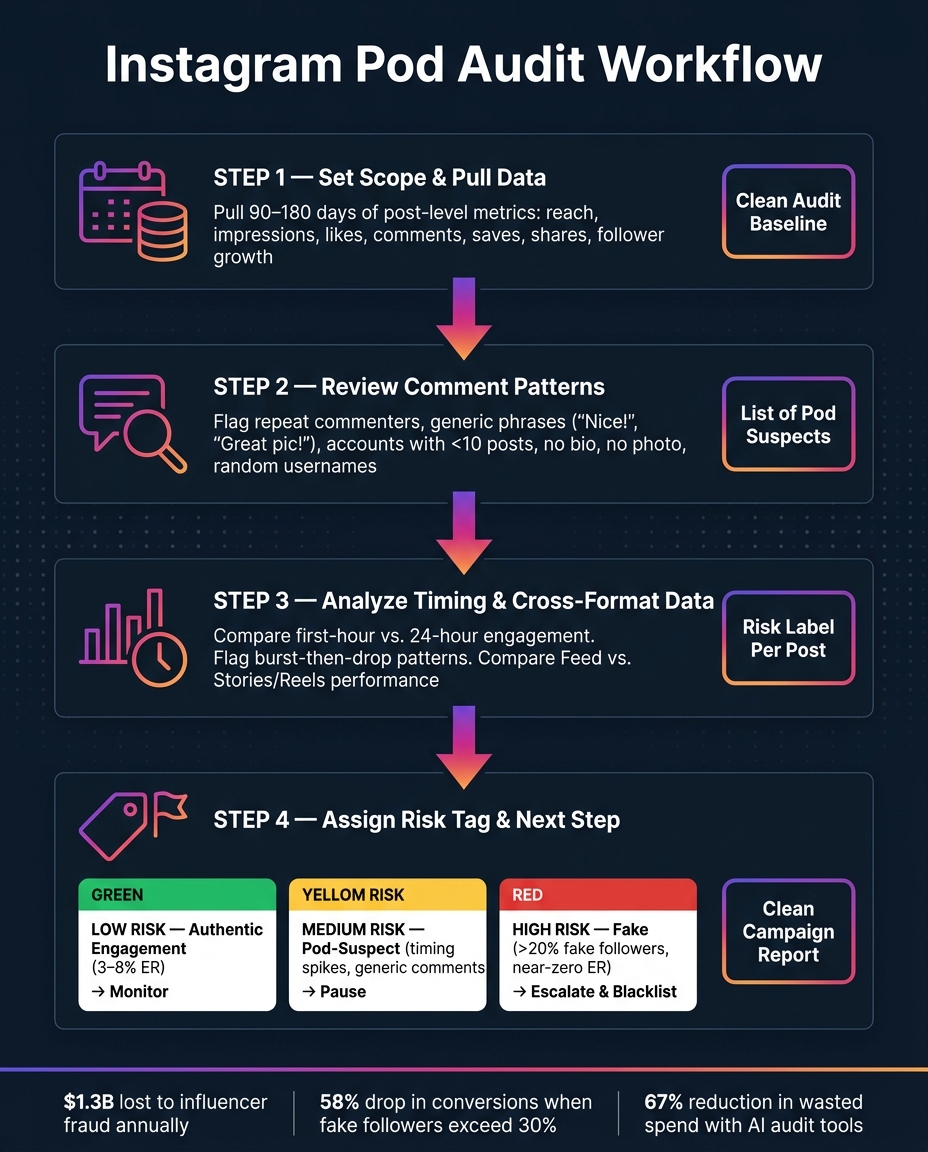
Instagram Pod Audit Workflow: Step-by-Step Process
Once a post lands in the review queue, use this workflow to sort normal engagement from pod activity. The goal is simple: turn early warning signs into a clear risk call. Each step should lead to a specific output that goes straight into your reporting, so the audit works as a reporting safeguard, not just a way to spot suspicious activity.
Start by defining the audit scope: which profiles you're checking, which campaigns are involved, and the date range. A 90–180 day window usually gives you enough history to spot repeat patterns. Pull post-level metrics from Instagram analytics or an API-based tool into a spreadsheet, including reach, impressions, likes, comments, saves, shares, and follower growth. That sheet becomes your baseline for comparison.
Once the data is in place, look closely at the last 20–30 posts and review the comment sections by hand. You're looking for the same accounts appearing again and again across different posts, especially when the comments are short, generic, or vague.
When you spot repeat commenters, do a quick profile check. Watch for accounts with:
Log every flagged account in the same spreadsheet. That makes it much easier to trace repeat patterns across posts.
After the comment review, check whether the engagement pattern looks natural. Compare first-hour engagement with 24-hour totals. If most of the interaction hits in the first hour and then falls off hard, flag it.
Next, compare feed performance with Stories and Reels. Engagement doesn't need to match perfectly across formats, but it shouldn't fall off a cliff either. If feed posts show strong engagement while Stories or Reels lag far behind, that's worth flagging too.
| Step | Inputs | Checks | Output |
|---|---|---|---|
| Scope Setting | Profile handle, 90–180 day date range | Reach, impressions, and follower growth trends | Defined audit parameters and clean audit baseline |
| Pattern Review | Last 20–30 posts, comment sections | Repeated engager clusters, generic/spammy comments | List of high-risk engagers and pod suspects |
| Quality Sampling | Follower list, commenter profiles | Profile completeness, follower-to-following ratio, username format | Risk label per post/account |
| Consistency Check | Feed vs. Stories/Reels data | First-hour engagement spikes and cross-format performance | Final risk level tagging (Monitor, Pause, or Escalate) |
Use the Authenticity Score column to give each post and account one clear label. That label should drive what happens next.
| Tag | Criteria | Risk Level | Follow-Up Action |
|---|---|---|---|
| Authentic Engagement | 3–8% engagement rate; specific, contextual comments; organic growth patterns | Low | Continue partnership; monitor for consistency across the next 10+ posts. |
| Pod-Suspect | Sudden timing spikes shortly after posting; generic comments like Nice! or Love this!; repetitive emoji chains | Medium | Pause campaign; pull native Instagram Insights and reach data; monitor the next 3 posts. |
| High-Risk Fake | More than 20% fake followers; high follower count with near-zero engagement; incomplete profiles or random alphanumeric usernames | High | Terminate partnership; escalate for deeper investigation; blacklist from future campaigns. |
After you tag a post, rebuild the campaign metrics without the flagged interactions. Start by subtracting flagged likes and comments from the total. Then divide that number by follower count to get the Authentic Engagement Rate.
Next, remove bot and inactive followers so you can move from Total Reach to Authentic Reach. These cleaner numbers give you a better base for pricing, forecasting, and reporting. Put plainly: if the inputs are off, the campaign math will be off too.
The tag should make the next move pretty straightforward.
This keeps follow-up tied to evidence instead of gut feel. A clean label, a clean data reset, and a clear next step help the team act fast without overreacting.
Fake engagement creates two big issues: it slows clean growth, and it throws off reporting. When that happens, campaign results look better or worse than they should, analytics get muddy, and budget calls become harder to trust.
That’s why the workflow matters. Use it to spot weak signals early, before they start skewing your numbers.
Then make those checks part of your routine. Add monthly pod reviews to your Instagram review cycle. Run a deeper audit every quarter before you sign or renew contracts, so you can check growth patterns, audience fit, and essential Instagram metrics. Brands using AI audit tools have reported cutting wasted marketing spend by as much as 67%.
If you want cleaner growth from day one, use a tool built for real engagement. UpGrow offers AI-powered Instagram growth with smart targeting and real-time analytics to help you grow real followers. Plans start at $39/month.
Look at patterns in timing, quality, and follow-through. Fake engagement often shows up as sudden spikes or activity that lands on a rigid schedule. It may also come from places that don’t line up with your audience and include generic, low-effort comments.
You can often spot it in what happens next, too. Think likes with no saves, no shares, and no DMs. That kind of activity looks busy on the surface, but it doesn’t lead anywhere.
Pay close attention to ratios that seem off and follower jumps that don’t match your content or campaign activity.
Match your pod or audience audit schedule to how fast your account is moving.
A slow-growing personal account usually doesn't need constant check-ins. Every 2–3 months is enough.
If you run a business account or you're a growing creator with under 10,000 followers, audit monthly. That cadence gives you enough time to spot changes before they turn into bigger problems.
Once you're an established creator with over 10,000 followers, move to an audit every 2 weeks. At that stage, things can shift fast, and a lot can happen between posts, partnerships, and audience spikes.
A few moments call for an extra audit no matter your usual schedule:
After you flag fake engagement in your pod audit, remove bot accounts and fake followers from your profile. Then, leave out any data tied to those accounts in your reporting so your metrics reflect actual reach.
If an account or collaborator goes past your fraud thresholds - for example, a bot rate above 60% or an engagement pod rate over 80% - disqualify them from reports entirely.