Ethics of AI in UGC: What Marketers Need to Know
Require disclosure, written consent, and verified claims when using AI in UGC to protect trust and stay FTC- and platform-compliant.
Require disclosure, written consent, and verified claims when using AI in UGC to protect trust and stay FTC- and platform-compliant.
4.98 /5 - from 58k reviews
Trusted by 50,000+ creators — get real engagement delivered to your profile in minutes, not days.

If AI UGC looks like a real customer but no real customer exists, you have a trust problem and, in many cases, a legal one.
I’d boil the whole topic down to this: use AI to help make content, not to fake human experience. The article shows that AI videos can cost as little as $3 per video, but it also points out the risk: 48% of consumers say AI-made social content feels less trustworthy, and the FTC can fine brands up to $53,088 per violation for fake or misleading reviews.
Here’s the short version:
A simple way to think about it:
| AI use | Risk level | What I’d do |
|---|---|---|
| Script help, captions, color fixes | Low | No special label needed |
| Translation with no likeness change | Medium | Review closely |
| Voice cloning, AI avatars | High | Add clear disclosure and get consent |
| Fake customer reviews or testimonials | Critical | Don’t publish |
The main point is simple: people trust UGC because they think a person is sharing a lived experience. Once AI starts pretending to be that person, the line gets crossed fast. So if I were building an AI UGC process for Instagram, I’d focus on three checks every time: clear disclosure, written consent, and proof for every claim.
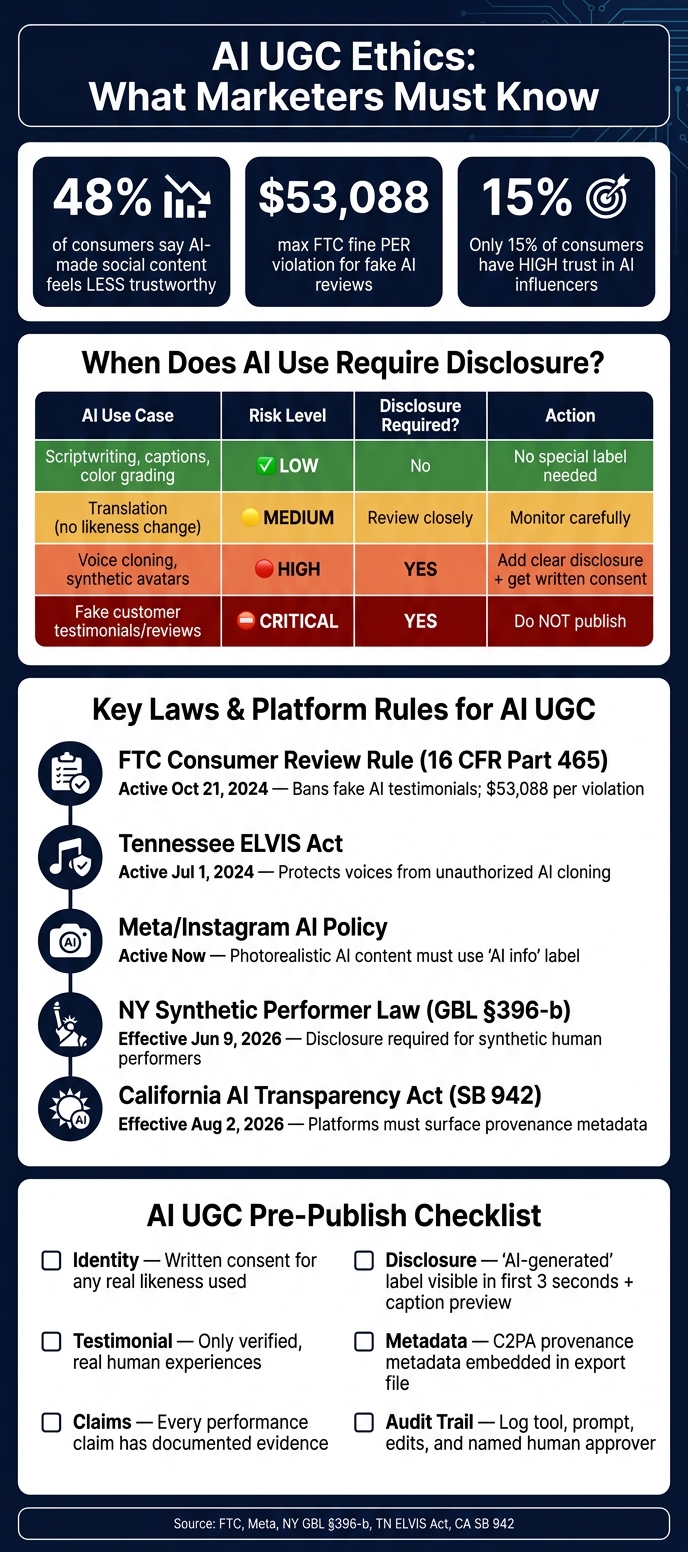
AI UGC Ethics: Risk Levels, Disclosure Rules & Legal Penalties
AI UGC is not the same as authentic UGC. And not all UGC types carry the same ethical weight. That line matters because the core issue is simple: Is AI helping a human tell the truth, or is it standing in for a human experience that never happened?
Here’s where the differences start.
A real person on camera is not the same thing as a synthetic performer. If AI creates or materially changes a face, voice, or body, disclosure matters.
Once that label is clear, the next step is figuring out where AI shows up in the workflow and when disclosure needs to happen.
The risk depends on what AI is doing, not just the fact that it’s there.
| AI Use Case | Ethical Risk | Disclosure Required? |
|---|---|---|
| Scriptwriting / hooks | Low | No |
| Auto-captions | Low | No |
| Color grading | Low | No |
| Translation | Medium | No, unless it changes identity or likeness |
| Voice cloning | High | Yes |
| Synthetic avatars | High | Yes |
| Fake testimonials | Critical | Yes |
Routine post-production work like noise removal, color grading, and auto-captions usually does not trigger disclosure concerns. Those tools clean up a video, but they do not change who is speaking or what the viewer thinks they are seeing.
The problem starts when AI generates or swaps out human presence. A synthetic avatar posed as a happy customer is not a small edit. A cloned voice reading lines the person never said is not basic polish. At that point, AI is no longer assisting the content. It is changing the truth claim inside the content.
That’s why the next ethical test isn’t Was AI used? It’s Does this change what viewers believe is real?
AI UGC is risky for one main reason: viewers bring a built-in assumption to UGC. They think they’re watching a real person talk about a real experience. That’s the whole appeal.
When that assumption is false, the content leans on trust it did not earn. It doesn’t just stretch the truth a bit. It uses the look and feel of peer validation to sell something under false pretenses.
"A polished brand ad that looks a little AI-generated is a polished brand ad. A 'customer testimonial' that looks a little AI-generated is a lie." - Social Native
The numbers show that audiences are already wary. Only 15% of consumers say they have high trust in AI influencers. And 80% of Gen Z regularly question the authenticity of the digital visuals they see.
That skepticism is already part of how people watch online content. Clear disclosure around AI use is what helps keep trust from slipping further.
The previous section showed when AI use turns into a trust issue. This section gets into what to do next. In practice, three controls matter most: disclosure, consent, and claim verification.
Disclose any AI-generated or materially altered face, voice, or body. You should also disclose any AI use that changes identity, likeness, or the reality of the experience shown. For Instagram, Meta requires self-disclosure for photorealistic AI video or realistic AI audio.
Where the disclosure appears matters just as much as the wording. To meet the FTC’s “clear and conspicuous” standard, disclosures should appear in the first line of the caption - before the “see more” break - and as an on-screen label within the opening seconds of the video. If you hide the disclosure at the end of a long caption, that does not meet the standard.
After disclosure, the next issue is simple: do you have permission to use a real person’s likeness in the first place?
If a real person’s face, voice, or likeness appears in AI-modified content, get written consent for that exact use. The consent should plainly cover AI modification and compensation.
A lot of standard creator contracts don’t deal with this problem:
"If your creator contracts do not explicitly address AI modification of footage, you have a gap that needs closing before Q3." - Dovile Miseviciute, SEO Lead, Billo
An AI modification clause should spell out what the brand is allowed to do. That can include voice cloning, face-swapping, or using the creator’s likeness as training data for AI-generated variations. If that language is missing, you’re working in a gray area you don’t want.
With consent in place, the next step is making sure every claim holds up.
AI can produce polished scripts fast. It can also spit out claims that sound believable without any proof behind them. Every claim made by an AI avatar needs fact-checking and evidence, just as it would if a human spokesperson said it.
Human review should cover facts, tone, and bias for every asset.
The FTC can impose civil penalties of up to $53,088 per violation for fake or misleading consumer reviews, including AI-generated testimonials.
One practical fix is an approved-claims brief. This is a campaign document that lists approved claims, restricted phrases, and required disclosures before any AI rendering starts. It’s much cheaper to catch a bad claim in the script than to pull a finished video after it goes live.
| Ethical Principle | Common AI UGC Risk | Practical Safeguard |
|---|---|---|
| Transparency | Audience feels deceived by an "uncanny valley" synthetic human | Use clear on-screen labels and platform "AI info" toggles |
| No fabricated testimonials | AI persona used to fabricate a "real customer" testimonial | Use AI for product demos; keep testimonials limited to real human experiences |
| Consent | Cloning a real creator's voice or face without permission | Obtain written, use-specific consent for any likeness modification |
| Accountability | No record of who approved a misleading AI asset | Log the tool used, the prompt, and the named human approver for every asset |
These principles only work if they’re built into legal review before publication. The rules here should feed straight into the legal checks in the next section.
At this point, ethics turns into rules you have to follow. If you use AI UGC on Instagram in the U.S., you need to pay attention to FTC rules, Meta policy, and state disclosure laws. And all of it comes back to the same three checks: transparency, consent, and accuracy.

The FTC's Endorsement Guides (16 CFR Part 255) apply to synthetic personas that people could mistake for real humans. So if an AI avatar tells a first-person product story, it doesn't get a free pass just because no human actor was involved.
The bigger issue is the Consumer Review Rule (16 CFR Part 465), which took effect on October 21, 2024. It directly bans AI-generated reviews or testimonials from "customers" who never used the product. The penalty is steep: $53,088 per violation. And yes, each fake review can count on its own. The FTC has already taken action in AI review cases, including Rytr.
The practical takeaway is simple: use AI presenters for brand claims you can back up, not fake customer testimonials.
Once claim rules are handled, the next question is ownership and permission. Before you publish, check the tool license, get written likeness consent, and make sure provenance metadata stays in place.
Some AI tools do not include commercial-use rights by default. In many cases, those rights are limited to paid plans. That means you should review the tool's terms of service before using any output in a paid campaign.
If a real person's face or voice is part of the asset, written consent should cover:
A lot of standard creator agreements leave those points out. That's where legal risk starts to creep in, especially under right-of-publicity laws and laws like Tennessee's ELVIS Act, which took effect on July 1, 2024, and protects a person's voice from unauthorized AI simulation.
There is also a technical layer here. C2PA provenance metadata embedded in AI-generated video files helps platforms detect and label content. If your editing workflow strips that metadata, you could end up with ad rejection or other platform penalties. It sounds minor, but it matters. Check your export settings and make sure the metadata survives.
Platform labels are just the baseline. State laws add another set of checks.
Meta requires self-disclosure for photorealistic AI video or realistic AI audio. It uses an "AI info" label tied to C2PA/IPTC metadata. In plain English: don't assume the system will catch everything for you. Manually toggle the label during upload.
Several U.S. state laws are already active, or will be soon. New York's Synthetic Performer Law (GBL §396-b) takes effect on June 9, 2026. It requires clear disclosure in any ad that features a fully synthetic human performer. It also applies to any brand whose ads are shown to New York audiences, even if the brand is based somewhere else.
California's AI Transparency Act (SB 942) becomes operative on August 2, 2026. It requires large platforms to surface provenance metadata and provide AI-detection tools.
Here’s the publish-check version of those rules:
| Regulation or Guidance | What It Means for AI UGC Video | Practical Action |
|---|---|---|
| FTC Consumer Review Rule (16 CFR Part 465) | Bans fake AI testimonials from "customers" who never used the product | Use AI for presenters with substantiated claims; keep testimonials to real humans |
| NY Synthetic Performer Law (GBL §396-b) | Requires conspicuous disclosure for fully synthetic human performers | Add "This ad features an AI-generated performer" to Reels served in NY |
| Tennessee ELVIS Act | Protects an individual's voice from unauthorized AI simulation | Never clone a real person's voice without written, use-specific consent |
| Meta/Instagram AI Policy | Photorealistic AI content must be disclosed via the "AI info" label | Toggle the "AI info" label during upload for realistic Reels |
| CA SB 942 | Requires large platforms to surface provenance metadata and offer AI-detection tools | Ensure AI tools embed machine-readable metadata in exported video files |
| C2PA Standards | Technical standard for embedded provenance metadata | Verify metadata is not stripped during editing or export |

Knowing the rules is one thing. Applying them every single time is what keeps teams out of trouble.
Every AI UGC asset needs a pre-publish approval brief and a review step before it goes live. The simplest way to make that happen is with a pre-publish checklist.
Every AI UGC video needs a human approval pass before publishing. The point is simple: catch problems at the asset level, not after a complaint shows up.
| Checkpoint | Questions to Ask | Action Required |
|---|---|---|
| Identity | Is this a fully synthetic persona, or does it resemble a real person without consent? | Attach written, use-specific consent. |
| Testimonial | Does the script imply a personal experience that never happened? | Use only verified, real experiences. |
| Claims | Can every performance result be backed by documented evidence? Tag each script line as a product feature, user benefit, or performance result before generating the video. | Attach evidence for every performance claim. |
| Disclosure | Is the "AI-generated" label visible in the first 3 seconds and in the caption preview? | Show the AI label in-frame within the first 3 seconds and in the caption preview. |
| Metadata | Is C2PA provenance metadata embedded in the final export file? | Verify C2PA metadata survives export. |
| Bias | Does the AI output reinforce harmful stereotypes or lack fair representation? | Flag for creative revision before approval. |
That review should also leave a paper trail. Log the tool, prompt, edits, and final approver for each asset.
This may sound like extra admin work. In practice, it saves time. A short review process up front is a lot easier than fixing a trust problem after content is already out in the wild.
Once an asset is approved, the next step is distribution. That part matters too.
UpGrow's AI targeting and live analytics can help you reach relevant audiences and track engagement. But precision cuts both ways. If you use it carelessly, you can damage trust just as fast as you can grow reach.
Use UpGrow's filters for location, age, gender, and language to reach people who are a fit for your product. Don't use those filters to shut out groups in ways that are discriminatory or predatory. The aim is relevance, not exclusion.
The same goes for analytics. Watch engagement quality in the live dashboard to make sure follower growth reflects real interest, not bot activity. Use UpGrow to monitor real engagement and avoid fake-growth signals. A spike in numbers might look good on a report, but if the audience isn't real, it won't help the business.
Once the workflow becomes repeatable, ethical AI UGC gets much easier to scale. The rules in this guide all point to the same idea: audiences want to know what's real. Brands that make that clear will build stronger trust than brands that treat disclosure like small-print legal copy.
The day-to-day takeaway is simple. Teams need a few steady habits:
Compliance helps you avoid legal and platform issues. Trust is what helps the business grow.
In the United States, you need to disclose content when AI-generated or heavily altered human likenesses could mislead people about whether what they’re seeing is genuine. That applies when AI changes how viewers understand the identity, experience, or opinion being shown, especially in reviews, testimonials, and endorsements.
Not every AI touch needs a label. Routine edits - like color grading, noise removal, or copy assistance - don’t require disclosure.
The label also can’t be buried or vague. It should be clear, easy to notice, and shown before someone interacts with the content.
Yes, but not for fake testimonials or misleading customer endorsements.
Under the FTC’s Consumer Review Rule, testimonials must reflect the genuine experiences of real people.
That means a brand can use AI avatars to walk through product features or read a brand-approved script. What it can’t do is make those avatars seem like actual customers if that isn’t true.
Cross that line, and the cost can be steep: deceptive use can lead to federal penalties of up to $53,088 per violation.
Marketers need a clear paper trail for all AI-generated UGC. It helps with legal compliance, and it shows audiences you’re not trying to hide the ball.
That record should include:
This kind of documentation matters more than most teams think. If a question comes up later - about rights, approval, or who made what - you don’t want to rely on memory or scattered Slack messages.