
Is It Safe to Buy Instagram Followers in 2026? (What Actually Gets You Banned)
Buying Instagram followers in 2026 rarely causes bans but often risks purges and reach loss—avoid password sharing and sudden spikes.
Buying Instagram followers in 2026 rarely causes bans but often risks purges and reach loss—avoid password sharing and sudden spikes.
4.98 /5 - from 58k reviews
Trusted by 50,000+ creators — get real engagement delivered to your profile in minutes, not days.
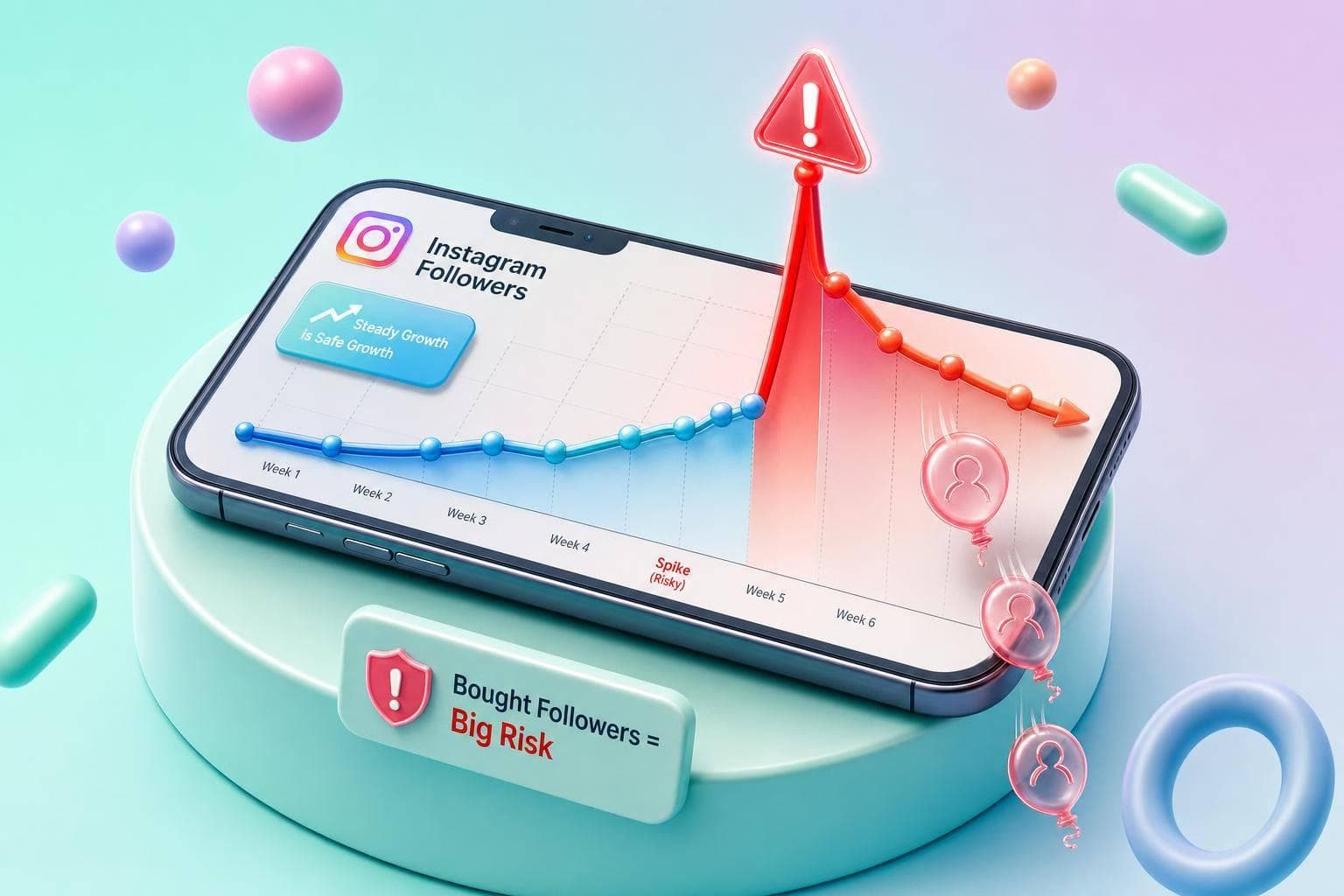
Yes - in most cases, buying Instagram followers in 2026 is more likely to lead to a purge or lower reach than a ban. From what I see in this article, the biggest danger is not the followers by themselves. It’s giving a provider your password, using bot-driven services, or creating a huge follower spike that looks fake.
If I had to sum up the whole piece in a few lines, it would be this:
The article also points to a few numbers that shape the risk:
Here’s the simple version: if you buy followers, the main thing that gets people in trouble is how the service operates. A provider that asks for your login, uses inside-account actions, or drops a large batch overnight creates the kind of pattern Instagram watches for. A service that only needs your public username and sends followers in slowly carries less risk, though you can still lose followers later in a cleanup.
Quick comparison
| Risk type | What it usually means | What tends to cause it |
|---|---|---|
| Ban | Account access issue or account penalty | Password sharing, spam tools, auto-like/comment/DM activity |
| Purge | Followers disappear later | Bot accounts, low-grade networks, platform cleanups |
| Reach loss | Posts get seen by fewer people | Weak engagement after a follower jump |
So if you want the shortest answer possible, I’d put it like this: buying followers alone is usually not what gets an account banned; bad providers, bot patterns, and account access are.
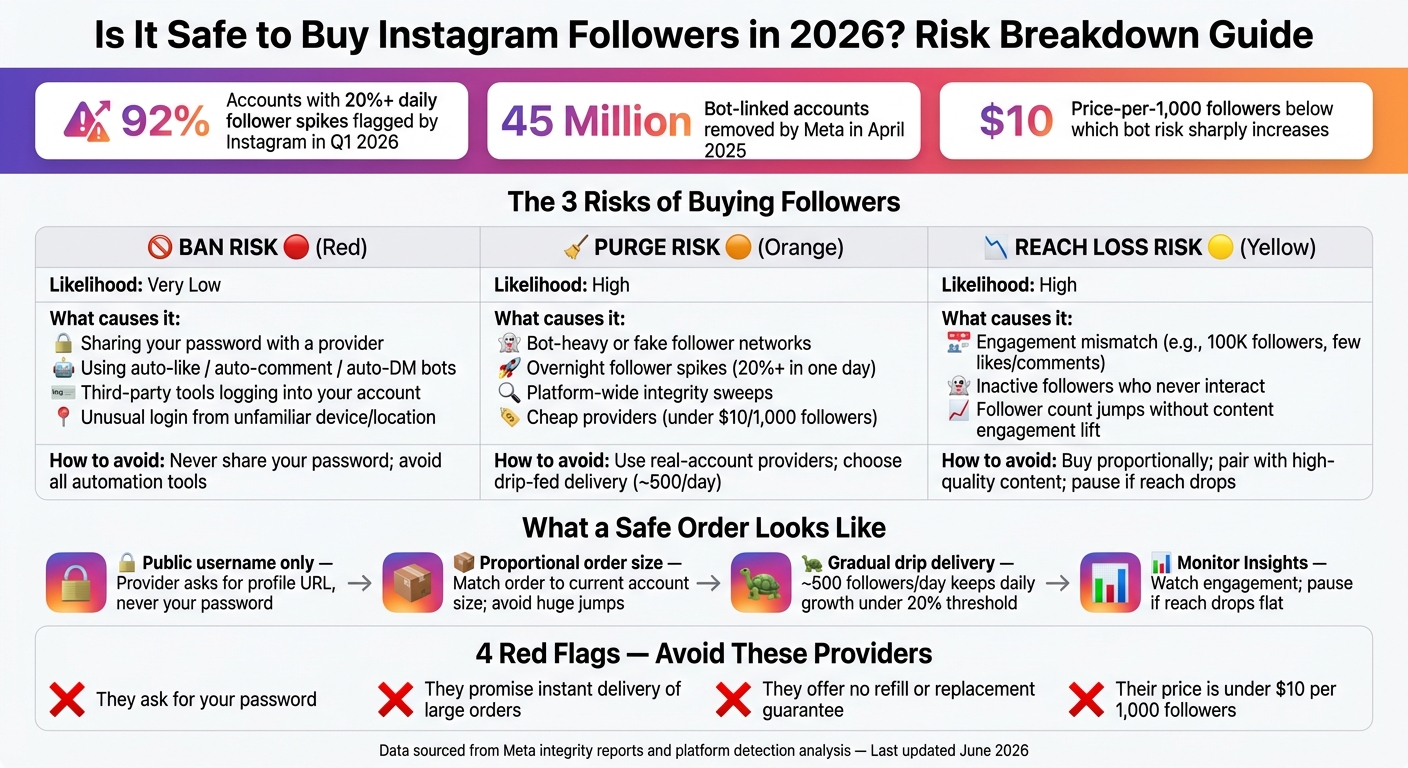
Instagram Follower Purchase Risk Guide: Ban vs Purge vs Reach Loss (2026)
Safety comes down to three things: ban risk, purge risk, and reach risk. To judge the risk, you need to know what Instagram tends to ban and what it often leaves alone.
Ban risk gets most of the attention. But it isn't the outcome people see most often. An outright ban for simply receiving followers is rare, mainly because you can't control who decides to follow your account.
Purge risk shows up more often. Instagram regularly removes inauthentic accounts, so cheap or low-grade followers can vanish and pull your follower count down with them. In April 2025, Instagram's integrity systems removed an estimated 45 million accounts tied to bot-farm networks.
Reach risk is slower and easier to miss at first. If a chunk of your followers never likes, comments, saves, or watches, your engagement rate drops. When that happens, your posts may be shown to fewer people.
Three factors keep showing up in lower-risk orders:
If even one of those three falls apart, the risk can climb fast.
Buying followers gets much riskier when the order looks unnatural. A big overnight spike is exactly the kind of sharp jump Instagram's spam systems are built to flag. If that spike comes with little or no engagement, the mismatch can lead to reach throttling or an Instagram shadowban.
Risk also goes up when a follower order is paired with other automation tied to your account, especially login-based actions. At that point, Instagram may read the pattern as coordinated inauthentic behavior. What started as a passive purchase can begin to look like a larger spam event.
Low-grade bot followers carry the highest purge risk because integrity sweeps target those accounts most aggressively. Many disappear fast.
That risk mostly comes from how the provider operates, not from the follower purchase alone. That's the line between a risky order and the behavior Instagram tends to ban.
Instagram usually doesn't ban people just because follows showed up on an account. It goes after the behavior behind the follows. So the main risk comes from how a service delivers them, not simply from the purchase itself.
Instagram cracks down on tools that like, follow, comment, or send DMs for you. Meta's detection systems watch for patterns like speed, frequency, and repetition. If activity looks mechanical and repetitive, that's a strong bot signal.
Coordinated fake activity is another big target. Meta's integrity team looks for botnet-style patterns, including:
In most cases, a follower purchase alone isn't what gets an account banned. Automation and account access are the bigger danger. That leads to the next issue: whether Instagram can spot bought followers even when no one logs into your account.
Never give your Instagram password to a follower service. If a provider asks for your login, that's the biggest danger in the whole process.
When a third-party tool signs in with your credentials, it can trigger Instagram's unusual login detection. Instagram tracks session tokens, and a login from an unfamiliar device or location can flag your account. That risk is worse than follower removal because it can affect access to the account itself.
It can get uglier fast. The tool may use your account to like, follow, or DM other people as part of a larger engagement network. That's exactly the kind of activity Meta is built to catch.
Real providers do not need your password. And a bad one can lock you out by changing the email attached to the account.
Even without password access, Instagram can still spot suspicious follower patterns.
Yes. Instagram can spot suspicious follower patterns, but in most cases the result is a purge or reach loss, not a ban.
If Instagram can spot these patterns, the next step is understanding what it usually does about them.
Instagram looks for unusual speed, repeated patterns, and weak account signals.
By early 2026, accounts with sudden daily follower spikes of 20% or more were being flagged 92% of the time.
It also looks at the quality of the accounts doing the following. Profiles with no photos, no posts, generic usernames, or mismatched locations are easier to sort as fake-looking or inactive. Another big signal is engagement mismatch. If an account has 100,000 followers but only a small number of likes or comments per post, that’s a clear red flag.
This detection doesn’t happen just once. It keeps running in the background, which is why followers from low-quality providers can vanish weeks after delivery, not only right away.
Here’s what that detection usually leads to in practice.
| Risk | How Likely | What Triggers It | How to Avoid |
|---|---|---|---|
| Ban | Very Low | Password sharing, using automation/bots to like/comment, active spamming | Never share your password; avoid auto-engagement tools |
| Purge | High | Fake-looking bot accounts, overnight spikes, platform-wide integrity sweeps | Use real-account providers; choose gradual drip-fed delivery |
| Reach loss | High | Engagement mismatch; inactive followers who don't interact | Buy in proportional amounts; pair with high-quality content to drive real engagement |
For most buyers, purge risk and reach loss matter more than bans. A replacement guarantee only helps if the provider actually replaces removed followers.
Reach loss is quieter, but it can hurt more. When follower count jumps without a matching lift in likes and comments, Instagram can throttle visibility and keep content out of Explore or hashtag search. If reach drops, stop purchased activity and let the account settle for 7–14 days. After that, follow how to recover after a follower purge.
Quality matters here. Strong providers keep far more delivered followers, while cheap bot panels tend to lose them fast.
If you still plan to buy, the next step is avoiding the provider signals that trigger these risks.
Once you know what Instagram tends to flag, the next step is simple: judge the provider, not the sales pitch.
If you buy followers, the safest orders steer clear of three things: password requests, bot-style delivery, and sharp jumps in follower count.
Use this checklist before you pay anyone.
1. They ask for your password. No legit service needs your password. A public username or profile URL is enough.
2. They promise instant delivery of large orders. A big order that lands all at once creates the kind of spike Instagram can flag. Slower, drip-fed delivery over a few days is much safer.
3. They offer no refill guarantee. Even high-quality followers can drop off during Instagram purges. A solid provider should offer at least a 30-day refill window.
4. Their pricing is under $10 per 1,000 followers. Prices below $10 per 1,000 followers often point to bot-heavy accounts.
If a provider clears those checks, look at how the order gets delivered.
A safer purchase follows a pretty simple pattern.
First, make sure the provider asks only for your public username or profile URL - nothing more. Then keep the order size in line with your current account size. You don’t want a small account jumping to a huge follower count overnight.
Choose gradual delivery. About 500 followers per day is a reasonable pace for most accounts. That helps keep daily growth away from the kind of 20% jump that can trigger detection.
Once the order starts, keep an eye on Instagram Insights. If your follower count goes up but reach and engagement stay flat, slow down or pause. If reach drops after delivery, stop new orders for a bit and let the account settle.
For a recovery plan if things go sideways, see how to recover after a follower purge.
Bought followers work best as a starting boost, not a full strategy on their own.
UpGrow focuses on real-account growth, no password access, and drip-delivered followers backed by AI targeting and human oversight. Buy Instagram followers from real accounts (no password, drip-delivered) and keep the built-in safeguards in place from day one.
Now that you know what Instagram actually targets, the answer is pretty simple: yes, with a few clear caveats. Buying Instagram followers is reasonably safe in 2026 if those followers come from real, active accounts, the delivery is drip-fed, and you never share your password.
The bigger risks are a purge and lower reach, not an outright ban. In plain English, the danger usually comes from provider quality and delivery speed, not from the purchase alone.
The safest path comes down to three things:
If you want lower-risk growth, stick with real accounts, slow delivery, and zero password access.
UpGrow's AI-powered growth targets real users based on your niche. Buy Instagram followers from real accounts (no password, drip-delivered), or start with a free trial. If you want more context on the bigger debate, read the honest truth about buying followers.
Last updated: June 2026
Usually, no. Instagram generally goes after fake accounts and automated activity, not people simply getting followers.
The bigger risk usually comes from low-quality providers. That can mean sharing your password, getting a massive spike all at once, or receiving bot followers that may later be removed. To stay safer, never share your password, choose gradual delivery, and look for real, active accounts with a refill guarantee.
Yes. Instagram can spot bought followers. But in most cases, it reacts more to the way those followers show up than to the simple fact that your follower count went up.
The biggest red flags are:
What happens next is usually a follower purge, not a ban. That’s why you should never share your password or use third-party apps.
No. Buying Instagram followers is not illegal.
But it can break Instagram’s Terms of Service. In most cases, enforcement goes after fake accounts and the services selling them, not users who just receive followers. The bigger risks are follower purges, lower reach after bot-driven spikes, third-party automation, or handing over your password.
Choose gradual delivery, not big instant spikes. A safer example is 500 followers a day for 10 days. That keeps growth closer to patterns that are less likely to trip Instagram’s spam classifiers.
The goal is to mimic natural growth. Avoid instant delivery. If you add thousands of followers in under two hours, that kind of spike can look abnormal and may lead to reach throttling.
Share this post&description=Buying%20Instagram%20followers%20in%202026%20rarely%20causes%20bans%20but%20often%20risks%20purges%20and%20reach%20loss%E2%80%94avoid%20password%20sharing%20and%20sudden%20spikes.&image=https://www.upgrow.com/blog-images/assets.seobotai.com/cdn-cgi/image/quality=75,w=1536,h=1024/upgrow.com/6a3dd9692902db05ecd810d2-1782439975262.jpg)


