
AI UGC Affiliate Marketing: 2026 Data Summary
2026 data on AI UGC for affiliates: trust gaps, Instagram disclosure and distribution rules, and testing for net affiliate revenue.
2026 data on AI UGC for affiliates: trust gaps, Instagram disclosure and distribution rules, and testing for net affiliate revenue.
4.98 /5 - from 58k reviews
Trusted by 50,000+ creators — get real engagement delivered to your profile in minutes, not days.
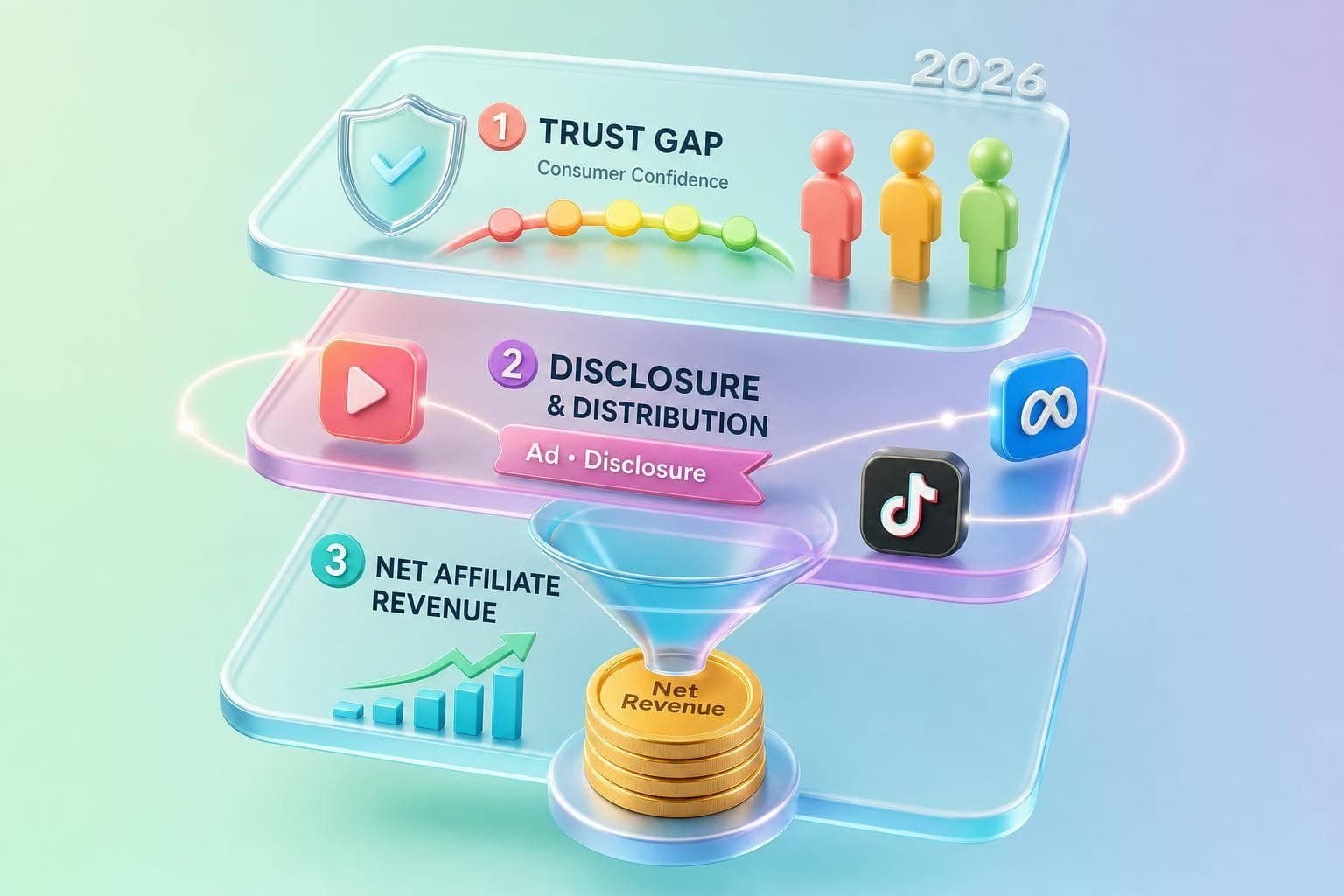
Here’s the short answer: in 2026, AI-made affiliate content can scale output, but trust drops fast when videos look fake, disclosures are weak, or sales quality falls after the click.
If I were scanning this topic fast, I’d focus on four things:
A few numbers set the tone:
So the big point is simple: don’t judge AI affiliate content by views or clicks alone. I’d look at earnings per click, refunds, repeat purchases, comment quality, and total profit after costs.
If you’re posting on Instagram, this is what I’d keep in mind:
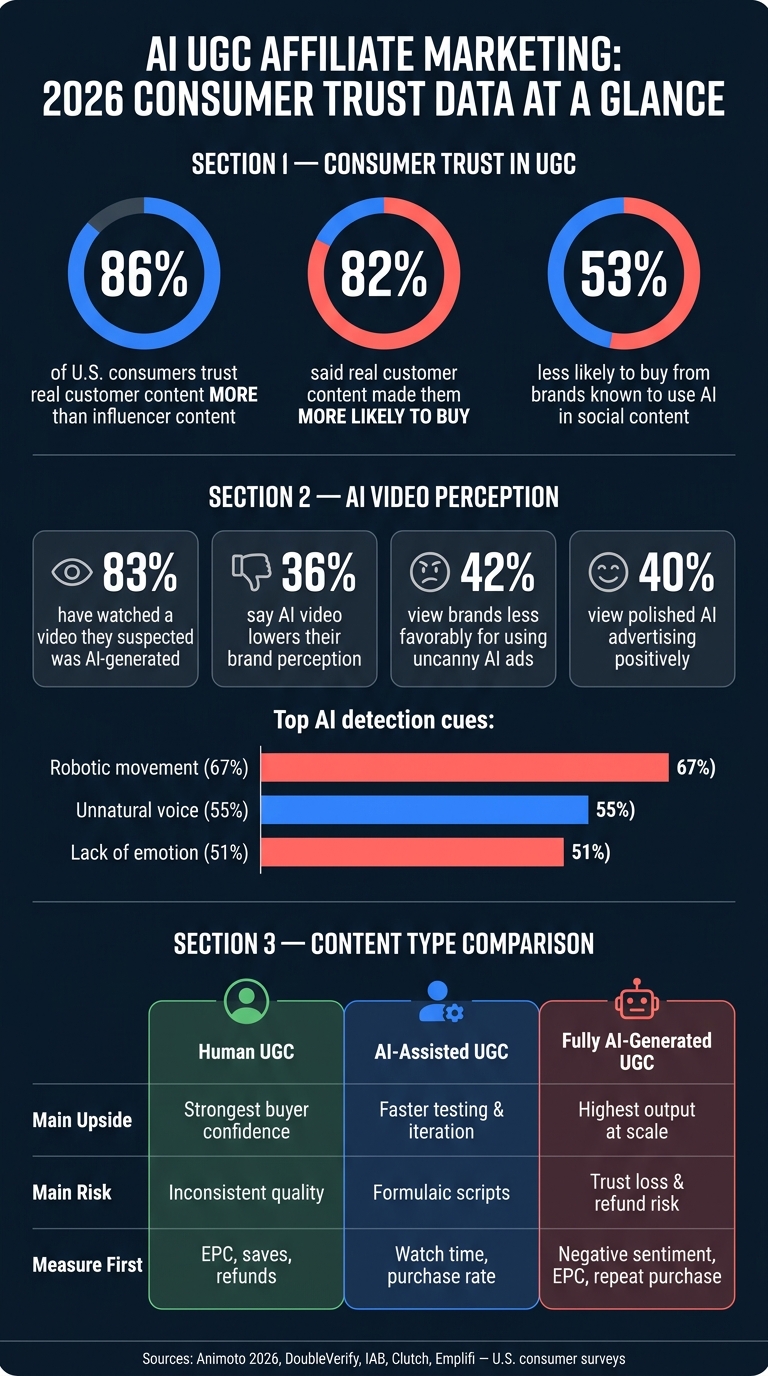
AI vs Human UGC: 2026 Consumer Trust & Affiliate Performance Stats
| Content type | Main upside | Main risk | What I’d measure first |
|---|---|---|---|
| Human UGC | Stronger buyer confidence | Mixed quality or weak creator-product fit | Saves, shares, EPC, refunds |
| AI-assisted UGC | Lower production time and easier testing | Formulaic scripts or vague AI use | Watch time, qualified clicks, purchase rate |
| Fully AI-generated UGC | Highest output at scale | Synthetic look, trust loss, refund risk | Negative sentiment, EPC, repeat purchase |
My takeaway: test each format under the same conditions and pick the one that brings the most net affiliate revenue, not the most attention.
UGC still shapes buying decisions. In 2026, 86% of surveyed U.S. consumers trusted real-customer content more than influencer content, and 82% said it made them more likely to buy.
The 2026 data points to a simple pattern: people react more against bad AI execution than AI by itself. Animoto's 2026 U.S. survey found that 83% of consumers said they had watched a video they suspected was AI-generated. The main tells were robotic movement (67%), unnatural vocal delivery (55%), and lack of emotional tone (51%). Even so, more than one-third trusted AI-generated content as much as human-made video, while 36% said AI-generated video would lower their perception of a brand.
Poor execution creates its own problem, apart from disclosure. A DoubleVerify global study found that 42% of consumers would view a brand less favorably if it used uncanny or obviously synthetic AI ads, while 40% viewed polished AI advertising positively. Gartner also reported that 49% of U.S. consumers believed generative AI had made available content worse. Put plainly, there are two separate issues here. Disclosure is about transparency. Weak pacing, synthetic voices, visual artifacts, and repetitive templates can hurt results even when disclosure isn't the main issue.
When studies seem to clash, the gap often comes down to four factors: audience age, product category, disclosure wording, and video quality. The IAB reported that 73% of Gen Z and Millennial consumers said knowing an ad used AI would either increase or not change their likelihood of purchasing. At the same time, 54% of consumers trust a brand less when its ads look AI-made. Those findings can both be true. One looks at how people say they respond to disclosure. The other looks at what happens when the ad visually signals "AI." In practice, trust tends to slip first in conversion quality, not reach.
| Content Type | Performance Implication | Main Trust Risk | Measurement Priority |
|---|---|---|---|
| Human-created UGC | Strongest perceived authenticity; best for trust | Inconsistent quality, creator-audience mismatch, or undisclosed incentives | Saves, shares, sentiment, earnings per click, refunds |
| AI-assisted UGC | Fastest path to testing, localization, and iteration without fully synthetic delivery | Content may become formulaic or obscure how much was created by AI | Cost per qualified click, watch quality, purchase rate, disclosure response |
| Fully AI-generated video | Highest scale, highest disclosure risk, weakest emotional credibility | Synthetic appearance, false testimonial risk, and reduced trust | Negative sentiment, brand-search lift, earnings per click, refunds, and repeat purchase |
Those trust gaps don't hit all at once. They show up in different ways at each stage of the funnel.
Clicks by themselves don't tell you much about affiliate quality. The Instagram metrics below do.
| Funnel Stage | Metrics to Report | Context Required |
|---|---|---|
| Reach | Impressions, unique reach, frequency, CPM, follower growth | Organic versus paid distribution, placement, audience size, and campaign dates |
| Attention | Three-second views, average watch time, completion rate, hold rate, rewatches | Video length, hook style, sound-on versus sound-off environment, and traffic source |
| Trust | Comment sentiment, positive-to-negative comment ratio, saves, shares, profile visits | Disclosure wording, content type, product category, audience age, and moderation method |
| Action | Link clicks, outbound click-through rate, landing-page views, purchase rate, earnings per click, affiliate revenue | Attribution window, commission structure, landing page, device, and new versus returning visitors |
| Retention and Quality | Refund rate, cancellation rate, repeat purchase, customer questions, unfollows, post-purchase sentiment | Return window, product risk, fulfillment quality, cohort period, and whether the sale was last-click or assisted |
Pay close attention to earnings per click. It's a better signal than click-through rate alone because it reflects traffic quality, not just traffic volume. Comments matter too. If people question whether the content is real, or whether the creator actually used the product, that can explain why a video gets solid reach but weak sales. That's why outcome quality matters more than reach by itself.
The data backs up five clear points: consumers run into AI video often; many think they can spot it; poor execution hurts brand perception; transparency is more expected; and real customer content remains a strong trust signal. What it does not prove is that all AI video cuts sales, that all human UGC converts better, or that disclosure by itself lifts conversion rates.
Geography matters too. Emplifi's 2026 report found that 35% of U.S. consumers were inclined to find AI-generated content authentic, compared with 28% in the U.K.. So a global number shouldn't be dropped onto U.S. Instagram affiliate campaigns without that context. Report the range and the setting, not a blended average built from percentages that don't match. Vendor case studies are directional until methodology, sample size, geography, and metric definitions are checked.
On Instagram, those performance gaps matter even more because disclosure and media-label rules affect distribution.
Instagram’s rules on affiliate promotion, AI content, and recommendation eligibility can shape how your Reels perform. And not just whether they stay live. The main thing to understand is this: Instagram treats commercial disclosure, AI labeling, and recommendation eligibility as three separate systems.
Product tagging and paid partnership disclosure are not the same thing.
Tagging a product in a Reel shows which item you’re promoting. In some cases, it also gives viewers a way to see product details or buy. The Paid partnership label does something different. It tells people that you have a business relationship with the brand. So a compliant affiliate Reel may need both: a tagged product and a separate disclosure. It’s smart to check the current Help Center and Commerce Manager rules, since product-tag access and checkout can change by market and account.
On the AI side, Meta started applying AI Info labels to some image, video, and audio content when it detects AI signals or when users mark the content as AI-generated. That label is about transparency. It is not an automatic takedown, and it does not replace affiliate disclosure.
Meta's documentation confirms that Community Standards apply to "all types of content, including AI-generated content."
Meta’s documented distribution policy says that limited originality content - content that is mostly repurposed from other sources - may be pushed less in distribution. That’s the documented risk with recycled AI Reels. The issue is not AI use on its own.
For example, a Reel built from another creator’s footage, plus an AI voice swap, a new caption, and a logo overlay can still carry distribution risk under that rule. The same goes for posting near-identical AI scripts or synthetic-presenter clips again and again. At that point, the account can start to look repetitive or low quality.
| Outcome | What it means | What to check |
|---|---|---|
| Content removal | The content violates a Community Standard, advertising rule, intellectual-property rule, or another enforceable policy. | Community Standards, ad policies, copyright |
| Not recommended | The post may stay visible to existing followers but not be broadly recommended in surfaces such as Reels or Explore. | Account Status, recommendation notices |
| Less distribution | The platform gives the content less reach because it is considered low quality, repetitive, repurposed, or otherwise unsuitable for broad recommendation. | Originality, repetition, production quality |
If reach drops on an AI-assisted Reel, check Account Status and any recommendation-eligibility notices before blaming the AI label. Look at the stated reason, fix that specific issue, and use Instagram’s review process instead of uploading the same asset again. That difference matters. A Reel can have the right disclosure and still get less reach if Instagram sees originality problems.
That’s why format testing matters so much here. Guessing usually leads people in the wrong direction.
Keep format testing simple. Once you've checked trust and platform risk, the next job is to see which format brings in the most net affiliate earnings under controlled conditions. With disclosure and distribution risk already mapped out, you can move into a clean creative test.
When you test these three video types, change only one thing: the production method.
Everything else should stay the same:
A good example is three 30-second Reels showing the same product demo and the same call to action, posted in the same time slot on similar days.
Give each version its own affiliate link or discount code so you can track results on its own. Let the test run for at least 7 to 14 days before making a call. Don't stop early just because one version had a big first day. That can throw off the read.
Track production time and cost along with performance. If you're working with a tight budget, output alone doesn't tell the full story. Time and spend matter too.
Report first-click, last-click, and assisted conversions separately. Once attribution is split out, compare profit, not just traffic.
Use net affiliate earnings as the main scorecard after refunds, cancellations, and creative costs. A video with fewer views can still win if it brings in cleaner sales.
Watch these signals closely:
Follower quality matters more than it seems. If new followers never engage with later posts, or they sit outside your target demographic, they won't help long-term affiliate results. Break out your data by age, gender, location, and language, especially if you're aiming at a specific group like U.S. women ages 25–44. A format can look good on the surface and still miss with the people most likely to buy.
Set your decision rule before the test starts. For example, name a winner only if one version leads on net commission and does not show a clear jump in refunds or follower drop-off.
Audience quality affects every result, so clean up your follower base before you compare formats. Use UpGrow only for that cleanup step. Don't treat growth data as proof that one video format converts better.
UpGrow offers AI-assisted targeting with filters for age, gender, location, and language, plus a live analytics dashboard that lets you watch audience composition in real time. Keep its role separate from your affiliate video findings. Audience growth and creative performance are two different variables, and mixing them will muddy your results.
After you test which formats perform best, perhaps by using an Instagram post optimizer, the next step is figuring out which 2026 signals are most likely to shape affiliate results. AI UGC can help you produce more content in less time. But affiliate revenue still comes down to trust, disclosure, and what you keep after refunds and costs. In plain English: judge every format by net revenue, not by views, saves, or follower count.
A 2026 Clutch survey found that 53% of consumers were less likely to buy from brands they knew used AI in social media content, and 64% said they would trust a brand or creator less if products were misrepresented with AI-generated content. At the same time, IAB research found that 73% of Gen Z and Millennial consumers said knowing an ad was created with AI would either increase or make no difference to their purchase likelihood. That split points to audience and category differences. That's why controlled testing beats guesswork.
These trust signals matter even more because Instagram's rules and automation can change how the same video gets distributed. If you're running affiliate campaigns through the rest of 2026, keep your eye on a few things:
The rest of 2026 comes down to four things:
Watch early engagement signals closely. If retention drops in the first few seconds, thumb-stop rate falls below 25%, or CTR slips under 0.8%, viewers may see the content as too polished or a little fake.
Don’t look at likes alone. Pay attention to saves, shares, comment depth, and watch-time completion too. Those signals usually tell you more about whether people trust what they’re seeing.
If those numbers start to slide, trust may be fading. Clear on-screen AI disclosures can help close that gap.
Run a controlled test for 48–72 hours with a small budget. Change only one variable at a time - like the hook, product angle, or call to action - so you can see what’s driving performance without muddying the results.
Also, add clear on-screen disclosures such as Ad or Created with AI near the start of the video. And before you scale any high-visibility placements, have a person review them first. That extra check can save you from small mistakes turning into expensive ones.
Focus on metrics that signal high-intent engagement and long-term audience quality: thumb-stop rate (above 25%), watch-time completion (above 70%), saves, shares, profile visits, and follow rate.
For business impact, track conversion rate, return on ad spend, and customer acquisition cost. Those numbers show whether your content is driving steady results, not just a short spike in traffic.


