
What Makes AI UGC Ads Illegal or Misleading?
Fake testimonials, hidden sponsorships, copied likenesses and unproven claims make AI UGC ads illegal.
Fake testimonials, hidden sponsorships, copied likenesses and unproven claims make AI UGC ads illegal.
4.98 /5 - from 58k reviews
Trusted by 50,000+ creators — get real engagement delivered to your profile in minutes, not days.
An AI UGC ad usually becomes illegal when it fakes a customer story, hides that it is sponsored, uses a real person’s face or voice without permission, or makes claims it can’t support.
If I had to boil it down, I’d watch for 4 things right away:
That’s the core issue. AI itself isn’t the problem. The problem is when the ad changes what people think they’re seeing.
A few simple rules cover most of the risk:
The short version: if people could be misled about who is speaking, what is real, what was paid for, or what the product can do, the ad is in risky territory.
I’d treat AI UGC ads like any other ad: tell people it’s an ad, get permission, don’t fake experience, and don’t promise results you can’t back up.
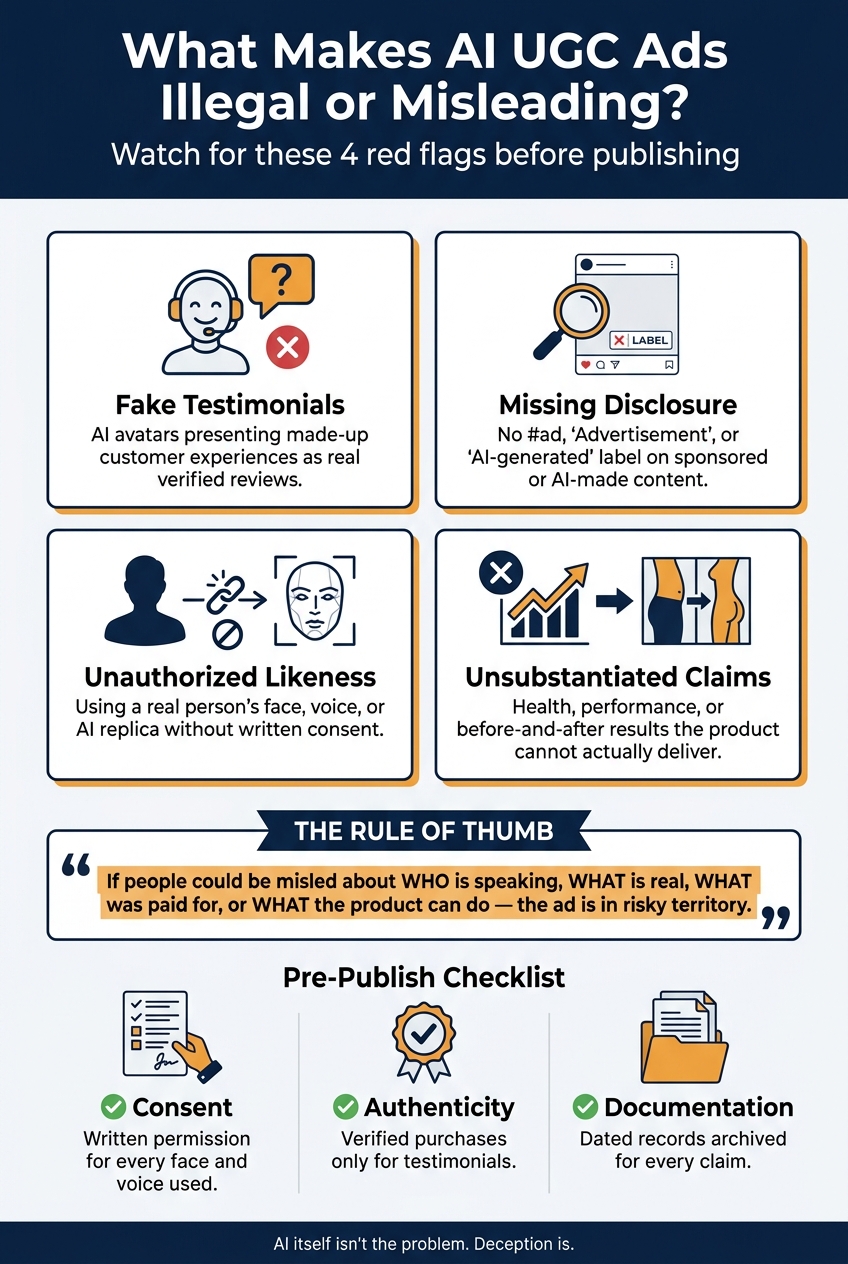
When AI UGC Ads Become Illegal: 4 Key Red Flags
An AI testimonial turns into a fake endorsement the second it shows a made-up experience as if it happened. If an AI avatar says, "I lost 20 pounds using this supplement", and no actual person got that result, that isn't a harmless stunt. It's a false claim.
The key issue is simple: real, verified experience. Only reviews from consumers whose purchases have been verified may be used in ads. AI-made testimonials break the law when they present fake customer experience as a real endorsement.
The line comes down to this: can a viewer read the content as actual customer feedback?
| Content Type | Legal Risk | Disclosure Needs |
|---|---|---|
| Real Customer UGC | Low - unless used without permission or beyond the scope the creator agreed to | Consent for image use |
| Scripted or AI-Made Testimonials | High - presenting a paid actor or AI avatar as an independent customer, or AI-written reviews as verified-purchase reviews, is prohibited | Clear, prominent "AI-generated" or #ad disclosure; AI content must be hard to tell from a real person only with disclosure |
Even if a claim is true, it can still mislead people when they can't tell who paid for it or whether AI helped shape it. Disclosure covers any paid, free, or discounted promotion between the brand and the person - or character - pushing the product. The same rule applies when AI or software changes how viewers understand the endorsement.
The disclosure also needs to be easy to spot. Use "Advertisement" or "Promotion" before hashtags, and make sure people can see it without scrolling. If the campaign runs across multiple posts, each post needs its own disclosure.
In the U.S., you can't use someone's image or likeness in ads or other commercial material without clear consent. That covers more than just a photo. It also includes a cloned voice or an AI-made image that closely resembles a person people can identify.
A disclosure can help explain what's on screen, but it doesn't give you permission to use a real person's face, voice, or likeness. That's the key point.
Deepfake-style ads carry even more risk. Using an AI-made digital replica of a real person to suggest they used or endorsed a product when they didn't is prohibited. And if an AI-made character is indistinguishable from a real person, it must be clearly labeled as AI-generated.
One more thing: approval for one ad use doesn't automatically cover every later version. An edit, repost, or paid placement may need its own permission.
A repost approval may sound simple, but AI editing changes the picture. Even if a creator says yes to a repost, that doesn't always mean yes to AI edits too.
When a brand edits reposted content with AI tools, the risk goes up fast, especially if the changes shift facial expressions or the original meaning. That kind of edit needs separate permission beyond basic repost consent, or it may violate the creator's right to control edits.
The safe move is pretty plain:
That's a lot less painful than trying to sort it out after a campaign is already live.
Once identity and disclosure are clear, the next step is simple: the claim still has to be true. An ad may look like UGC, but that doesn't change the rules. AI UGC ads have to meet the same truth-in-advertising standards as any other ad.
The biggest danger zones are health claims, performance promises, and before-and-after visuals. If AI shows results the product can't deliver, that visual needs substantiation. And if before-and-after content is made with AI, it should be clearly and prominently labeled "Simulated".
Visual details can also send the wrong message. AI-made backgrounds and ingredient cues may look harmless, but they can still mislead viewers. For example, showing a product next to AI-generated aloe leaves when the formula contains no aloe misrepresents what's in the product. Same idea, different format: don't use AI to show results the product can't substantiate.
That same rule applies to claims about the AI itself. AI-washing means saying the brand uses AI features or data practices that it doesn't actually use.
A couple of common examples:
| Claim Category | Deceptive Practice | Required Evidence or Disclosure |
|---|---|---|
| Product Performance | Using AI to simulate results, such as hair growth or weight loss, that the product cannot actually achieve | Reliable scientific substantiation; "Simulated" label on AI visuals |
| AI Capability | Claiming advanced automation for a manual or basic software process | Clear description of the actual tech functionality |
| Ingredient Accuracy | AI backgrounds showing ingredients not present in the formula | Visuals must match the actual product composition |
Use AI for style, not proof.
When an AI UGC ad crosses the line, responsibility doesn’t sit with just one party. Brands, agencies, and creators can all share liability if the ad breaks the rules. And one thing is clear: a brand can’t hand off accountability to its agency.
That’s why someone on the team needs to own the pre-publish review. Before anything goes live, check the basics: Are disclosures easy to see without scrolling? Are all claims backed up? Is there a dated record of written permission for every face and voice used in the ad?
The best way to cut risk is to bake these checks into the approval process. Use a pre-publish checklist every time: visible disclosure, written consent for likeness or voice, verified purchases only, and records for every claim. Review the checklist below before each post goes live.
| Guardrail | Practical Action | Risk Mitigated |
|---|---|---|
| Consent | Direct DM or comment request with specific usage terms | Copyright and image rights violations |
| Authenticity | Verified purchases only | Fake testimonial claims and consumer mistrust |
| Documentation | Archive a dated record of written permission | Future legal disputes |
The same red flags keep showing up: fake endorsements, hidden sponsorships, copied identity, and claims with no proof. Safer AI UGC ads are truthful, clearly disclosed, based on consent, and backed by proof.
No. Disclosure is mostly needed when AI changes how real people, places, or events appear, or when it could mislead consumers.
Small touch-ups like noise removal or color correction usually don't need a label. But realistic synthetic media, fake testimonials, or digital replicas should be clearly disclosed to keep trust intact and meet FTC standards and changing laws.
Yes - but not as a fake customer or testimonial.
FTC guidelines say testimonials must reflect real, honest experiences from actual people.
If you use a synthetic person in an ad, make it clear that the person is AI-generated. Think of AI avatars as a visual device, not as proof of customer results.
If an AI-generated UGC ad breaks the rules, the brand behind it is usually on the hook. In the U.S., the FTC looks at whether the ad is deceptive. It does not treat the AI itself as the party at fault.
So if a brand publishes or sponsors an ad with fake testimonials, invented product experiences, or hidden AI use, that brand can be held responsible. The fallout can include fines of up to $51,744 per violation, account suspensions, and damage to the brand’s reputation.


