
AI Caption Generators for Instagram: Free Guide
Use free AI tools to draft Instagram captions: prompt templates, length rules, editing checklist, and a repeatable workflow.
Use free AI tools to draft Instagram captions: prompt templates, length rules, editing checklist, and a repeatable workflow.
4.98 /5 - from 58k reviews
Trusted by 50,000+ creators — get real engagement delivered to your profile in minutes, not days.
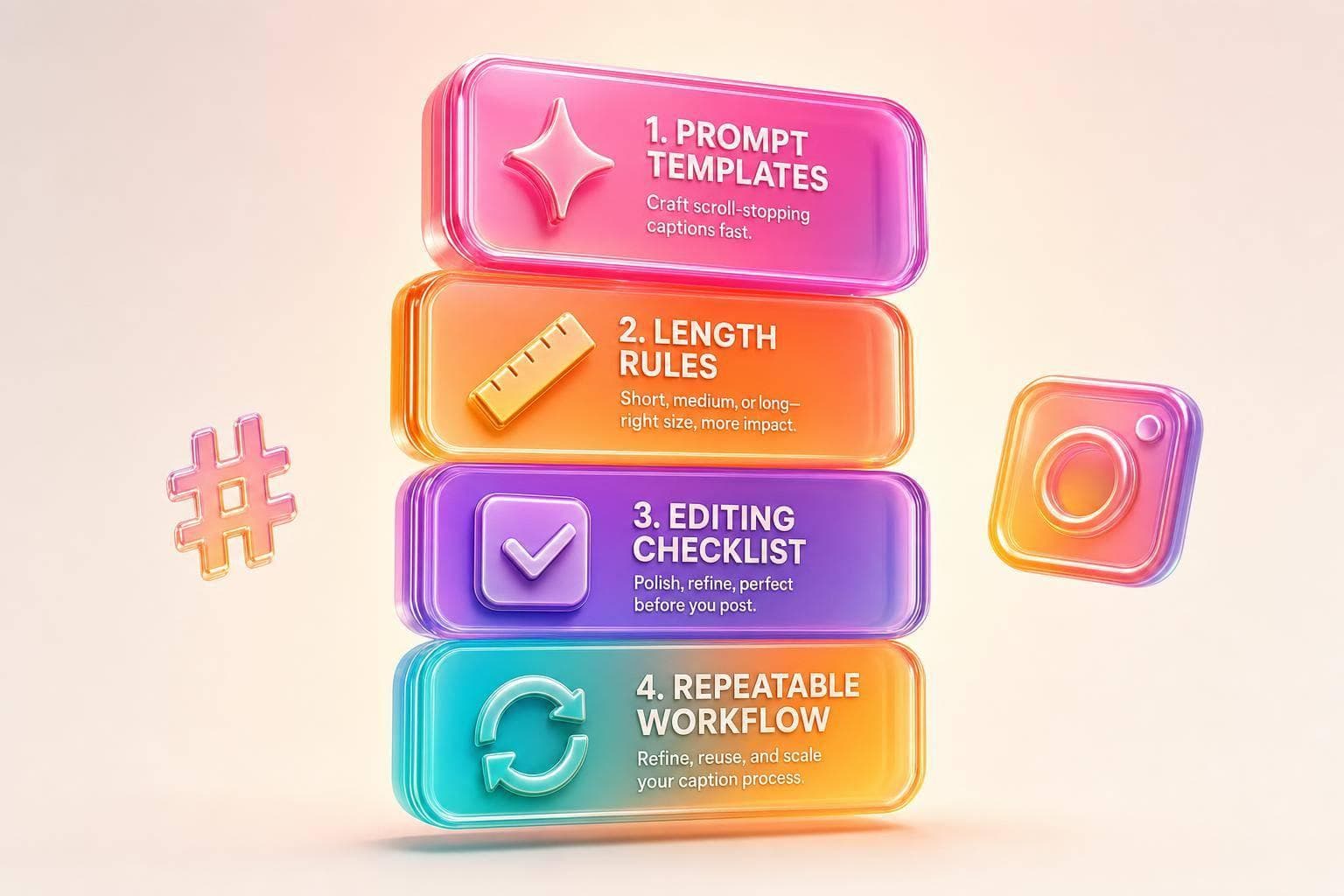
You can get better Instagram captions from free AI tools fast - but only if you give them clear inputs and review the draft before posting.
If I had to sum up the full guide in a few lines, it would be this:
The article’s core point is simple: free AI caption generators save time on the first draft, but they do not replace judgment. A loose prompt often leads to weak, generic copy. A tighter prompt - one that includes the post type, audience, goal, proof point, tone, CTA, and words to avoid - usually gives you drafts that need less editing.
A few data points stand out:
That leads to a clear working rule:
What I like about the guide is that it stays practical. It does not treat AI as a magic fix. Instead, it shows a simple workflow: start with a short brief, use a reusable prompt, generate three versions, edit the strongest one, then check results after publishing. That is where the time savings come from.
Here’s the article in one plain-English snapshot:
| Focus Area | Main Point |
|---|---|
| What free tools do | Turn a short brief into caption drafts |
| What improves output | Clear prompts with facts, audience, goal, and tone |
| What makes a caption work | Hook, context, value, CTA, and keyword-rich ending |
| Best use by format | Reels short, carousels medium, photos longer if needed |
| What AI does well | Hooks, variants, and draft structure |
| What people must do | Check facts, disclosures, tone, links, and final fit |
| Best workflow | Prompt, draft 3 versions, edit, review, post, learn from results |
So if you want the shortest possible takeaway, it’s this: use AI to beat the blank page, then use human review to make the caption fit the post, the brand, and the facts.
That’s the full article boiled down into the points that matter most.
Free AI caption generators take a short brief and turn it into several caption drafts you can review. That input is what turns a blank prompt into draft options you can actually use.
In most cases, you’ll enter a few core details: what’s in the photo, Reel, or carousel; who the post is for; the tone you want; the goal of the post; and any words or phrases you want included - or left out.
A tool might ask for things like:
Format matters too. A Reel caption usually needs a strong hook right away because the video carries most of the context. A carousel caption often works better with a structure that nudges people to save the post. When you tell the tool what format you’re using, it can shape the draft around how that type of Instagram post tends to work.
If you type something like "write an Instagram caption about sourdough," the tool doesn’t have much to go on. You’ll often get a generic caption that needs a full rewrite before you can use it.
A tighter brief works much better. When you spell out the format, audience, tone, and any phrases to avoid, the drafts usually come back more specific and much closer to publish-ready.
"AI solves the drafting bottleneck, not the judgment bottleneck. Human review still matters." - Arnab Dey, LunaBloom AI
Put simply, vague prompts lead to generic captions. Structured prompts lead to drafts that need less editing. And that makes the next round of caption edits a lot faster.
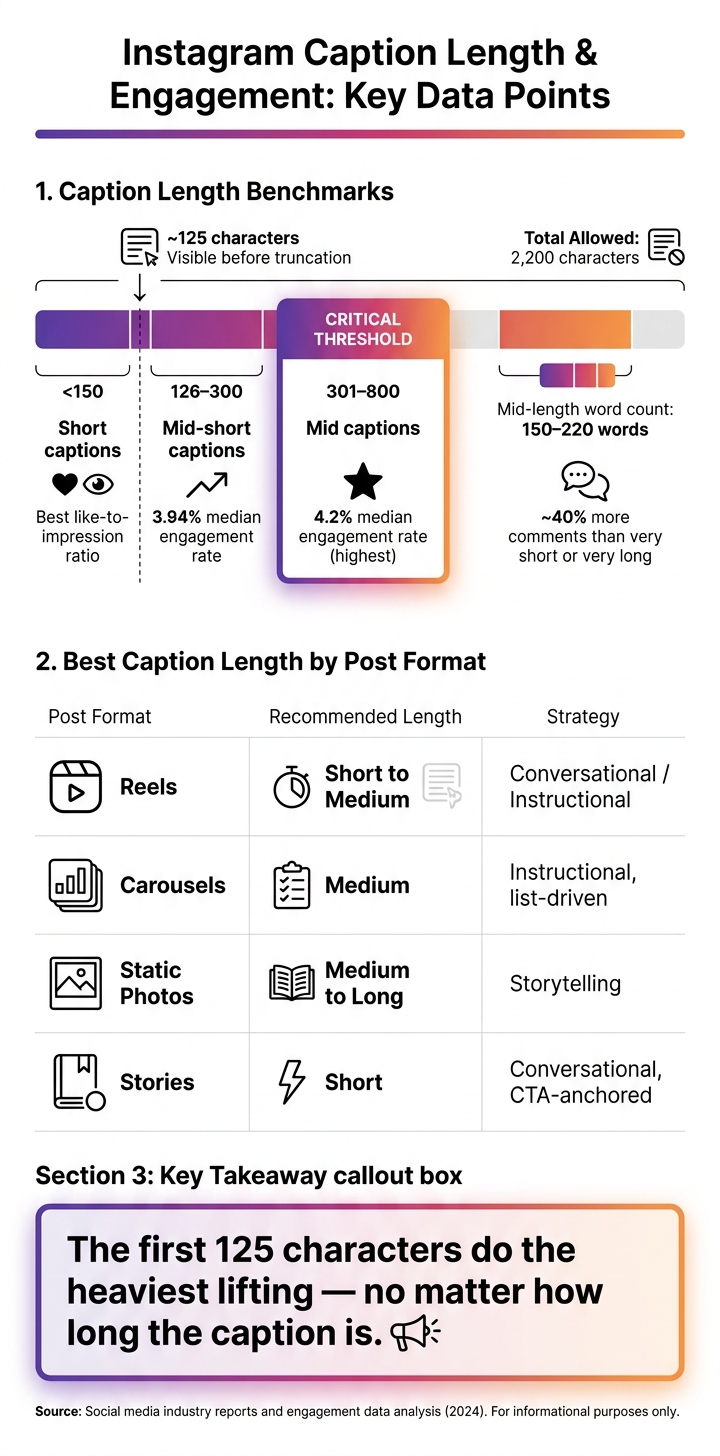
Instagram Caption Length vs. Engagement Rate: What the Data Shows
Better prompts lead to better drafts. If the tool has the right facts, knows who the post is for, and understands the angle, the output gets much easier to work with.
Copy this template and fill in the brackets for each post:
"Write three Instagram caption variants for a [post type: Reel / carousel / static photo] about [topic]. The audience is [audience + their main pain point]. The objective is [objective]. Use this proof point: [verified proof point]. The primary keyword is [keyword]. Sound [tone adjectives]. Start with a hook under 12 words, add one sentence of context, include a value section with steps or lessons, add one clear CTA to [CTA destination], and end with a keyword-rich closer. Avoid [phrases to avoid]. Return each variant with its character count for each variant."
The two fields that matter most are the verified proof point and the phrases to avoid. Those details often decide whether the caption sounds specific or generic.
Also, ask for at least three variants. That gives you a few angles to compare instead of getting stuck with the first draft.
Once you have a draft with a decent structure, fix the weakest line first. Be direct about what’s off. Call out vague wording, add the facts it missed, ask for a stronger opening, or request a clearer format, like steps instead of one dense paragraph.
If the tool keeps missing the mark, build the caption in parts. Start with the hook. Then ask for one context sentence. Next, ask for the value section with three short steps. Finish with a clear CTA.
That slot-by-slot method gives you more control. You don’t have to accept or reject the whole caption in one shot.
After structure, length is the next thing to set. And the right length depends on the post type, not just the topic.
Instagram allows up to 2,200 characters per caption, but only the first ~125 characters show before the "more" truncation. That means the opening line does most of the heavy lifting no matter how long the caption is.
The data backs that up:
| Post Type | Best Length | Tone | Why It Works |
|---|---|---|---|
| Reel | Short to medium | Conversational or instructional | Video carries context; caption needs quick framing |
| Carousel | Medium | Instructional | List-driven structure earns saves |
| Static Photo | Medium to long | Storytelling or conversational | Post needs caption to carry the full context |
| Story | Short | Conversational | Question-led or CTA-anchored |
In plain English: use short captions for Reels, medium captions for carousels, and longer captions when the post needs more context. Once length is locked in, the draft is ready for human review and polish to get more followers on Instagram organically.
Treat every AI output as a first draft, not a finished caption. The tool gives you speed and structure. Your job is to make the draft accurate, specific, and on-brand before it goes live.
Even with a strong prompt and the right caption length, you still need a human review before posting. That’s the step where a usable draft turns into something ready to publish.
AI drafts can sound polished, but they often drift into generic language. That’s where a human reviewer steps in and catches what the tool can’t check on its own.
Factual accuracy comes first. Check every product name, date, price, and link by hand. If a caption mentions a date, compare it with the original source.
Regulated claims and disclosures also need human review. If the post includes a partnership disclosure or any regulated claim, the wording needs to be clear and correct. AI won’t reliably add disclosure language or legal phrasing on its own.
Tone and brand fit matter too. A phrase that seems neutral in one setting can feel awkward in another. Human review is what catches slang, tone problems, and brand mismatches.
AI drafts fast; humans verify accuracy, compliance, and tone.
Use this split to decide what AI can draft and what has to stay with the reviewer.
| Task | AI Handles It | Human Required |
|---|---|---|
| Generating hooks, caption variants, and keyword-rich closers | ✓ Fast and consistent | - |
| Fact-checking details, managing disclosures, adjusting tone, and final approval | - | ✓ Required |
AI handles drafting; humans handle judgment and accuracy.
Run the last pass in this order:
Use this checklist every time so caption review becomes a repeatable step instead of a last-minute fix. Once the process becomes routine, it supports a faster posting workflow.
Once the draft is reviewed, the next move is to build a workflow you can use again and again. Caption generation should sit inside your posting process, not off on its own.
Start with a short brief: audience, subject, proof point, keyword, and post type. Drop that into a reusable prompt, generate three versions, then edit the strongest one.
After the post goes live, look at which prompts lead to more reach or saves. If a pattern starts falling flat, update the prompt template. That way, your prompts get better over time because they come from performance data, not gut instinct.
Standardize what works by using proven Instagram caption ideas so every new post starts from a stronger place.
A reusable prompt template means you don't have to start from zero for every post. Set your brand persona, banned phrases, and standard CTA destination once. Then plug in the post-specific details each time. It saves time and keeps human judgment where it matters most: the final pick.
"Strategic rule: Generate more options, publish fewer, and keep the human decision at the center." - Arnab Dey
You end up with faster drafting, tighter brand consistency, and a process your team can repeat without much friction.
Free AI caption generators are useful for brainstorming angles, getting past writer's block, and turning out multiple drafts in seconds.
"AI captions work best as a distribution system, not a writing shortcut." - Arnab Dey, LunaBloom AI
Use AI for speed, and keep humans in control of the final caption.
Include six core details: the post description, target audience, tone of voice, goal, preferred caption length, and any rules or limits.
If you're writing for people in the United States, say U.S. English and American spelling.
You can also add a few extra directions, such as:
That gives the writer a much clearer target and usually leads to better captions on the first try.
It depends on your content and what you want the post to do. Instagram cuts off captions after about 125 characters, so your opening needs to be short enough to make people tap for more.
For fast-scrolling posts like Reels or memes, keep captions around 125 to 150 characters. Short works better there because people move fast.
For educational carousels, longer captions can do more of the heavy lifting. Think around 400 characters, or even 1,200 to 2,000 characters, when you need extra context, storytelling, or deeper explanation.
The best way to figure out what lands? A/B testing. Try different caption lengths and see what gets more taps, saves, shares, or comments.
Always do a human review. Read the caption aloud to make sure it sounds natural and easy to follow, and check for grammar issues.
Also, confirm the first 125 characters have a strong hook, the tone matches your brand voice, the call to action is clear, any claims are accurate, and the caption fits the audience while working well for screen readers.


