
Boost Engagement with Follower Sentiment Insights
AI-driven sentiment analysis turns Instagram comments and mentions into emotional insights that improve engagement.
AI-driven sentiment analysis turns Instagram comments and mentions into emotional insights that improve engagement.
4.98 /5 - from 58k reviews
Trusted by 50,000+ creators — get real engagement delivered to your profile in minutes, not days.

Engagement on Instagram is becoming harder, with average rates dropping to just 2.2% in 2026. Traditional metrics like likes and views don’t explain why this is happening. Sentiment analysis offers a solution by analyzing the emotional tone of audience interactions - positive, negative, or neutral - using AI and natural language processing.
Here’s what you need to know:
Sentiment analysis isn’t just about understanding your audience - it’s about creating content that resonates emotionally, driving deeper connections and higher engagement.
Sometimes, high view counts can mask deeper issues with audience interaction. Sentiment analysis helps uncover these hidden problems. For instance, a flood of generic comments like "Great post!" might signal passive scrolling rather than meaningful engagement. Similarly, a sudden increase in negative feedback after a campaign or content change can indicate dissatisfaction. If positive sentiment drops below 80%, it's a clear sign to dig deeper into potential problems.
"If you only track engagement, you can end up rewarding the loudest moment. Sentiment analysis helps you reward the healthiest outcome." - Lynne Clement, Influencer Marketing Expert, Influencity
Beyond surface-level metrics, sentiment data offers a deeper look at audience reactions. It can highlight patterns and catch subtleties like sarcasm or backhanded compliments that raw numbers often miss.
Take Instagram, for example. Saves and shares are far more meaningful to its algorithm than likes because they reflect genuine interest and value. A post with 500 likes but no saves tells a very different story than one with 100 likes and 50 shares. Sentiment analysis helps you interpret these differences and understand what truly resonates with your audience.
| Interaction Type | Engagement Signal |
|---|---|
| Saves | Indicates high value - users want to revisit later |
| Shares | Shows strong endorsement - genuine audience advocacy |
| Comments | Signals conversational intent - tone analysis needed |
| Likes | Low-effort engagement - least meaningful on its own |
Once you identify patterns, the next step is connecting them to specific posts or campaigns. This turns raw data into actionable insights. For example, the Atlanta Hawks used sentiment analysis over a three-month period in 2024 to track shifts in fan preferences. By adjusting their Instagram content strategy accordingly, they saw video views increase by 127.1% and their Facebook audience grow by 170.1%.
Monitoring "sentiment velocity" - how quickly audience tone shifts after a post goes live - is especially important. A sharp negative turn in the first 24–48 hours might signal issues like a misleading hook, pricing concerns, or a mismatch with audience expectations. Spotting this early allows for quick fixes, such as pinning a clarifying comment, tweaking captions, or redirecting efforts toward better-performing content. These insights help refine your strategy, keeping your content aligned with audience sentiment.
"Engagement tells you how much activity a post created. Sentiment analysis tells you what the comments meant." - Lynne Clement, Influencer Marketing Expert
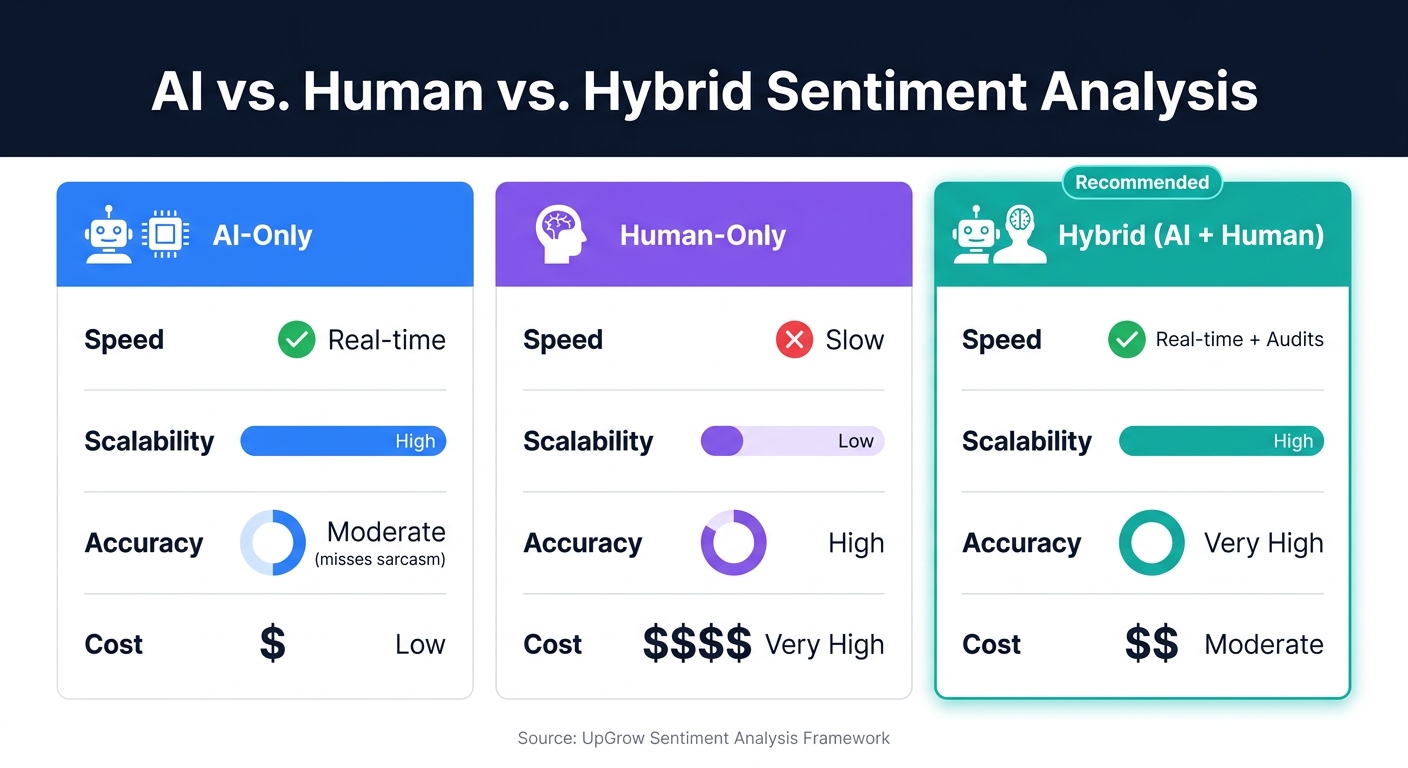
AI vs Human vs Hybrid Sentiment Analysis: Speed, Accuracy & Cost Compared
To make sentiment analysis tools effective, understanding their technical foundation is crucial.
These tools rely on Natural Language Processing (NLP), machine learning, and opinion mining to process and interpret text. The process typically starts with data cleaning (removing irrelevant information) and tokenization (breaking text into smaller, analyzable units). Then, Named Entity Recognition (NER) identifies key entities like brand names, locations, or other significant mentions.
Once the data is processed, tools classify sentiment at different levels. Basic polarity scoring assigns a sentiment score from -1 (negative) to +1 (positive). More advanced techniques, like Aspect-Based Sentiment Analysis (ABSA), can identify mixed sentiments within a single comment. For instance, if someone says, "The design is fantastic, but the customer service was frustrating", ABSA can separate the positive sentiment about the design from the negative sentiment about the service. Additionally, intent analysis can determine whether a comment reflects a purchase interest, a complaint, or a request for help.
Sentiment analysis tools gather insights from multiple Instagram sources, including post comments, story replies, branded hashtags, and public mentions - even when your account isn’t directly tagged. Capturing untagged mentions is particularly valuable for understanding organic conversations about your brand.
Direct messages (DMs) can also be analyzed, provided the process aligns with Instagram's API rules and community standards. The key takeaway here? The more diverse your data sources, the more comprehensive your understanding of audience sentiment becomes.
However, collecting data is just the beginning. Effective sentiment analysis requires a balance between automated systems and human interpretation.
AI excels at handling massive amounts of data, analyzing millions of comments and mentions in seconds, flagging sentiment changes, and routing urgent feedback to the right teams. But it has its limitations. Sarcasm, irony, and cultural slang often confuse automated models.
"A comment like, 'Great, another software update,' can be positive or negative depending entirely on context. AI models need a massive amount of training data to begin to understand these nuances." - Sprout Social
This is where human review becomes essential. In a hybrid system, AI takes care of large-scale processing, while human reviewers handle trickier cases - comments that require cultural understanding, industry-specific jargon, or subtle tonal interpretation. Instagram itself employs a similar approach, as noted in its Help Center: "At other times, our technology sends content to human review teams to take a closer look and make a decision on it.".
UpGrow follows this logic, blending AI with human expertise to ensure audience feedback is addressed quickly and thoughtfully. This combination creates a strong foundation for the audience engagement strategies discussed later.
| Feature | AI-Only | Human-Only | Hybrid (AI + Human) |
|---|---|---|---|
| Speed | Real-time | Slow | Real-time with occasional audits |
| Scalability | High | Low | High |
| Accuracy | Moderate (misses sarcasm) | High | Very high |
| Cost | Low | Very high | Moderate |
When you notice a boost in positive sentiment, it's a clear sign that something in your content is hitting the mark. This is your chance to double down on what works. Look closely at the content types or formats driving this reaction and create more of the same to strengthen your connection with the audience.
"Sentiment analysis is the emotional gut check your campaigns need. It's not about replacing your current metrics - it's about completing the picture." - Influencity
Content that sparks neutral sentiment shouldn’t be overlooked either. Neutral often indicates that while the material is informative, it lacks emotional pull. To shift this, consider turning a static post into an engaging Reel, weaving in a personal story, or finishing with a direct question to invite interaction.
These strategies not only amplify positive engagement but also prepare you to address negative feedback effectively.
Even when the majority of feedback is positive, negative comments are an opportunity to learn and improve. Think of them as valuable data rather than threats. To handle this effectively, set up a system that ensures no feedback goes unnoticed.
For example, use AI tools to flag and categorize negative comments in real time. Urgent issues can be escalated to a senior community manager or support specialist, ensuring a public response within 24 hours. This approach aligns with the 73% of users who expect brands to engage promptly. Publicly resolving a concern not only addresses the individual complaint but also shows your audience that their voices matter.
Patterns in negative feedback often reveal deeper issues. If recurring complaints center around a confusing product feature or the tone of a campaign, it’s a sign to make changes at the root level - whether in the content itself or the product design.
Sentiment data does more than just guide responses; it sharpens your understanding of your audience and enhances your engagement strategy. If a specific demographic consistently reacts negatively, it’s a signal to tweak your messaging to better align with their expectations.
Breaking sentiment into categories like location, age, or language provides a clearer view of who your content resonates with. Tools like UpGrow’s targeting filters - covering factors like location, age, gender, and language - make it easier to act on these insights. If sentiment data highlights a disconnect with a particular group, you can either adjust your filters to focus elsewhere or fine-tune your messaging to better meet their needs.
The insights gained from sentiment analysis can make community management more precise and impactful. By identifying emotions like frustration, excitement, or confusion in real time, community managers can tailor their tone to each interaction, avoiding generic, one-size-fits-all responses.
Intent analysis tools can also speed up response times by routing interactions to the right team members immediately. As Sprout Social explains:
"Social media sentiment analysis translates social media behavior into actionable business data, helping brands make informed decisions to evolve continuously and stay competitive."
Emotionally connected customers are incredibly valuable, delivering a 306% higher lifetime value compared to those who are simply satisfied. Using sentiment data to guide community management is one of the most effective ways to nurture those deeper connections.
Start by identifying your baseline metrics. Record your current engagement rate, reach, and follower count to establish a clear reference point. Then, include sentiment metrics like Net Sentiment Score (NSS), Customer Satisfaction Score (CSAT), and Net Promoter Score (NPS). These scores provide a snapshot of your audience's emotional connection with your brand before making any adjustments.
Here’s a good rule of thumb: a sentiment score above 80% suggests solid brand health, while anything below 50% indicates areas that need improvement. Use these numbers to set realistic engagement goals. For instance, if your positive sentiment is currently at 65%, aim to raise it to 75% within 90 days by focusing on strategies like improving response times or diversifying your content.
To measure what Instagram’s algorithm values most, try a weighted engagement formula: (saves × 3 + shares × 3 + comments × 1.5 + likes × 1) ÷ reach × 100. This formula prioritizes saves and shares, which Instagram views as stronger signals of content value compared to likes.
Once you’ve established your baseline, focus on tracking these metrics regularly to spot shifts and adapt effectively.
Consistent monitoring is what separates growing brands from stagnant ones. In fact, 87% of successful Instagram creators review their analytics weekly, compared to just 23% of those who struggle. Implement a two-tier review system to stay on top of your metrics:
This ongoing review process ensures you can adjust your strategy as needed and avoid stagnation.
For campaigns or product launches, increase your monitoring to daily checks. AI-powered tools can send automatic alerts if sentiment scores drop by 20% or more, giving you the chance to take action before small issues escalate.
Once your metrics are in place, integrate them with advanced AI growth tools to make real-time adjustments.
Platforms like UpGrow combine live analytics with AI-driven targeting, allowing you to use sentiment insights to refine both your audience and your approach. For example, if your sentiment analysis indicates a disconnect with a particular group, UpGrow’s targeting filters can help you shift your focus quickly. Its real-time dashboard also lets you see if these changes lead to better engagement.
One effective tactic is to monitor your engagement velocity in the first 60–90 minutes after posting. If early interactions are positive and sentiment is strong, take action: share the post to Stories, respond to comments, or even boost it with paid promotion. Instagram’s algorithm uses this initial engagement window to gauge a post’s reach potential, so acting quickly can significantly expand your content’s visibility.
Instagram engagement saw a 28% drop between 2024 and 2025 and continues to decline in 2026. In this challenging environment, simply increasing the volume of posts won’t solve the problem. The key lies in understanding the emotions driving your audience’s behavior.
This is where follower sentiment analysis steps in. It transforms vague feedback - like a spike in negative comments, a sudden drop in saves, or a flood of enthusiastic DMs - into actionable insights. With this data, you can fine-tune your content, posting schedule, and audience targeting.
Even small adjustments can have a big impact over time. For instance, responding to DMs within 60 minutes has been shown to boost future engagement by 23%. Additionally, formats like Carousels and Reels consistently perform better than static posts.
Platforms like UpGrow make this process easier by leveraging AI to analyze sentiment data in real time. With tools like these, you can quickly adapt your strategy, tailoring content to specific niches, locations, age groups, and even languages. As content creator Janine Heinrichs explains:
"UpGrow is not just about numbers – it's about quality and quantity by reaching the most people who would be specifically interested in your content."
Building a thriving community requires more than just numbers; it’s about creating a genuine connection with your audience. Sentiment analysis, combined with the right tools, helps you achieve that connection while driving long-term growth.
The quickest way to understand follower sentiment on Instagram is by leveraging social listening tools that assess audience feedback. Platforms powered by AI can break down consumer perceptions effectively, while automated tools, such as language models, make it easier to analyze large volumes of comments. These tools allow you to gather meaningful insights about sentiment swiftly, without requiring complex setups.
To figure out if a drop in sentiment is a real concern, look for changes that are both noticeable and consistent over a period of time, rather than just momentary shifts. Pay attention to the bigger picture by examining the context, reviewing engagement metrics, and identifying recurring feedback patterns. This approach helps separate genuine issues from short-term anomalies.
To transform negative sentiment into meaningful engagement, it's essential to approach concerns with a constructive mindset and a sincere willingness to help. Start by acknowledging the issue and thanking the individual for bringing it to your attention. This shows you value their input. Then, focus on offering solutions or steps to address the concern.
Steer clear of sounding defensive - try to view negative feedback as a chance to strengthen trust. Respond quickly, with empathy and professionalism, to show you're genuinely committed to improvement. This approach not only resolves issues but also encourages productive, two-way conversations.


