
How AI Detects Fake Instagram Engagement
How AI spots fake Instagram engagement—identifying purchased followers, bots and coordinated networks via timing, NLP and graph signals.
How AI spots fake Instagram engagement—identifying purchased followers, bots and coordinated networks via timing, NLP and graph signals.
4.98 /5 - from 58k reviews
Trusted by 50,000+ creators — get real engagement delivered to your profile in minutes, not days.

Fake Instagram engagement costs brands $1.3 billion annually, with up to 25% of influencer followers being fake. AI tools are essential in identifying fraudulent activity, which includes purchased followers, bots, and engagement pods. These tools analyze patterns like unnatural timing, geographic mismatches, and low-quality comments to detect inauthentic behavior. For brands, fake engagement leads to wasted budgets, unreliable data, and potential penalties from Instagram or legal authorities.
Key takeaways:
Using AI-powered audits ensures marketing budgets are spent on increase Instagram engagement and boost campaign effectiveness and ROI.
AI systems analyze the complete behavioral profile of each account, cross-referencing multiple signals to distinguish genuine human activity from automated scripts.
One of the most obvious signs AI looks for is unnatural timing. Real users engage at irregular intervals - like during a morning coffee, a quick break at work, or late at night before bed. Bots, on the other hand, operate on rigid schedules. AI models human behavior as naturally random, so when interactions occur at exact intervals (like a "like" every 60 seconds), it raises a red flag for fraudulent activity.
Another key metric is downstream behavior. A real user who likes a post might also save it, visit the profile, or share it through direct messages (DMs). When likes happen without any of these follow-up actions, it strongly suggests inauthenticity. Instagram's updated ranking system, which prioritizes sends per reach (DM shares), has made this signal even harder for bots to fake.
"Sharing a post through a direct message takes deliberate effort... replicating genuine DM-sharing behavior at scale is a different problem entirely." - Kyle Francisco, Kenji.ai
AI also identifies geographic mismatches, such as a U.S.-based account receiving most of its engagement from unexpected regions, and comment quality issues, like generic phrases ("Great post!"), emoji-only replies, or multiple comments posted in rapid succession.
These patterns are part of a broader AI strategy to verify account authenticity.
Modern detection systems rely on a mix of techniques to identify fake engagement:
| AI Method | What It Does | Models Used |
|---|---|---|
| Machine Learning | Classifies accounts as real or fake | Random Forest, XGBoost, SVM |
| NLP | Analyzes comment text for authenticity | BERT, RoBERTa, stylometric analysis |
| Graph Analysis | Detects network coordination | Graph Neural Networks (GNNs) |
| Anomaly Detection | Spots statistical outliers in behavior | Isolation Forests, Gaussian Mixture Models |
| Computer Vision | Identifies fake or stolen profile images | CNNs, Siamese Networks |
Natural Language Processing (NLP) plays a crucial role in countering more advanced bots. While older bots reused identical comments, newer ones use GPT-based models to generate unique responses. NLP tools like BERT can detect these by measuring semantic drift - minimal variation in meaning across thousands of comments, even when the wording changes.
Graph analysis focuses on identifying coordinated inauthentic behavior (CIB) across networks. Instead of analyzing accounts individually, it maps relationships between them. Fake networks often display dense clustering, with the same group of accounts interacting with identical content in rapid succession - a pattern that organic audiences rarely produce at scale.
These methods combine diverse data sources to build highly effective detection systems.
AI systems rely on multiple layers of data to construct behavioral profiles. While the Instagram Graph API provides essential Instagram analytics like profile details, post timestamps, captions, and engagement counts, deeper insights come from device and network metadata. This includes IP addresses, hardware signatures, app version details, and TLS fingerprint patterns.
Behavioral biometrics introduce an additional layer of analysis. AI examines micro-interactions, such as how users scroll, tap, or press on their screens. Humans naturally vary in these movements, while bots exhibit mechanical consistency. Even when bots use physical hardware to mimic real interactions, Instagram’s systems can often tell the difference.
Finally, AI evaluates account-level history. It considers factors like account age, whether the profile is complete (bio, photo, contact info), and the follower-to-following ratio. One standout metric is the activity ratio - total interactions divided by reading time. Ratios above 1,000 are highly correlated with fake engagement, with an AUC (Area Under Curve) of 0.94, showing the model's reliability in distinguishing real from fake.
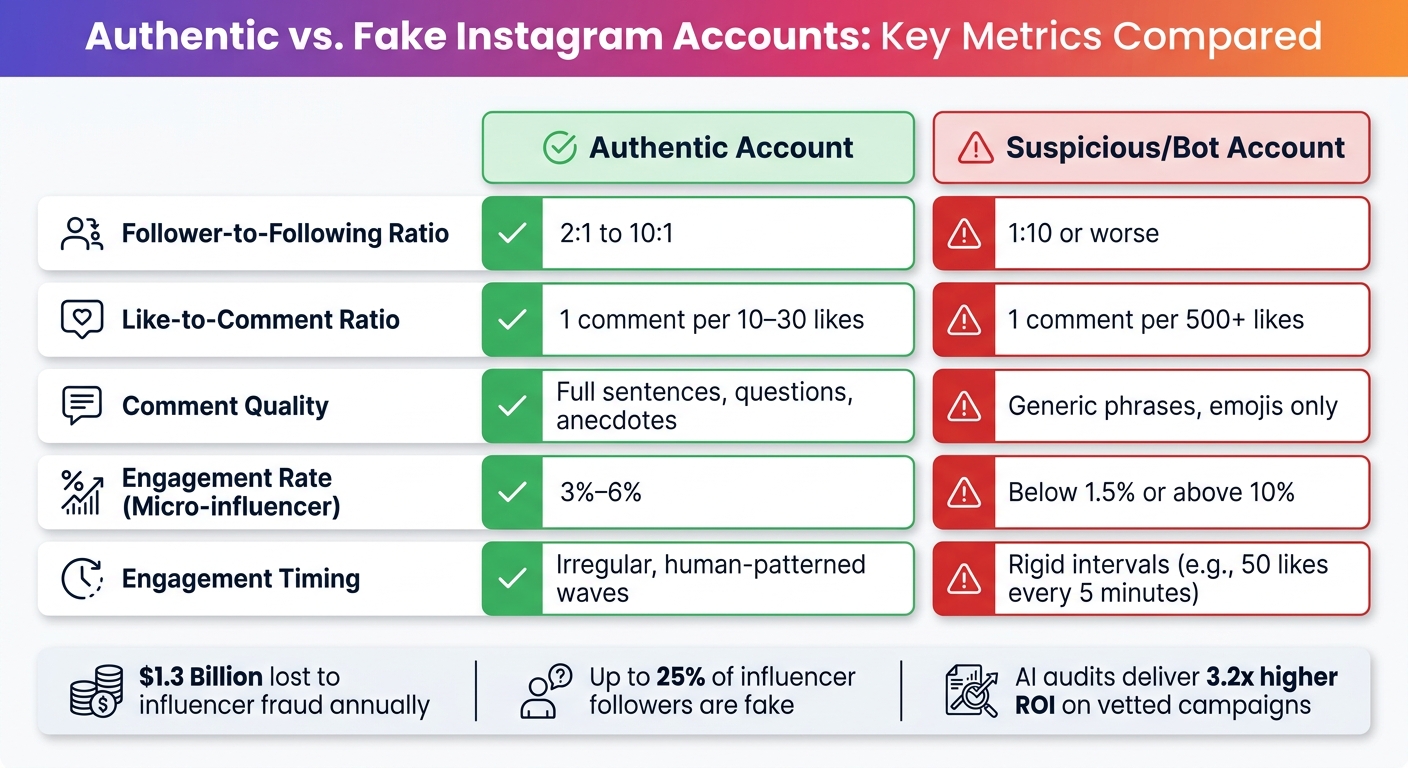
Authentic vs. Fake Instagram Accounts: Key Metrics Compared
AI dives deep into engagement patterns to separate authentic activity from fake. One key focus is the timing and bursts of likes. Genuine engagement tends to occur in irregular waves, reflecting human behavior. In contrast, bot activity often shows up as consistent patterns or sudden spikes - like 50 likes showing up every 5 minutes - without any natural context to back it up.
Another key metric is the like-to-comment ratio. For most real accounts, you’ll see around 1 comment for every 10–30 likes. But when that ratio balloons to something like 1 comment per 500 likes, it’s a clear sign that someone might’ve bought likes without bothering to get real interactions. Additionally, AI flags accounts with large follower numbers but engagement rates way below the industry standard (typically 1.5–3%). These are often signs of artificially inflated follower counts.
These metrics act as a starting point, paving the way for deeper analysis of followers and comments.
AI doesn’t stop at surface-level data - it evaluates the quality of every follower and commenter using a probability score from 0 to 1. This score is based on factors like account age, profile completeness (such as having a bio and profile photo), posting frequency, and the follower-to-following ratio. For instance, an account following 7,000 people but having zero followers of its own raises immediate suspicion.
Low-quality comments are another red flag. AI can spot these by their generic language, overuse of emojis, and lack of substance. It also measures session depth, which looks at how an account interacts with posts. Accounts that engage with a single post across multiple profiles or show shallow interaction patterns are often identified as bots.
Here’s a quick comparison of how authentic and suspicious accounts measure up across key metrics:
| Metric | Authentic Account | Suspicious/Bot Account |
|---|---|---|
| Follower-to-Following Ratio | 2:1 to 10:1 | 1:10 or worse |
| Like-to-Comment Ratio | 1 comment per 10–30 likes | 1 comment per 500+ likes |
| Comment Substance | Full sentences, questions, anecdotes | Generic phrases, emojis only |
| Engagement Rate (Micro-influencer) | 3%–6% | Below 1.5% or above 10% |
These insights give AI a more comprehensive picture of account authenticity.
AI doesn’t just examine individual accounts - it zooms out to identify patterns across entire networks. This is where it gets especially powerful, as it can detect coordinated fake activity that might not be obvious from a single profile.
Fake engagement groups, like bot clusters or engagement pods, often leave behind a distinct trace. For example, they show modularity values (Q) above 0.7, compared to the 0.3–0.5 range typical in organic communities. These fake networks are tightly interconnected, with accounts frequently engaging with the same content at nearly the same time.
AI also cross-references technical details like IP addresses and device signatures. Bot farms usually operate from datacenter IPs rather than mobile carrier ones, and their devices often have nearly identical configurations with minimal variation (entropy under 5 bits) since they’re run on the same machines.
"The algorithm keeps getting better at spotting scripts pretending to be people. The brands winning on Instagram in 2026 won't be gaming metrics; they'll be the ones whose traffic looks real because it actually is." - Kyle Francisco, Kenji.ai
When these network-level anomalies are confirmed, Instagram doesn’t always go straight to banning accounts. Instead, it often uses distribution suppression. This means reducing the visibility of posts from accounts linked to suspicious activity, keeping them lower in Feeds and off the Explore page entirely.
To start an AI-powered engagement audit, you need structured, reliable data. Begin by collecting profile-level metrics like follower-to-following ratios and post-to-follower ratios. These numbers, gathered through AI tools or platform APIs, offer a quick snapshot of an account's activity and can help highlight obvious red flags like mass-following behavior.
Next, dive deeper by analyzing the last 12–20 posts. Look at metrics such as likes, comments, and how quickly those interactions occur after posting (engagement velocity). Then, sample 50–100 followers to spot bot-like traits - profiles without photos, usernames that look like random strings of letters and numbers, or accounts with no original posts. Export comment text for natural language processing (NLP) to differentiate real conversations from generic bot comments like "Great post!".
Properly organizing this data is essential. It helps uncover fake engagement, which can drain your campaign budget and weaken your results.
Once the audit is complete, you'll typically receive scores like an Audience Authenticity Score or a bot probability score (ranging from 0 to 1) for each account. The challenge lies in interpreting these numbers and deciding how to act on them.
Here are some benchmarks for engagement rates based on account size:
| Account Size | Follower Range | Healthy Engagement Rate | Suspicious Engagement Rate |
|---|---|---|---|
| Nano-influencer | 1K–10K | 5%–10% | < 2% or > 15% |
| Micro-influencer | 10K–50K | 3%–6% | < 1.5% or > 10% |
| Mid-tier influencer | 50K–500K | 2%–4% | < 1% or > 8% |
| Macro-influencer | 500K–1M | 1.5%–3% | < 0.8% or > 6% |
| Mega-influencer | 1M+ | 1%–2.5% | < 0.5% or > 5% |
Source: Insvii Data-Driven Analysis, 2026
Set clear thresholds for disqualifying accounts. For instance, if an audit reveals a bot rate above 60% or an engagement pod rate over 80%, disqualify the account immediately - no need for further review. For cases that are less clear-cut, use the audit findings to renegotiate terms. For example, in early 2024, a beauty brand discovered that 42% of a proposed influencer's followers were fake. This insight allowed them to renegotiate a $50,000 contract down to $29,000, aligning costs with authentic reach.
"If you're paying $10,000 for a sponsored post based on follower count, and 25% are bots, you're wasting $2,500 on impressions that will never convert." - CreatorScore
Another key indicator is geographic alignment. For example, a U.S.-based lifestyle influencer with 80% of their audience in Southeast Asia is a strong signal of purchased followers, even if their engagement rate seems fine.
With this data in hand, the next step is to implement automated systems to catch fraudulent activity as it happens.
One audit isn’t enough. Influencers can buy followers or engagement mid-campaign to meet performance targets, meaning the data you collect early on might not hold up by the end of the campaign.
To stay ahead, automate alerts for specific patterns. Red flags include engagement arriving in consistent batches (e.g., 50 likes every 5 minutes), sudden follower spikes without a viral post or press coverage, or a rising bot percentage over multiple weeks. Brands using AI audit tools have reported cutting wasted marketing spend by 67% in Q1 2024 by detecting these issues early.
At a minimum, conduct monthly audits for any ongoing influencer program. For larger campaigns, include fraud clauses in influencer contracts. Specify that AI monitoring will verify engagement and that any detected fraud will trigger financial penalties. This approach shifts responsibility to the influencer and ensures your brand has a clear, data-backed way to address any problems.
Eliminating fake engagement is just the first step. To secure lasting, genuine growth on Instagram, you need tools designed for authenticity. UpGrow helps you achieve this by building on advanced AI audits to ensure every interaction reflects real engagement.
UpGrow’s AI doesn’t just detect fake activity - it actively works to grow your audience with real followers. By using filters like location, age, gender, language, interests, and hashtags, the platform targets users who genuinely align with your content. Unlike bots that use rigid, predictable patterns, UpGrow mimics human engagement behavior to stay under Instagram’s radar. Plus, it’s been fully compliant with Instagram’s policies since 2016 and never requires your password for operation.
Keeping track of your progress is easy with UpGrow’s live dashboard. It offers real-time insights into follower trends, highlights unusual activity spikes, and lets you download detailed PDF reports. This level of monitoring ensures your growth remains as organic as it appears.
For faster results, UpGrow’s Boost™ tool uses advanced pattern recognition to safely accelerate follower growth. Beta testers reported a 275% increase in monthly followers.
Agencies can also take advantage of features like bulk discounts and tools for managing multiple accounts efficiently. Starting May 2026, all plans are discounted by 60%, with prices beginning at just $39 per month.
"In 3 months, we gained 20,000+ real followers - boosting our brand and sales." - Jennifer Khan
With a 4.98 out of 5 rating from over 58,000 reviews and a client base of more than 100,000 creators, agencies, and businesses since 2016, UpGrow has earned its reputation as a trusted growth partner.
Let's tie everything together: AI-driven insights are a game-changer when it comes to protecting and improving your Instagram engagement.
Fake engagement isn't just an empty number - it can seriously drain marketing budgets. Consider this: influencer fraud costs brands around $1.3 billion annually, and campaigns involving accounts with over 30% fake followers experience 58% lower conversion rates. The upside? AI tools make it much easier to spot these issues before they eat into your budget.
The main point is clear: fake engagement can quietly sabotage your reach. Instagram's evolving detection systems penalize accounts with fake followers by reducing their organic reach - without any alerts or notifications. Rebuilding trust with the algorithm requires months of genuine activity, so prevention is key.
A few smart practices can help you stay ahead. Use an AI-powered follower audit monthly and always audit accounts before signing influencer deals. Watch out for red flags like sudden follower spikes, identical comment patterns, or generic responses like "Great post!" Brands that integrate AI vetting tools see a noticeable drop in wasted spending, while influencer campaigns that pass these checks deliver 3.2x higher ROI compared to unvetted ones.
One more thing to keep in mind: nano-influencers - those with 1,000 to 10,000 followers - boast an average 8.7% engagement rate, far surpassing the 1.6% rate for mega-influencers. AI makes it easier to identify and evaluate these smaller but highly effective creators at scale.
These findings emphasize the importance of using AI not just to weed out fake engagement but to build authentic Instagram growth that lasts.
If you're looking to turn these insights into action, UpGrow offers a powerful solution. While detecting fake engagement is one part of the equation, maintaining clean growth is the other. UpGrow excels at both. Its AI-driven targeting attracts real followers based on filters like location, age, gender, and interests. Meanwhile, its live dashboard monitors for unusual activity, helping you address potential issues early.
Since 2016, UpGrow has been fully Instagram-compliant and never asks for your password. This is a big deal, as sharing login credentials can quickly trigger Instagram's detection systems. With pricing starting at just $39/month (currently 60% off through May 2026) and a stellar 4.98/5 rating from 58,000+ reviews, UpGrow provides a reliable path to building a genuine audience and achieving measurable growth.
Yes, Instagram’s detection systems sometimes mistakenly flag genuine accounts as bots. This usually happens when an account shows unusual behavior or engagement patterns. That said, these systems are mainly built to identify fake or suspicious activity, so errors like this don’t happen often.
Brands are leveraging AI to dig into Instagram data and uncover meaningful insights. By analyzing factors like account age, posting history, profile completeness, and follower-to-following ratios, AI can paint a clearer picture of an account's authenticity.
It doesn’t stop there - engagement patterns are scrutinized too. Things like the quality of comments, how consistently users interact, and any unusual activity are reviewed. Red flags, such as incomplete bios, suspicious usernames, or sudden, unnatural spikes in likes or comments, are also identified.
These tools make it easier to spot fake activity and ensure engagement metrics reflect genuine interactions during audits.
Regularly review influencers at least every 90 days during a campaign to ensure their engagement remains genuine and trustworthy. Since Instagram's systems for detecting fake engagement and analytics tools often work on shorter cycles, these periodic audits help you stay on top of any changes and maintain credibility.


