
Instagram vs TikTok Brand Deals: Guide 2026
TikTok drives discovery; Instagram drives sales. Learn how goals, formats, engagement, audience and usage rights shape 2026 brand deals.
TikTok drives discovery; Instagram drives sales. Learn how goals, formats, engagement, audience and usage rights shape 2026 brand deals.
4.98 /5 - from 58k reviews
Trusted by 50,000+ creators — get real engagement delivered to your profile in minutes, not days.
If I had to sum it up in one line: use TikTok for reach, use Instagram for sales.
That’s the short answer. In 2026, brand deals are less about follower count and more about goal, format, audience fit, and usage rights. TikTok is often the better pick when I want people to find a product. Instagram is often the better pick when I want people to click, shop, and come back.
Here’s the article in plain English:
If I’m picking one platform for awareness, I’d lean TikTok. If I’m picking one for sales, I’d lean Instagram. If I want full-funnel results, I’d use both in sequence.
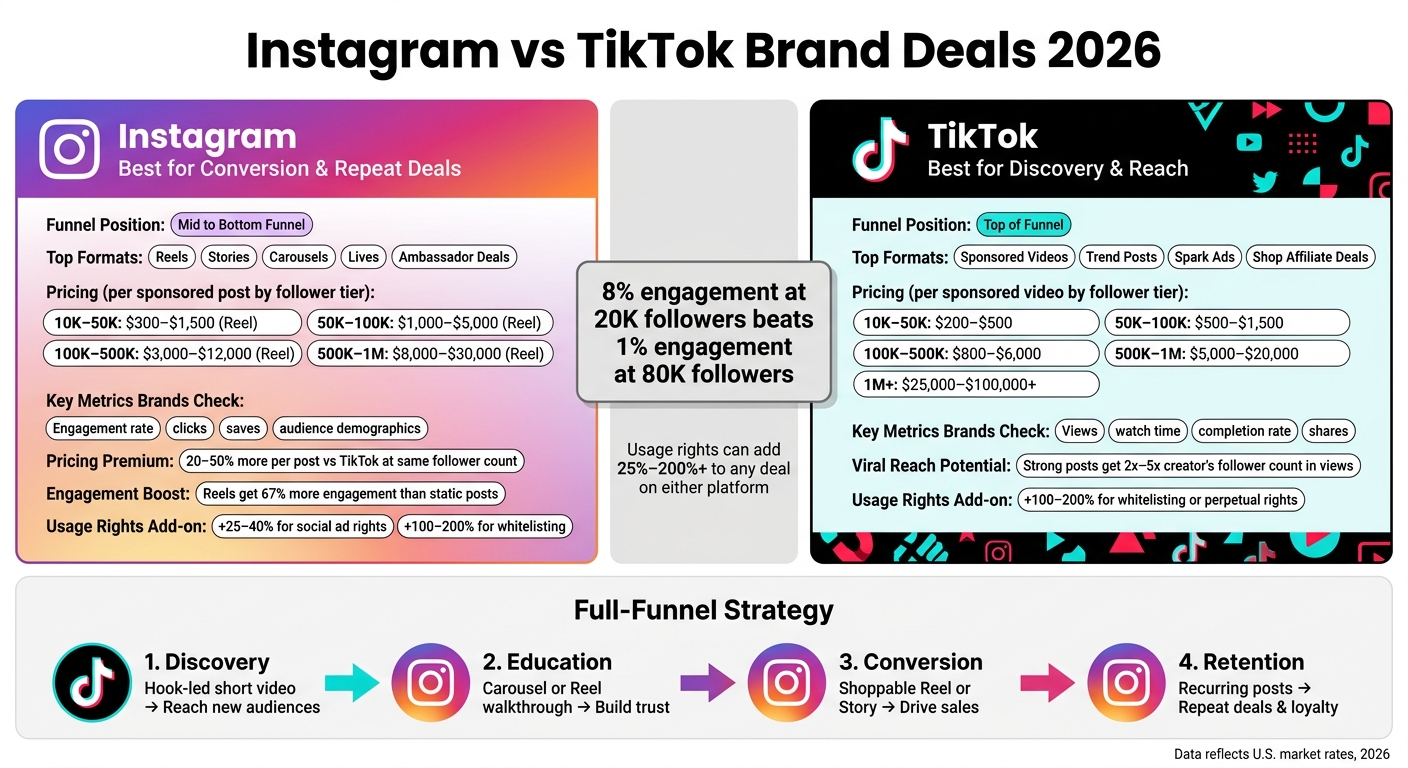
Instagram vs TikTok Brand Deals: Platform Comparison 2026
| Point | TikTok | |
|---|---|---|
| Best for | Sales, repeat deals, product education | Reach, discovery, fast exposure |
| Common deal types | Reels, Stories, carousels, Lives, ambassador deals | Sponsored videos, trend posts, Spark Ads, Shop affiliate deals |
| Pricing at similar size | Often higher | Often lower |
| Main metrics brands check | Engagement, clicks, saves, audience data | Views, watch time, completion rate, shares |
| Best role in funnel | Mid to bottom | Top |
| Ad reuse | Strong for polished UGC and paid social | Strong for native-feel UGC and Spark Ads |
One more thing: a smaller creator with 8% engagement can beat a larger creator with 1% engagement. That’s why this comparison is about performance, not just reach.
Instagram gives brands a few paid formats, and each one does a different job. Brand deals on Instagram tend to work best when a company wants multiple touchpoints, stronger buying intent, and content it can reuse later.
Sponsored Reels are built for reach. They often beat static posts and fit product launches, demos, and promo code pushes, generating about 67% more engagement than static feed posts. Story packages are better for clicks and purchase intent. Carousels help with education and trust.
A lot of brands don't buy just one format. They buy a package: a Reel, Stories, and a carousel, sometimes with UGC-for-ads and whitelisted paid amplification added in. That mix works because it covers reach, trust, and trackable action.
Instagram Lives can also work as add-ons for Q&A sessions and interactive demos. And long-term ambassador programs make sense for repeat launches and affiliate tracking.
Once the format is set, pricing becomes the next part of the conversation.
Follower count gives brands a starting point, but it doesn't decide the whole deal. Engagement and audience quality usually have more weight. Rates go up when the format, the audience, and the usage rights give the brand more value.
Here are typical U.S. Instagram brand deal ranges by format and follower range in 2026:
| Format | 10K–50K followers | 50K–100K followers | 100K–500K followers | 500K–1M followers |
|---|---|---|---|---|
| Reel | $300–$1,500 | $1,000–$5,000 | $3,000–$12,000 | $8,000–$30,000 |
| Feed post / carousel | $200–$1,200 | $800–$3,500 | $1,500–$8,000 | $5,000–$25,000 |
| Story set | $75–$400 | $200–$1,000 | $500–$3,000 | $1,500–$5,000 |
A few things push pricing up fast:
Reels also tend to cost 20% to 50% more than static posts because they take more work to produce.
For creators in the 50K–100K range, bundle deals like one Reel plus 3–5 Stories often fall around $2,000 to $7,000. In many cases, that bundle is 15% to 25% cheaper than buying each piece on its own.
Brands don't just look at follower count. They price creators based on engagement rate, saves, shares, and audience demographics. Many also check authenticity scores, and a lot want to see 85% or higher before they move ahead.
A strong media kit is one of the most useful tools here. It should show average reach and impressions by format, engagement rate across recent posts, audience demographics like age, gender, and top U.S. cities, plus one or two short case studies with past results. That way, the pitch is no longer just about cost.
For example, a Reel that reached 500,000 accounts with a 7% engagement rate and 5,000 link clicks shifts the conversation from price alone to what the creator can actually deliver.
When the numbers are good, rates usually follow. Better metrics also give creators more room in negotiations, which sets up the next comparison: how Instagram pricing and performance stack up against TikTok.
TikTok brand deals are built for reach. A strong video can pull in views equal to 2x to 5x a creator’s follower count. That’s a big deal because TikTok tends to reward discovery-first campaigns more than repeat-touch campaigns. Put simply, TikTok shines when a brand wants more people to see something fast, not when it needs a long, detailed sales pitch.
The most common paid format is the sponsored video. In this setup, a creator posts a short clip that features a brand in exchange for a flat fee tied to specific deliverables. Product demos tend to do well, especially when the creator shows the item in use in a way that feels native to TikTok and lands a strong hook in the first 1–3 seconds.
Another common option is trend-based campaigns. These connect a brand message to a sound, meme, or challenge that’s already picking up steam. When the creator works that trend into their own style instead of forcing it, reach can climb.
Brands also go beyond one-off posts:
Product seeding is often the first step for nano and micro creators. A brand sends free product, and a paid deal may come later if the post performs well.
TikTok pricing comes down to performance. Brands look at views, watch time, completion rate, shares, comments, niche fit, and originality.
Typical U.S. sponsored-video rates in 2026:
| Follower Range | Typical Rate per Sponsored Video |
|---|---|
| 10K–50K | $200–$500 |
| 50K–100K | $500–$1,500 |
| 100K–500K | $800–$6,000 |
| 500K–1M | $5,000–$20,000 |
| 1M+ | $25,000–$100,000+ |
A few things can push those rates up. If a creator posts strong watch time and high completion rates on a steady basis, brands may pay more because they expect better reach. Niche matters too. Finance creators often earn $800–$3,000 per deal, while beauty and skincare creators with similar audience size tend to land $400–$1,800. Timing also affects pricing. If a brand needs a fast turnaround tied to a launch or seasonal push, that can mean a higher fee.
Usage rights are a separate part of the deal. A standard sponsored post is one thing. But if a brand wants to turn that same video into a paid ad for 30 or 90 days, that usually means an added licensing fee. A 30-second UGC video with full usage rights often costs $150–$500, and whitelisting or perpetual usage rights can add 100% to 200% on top of the base rate.
Those numbers only tell part of the story; the next comparison looks at how TikTok’s performance-led pricing compares with Instagram.
On TikTok, a pitch has to move fast. A good one shows audience fit, creative fit, and performance fit without wasting time. Brands want proof that your style matches how people use the platform: fast hooks, visual storytelling, and formats that don’t feel like old-school ads.
Lead with recent performance data. That usually means average views, watch time, completion rate, shares, and comments from your recent videos. Brands also check authenticity scores, and many want to see at least 85% real followers before they move ahead. If your content often gets 2x to 5x your follower count in views, call that out clearly.
It also helps to show that you understand trends. Don’t pitch a stiff script. Show how you’d turn the brand’s message into a TikTok-native format, like a hook-led demo, a before-and-after reveal, a duet, a stitch, or a challenge-style post.
For U.S. campaigns, use clear disclosures like #ad or paid partnership in the caption and on screen. Don’t hide them in a pile of hashtags.
With formats and pricing out of the way, the next step is simple: which platform does a better job at each stage of a campaign?
TikTok is stronger for discovery. Instagram is stronger for sales and long-term brand work. That split comes down to how people use each app.
Instagram is the better closer. Product tags, link stickers, and shopping features make it easier for someone to go from seeing a product to buying it. And when brands want repeat deals or ambassador-style work, Instagram tends to offer a steadier audience and better community ties.
| Objective | Instagram Advantage | TikTok Advantage | Best Fit |
|---|---|---|---|
| Awareness | Reels can reach 2–5x the creator's follower count | Viral discovery for non-followers | TikTok |
| Conversion | Product tags, link stickers, and shopping tools | Early awareness | |
| Repeat Deals | Community-building and a more stable audience | High content turnover, trend-driven | |
| UGC Campaigns | Polished assets for follow-up ads and product pages | Raw, native-feel content for Spark Ads | Both |
The deal setup looks similar on both apps, but what brands are paying for is not quite the same.
On Instagram, brands often pay more for polished content that can drive clicks and track sales. On TikTok, they’re usually paying for reach, engagement, and the upside of a viral post.
One benchmark stands out: Instagram creators at similar follower counts often make 20–50% more per sponsored post than TikTok creators. That price gap reflects Instagram’s stronger sales value for brands.
| Deal Type | How It Works on Instagram | How It Works on TikTok | Common Pricing Factors (USD) |
|---|---|---|---|
| Sponsored Post | Feed posts, Reels, Stories with product tags and link stickers; brands value aesthetics and conversion | Short-form vertical video built around trends and hooks; brands value reach and authenticity | Follower tier, niche, engagement rate, U.S. audience share |
| Affiliate Offers | Link stickers, bio links, and shoppable posts make conversion tracking straightforward | Promo codes and link-in-bio; more friction driving users off-app | Commission rate + flat base fee; higher flat fee on TikTok when tracked sales are harder to attribute |
| UGC / Ad Licensing | Polished assets reused in feed ads, Stories, Reels, and product pages | Raw, native-feel content used in Spark Ads and discovery campaigns | Number of assets, usage duration, platform rights; priced per asset rather than by follower count |
| Ambassadorships | Recurring posts, Stories, Reels, discount codes, and ongoing community engagement; higher monthly retainers | Regular short-form content keeping the brand in trending conversations | Monthly retainer ($1,000–$9,999 per month), deliverable count, performance bonuses |
If a brand wants full-funnel results, using both platforms together often makes the most sense. TikTok can put the product in front of new people. Instagram can help turn that interest into a sale.
A simple setup looks like this: a TikTok creator posts a short, hook-led video to introduce the product to a cold audience. Later that week, an Instagram creator shares a more detailed carousel, Reel, or Story walkthrough for people who already saw the product and want more context before buying. From there, product tags or link stickers make the purchase step much easier.
| Campaign Stage | Platform | Creator Deliverable | Brand Goal |
|---|---|---|---|
| Discovery | TikTok | Hook-led short-form video, trend-native format | Reach & awareness with new audiences |
| Education | Detailed carousel, Stories, or Reels walkthrough | Trust-building | |
| Conversion | Shoppable Reel or Story with product tag/link sticker | Direct sales and tracked ROI | |
| Retention | Recurring posts and community engagement | Repeat deals and audience loyalty |
Start with the goal of the campaign. Use TikTok for discovery and Instagram for conversion, trust, and repeat partnerships.
Once that goal is set, pricing tends to sort itself out by platform. Instagram brand deals often pay 40%–70% more per follower, so it makes sense to lean on Instagram when conversion matters and use TikTok when you want efficient reach.
After price, the next things that matter most are audience quality and usage rights. The rate alone isn’t the whole deal. A creator with 20,000 followers and 8% engagement can bring more value than one with 80,000 followers and 1% engagement. Brands that look at comments, audience fit, and past results instead of just follower count often get better outcomes.
Usage rights need their own line item. For paid media rights, add 25%–40% for social ad rights and 100%–200% for whitelisting.
A strong media kit doesn’t need to be long. Keep it tight and useful:
If one platform can’t do both jobs, use them together in sequence. Go with TikTok for discovery, then move to Instagram for education, conversion, and repeat follow-up.
Pick the platform that matches your main goal.
Use TikTok if you want fast user growth, high engagement, viral reach, and better access to Gen Z. It’s built for discovery, so new brands can get in front of people fast.
Use Instagram if your focus is brand building over time, professional networking, community ties, audience segmentation, and driving purchases from Millennials. It’s often the better place to shape how people see your brand and turn attention into sales.
A simple way to think about it: start with TikTok to get attention, then use Instagram to deepen your brand identity and build long-term loyalty.
There’s no one set rate for usage rights or whitelisting, which is why clear contract terms matter more than anything else.
Use an AI Rate Estimator to get a rough sense of what your work may be worth based on your audience size and engagement. Then make sure your agreement spells out the key details:
Those details have a direct impact on pricing, so vague terms can cost you.
Yes. In 2026, smaller creators can still land high-paying brand deals because brands care more about strong engagement and niche influence than follower count alone.
Here’s the shift: a smaller, active audience often beats a big, quiet one. Brands want people who can move attention, spark clicks, and drive action.
In fact, 73% of U.S. brands now set aside budget for creators with fewer than 50,000 followers, up from 47% three years ago. That’s a big change, and it opens the door for creators who know their audience well.
What should you focus on? Keep your engagement rate in a healthy range - ideally 1% to 5% - and build an active audience that interacts with your content on a regular basis.


