Instagram Organic Reach Statistics 2026: The Decline by Account Size & Format
Follower reach fell to ~3.5%–8.9% in 2026; Reels drive discovery, carousels boost follower reach, and smaller accounts outperform large ones.
Follower reach fell to ~3.5%–8.9% in 2026; Reels drive discovery, carousels boost follower reach, and smaller accounts outperform large ones.
4.98 /5 - from 58k reviews
Trusted by 50,000+ creators — get real engagement delivered to your profile in minutes, not days.
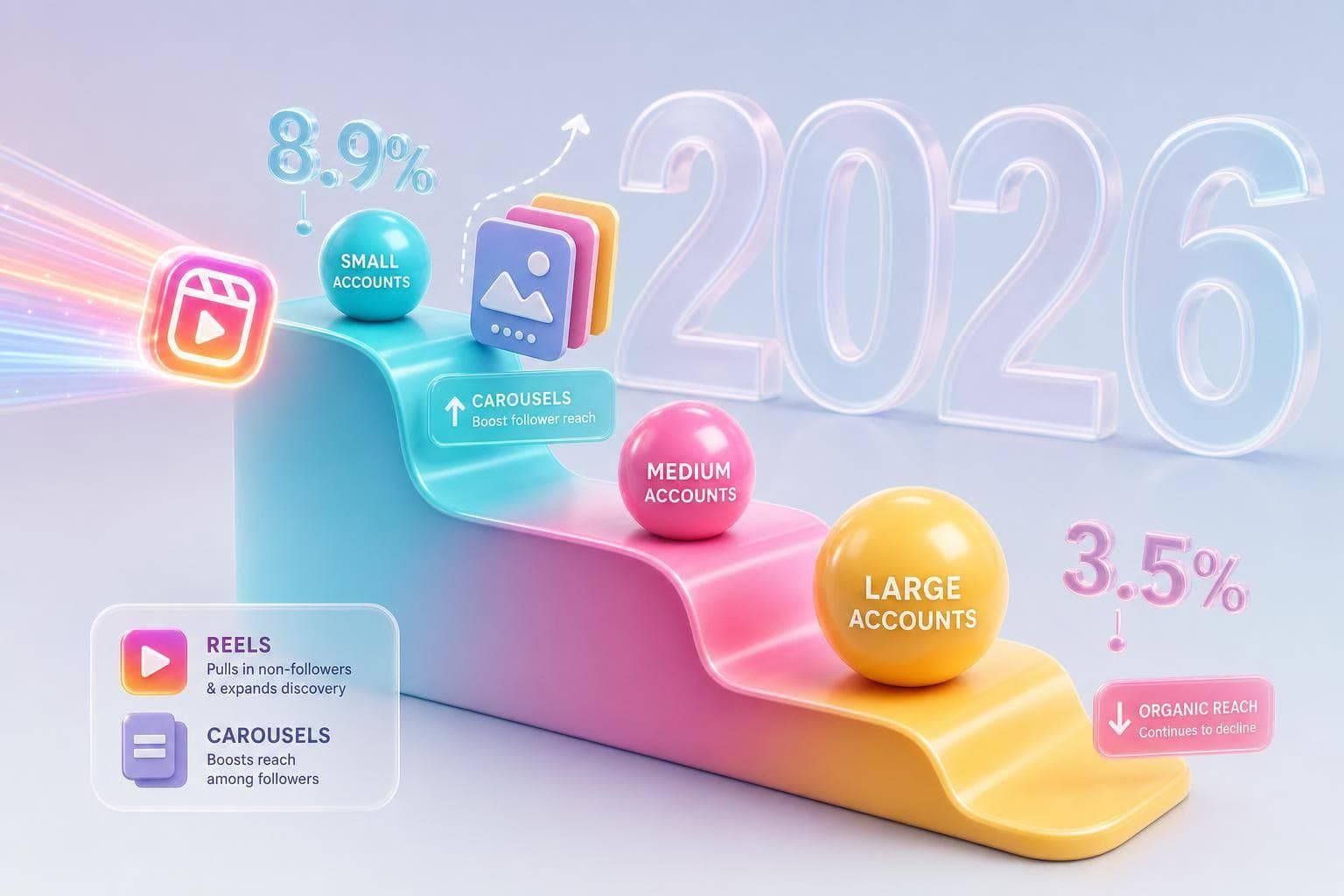
Instagram organic reach is lower in 2026, and the drop is hitting large accounts the hardest. I’d sum it up like this: follower reach is now about 3.5%–8.9%, smaller accounts still do better than big ones, and Reels get the most discovery while Stories stay lowest.
If you want the short answer, here it is:
So if your reach is down, it does not always mean your content is failing. In many cases, Instagram is just showing posts to fewer followers and trying to get more non-followers to see them instead.
The big shift: in 2026, reach is less about how many followers you have and more about format, early engagement, and how much people watch, save, or share your post. To maximize these metrics, you can use an Instagram post optimizer to refine your content strategy.
| Area | What the data says |
|---|---|
| Average follower reach | 3.5%–8.9% |
| Total average reach | Up to 28.3% |
| Best format for discovery | Reels |
| Best format for follower reach | Carousels |
| Lowest format | Stories |
| Best-performing account group | Under 10K followers |
| Main reason for decline | More competition + more recommendation-based distribution |
If I had to put the full article into one simple takeaway, it would be this: Instagram reach is shrinking for followers, shifting toward non-followers, and changing based on account size and post format.
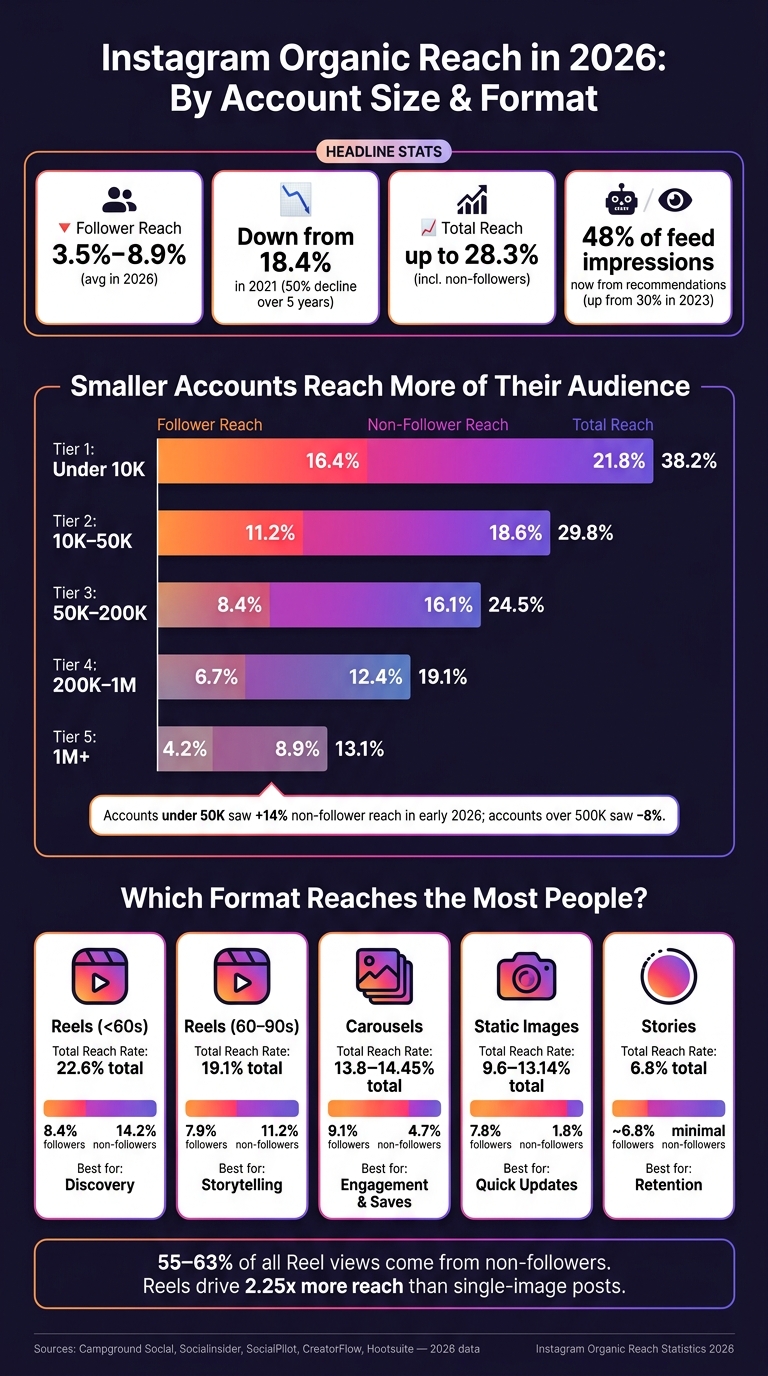
Instagram Organic Reach by Account Size & Format (2026)
The answer depends on what, exactly, is being measured. In 2026, Instagram organic reach varies a lot by source: follower reach sits around 3.5%–8.9%, while total reach can go as high as 28.3%. That spread isn't random. It comes from different definitions, datasets, and sampling methods.
There’s another wrinkle here. In April 2025, Instagram replaced "organic impressions" with "post views" and "profile views," which makes year-over-year comparisons messier. So when you line up 2026 reports, it helps to treat them as guideposts, not apples-to-apples matches, or test your expertise with an Instagram Metrics Knowledge Quiz.
Different research teams use different sample sizes, account types, and definitions - so the numbers below aren't interchangeable. Use them as directional benchmarks, not hard targets.
| Source | Year | Avg. Reach Rate | What It Measures | Reported Trend |
|---|---|---|---|---|
| Outfame | 2026 | 3.5% | Follower reach per post | 12% YoY decline |
| Campground Social | 2026 | 28.3% | Total reach (follower + non-follower) | Stable total, shifting mix |
| SocialPilot / Metricool | 2026 | 7.6% | Organic reach of followers | Down 40% vs. 2023 |
| CreatorFlow / Hootsuite | 2026 | 6.8% | Reach rate for accounts under 100K | Dropped from 12% in 2023 |
Part of this spread comes down to account size. A small creator account and a large brand account often play by very different reach rules.
Follower reach has tightened a lot, and the data backs that up. Follower reach dropped from 18.4% in 2021 to 8.9% in 2026 - about a 50% decline across five years.
At the same time, Instagram has put more weight on recommendations. Its recommendation engine now drives an estimated 48% of all feed impressions in 2026, up from 30% in 2023. In plain English: Instagram is leaning less on your follower base and more on discovery. That shift tends to hit larger accounts harder, which is why the next section looks at reach by account size. To combat these declines, creators are turning to proven Instagram growth strategies to maintain visibility.
Campground Social's 2026 data shows a clear pattern: the more followers an account has, the lower its reach rate tends to be.
And the drop isn't spread out evenly. Bigger accounts take a harder hit. As organic reach has tightened across Instagram, large accounts have lost more distribution per post than smaller ones.
The table below shows how follower reach, non-follower reach, and total reach change across account tiers, based on Campground Social's 2026 data.
| Account Size Tier | Avg. Follower Reach % | Avg. Non-Follower Reach % | Source-Reported Total Reach Rate | Source | Year |
|---|---|---|---|---|---|
| Under 10K | 16.4% | 21.8% | 38.2% | Campground Social | 2026 |
| 10K–50K | 11.2% | 18.6% | 29.8% | Campground Social | 2026 |
| 50K–200K | 8.4% | 16.1% | 24.5% | Campground Social | 2026 |
| 200K–1M | 6.7% | 12.4% | 19.1% | Campground Social | 2026 |
| 1M+ | 4.2% | 8.9% | 13.1% | Campground Social | 2026 |
That gap helps show where Instagram's reach squeeze is hitting hardest. Smaller accounts still get a larger share of both followers and non-followers. Large accounts, by contrast, see compression from both sides.
CreatorFlow's February 2026 numbers come in lower: 8.2% for accounts under 10K and 3.6% for accounts over 1M. That's a good reminder not to treat one benchmark like gospel. Different studies use different methods, so side-by-side checks matter.
One stat stands out. Accounts under 50,000 followers saw a 14% increase in non-follower reach in early 2026, while accounts over 500,000 followers saw an 8% decline during the same stretch.
A big reason comes down to how Instagram tests content. The platform often shows a post to a small portion of an audience first, then decides whether to push it farther. Larger accounts usually have more inactive followers, and that can drag down early engagement.
If those first signals are weak, distribution gets cut early. In plain English: the post may stall before it reaches much of the account's own audience, let alone new people.
For smaller accounts, discovery tends to play a bigger role in total reach. For larger ones, both follower reach and non-follower reach get squeezed.
Account size sets the ceiling. Format often decides whether a post gets anywhere close to it.
Yes - Reels reach more people than static posts in 2026.
Campground Social reports 22.6% average reach for short Reels, compared with 13.8% for carousels and 9.6% for static images. Socialinsider, using data from 35 million posts, shows an even bigger spread: Reels at 30.81%, carousels at 14.45%, and static photos at 13.14%.
The big reason is distribution. Most Reel reach comes from people who don't follow the account. Between 55% and 63% of all Reel views come from non-followers. Static images look almost opposite by comparison, with just 1.8% of total reach coming from non-followers. So this isn't just a case of one format doing a bit better than another. Instagram is pushing these formats through very different paths.
Reels are built for discovery. They help accounts get in front of new people. But that doesn't mean they fix the drop in follower reach happening across the platform.
| Format | Average Reach Rate | Follower Reach | Non-Follower Reach | Main Use | Source |
|---|---|---|---|---|---|
| Reels (<60s) | 22.6% | 8.4% | 14.2% | Discovery | Campground Social |
| Reels (60–90s) | 19.1% | 7.9% | 11.2% | Discovery / storytelling | Campground Social |
| Carousels | 13.8%–14.45% | 9.1% | 4.7% | Engagement / saves | Campground Social / Socialinsider |
| Static Images | 9.6%–13.14% | 7.8% | 1.8% | Quick updates | Campground Social / Socialinsider |
| Stories | 6.8% | ~6.8% | Minimal | Retention / loyalty | Campground Social |
This split matters. Instagram now sends much more reach to non-followers than followers, and format plays a big part in that. Reels can stretch distribution farther, but account size still limits how far that reach can go. Using Instagram growth tools can help overcome these limitations by optimizing content for the algorithm.
Reels lean hard toward non-follower distribution. Carousels and static posts still depend more on people who already follow the account. In fact, carousels have the highest follower reach rate of any format at 9.1%. Instagram may also resurface a carousel and lead with a different slide if the first pass doesn't get enough interaction. That gives carousels a second shot in a way single-image posts often don't get.
Stories sit on the other end. They work mostly as a retention tool, with very little non-follower distribution. They're less about discovery and more about staying in front of people who already know the account.
Socialinsider also found that Reels drive 2.25x more reach than single-image posts. But reach and engagement are not the same thing. Reels win on discovery. Carousels win on engagement.
That gap between discovery and follower distribution sets up the algorithm signals behind the drop.
Account size and format still matter. But Instagram no longer hands out reach based on follower count alone. It now distributes content based on predicted interest and engagement.
Instagram reach is dropping because more content is fighting for fewer follower impressions, while Instagram now rewards essential Instagram metrics like watch time, shares, and saves more than likes. Three things are squeezing organic reach at the same time: content oversupply, a shift from follower-based distribution to interest-based recommendations, and more pay-to-play pressure. Brands published 24.04% more content in 2026 than the year before, which means a lot more competition for the same pool of attention.
That shift helps explain why views, sends, and shares now carry more weight than likes.
Instagram now uses views-based ranking across photos, carousels, and Reels. Put simply, the algorithm looks more closely at watch time, DM sends, and saves than at likes by themselves.
"Watch time is the number-one ranking factor for Instagram content." - Adam Mosseri, Head of Instagram
Likes still count, but shares and saves push distribution much more than likes alone. Shares and saves are weighted 5–10x more heavily than likes for distribution. Instagram also gives more reach to original content, especially from smaller creators, while pulling back on aggregator accounts and frequent reposts. On average, original posts can get 40%–60% more reach than reposted content. For more on how the views metric is changing distribution, see the discussion on buy Instagram views.
This doesn't mean organic reach is gone. It means Instagram is giving more reach to content that shows stronger intent signals.
The mix has moved from follower reach to non-follower reach. Organic reach still exists, but now it depends more on audience fit. Accounts with more than 200 genuine daily interactions maintain reach rates 2.4x above the platform average. This highlights the need to increase Instagram engagement through high-quality interactions rather than just volume. That’s why why your Instagram reach suddenly dropped often comes down to audience quality just as much as content quality.
If you're trying to rebuild reach in this setup, audience fit matters more than raw follower count. UpGrow's AI-powered targeting is built to attract that kind of engaged, well-matched audience.
A good Instagram reach rate in 2026 depends on account size and content format.
Smaller accounts with under 10,000 followers often see 8%–15% organic reach. Larger accounts with more than 100,000 followers usually land in the 3%–7% range. That drop is pretty normal. As an audience grows, it gets harder to put each post in front of the same share of followers.
Format also makes a big difference. Reels are still out front at about 22.6% reach, while static image posts average about 9.6%.
And there’s one more thing worth paying attention to: reach doesn’t move on luck alone. It often grows when people share and save your post. Those two signals tend to help content travel farther, especially since results can shift a lot based on niche and how your audience uses Instagram.
A sudden drop in Instagram reach in 2026 usually comes from algorithm changes, not some random glitch.
Instagram now puts more weight on shares, saves, and comments than likes. So if your content isn’t getting those signals, it often gets shown to fewer people.
A few other things can drag reach down too:
In plain English: even if your follower count stays the same, your posts can still reach fewer people if they don’t match what Instagram is pushing now.
Yes. On Instagram, smaller accounts usually get higher organic reach rates than larger ones.
Here’s what the 2026 data shows:
Put simply, bigger accounts aren’t getting the same reach per follower they used to. Their reach is getting squeezed, while smaller accounts have lately seen more reach from people who don’t already follow them.
Hashtags can still help, but they’re not the main engine of organic reach in 2026.
Instagram’s algorithm now leans much more on content quality and stronger interaction signals, especially completion rates, shares, and saves, than on metadata like hashtags.
What does that look like in practice? Content that holds attention tends to go farther. And formats built for interaction, like carousels or original Reels, are usually a better bet for growing reach.
Share this post