AI Fake Engagement Detection: Q&A Guide
How AI detects fake followers, bot comments, and follower spikes — score ranges and manual checks to verify influencer audiences.
Fake engagement can waste money fast. If I’m checking an Instagram account, I look at follower spikes, weak comment quality, low engagement, odd audience locations, and profile patterns before I trust the numbers.
Here’s the short version:
- AI tools score accounts by checking profile data, post performance, and audience behavior
- A single spike does not prove fraud; patterns across many signals matter more
- Common warning signs include bought followers, bot comments, engagement pods, and inactive followers
- Reports usually show a 0–100 score or a low / medium / high risk label
- I’d treat 80–100 as safer, 60–79 as a manual review case, and below 60 as a pause or no-go
- Before spending money, I’d still check recent followers, comment threads, growth history, and Instagram Insights
A few numbers make the risk hard to ignore: influencer fraud is tied to about $1.3 billion in lost ad spend each year, accounts with more than 30% fake followers can see 58% lower conversion rates, and brands can lose buyer confidence when they partner with inflated accounts.
At a basic level, AI fake engagement detection asks one question: do the likes, comments, followers, and growth pattern make sense together? If the numbers don’t match, that’s where the risk starts.
How To Spot FAKE Influencers In 2025
sbb-itb-3c55afb
How AI tools detect fake followers and manipulated engagement
AI detection looks at behavior, profiles, content, and account relationships together before it gives an authenticity score.
Behavioral signals AI systems scan
AI systems track how accounts act over time, not just how they appear in a single snapshot. That matters because fake activity often shows up in patterns. One account might follow far more people than follow it back. Another might jump in followers overnight. AI also flags fast bursts of likes or follows that are then followed by long stretches of silence.
Growth patterns get a close look too. A sharp follower spike can be normal after a post goes viral. But AI doesn’t stop at the spike itself. It checks whether those new followers have complete profiles and whether engagement grew at the same pace. If follower count shoots up but likes, comments, or other activity don’t move much, it’s a sign you need to increase Instagram engagement organically.
Incomplete profiles can add more doubt. Usernames made of random letters and numbers, missing profile photos, or blank bios can point to fake activity, especially when those accounts show up in groups and share little follower overlap.
Behavior is only part of the picture. Comment quality matters too.
How AI analyzes comments and content
AI also reviews comment text for relevance and repetition. Generic comments like "Great pic!" or "Nice!" can look suspicious when they have nothing to do with the post. The same goes for emoji-only replies that appear again and again. When the same phrases show up across many posts, the risk score goes up.
Why detection relies on patterns, not a single red flag
AI combines profile analysis with comment-quality checks before assigning a final authenticity score. That layered approach helps cut down on false positives. For example, a sharp growth spike by itself isn’t enough to label engagement as fake. If the new followers have complete profiles and engagement grows in step with the audience, AI is more likely to treat that jump as organic instead of manipulated.
Those signals feed into the final authenticity score.
What data AI engagement audits scan and how scores are built
Profile, post, and audience data used in scoring
The score usually comes down to a simple formula: profile signals + post signals + audience signals = authenticity score.
At the profile level, AI tools look at basics like a complete bio, a profile photo, and username patterns to judge whether an account seems real or generic. They also look for odd combinations. For example, an account with very few posts and a huge follower count can hint at inflated reach.
Post data fills in the picture. Tools scan recent content and performance signals like likes, comments, views, saves, and shares across the last 10 posts to set an engagement baseline. Then they compare that baseline against follower count. For accounts with 50,000+ followers, an engagement rate below about 1% is often treated as a warning sign that the audience may be inactive or fake.
Audience data is mostly about growth over time. A sharp jump in followers, without matching virality or press coverage, can suggest purchased followers. Geography matters too. If most of an audience sits in regions that don't line up with the creator's content language or target market, that can push the risk score higher.
How authenticity scores are typically presented
Most tools show a top-line score in one of two ways:
- A 0–100 index, where higher numbers usually mean lower-risk engagement
- A simple label like low, medium, or high risk
Some platforms use both, often with color-coded indicators so teams can review accounts faster.
The headline number is useful, but it shouldn't be the only thing you look at. The real value comes from the signal breakdown. That's where you can see why a tool flagged an account instead of just seeing that it did.
What accuracy looks like in practice
AI authenticity tools are built for pattern-based confidence, not perfect certainty. When multiple signals line up - low-quality commenters, repeated growth spikes, geographic mismatch, and a thin posting history - the overall risk rating becomes much more dependable.
There are limits, though. These tools can only work with public data, which means private follower activity and Instagram's internal trust signals are out of view. On top of that, real audiences don't always behave neatly. Older accounts, or brands with broad reach, can show uneven or weaker engagement over time even if no fake followers were ever bought.
That gray area is why borderline scores usually need a human review before any budget decision.
How to read an AI fake engagement report
Key report sections and what they mean
After the overall score, look at the breakdown. That’s where you see which signals pushed the score up or down. Start with the fake follower percentage. Then move to the engagement breakdown so you can see why the account landed at that score.
Next, check follower growth patterns. Most tools show a timeline of audience growth, which makes sudden spikes easy to spot. If an account picked up thousands of followers in a 24-hour period, that jump matters. It helps explain where the score came from, not just that something odd happened.
Then review the comment quality findings. The tool scans comment text to separate thoughtful, varied replies from repetitive, low-value comments. Phrases like "Nice!" or "Great pic!" repeated across dozens of posts can point to bot activity or coordinated engagement groups.
It also helps to separate fake followers, ghost followers, and coordinated engagement. They’re not the same thing. One issue may mean the audience needs cleanup. Another may mean the engagement itself can’t be trusted. Sometimes it’s both.
Common red flags to check before taking action
Use these red flags to decide whether an account needs approval, manual review, or rejection.
| Red Flag | Meaning | Pattern to look for | Next Action |
|---|---|---|---|
| Abrupt follower spikes | Purchased followers or bot attacks | Thousands of new followers in 24 hours without a viral post | Review the growth timeline |
| Irrelevant comments | Bots or coordinated engagement groups | Repetitive phrases like "Nice!" or "Great pic!" across all posts | Reject if generic comments dominate across multiple posts |
| Low engagement rate | Inactive or fake audience | 10,000+ followers but fewer than 50 likes per post | Reject partnership |
| Uneven post performance | Manipulated likes or views | One post has 2,000 likes while others have 20 | Review consistency across the last 10 posts |
| High following ratio | Follow-unfollow bot tactics | Account follows 7,000+ people with a low follower return | Monitor for 30 days for stability |
| Incomplete audience profiles | Bot accounts in the follower base | Followers with no profile picture, no bio, and 0 posts | Sample 20–30 followers; if incomplete profiles appear in clusters, audience quality is weak |
How to act on audit results and protect long-term growth
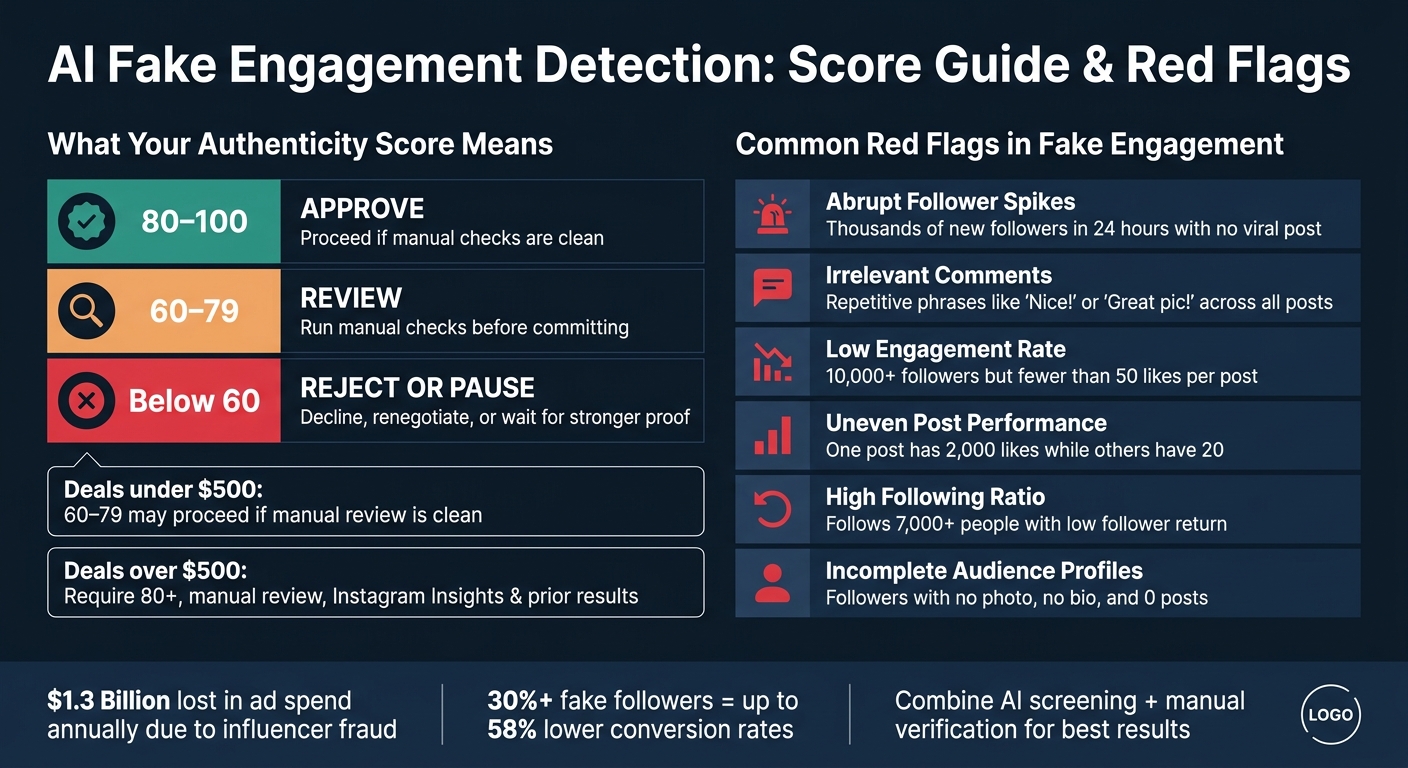
AI Fake Engagement Detection: Score Guide & Red Flags
When to approve, review, or reject an account
Once a report flags risk, turn that score into a clear decision. AI authenticity scores work best as a screening tool, not a one-shot yes/no rule.
| Score Range | Decision | Next Step |
|---|---|---|
| 80–100 | Approve | Proceed if manual checks are clean |
| 60–79 | Review | Run manual checks before committing |
| Below 60 | Reject or pause | Decline, renegotiate, or wait for stronger proof |
For deals under $500, an account in the 60–79 range can move forward if the manual review looks clean. For deals over $500, set a higher bar: require 80+, a manual profile review, Instagram Insights, and prior campaign results.
How to confirm AI findings manually
Use the score as a filter, then check the account yourself.
AI scores show you where to look. Manual checks show you what's actually there.
Start with the account’s recent followers. Review the last 50–100 and watch for empty profiles, missing photos, no posts, odd usernames, or very high following-to-follower ratios. If you see those signs in clusters, that’s usually a red flag.
Then read comment threads on at least five recent posts. Generic replies like “Nice!” or “Great pic!” repeated again and again can point to weak engagement. Comments that mention the post itself are usually a better sign.
After that, compare the audit with Instagram Insights or other first-party analytics when you can get them. Say the audit shows a big share of overseas followers, but Insights says the audience is mostly U.S.-based. That kind of mismatch deserves a closer look.
Why building an audience without shortcuts matters
Cleaning up fake engagement after the fact is expensive and slow. It can skew performance data, hurt trust, and create problems that are much harder to fix later. That’s why authenticity checks should be part of your normal workflow, not something you do only when a campaign falls apart.
Use AI to screen accounts. Check borderline cases by hand. Put audience quality ahead of follower count. Use the score, review the profile, and make sure the audience is real.
Conclusion: Key points to remember about AI fake engagement detection
After reviewing the report and checking the account by hand, a few points stand out.
AI fake engagement detection works best when you use it for pattern analysis. Don’t fixate on one signal in isolation. Look for groups of signs that show up together: spikes in activity, long periods of dormancy, generic comments, incomplete profiles, and skewed follower ratios. Think of the score as a screening signal first, then confirm what’s going on with a manual review.
The risk is real. Fake engagement can distort ad spend and weaken campaign results.
The most reliable approach is to combine AI screening, report analysis, and manual verification. On top of that, run monthly audits to keep audience quality high.