
Ultimate Guide to Scaling Instagram Collaborations
Practical guide to finding, vetting, and managing Instagram creator collaborations at scale using templates, AI tools, scheduling, and KPI tracking.
Practical guide to finding, vetting, and managing Instagram creator collaborations at scale using templates, AI tools, scheduling, and KPI tracking.

Scaling Instagram collaborations can help you grow your audience, boost engagement, and drive revenue. By partnering with creators and brands, you tap into their networks, making your content visible to new audiences. Here’s a quick breakdown:
This guide covers how to find the right creators, manage campaigns, and track performance to grow your Instagram presence effectively.
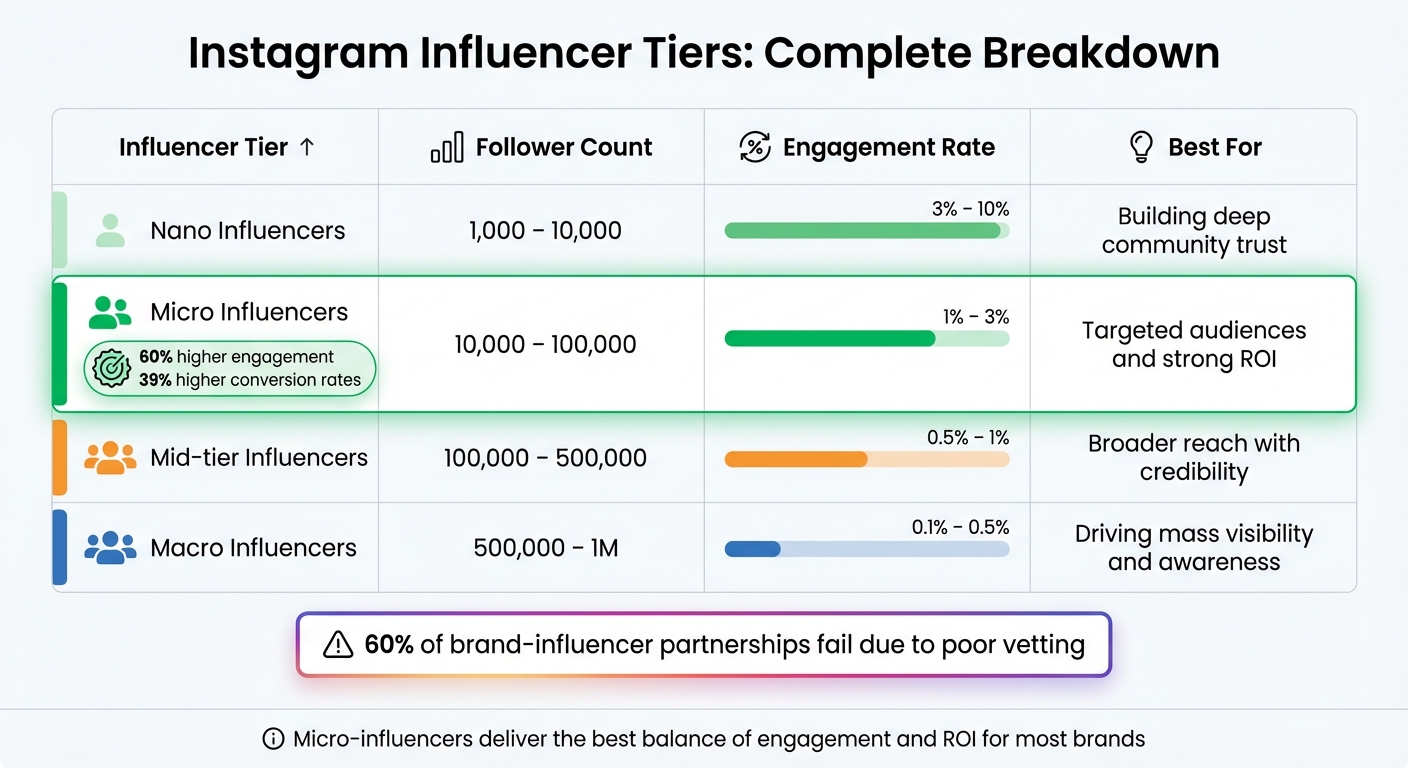
Instagram Influencer Tiers: Follower Count, Engagement Rates & Best Use Cases
Partnering with the right collaborators is key to any scaling strategy. But it’s not about teaming up with just anyone who has a following - it’s about working with creators whose audiences genuinely align with your brand. Micro-influencers, those with 10,000 to 100,000 followers, are especially effective. They deliver 60% higher engagement and 39% higher conversion rates thanks to their loyal, niche audiences, which can significantly improve ROI.
Once you’ve identified potential collaborators, thorough vetting is a must. Around 60% of brand-influencer partnerships fail or underperform due to poor vetting or mismatched audiences. This means you should look beyond basic metrics like follower numbers. Focus on engagement quality, audience authenticity, and alignment with your brand values. A creator with 50,000 followers and strong engagement can often outperform one with 200,000 followers but less authentic interaction.
To locate the right creators, start by exploring industry-specific hashtags like #sustainablefashion or #naturalhairtips. These can help you find creators actively engaging in your niche. Instagram’s Explore page and Reels are also great tools - search for trending sounds relevant to your field and see which creators are using them effectively.
Competitor analysis is another smart tactic. Check out who follows and comments on your competitors’ posts. These engaged users are often familiar with your product category and could be open to collaborations. For B2B campaigns, LinkedIn is invaluable - search for thought leaders with 10,000 to 50,000 followers who are recognized in their field.
You can also look for creators who already use tags like #Ad or #Gifted. These individuals are experienced in brand collaborations and often have established workflows.
| Influencer Tier | Follower Count | Engagement Rate | Best For |
|---|---|---|---|
| Nano | 1,000 – 10,000 | 3% – 10% | Building deep community trust |
| Micro | 10,000 – 100,000 | 1% – 3% | Targeted audiences and strong ROI |
| Mid-tier | 100,000 – 500,000 | 0.5% – 1% | Broader reach with credibility |
| Macro | 500,000 – 1M | 0.1% – 0.5% | Driving mass visibility and awareness |
After identifying creators, assess their authenticity and engagement levels before moving forward.
Once you’ve found potential collaborators, it’s time to dig deeper into their audience and content. Start by checking for audience authenticity. Look out for sudden spikes in follower counts or generic, bot-like comment patterns. Sampling 50–100 followers can give you a clearer picture of their audience quality. This step matters because 71% of consumers unfollow influencers caught using fake followers, which could harm your brand’s reputation.
Next, evaluate engagement quality. Don’t just count likes - look at comments, shares, and saves. These actions are stronger indicators of campaign impact. For example, "Saves" might be worth three times more than "Likes", and "Shares" four times more. As Volodymyr Lebedenko, Head of Marketing at HostZealot, advises:
Analyze the comment section closely. Are followers engaging in meaningful conversations? Are they asking topic-related questions? Or are they simply dropping emojis?
Pay attention to thoughtful interactions rather than empty gestures.
Geographic alignment is another key factor. Make sure the creator’s audience is in regions where your product is available. Also, review the creator’s bio, tone, and past brand collaborations to ensure they align with your brand’s voice and values. A helpful guideline is the "70/30 rule" - give 70% direction while leaving 30% creative freedom to let the creator maintain their authentic voice.
Finally, assess the creator’s track record with past partnerships, including references and responsiveness (ideally within 24–48 hours). With 73% of brands expected to prioritize authenticity in creator partnerships by 2026, taking time to vet properly is crucial. A structured approach, like using a weighted scoring matrix (e.g., 25% for Audience Fit, 20% for Engagement Rate, 20% for Brand Safety), can help you make objective, data-driven decisions.
Once you've chosen the right collaborators, the next big challenge is managing multiple partnerships without losing focus on quality or deadlines. By 2025, brands are expected to work with 15–25 creators per campaign. To simplify communication, ditch scattered emails and direct messages in favor of a centralized project management system.
Standardized templates for creative briefs, digital contracts, and feedback processes are essential when scaling up to 15 or more creators. Adding schedule buffers can be a lifesaver - if one creator falls behind, the entire campaign won't come to a halt.
Using a tiered approach can also make a big difference. Different types of creators need different levels of engagement. Macro-influencers might need detailed guidance and regular check-ins, while micro-influencers often thrive with clear but flexible guidelines. Campaigns involving 5–20 creators in a tiered structure have shown an average ROI of 4.5×, compared to 3.2× for campaigns with a single creator. Assigning specific roles within your team - like influencer search, performance tracking, or approvals - helps avoid confusion and keeps everything running smoothly.
Efficient workflows are what separate organized campaigns from chaotic ones. An asynchronous-first workflow, where both your team and creators can contribute on their own schedules, works especially well for teams spread across time zones. Automating payments can further build trust with creators and encourage them to work with you again.
Real-time dashboards are another game-changer. By tracking engagement rates, reach, and sentiment across all creator accounts, you can quickly identify top performers and adjust your strategy. Brands using these dashboards have seen up to 67% higher ROI compared to those relying only on surface-level metrics. For example, a sustainable fashion brand that partnered with 20 micro-influencers (each with 5,000–15,000 followers) reached 1.2 million people and exceeded its conversion goals by 43%.
These systems not only streamline current operations but also set the stage for integrating AI tools to further simplify campaign management.
AI tools can make managing multiple collaborations much easier. For instance, UpGrow uses artificial intelligence to provide real-time analytics, automate growth, and optimize profiles. It focuses on organic follower growth through a mix of AI and human expertise, offering features like location filtering and detailed performance analytics to help you identify which collaborations are actually delivering results.
Advanced AI systems can even predict the best-performing creator combinations by analyzing audience overlap and engagement history before a campaign starts. During a campaign, these tools can monitor performance and suggest changes if certain creators aren't meeting expectations. Additionally, social media analytics platforms with automated tracking can cut down on manual data entry by as much as 80%.
Once you have robust systems and AI tools in place, tracking performance becomes the next step. Start by defining clear KPIs for each creator type: macro-influencers might focus on building broad awareness, while micro-influencers are better suited for driving conversions and authentic engagement. Instead of focusing solely on likes, look at metrics like saves and shares, which indicate deeper interest and potential for virality.
Using UTM parameters is another effective strategy. These help you track website traffic, add-to-cart actions, and purchases linked to each creator. A multi-touch attribution model can reveal which collaborators are most influential in a customer's journey. For example, a tech product launch that used a mix of mid-tier creators for educational content, micro-creators for platform-specific engagement, and macro-influencers for credibility saw 2.8× higher sign-ups compared to previous single-influencer campaigns.
It's also worth keeping an eye on relationship health. Monitoring creator satisfaction and repeat collaborations can show that long-term partnerships often deliver better ROI than one-off deals. Lastly, ensure any third-party tracking tools you use are compliant with Meta-authorized APIs and OAuth authentication to protect your accounts. To assess whether your management platform is worth the cost, use this formula:
(Time Saved × Hourly Rate) + Revenue Impact > Monthly Cost.
| Tool Type | Key Features for Scaling |
|---|---|
| Campaign Management | Centralized briefs, digital contracts, automated payments |
| Project Tracking | Task assignments, workflow automation, deadline tracking |
| Analytics & Reporting | Real-time ROI tracking, sentiment analysis, attribution |
| Content Planning | Visual calendars, multi-account scheduling, approval workflows |
Running campaigns with multiple collaborators is no small feat. The real challenge lies in keeping everything organized while ensuring that quality remains consistent. Managing large-scale campaigns demands a different strategy compared to one-off collaborations - it’s all about maintaining balance without overwhelming your team or audience.
Timing can make or break a campaign. Did you know that Instagram posts with collaborators generate 4.39 times more interactions than solo posts? They also achieve 4.78× more impressions than standard posts. To take full advantage of these benefits, especially at scale, you need a scheduling system that minimizes manual work.
The problem with native tools? They require you to invite collaborators at the exact moment of publishing. That’s fine for a single post but becomes chaotic when juggling multiple creators across different time zones. Thankfully, third-party scheduling platforms can automate collaborative posts across feeds, Reels, and carousels. This eliminates the last-minute rush and keeps everything on track.
Fast forward to 2026, and Instagram now allows brands to invite collaborators after a post goes live. Forgot to add a partner? No problem - you can include them mid-campaign without having to delete and repost. Plus, you can now add up to five collaborators (six accounts total) to a single post or Reel.
For big launches, consider breaking your content into phases: start with a teaser, follow up with a live announcement, and wrap up with a recap. This keeps your audience engaged over time. If you have a professional account, you can schedule collaborative posts up to 75 days in advance. However, some platforms might still require a "Notify Me" step to finalize collaborator invitations.
"I would recommend having the larger of the two creators initiate the collab, that seems to do better… it will allow that post to go to not just your followers but their followers as well, and because they have more, that will help your reach."
- Adam Mosseri, Head of Instagram
These scheduling updates make it easier than ever to keep campaigns running smoothly while maximizing audience interaction.
Once your content is scheduled, interactive tools can take your engagement to the next level. Features like polls, emoji sliders, and question stickers invite active participation from your audience. When scaling collaborations, these tools can help maintain a sense of authenticity while gathering valuable feedback. Instead of pushing promotional messages, use interactive content to learn what your audience cares about - their preferences, challenges, and interests.
Pairing interactive elements with Instagram's "Collab" feature amplifies their impact. When multiple creators share a post that includes interactive stickers, you’re engaging multiple communities at once. The secret? Give collaborators creative freedom. Less control often leads to more natural, engaging content. And here’s a key stat: 61% of consumers are more likely to advocate for a brand they fully trust, and authenticity plays a big role in earning that trust.
Take LitJoy Crate and To Bee Read as an example. They co-authored posts for waitlist sales and used interactive prompts to ask followers for "hot takes" and book-related opinions. Sharing controversial responses sparked lively discussions and strengthened community ties. Similarly, Booking.com teamed up with niche “mermaid” creators during New York’s Fleet Week. By allowing these creators to stay true to their unique style while subtly incorporating the brand, they connected with a specific audience during a relevant moment - without coming off as overly corporate. The lesson? Subtle branding, like using props or merchandise, works far better than forced captions.
Timing matters here, too. Post interactive stories and polls during peak activity hours to maximize participation. Sharing poll results not only encourages further discussion but also shows your audience that their input is valued. This approach doesn’t just boost engagement - it doubles as cost-effective market research.
| Interactive Feature | Best Use Case | Engagement Benefit |
|---|---|---|
| Polls | Gauge audience preferences for content or product features | Encourages quick interaction and provides insights |
| Emoji Sliders | Measure the intensity of audience feelings on a topic | Offers more nuanced feedback than simple polls |
| Question Stickers | Collect open-ended feedback or ideas from followers | Builds stronger community ties and uncovers authentic opinions |
| Quizzes | Educate audiences about products or brand values in a fun way | Increases time spent on content and boosts shareability |
The Instagram algorithm favors content with high interaction. Using interactive stickers can increase your chances of landing on the "Explore" page. As Hootsuite puts it:
"Collabs let you show the more human side of your brand - less polished, more personal, and way more engaging."
This human touch is crucial to avoid the pitfalls of mass marketing. It’s about creating campaigns that feel personal and resonate with your audience.
Tracking the right metrics is the difference between campaigns that look good on the surface and those that genuinely drive results. One crucial metric is Engagement Rate by Reach (ERR), which evaluates content quality independently of how widely it’s distributed. This helps determine whether your collaboration resonates with the audience, regardless of reach. Aim for a 50%+ average view duration on Reels and high save or share rates to ensure your content provides ongoing value.
To measure sales directly, establish baseline revenue and use UTM parameters like ?utm_source=influencer&utm_medium=instagram to track the performance of each influencer. Remember, the quality of engagement matters more than follower count - 73% of marketers consider influencer fraud their top concern for 2026. Spot red flags like sudden spikes in followers or engagement rates below 1%.
Here’s a simple ROI formula:
ROI = [(Sales from Campaign – Campaign Costs) ÷ Campaign Costs] × 100
Don’t forget hidden costs such as team hours, software fees, and product gifting, as ignoring these can inflate your ROI by 30–50%. Use a 60–90 day attribution window instead of the typical 7–14 days, as influencer campaigns often yield long-term results. Interestingly, customers acquired through influencers tend to have a 23% higher lifetime value compared to those from paid ads.
| Metric | What It Measures | Success Benchmark |
|---|---|---|
| ERR (Engagement Rate by Reach) | Content quality | Maintain or improve rate as reach grows |
| Average View Duration | Reel retention | 50%+ for Reels |
| Reach Expansion | New accounts reached | Significant lift compared to solo posts |
| Save Rate | Evergreen value | High volume indicates long-term utility |
Structured tracking of partnerships can improve ROI confidence by 73%. Keep an eye on "reach expansion", which tracks the number of new accounts reached through an influencer’s audience. Ideally, the overlap between your audience and the influencer’s should be 20–40% for the best results.
While metrics are key, avoiding common mistakes is just as important to ensure successful collaborations. One major misstep is restricting creators too much. As Meagan Lum, Social Media Strategist at Booking.com, advises:
When collaborating with a creator, the best thing you can do is give them creative freedom and let them do their thing. The fewer restrictions and mandatory branded keywords you impose on them, the better the content will be.
Overly rigid guidelines can strip away the authenticity that makes influencer content so impactful.
Another common issue is a concept-feed mismatch, where the content doesn’t align with the influencer’s style or niche. This can hurt engagement, even if the partnership seems logical on paper. To avoid this, test the waters: run A/B tests comparing solo posts versus collaborative ones with identical hooks and timing. For example, a trainer and nutritionist collaboration led to a 113% increase in reach and a 174% boost in follower growth compared to solo efforts.
Managing more than 50 partnerships through spreadsheets and emails can also backfire. 68% of brands report struggling with quality and ROI when scaling partnerships this way. Using dedicated platforms to handle contracts, payments, and compliance can reduce admin work by 60–70% and help catch compliance issues early. Always disclose sponsored content with labels like "Paid Partnership" or #ad to stay within FTC guidelines and maintain trust.
Finally, watch for private account limitations. If an influencer’s account is private, their posts won’t be visible to anyone outside their follower list, no matter the collaborator’s reach. Diversify your influencer portfolio to avoid over-reliance on one type of creator. Brands that use a mix of influencers see 23% higher engagement rates. A balanced budget allocation - 40% to micro-influencers, 35% to macro, 15% to mega, and 10% to nano - can help you strike the right balance between reach, cost, and authenticity.
Growing your Instagram collaborations effectively demands a smart, data-focused strategy. Brands experiencing over 50% annual revenue growth are now leveraging AI-powered tools to identify niche creators and confirm authentic engagement rates between 2% and 8%. These tools, paired with real-time performance dashboards, are setting a new benchmark for streamlined campaign management.
The numbers speak for themselves: influencer content generates 11× higher ROI compared to traditional digital marketing, with 89% of marketers vouching for its superior results. These outcomes are driven by a mix of precise discovery methods, organized management systems, and diverse collaboration styles. From cross-promotions with other brands to Instagram Collabs (allowing up to five partners per post) (allowing up to five partners per post), the possibilities for partnership-driven growth are expanding.
Platforms like UpGrow simplify this process. With features like AI Smart Search, you can filter creators by niche, location, and engagement. The Engagement Rate Calculator ensures authenticity, while the Brand Matchmaker connects you with creators whose audience aligns with your target demographic. These tools take the guesswork out of managing influencer partnerships, saving time while boosting results.
Striking the right balance between creative flexibility and performance metrics is crucial. As Alyssa Gagliardi from Later aptly states:
Engagement is currency, and when it's shared, all collaborators cash in.
With 90% of Instagram users already following at least one brand, the potential for meaningful partnerships is enormous.
Clear vetting, diverse collaborations, and AI-driven tools like UpGrow can turn Instagram into a powerful growth platform. With a free trial, Growth-Guarantee, and plans starting at $39/month, you have everything you need to scale your collaborations and drive sustainable results.
You can determine if a creator’s followers are genuine by examining a few key factors:
To spot these red flags, you can rely on AI-powered tools or even conduct manual checks. Both methods can help reveal patterns that indicate whether a following is authentic or artificially inflated.
To grow rapidly through Instagram collaborations, make sure your collab brief covers the essentials. Start with clear objectives - whether you’re aiming to boost reach, drive engagement, or achieve another goal. Include details about your target audience, such as their age, gender, location, and interests, so collaborators can tailor their content effectively. Be specific about content expectations, outlining required post formats, branding guidelines, and messaging.
Don’t forget to add timelines, deliverables, and performance metrics to track results. Also, clarify communication channels and provide key contact information to streamline the process. Tools like UpGrow can assist in refining your targeting and analyzing performance, helping you achieve faster results. A detailed, well-organized brief keeps everyone on the same page and ensures smoother execution.
To figure out how much each collaborator contributes to sales, rely on influencer campaign analytics and attribution methods. These tools allow you to track specific touchpoints and conversions tied to each partnership. By focusing on clear metrics and KPIs, you can assess how these collaborations affect revenue and overall business performance.
Share this post


