
Ultimate Guide to Instagram Multilingual Chatbots
Step-by-step guide to building Instagram multilingual chatbots: language detection, real-time translation, consistent brand tone, analytics, privacy, and ROI.
Step-by-step guide to building Instagram multilingual chatbots: language detection, real-time translation, consistent brand tone, analytics, privacy, and ROI.
4.98 /5 - from 58k reviews
Trusted by 50,000+ creators — get real engagement delivered to your profile in minutes, not days.
Instagram multilingual chatbots help businesses communicate with users in their preferred language, boosting customer engagement and satisfaction. Here's why they matter:
These bots improve global reach, user experience, and customer support speed. For example, Veritas Finance added regional languages and saw a 40% increase in interactions, while INAI improved satisfaction by 45% with bilingual support.
Key Features:
Setup Steps:
Measure performance by tracking metrics like resolution rates and satisfaction scores. Regularly refine the bot using user feedback and analytics. With proper implementation, multilingual chatbots can transform your Instagram marketing strategy.
Multilingual Instagram Chatbot Statistics and ROI Benefits
Multilingual chatbots open the door to global markets that were once out of reach due to language barriers. Think about the millions of Chinese, Spanish, and Arabic speakers who might skip over brands that only communicate in English. By speaking their language, businesses can connect with these untapped audiences.
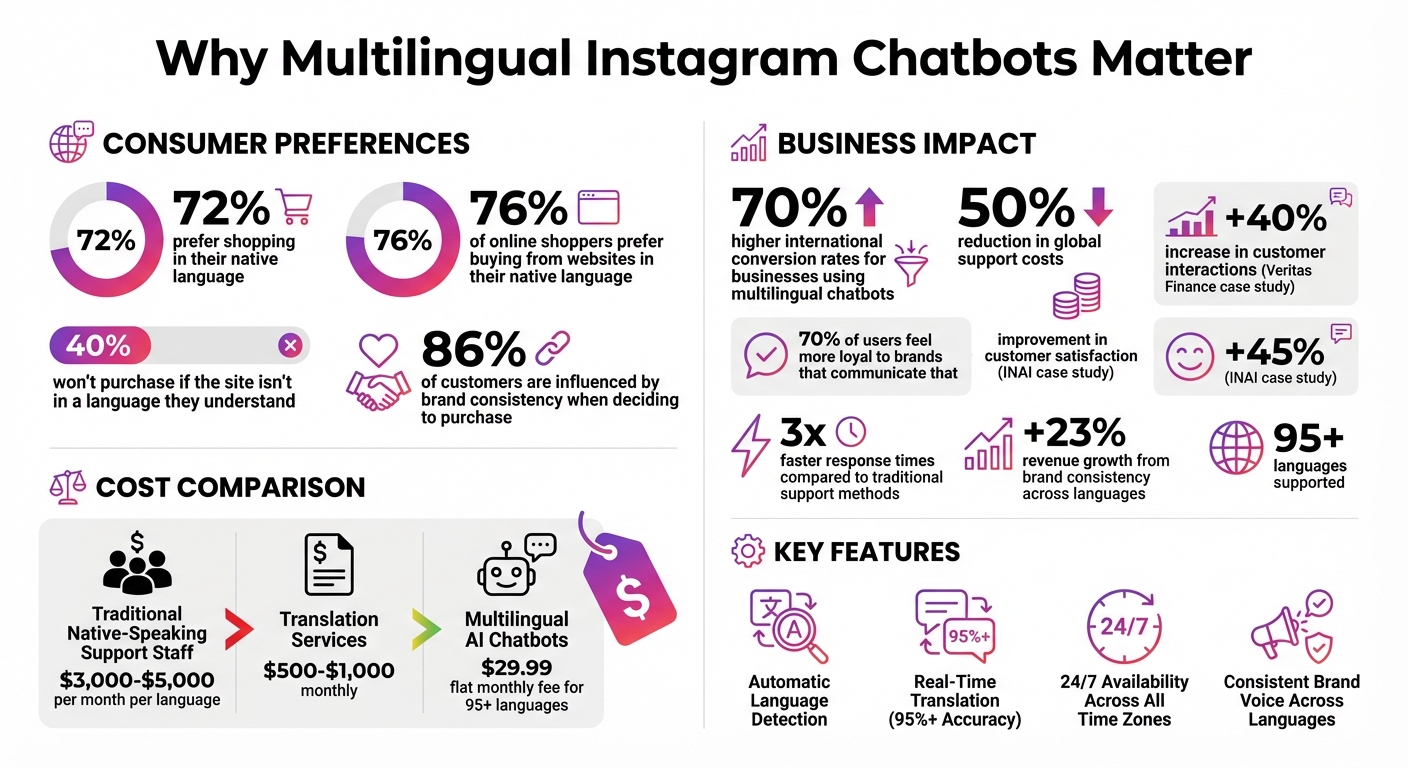
The results speak for themselves. Take Veritas Finance Limited, an Indian financial institution. In 2024, they introduced a multilingual chatbot to serve rural MSMEs struggling with language barriers. By adding support for Hindi, Bengali, Kannada, Tamil, and Telugu, they saw a 40% jump in customer interactions, reaching markets they couldn't before. Similarly, Mexico’s INAI (National Institute for Transparency) launched a bilingual chatbot in English and Spanish, boosting customer satisfaction by 45% by offering information in users' preferred languages.
Here’s a telling stat: 76% of online shoppers prefer to buy from websites in their native language, and 40% won’t even consider making a purchase if the site isn’t in a language they understand. If your Instagram account sticks to English only, you could be missing out on a massive chunk of potential customers and opportunities to get more followers on Instagram organically.
By breaking language barriers, businesses not only expand their reach but also create a more personalized experience that aligns with users' expectations.
When people can interact in their native language, it creates a sense of ease and trust. Modern multilingual chatbots take this to the next level. They can automatically detect a user’s language from the first message - no awkward menu navigation or manual selection required. Even better, they adapt to cultural subtleties, like choosing between the formal "Usted" and casual "Tú" in Spanish, or recognizing regional slang and terminology. Some bots even allow code-mixing, so bilingual users can switch languages mid-conversation without missing a beat.
These thoughtful features make a real difference. Businesses that provide native-language support report a 40% increase in satisfaction among non-English speakers. Plus, 70% of users say they feel more loyal to brands that communicate in their preferred language.
It’s not just about understanding - it’s about making every interaction seamless and human.
Speed matters, especially on Instagram. Multilingual chatbots can respond to international customers three times faster than traditional support methods. They’re available 24/7, no matter the time zone, and don’t require the hefty costs of hiring human staff around the clock. Businesses can further optimize their workflow by using free AI-powered Instagram tools to manage engagement alongside their chatbot.
The financial benefits are hard to ignore. Hiring native-speaking support staff can cost between $3,000 and $5,000 per month per language. In contrast, multilingual AI chatbots often run on a flat monthly fee - like $29.99 for support in over 95 languages. Even translation services, which can cost $500 to $1,000 monthly, can’t compete with the instant responses that AI-powered chatbots provide.
Top-tier multilingual chatbots eliminate the need for users to manually pick their language. Instead, they tap into Natural Language Processing (NLP) and machine learning to identify the user's language right from the first interaction. By analyzing linguistic patterns and character sets - like Chinese or Cyrillic - these systems use probabilistic models to differentiate between closely related languages, such as Spanish and Italian.
Once the language is detected, the chatbot seamlessly switches to the corresponding language model, ensuring responses are both accurate and context-aware. Advanced systems go a step further by interpreting user intent and adapting to cultural subtleties. To handle mixed-language inputs, many chatbots include a fallback mechanism that defaults to the last detected language.
"A multilingual AI chatbot automatically detects the user's language and responds accordingly. It uses advanced natural language processing (NLP) to understand and translate in real-time, offering a personalized experience." - BotPenguin
For added flexibility, a manual "Language Switch" option can help users override detection errors. Platforms like Instagram even offer tools like the {{locale}} attribute to identify a user’s default app language, simplifying the process.
Next, let’s see how real-time translation enhances these interactions by adding deeper cultural relevance.
Real-time translation relies on Neural Machine Translation (NMT) and large language models to deliver quick, accurate, and context-sensitive responses.
Here’s how it works: APIs like Google Translate or Microsoft Translator - or native AI models - process user input, tap into a centralized knowledge base, and craft a response in the detected language. This all happens in mere seconds. For languages with unique layouts, such as Arabic or Hebrew, advanced systems ensure proper formatting for right-to-left (RTL) scripts and compatibility with Unicode fonts.
Modern AI translation tools boast over 95% accuracy for business communications. By maintaining a single knowledge base - often in English - and leveraging AI for translations, businesses can avoid the hassle of creating and updating separate language scripts. Additionally, uploading industry-specific glossaries ensures that technical jargon and brand-specific terms are translated consistently.
Accurate language detection and translation are just the beginning. To truly connect with customers, your brand’s tone and personality must remain consistent across all languages. Studies show that 86% of customers are influenced by brand consistency when deciding to purchase or stay loyal. A chatbot that mirrors your brand’s voice - whether in English, Spanish, or Japanese - strengthens trust and reinforces your professionalism.
Direct translations often fall short when it comes to cultural subtleties. To bridge this gap, effective chatbots use conversational style guides and custom glossaries to maintain a uniform, engaging tone across languages.
Managing your messaging through a centralized platform makes this process even smoother. Update your content once, and those changes will reflect across all supported languages. This approach not only saves time but also ensures that every market receives the same up-to-date information. Companies that prioritize brand consistency can see revenue growth of up to 23%.
Ready to bring a multilingual chatbot to your Instagram? Follow this step-by-step guide to get everything up and running smoothly.
Start by ensuring your Instagram Business or Creator account is linked to a Facebook Business Page where you have admin access. Keep in mind that your account should have fewer than 500,000 followers. Once connected, enable API access by navigating to Privacy > Messages on Instagram and toggling on "Allow Access to Messages".
It's also crucial to verify that the platform you choose to build your chatbot is an authorized Meta partner. This helps you stay compliant with Instagram's policies.
Pick a chatbot platform that offers tools for both automation and multilingual functionality. Look for features like a visual flow builder and localization options to provide a seamless experience across different languages. Some popular platforms include:
The best platforms allow you to create a master conversation flow in one language and then duplicate it for translation into other languages. This saves time compared to building separate bots from scratch. For even better results, choose platforms that support automatic language detection using system attributes like {{locale}}. If the platform integrates with NLP tools like Dialogflow, your bot can better understand slang, regional dialects, and user intent.
To make your chatbot effective, map out common user questions and craft responses for each language. Start with a welcome message that includes buttons or quick replies, giving users the option to manually select their language if automatic detection isn't enough. Set up triggers based on keywords, phrases, or even emojis, and use branching logic to guide conversations dynamically depending on the language or user interaction.
Keep the tone conversational and engaging - add emojis sparingly to keep things fun. Always include a "Talk to Agent" option so users can connect with a human if the bot encounters a language it doesn’t recognize or a more complex query. Once you've configured responses, test everything thoroughly before moving forward.
Before your chatbot goes live, test it thoroughly using a personal Instagram account rather than your business account. Some platforms may require assigning your test account "Owner" status via a QR code or link to enable internal testing flows.
Here’s a checklist to guide your testing process:
| Testing Element | Purpose | Success Criteria |
|---|---|---|
| Welcome Message | First interaction | Automatically triggers on subscription or the first DM. |
| Standard Reply | Fallback for unknown input | Offers a helpful response or a "Talk to Human" option. |
| User Input Field | Collecting user data | Correctly saves variables (e.g., email, language preference) to your CRM. |
| Unsubscribe Command | Compliance with regulations | Successfully removes the user from the bot list and sends a confirmation. |
During testing, include internet slang, common typos, and emojis to ensure the chatbot recognizes triggers in all supported languages. Also, confirm that the human handover process works smoothly and that all conversation logs appear correctly in your platform's Conversations or Inbox tab.
Once your testing confirms everything is working as expected, launch your chatbot. Monitor analytics right away to track user sessions, message flows, and any potential issues, such as conversation loops where users might get stuck.
Once your multilingual chatbot is live, it’s critical to track its performance for each language. Start by segmenting analytics by language - this means monitoring metrics like resolution rates, conversation length, and Customer Satisfaction (CSAT) scores for every language version. This approach helps pinpoint areas needing improvement. For example, you might notice users of a specific language experiencing longer resolution times or dropping off more frequently.
Key performance indicators like response accuracy (aim for over 85%) and fallback rate (keep it under 15%) are essential. To uncover issues, review at least 20 random chat transcripts per language each month and tweak the bot’s logic as needed. This data-driven strategy allows you to refine each language version of your chatbot.
In June 2024, ZALORA, a fashion e-commerce platform, introduced an AI-powered customer service chatbot across Southeast Asia. The bot allowed users to seamlessly switch between English, Mandarin, and other local languages mid-conversation, boosting their customer inquiry deflection rate by 30%. Similarly, Kuwait Telecommunications Company (stc) deployed a multilingual chatbot supporting Arabic and English on its website and WhatsApp. This resulted in a 60% automation rate for routine tasks and reduced customer wait times to under one minute.
To measure success, track metrics like Goal Completion Rate (GCR), Human Takeover Rate (keep it below 20%), and CSAT scores (target 80% or higher) for each language. Since different languages and regions often have unique conversational norms, it’s better to set baseline KPIs for each language rather than applying a universal benchmark.
Performance data can guide efforts to improve response quality. Use Natural Language Processing (NLP) to interpret user intent and context rather than relying on literal translations, which often miss subtleties like slang or idiomatic expressions. Regularly update the chatbot’s knowledge base with regional dialects, local slang, and culturally specific phrases based on actual user interactions. Before launching or updating a language, have native speakers test the bot to ensure it feels authentic and contextually accurate.
To maintain consistency, create a multilingual glossary of 50–150 key terms (e.g., product names or policies) and a style guide covering elements like formality and date formats. Additionally, track "unknown intent" errors by language to identify which FAQs need to be developed or refined. When the bot struggles to understand a query, program it to ask clarifying questions in the user’s language instead of defaulting to English.
Even the most advanced chatbot needs human support for complex scenarios. Set up clear handover triggers for situations where sentiment analysis detects frustration or when queries exceed the bot’s capabilities, ensuring a smooth transition to a human agent. A strong containment rate - where 70% to 80% of queries are resolved without human intervention - is a good benchmark.
"Measuring chatbot performance is the only way to know whether your AI agents are helping users or frustrating them." - Jotform
It’s worth noting that 76% of consumers prefer interacting with brands in their native language, and 68% would switch to a competitor offering native-language support. By consistently monitoring performance and making adjustments based on data, you can create a chatbot experience that feels personal and effective, no matter the language.
Once you've refined your performance metrics, it's time to tackle the common hurdles that come with multilingual chatbots. These challenges - like language detection errors, regional dialect variations, and data privacy concerns - can impact user experience and even lead to frustrated customers abandoning their Instagram DMs. Here's how to address them effectively.
One common issue is that chatbots can struggle with short, ambiguous inputs like "Hi" or "OK", or they might confuse similar languages, such as different variants of Spanish. To overcome this, implement automatic language detection followed by a quick confirmation prompt, such as: "I detected Spanish; would you like to continue in this language?" This allows users to correct the bot immediately if needed.
Adding a "Change Language" button gives users more control, allowing them to manually select their preferred language. Additionally, leveraging device language settings can improve accuracy. If the chatbot is uncertain about the language, it’s best to default to English while offering a menu of other options for the user to choose from.
Dialects and regional variations can significantly impact how users interact with your chatbot. These differences go beyond just vocabulary - they can influence preferences for payment methods, levels of formality, and even emoji usage. For example, some users might expect cash-on-delivery options, while others prefer digital payments like Apple Pay.
To address this, train your chatbot with localized datasets that include regional slang and idioms. Create region-specific conversation flows to better match local expectations. Maintaining a glossary of 50–150 key terms - covering product names, technical terms, and policy language - ensures consistency across all translations. Before rolling out or updating a language, test it with native speakers through A/B testing to fine-tune tone, formality, and any cultural nuances. Advanced NLP tools can also help your chatbot maintain context when users switch languages mid-conversation.
Managing user data responsibly is critical, especially when dealing with multilingual chatbots that operate across different regions. Compliance with regulations like GDPR, Germany's TTDSG, and the upcoming EU AI Act (effective August 2026) is non-negotiable. GDPR, for example, requires a lawful basis for every instance of data processing, such as explicit user consent or fulfilling a contract. By 2026, EU-based chatbots must also clearly disclose when users are interacting with AI rather than a human.
To safeguard privacy, redact personally identifiable information (PII) - like names, email addresses, and order numbers - before sharing data with third-party services. Set short retention periods for chat transcripts, and provide users with easy ways to access, modify, or delete their data. Using active opt-ins, such as an unchecked checkbox before starting a chat, ensures informed consent. For large-scale or high-risk deployments, conducting a Data Protection Impact Assessment (DPIA) can help identify and address potential risks.
If you plan to use user conversations to train your AI models, transparency is key. Clearly disclose this practice and offer an explicit opt-out option. Non-compliance with GDPR can result in penalties of up to €20 million, so integrating privacy protections into your chatbot’s core design is not just a legal requirement - it’s a best practice. With these measures in place, you can focus on refining your chatbot's performance while keeping user trust intact.
Multilingual chatbots have become a game-changer for Instagram brands aiming to thrive in the global marketplace. With English speakers making up only a portion of the worldwide audience, offering support in native languages opens doors to markets that were once out of reach. This approach lays the groundwork for a focused and effective multilingual strategy on Instagram.
Here’s why it matters: Studies show that most consumers prefer businesses that communicate in their native language, a factor that directly influences both purchasing decisions and customer loyalty. In other words, speaking your audience’s language isn’t just polite - it’s profitable.
The return on investment speaks for itself. Companies using multilingual AI chatbots report noticeable boosts in international conversion rates while cutting global support expenses significantly. On top of that, these bots deliver responses up to three times faster than traditional methods, providing 24/7 availability across all time zones without requiring staff to work odd hours.
Achieving success, however, takes more than just deploying a chatbot. Start by focusing on the languages that align with your largest customer bases or those with the most revenue potential. Test your chatbot extensively with native speakers to ensure accuracy and authenticity. A hybrid model - where the bot can seamlessly transfer complex inquiries to human agents - ensures smooth interactions. And don’t overlook the importance of tailoring your chatbot to reflect local customs, preferences, and communication styles. By following these steps, you can create genuine connections with a global audience and unlock the full potential of multilingual engagement.
Start by focusing on languages that align with your audience and market opportunities. Spanish, Mandarin, and Arabic are among the most widely spoken languages globally, offering the chance to connect with diverse groups. For example, in the U.S., 22% of residents speak Spanish at home, making it a strong contender for your initial rollout.
It's smart to begin with one or two primary languages that have the most potential impact. Once your chatbot gains traction and evolves, you can gradually add more languages to broaden its engagement and reach worldwide.
To fix language detection errors in your multilingual Instagram chatbot, consider these steps:
Additionally, crafting customized greetings or prompts for each language can help improve interactions and make communication smoother for users from diverse backgrounds.
When it comes to Instagram chatbots, data privacy is tightly regulated by Meta's policies. These policies are designed to ensure compliance with privacy laws like GDPR.
Here’s what businesses need to keep in mind:
Meta also has strict rules for AI-driven features. These features can only operate with user permission, and interactions with the chatbot may be used for targeted advertising. However, users have the option to adjust their privacy settings or opt out of such ads.
Share this post


