
Ultimate Guide to Instagram Hashtags 2026
2026 Instagram hashtag tactics: prioritize 3-9 targeted niche tags, optimize placement for Reels and Stories, avoid banned tags, and use AI for analytics.
2026 Instagram hashtag tactics: prioritize 3-9 targeted niche tags, optimize placement for Reels and Stories, avoid banned tags, and use AI for analytics.
4.98 /5 - from 58k reviews
Trusted by 50,000+ creators — get real engagement delivered to your profile in minutes, not days.

In 2026, Instagram hashtags are no longer about quantity - they’re about precision and context. Hashtags now act as semantic signals that help Instagram's AI categorize your content, ensuring it reaches the right audience. Here's what you need to know:
Hashtags are now a tool for categorization and discovery, not just visibility. Pairing a smart hashtag strategy with tools like UpGrow can drive real results in 2026.
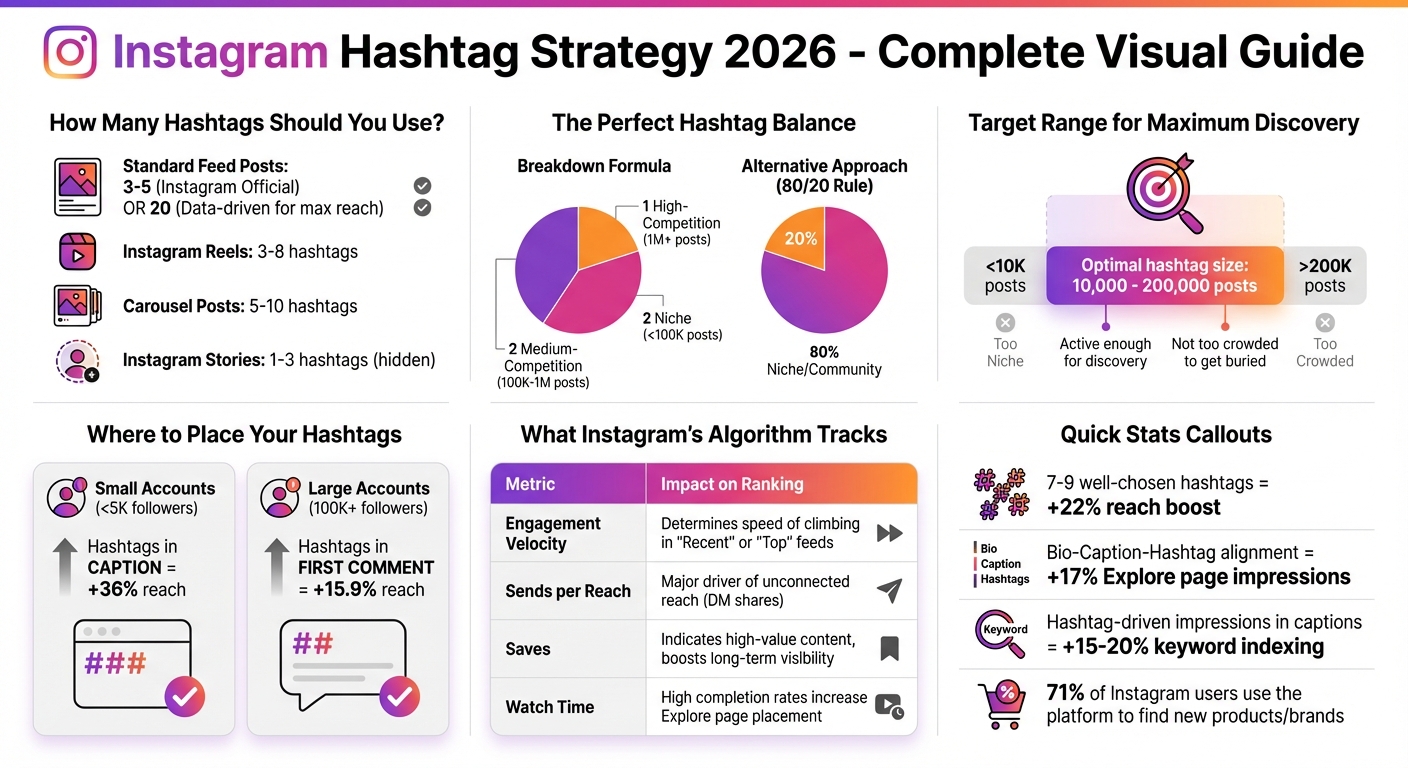
Instagram Hashtag Strategy Guide 2026: Optimal Numbers and Placement
Instagram's algorithm in 2026 has evolved far beyond treating hashtags as simple keywords. Now, it performs a detailed semantic analysis, considering how hashtags relate to your visuals and captions. A key concept is the "Bio-Caption-Hashtag Trinity", which examines how well your account bio, post captions, and hashtag clusters align. Accounts that successfully connect their bio keywords with their hashtag themes experience a 17% boost in Explore page impressions.
The algorithm also identifies "overlapping hashtag groups", where your post shares 2–3 mid-volume hashtags with viral content from similar niches. This strategy helps your content reach audiences who don’t follow you yet, increasing your unconnected reach.
"In 2025, hashtags serve as semantic signals that help Instagram's AI categorize your content rather than direct discovery mechanisms." - Hanna Laas, Author
Instagram determines a post's ranking based on signals like popularity, interaction history, and hashtag usage patterns. A particularly important factor is engagement velocity - how quickly your post attracts interactions within the first hour. This can significantly influence whether your post ranks in hashtag feeds.
Hashtags act as categorization tools, making your content discoverable to new users. In 2026, 71% of Instagram users say they use the platform to find new products and brands. When hashtags are relevant, your posts can appear in Instagram's search results, on the Explore page, and in the Reels feed, even for users who haven’t encountered your account before.
Instagram's AI now evaluates the visual content of your photos or videos to ensure they match the hashtags you’ve used. Simply adding trending hashtags that don’t fit your content won’t work anymore. Additionally, public posts from business and creator accounts are indexed by Google, meaning your hashtag-optimized content could show up in search engine results. Including hashtags in captions improves keyword indexing by 15–20%, while Instagram's natural language processing can surface your posts even without exact hashtag matches.
Engagement doesn’t just boost visibility - it also refines how hashtags perform. High engagement signals that your content is valuable, increasing its chances of ranking at the top of hashtag searches or appearing on the Explore page. One standout metric in 2026 is "Sends per Reach", which tracks how often users share your content through Direct Messages. Adam Mosseri, Head of Instagram, explains:
"Sends via DMs are the one that carries the most weight. The more your post is shared in this way, the better it will perform."
Encouraging DM shares can dramatically expand your reach to new audiences. On the flip side, negative signals - like users quickly scrolling past your post - can hurt its ranking in hashtag feeds. Creating content that people want to save, such as infographics, tutorials, or checklists, sends a strong signal to the algorithm that your post has lasting value, which improves its visibility over time.
| Metric | Role in Hashtag Ranking |
|---|---|
| Engagement Velocity | Determines how quickly a post climbs in "Recent" or "Top" hashtag feeds |
| Sends per Reach | Major driver of unconnected reach; predicts likelihood of DM shares |
| Saves | Indicates high-value content, boosting long-term visibility in niche hashtag feeds |
| Watch Time | High completion rates for Reels signal quality, increasing chances of Explore page placement |
Hashtags have come a long way by 2026. They’re no longer just "growth hacks" but have become key signals for Instagram's AI to classify content, making it easier to appear on the Explore page and in search results. The trend now leans toward using fewer, more precise hashtags for better performance.
User behavior reflects this change. Instead of broad tags like #love, which has over 2.1 billion posts, people are searching for more specific phrases that connect them to niche communities.
Targeted hashtags are now the go-to for influencers and brands. They strike a balance between specificity and engagement. The sweet spot? Hashtags with 10,000 to 200,000 posts - active enough to draw attention but not so crowded that your content gets lost. A good rule of thumb is the 80/20 approach: use 80% niche hashtags and 20% trending ones.
Here are some examples of niche hashtags that are working well in 2026:
For the best results, mix hashtags with varying levels of competition: one high-competition tag (1 million+ posts), two medium-competition tags (100,000–1 million posts), and two niche tags (under 100,000 posts). If your target audience is local, location-specific tags like #NYCMarketing or #AustinRealEstate can be especially effective.
Big events in 2026, such as the Milan Winter Olympics, Super Bowl LX, and the FIFA World Cup, are shaping hashtag trends. Brands should plan ahead with tags like #MilanCortina2026, #SuperBowlLX, and #FIFAWorldCup2026.
Cultural moments also play a role. For instance, 2026 marks the Lunar Year of the Fire Horse, making #YearOfTheFireHorse a key tag in February. Seasonal hashtags are becoming more specific too; instead of generic ones like #summer, users are searching for tags like #SummerSolstice2026 or #SunsetChasers.
| Quarter | Key 2026 Events | Priority Hashtags |
|---|---|---|
| Q1 | Winter Olympics (Milan), Super Bowl LX, Lunar New Year | #MilanCortina2026, #SuperBowlLX, #YearOfTheFireHorse |
| Q2 | Earth Day, Star Wars Day, FIFA World Cup Kickoff | #EarthDay2026, #MayTheFourth, #FIFAWorldCup2026 |
| Q3 | FIFA World Cup Final, International Cat Day | #WorldCupFinal, #InternationalCatDay, #WorldPhotographyDay |
| Q4 | Black Friday, Diwali, Hanukkah, Christmas | #BlackFridayDeals2026, #Diwali2026, #UglyChristmasSweaterDay |
Even quirky holidays like #PretendToBeATimeTravelerDay (Dec 8) can spark engagement. To avoid being flagged as spam, rotate between 3 to 5 different hashtag sets. Tailoring hashtags for specific content types, like Reels and Stories, can also help refine your reach.
For Reels, hashtags act as metadata that guides Instagram's algorithm to share your video with the right audience. Popular options include #reelitfeelit, #trendingsound, #explorepage, #fyp, and #viral. The ideal number of hashtags for Reels is 3 to 8, focusing on content categorization rather than broad discovery.
When it comes to Stories, using 1 to 3 hashtag stickers or text-based hashtags can effectively target niche audiences without overwhelming the visuals. A 2026 case study revealed that one post received 5,026 views, with 92% of those views coming directly from hashtag discovery. This highlights how well-chosen hashtags can still drive meaningful results, especially when they align with Instagram's content categorization systems.
Instagram’s algorithm prioritizes precise signals, and choosing the right hashtags can make a big difference in how your content performs. The focus should be on relevance rather than sheer volume. Hashtags act as content signals that help categorize your posts for both the Explore page and search results.
A solid hashtag strategy balances three types: high-volume (over 1 million posts), medium-volume (100,000–1 million posts), and niche (less than 100,000 posts). A good rule of thumb is to use one high-competition hashtag, two medium-competition hashtags, and two niche hashtags in each post. This approach ensures visibility while avoiding the clutter of oversaturated hashtags.
Take the lifestyle brand EmptyCup as an example. In December 2025, they applied the "3T Hashtag Stack" strategy, rotating niche-specific hashtags over a 60-day period. The result? They gained 15,000 followers and garnered 7 million total impressions, with each post averaging over 20,000 impressions just from hashtag discovery.
Don’t forget about branded hashtags. These aren’t just vanity tags - 70% of all hashtags on Instagram are branded. They help collect user-generated content and build authority over time.
"Branded hashtags enable businesses to curate user-generated content that not only drives engagement but also enhances brand visibility".
For local businesses, combining a location with a niche tag (e.g., #AustinFitness or #NYCMarketing) is a smart way to reach local audiences with high intent. Follow the 80/20 rule: dedicate 80% of your hashtags to niche or community tags, and the remaining 20% to broader or trending tags.
Since Instagram’s algorithm values context, your hashtag choices should align with your content’s focus. Next, let’s figure out how many hashtags are ideal for each post.
The number of hashtags you use depends on your account size and content type. Instagram officially suggests 3–5 highly relevant hashtags per post. However, a study of 18 million posts found that 20 hashtags deliver the highest average reach, while 30 hashtags maximize engagement.
For smaller accounts (under 5,000 followers), placing hashtags in the caption can increase reach by 36%. For larger accounts (100,000+ followers), putting hashtags in the first comment boosts reach by 15.9%.
Here’s a quick guide based on content type:
| Content Type | Recommended Hashtag Count | Primary Goal |
|---|---|---|
| Standard Feed Post | 3–5 (Official) or 20 (Data-led) | Categorization & Reach |
| Instagram Reels | 3–8 | Discovery & Algorithm Signaling |
| Carousel Posts | 5–10 | Engagement & Retention |
| Instagram Stories | 1–3 (Hidden) | Community Building |
For Instagram Reels, stick to 3–8 hashtags to support discovery without overloading. Stories work differently - hashtags won’t show up on hashtag pages, so it’s better to use stickers for community interaction.
To avoid being flagged as spam, rotate your hashtag sets. Repeating the same hashtags on every post can signal automation to Instagram’s algorithm, which may limit your reach.
Using the wrong hashtags can hurt your visibility. Overused hashtags (those with over 1 million posts, like #love or #fashion) will bury your content in minutes. Worse, banned hashtags can lead to a shadowban, drastically reducing your reach.
To check if a hashtag is banned, search for it on Instagram. If the "Recent" posts section is missing or there’s a warning about hidden posts, avoid it. Common banned tags include #goddess, #stranger, #instamood, and engagement-bait tags like #like4like or #follow4follow.
Aim for hashtags in the 10,000 to 200,000 post range. This sweet spot offers enough traffic to be discoverable without overwhelming competition. Always check the "Recent" tab of a hashtag before using it. If the content looks spammy or irrelevant, skip it - you don’t want to associate your brand with low-quality posts.
"Hashtags are the currency of attention on Instagram. They allow businesses to cut through the noise, connect with their target audience, amplify their content's reach, and engage with potential customers".
Hashtags have always been a key part of Instagram strategy, but with Instagram's 2026 algorithm, the game has become more intricate. Thankfully, advanced AI tools like UpGrow are here to make hashtag targeting smarter and more effective.
UpGrow's AI engine, developed over five years, eliminates the need for manual hashtag research. It generates tailored hashtag sets for Posts and Reels, focusing on attracting real followers instead of just boosting surface-level metrics. In short, it takes the guesswork out of hashtag strategy and replaces it with precision.
One of the standout features of UpGrow is its real-time analytics dashboard. It provides a live breakdown of how your hashtags are performing - showing which tags are driving profile visits, converting followers, and increasing engagement. Plus, it includes anomaly alerts to notify you if your strategy triggers spam flags or if engagement takes an unexpected dive.
"AI turns Instagram posting from guesswork into data-driven strategy, predicting which visuals, captions, hashtags, and timings will spark viral engagement." - Social Ninjas from UpGrow
The platform also tracks "Impressions from Hashtags" as a separate metric, which is incredibly useful. This lets you create and rotate hashtag banks tailored to specific content types - like educational, promotional, or entertainment posts - while avoiding algorithmic penalties. Beyond impressions, UpGrow also excels in audience targeting.
UpGrow goes beyond optimizing hashtags - it actively targets users engaging with them. Its Smart AI-Targeting feature allows you to use hashtags as filters, drawing in users who interact with those specific tags. For example, a fitness coach can target users engaging with niche hashtags like #FunctionalTraining or #MobilityWork (tags with fewer than 100,000 posts). The AI then organically engages with these users, driving meaningful profile visits.
You can refine this targeting even further by adding filters for location, age, gender, and language. For instance, a restaurant in Austin could target #AustinFoodie users aged 25–45 within a 10-mile radius, ensuring engagement is localized and relevant.
UpGrow has earned the trust of nearly 59,000 users, boasting a 4.98/5 rating from over 58,000 reviews. Many users report impressive growth - gaining between 4,000 and 20,000 followers within a few months by combining smart hashtag targeting with AI-driven engagement.
"UpGrow feels like a social media superpower. I've been able to gain over 4k real Instagram followers in just a few weeks!" - Manuri Clothing
To top it off, UpGrow offers downloadable PDF reports that detail which hashtag campaigns drove the most growth. This makes it easy to refine your strategy monthly. With Instagram's compliance standards becoming stricter, having a tool that monitors automation and optimizes performance in real time is more important than ever. UpGrow ensures your hashtag strategy stays sharp and effective.
Instagram's 2026 algorithm has shifted the focus of hashtag strategies to quality over quantity. Instead of using a long list of tags, the platform now rewards content that includes 3 to 5 highly relevant hashtags. This approach helps Instagram's AI better understand your content and target the right audience.
The numbers back this up. A carefully chosen mix of high-competition, medium-competition, and niche hashtags can increase non-follower reach by 35–60%. For example, in early 2026, a D2C brand streamlined its hashtag use - dropping from 30 tags to just 7 (5 niche, 1 branded, and 1 location-based). The result? A 42% increase in reach and a 28% jump in post saves during a single campaign. These kinds of results emphasize the importance of refining your hashtag strategy.
However, doing this manually can be a headache. It’s time-consuming and requires constant adjustment. That’s where tools like UpGrow come in. With real-time analytics and smart targeting, UpGrow takes the guesswork out of optimization. It automates the trial-and-error process, helps avoid spam penalties with smart rotation, and delivers concise performance reports - saving both time and effort.
To get the most out of Instagram hashtags for a small account in 2026, it’s all about quality over quantity. Instagram suggests sticking to 3-5 highly relevant hashtags per post. A smart move is to mix broad hashtags (those with over 1 million posts) with niche-specific ones (those under 100,000 posts) to connect with both wider audiences and more targeted groups. For better visibility, place your hashtags directly in the caption rather than in the comments.
Steer clear of banned hashtags to avoid shadowbanning, and switch up your hashtag sets regularly to reach different audiences. Pairing your hashtags with strong captions, location tags, and engaging visuals is key to boosting your post's performance. Branded or local hashtags can also help you create a sense of community around your niche.
If you need extra help, tools like UpGrow can assist in finding the right audience and tracking your progress, keeping your hashtag strategy on point with current trends. By combining a consistent and relevant hashtag plan with top-notch content, your small account can grow steadily and authentically in 2026.
AI tools like UpGrow bring a lot to the table when it comes to Instagram hashtags. They dive into your content and analyze current trends to suggest hashtags that are spot-on for your audience. This means your posts are more likely to land in front of the right people, boosting both visibility and engagement.
Another big win? These tools help you stick to Instagram’s best practices. For example, instead of cramming 30 hashtags into a post, they recommend focusing on 3–5 highly targeted ones - perfect for aligning with Instagram’s ever-changing algorithms.
But it doesn’t stop there. AI tools take the hassle out of hashtag research by automating the process. They even provide real-time updates to keep your strategy sharp. Plus, they help you sidestep banned or shadow-banned hashtags, ensuring your posts stay visible and comply with Instagram’s rules.
In short, tools like UpGrow simplify your hashtag game, saving you time while helping your account grow naturally with less effort.
Niche hashtags are an excellent way to increase your visibility on Instagram by targeting highly specific audiences. Unlike generic hashtags, which can get lost in a sea of posts, niche hashtags zero in on particular topics, communities, or interests. This makes it much easier to connect with users who are genuinely interested in what you’re sharing.
When used strategically, niche hashtags can boost your content's discoverability and help you attract followers who are more likely to engage with your posts. Combine them with trending or location-based hashtags to expand your reach even further and connect with the right audience for your content.


