
Common UGC Localization Challenges and AI Solutions
AI lets brands scale UGC localization without losing authenticity by preserving voice, handling slang, and automating multilingual moderation.
AI lets brands scale UGC localization without losing authenticity by preserving voice, handling slang, and automating multilingual moderation.
4.98 /5 - from 58k reviews
Trusted by 50,000+ creators — get real engagement delivered to your profile in minutes, not days.
Brands that rely on user-generated content (UGC) face major challenges when targeting global audiences. From language barriers to cultural differences, adapting UGC for different regions is complex. This article explores how artificial intelligence (AI) is tackling these issues, helping businesses save time, reduce costs, and improve engagement.
AI is reshaping how brands approach UGC localization, making it faster, more efficient, and scalable for global markets.
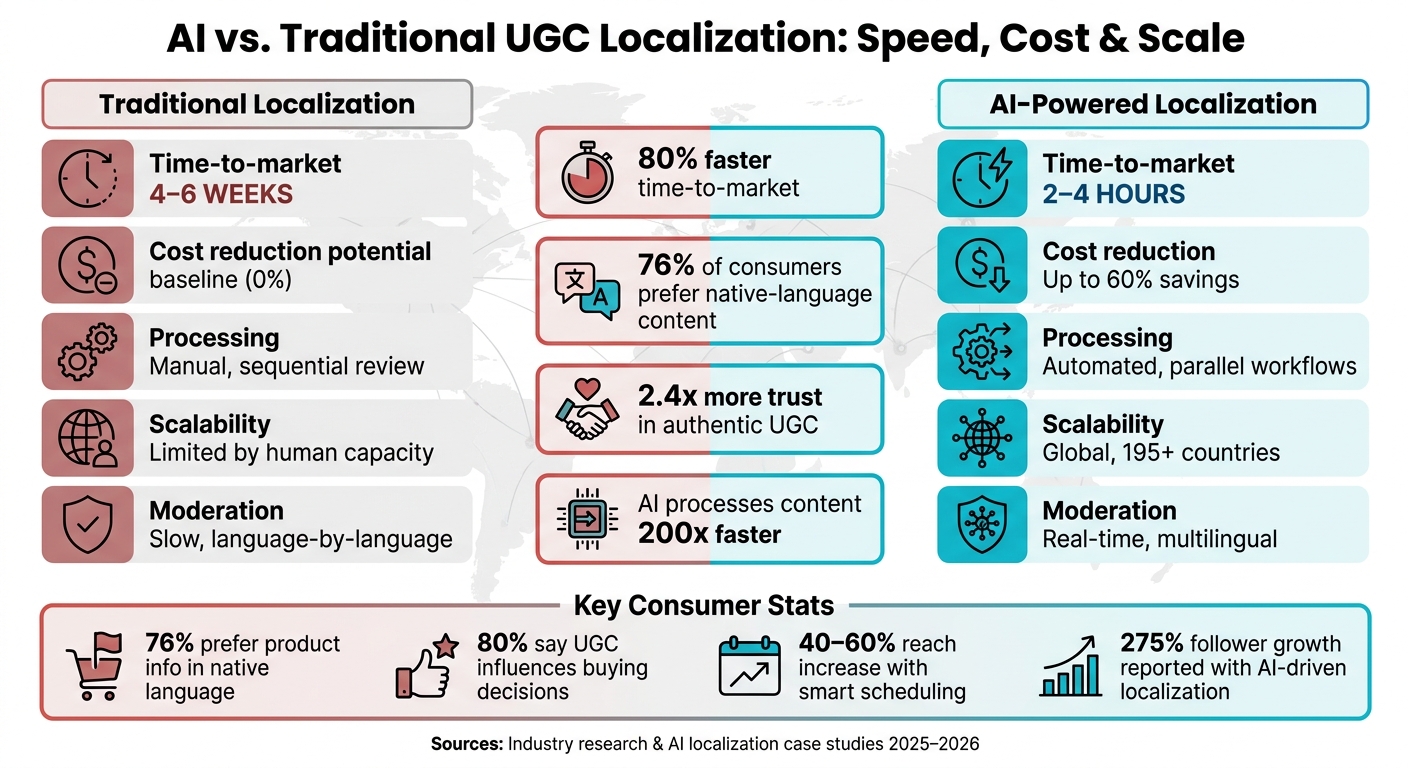
AI vs. Traditional UGC Localization: Speed, Cost & Scale
Expanding user-generated content (UGC) to global markets sounds straightforward until you encounter hurdles like language barriers, cultural differences, and operational complexities. These obstacles emphasize the importance of precise localization strategies.
UGC doesn't come with a style guide. Creators often use incomplete sentences, code-switching, and regional slang, making it tricky to maintain a unified brand voice. Without a centralized glossary, product names may get mistranslated, slogans might lose their impact, and hashtags can fail to resonate.
The result? Your brand risks sounding like entirely different companies in different regions. Without AI tools to enforce consistent terminology, localized posts can drift far from your original messaging.
"The goal is not perfect literary translation; the goal is controlled equivalence at scale." - Daniel Mercer, Senior SEO Content Strategist
Overcorrecting by forcing local slang into translations can backfire, creating an unnatural tone that alienates audiences. Beyond maintaining brand voice, navigating cultural nuances like slang and memes adds another layer of complexity.
The informal nature of UGC is what makes it relatable, but translating jokes, memes, and idioms is rarely straightforward. Literal translations often miss the mark, leading to confusion or unintended meanings.
Take, for example, Facebook's 2020 mistranslation incident, where the Thai word for "birthday" was mistakenly rendered as "memorial day." This error caused a public relations issue and forced a temporary shutdown of English-to-Thai auto-translation.
Even seemingly minor missteps can have consequences. A thumbs-up emoji, seen as friendly in the U.S., can carry offensive connotations in parts of the Middle East and Latin America. For video content, poorly dubbed audio that doesn’t match the creator’s energy or lip movements can create an unsettling "uncanny valley" effect, immediately breaking viewer trust.
Moderation adds another layer of complexity. Multilingual campaigns require real-time screening of UGC to catch harmful content and policy violations. This often means reviewing both the original content and its localized versions to account for shifts in tone and meaning.
Compliance with regional regulations adds further challenges. Laws like GDPR, rules around testimonial disclosures, and requirements for machine-translation transparency must all be managed. Interestingly, approximately 10–20% of content accounts for 80% of a brand's legal exposure. This concentration of risk underscores the importance of getting moderation right. These challenges not only slow down global campaigns but also highlight the growing need for AI-driven solutions, which are explored in the next section.
One of the biggest hurdles in AI-assisted localization is maintaining a consistent brand voice. As Julia Diez, a Localization Expert, explains:
"AI is a multiplier. Bad terminology becomes faster bad terminology. Inconsistent tone becomes globally inconsistent tone."
Modern translation management systems address this by centralizing glossaries and setting up lists of "forbidden terms" to prevent off-brand language. Additionally, AI platforms can be trained using a brand's existing content - sometimes with as few as 5 to 100 posts - to replicate tone and style across multiple languages. Some organizations are taking it a step further by developing semantic layers. These layers make brand guidelines and tone rules machine-readable, ensuring that AI-generated content stays aligned with the brand's identity.
Adapting tone to fit cultural nuances is another challenge AI is helping to solve. Slang, humor, and cultural references often can't be translated directly, but AI is improving at handling these subtleties. Advanced frameworks like Graph-of-Thoughts (GoT) break the translation process into stages: identifying constraints, drafting, and refining for cultural and stylistic accuracy. For instance, idioms or playful expressions in American English can be adjusted to resonate with audiences in Japan or Brazil.
For video-based user-generated content (UGC), AI dubbing tools are making strides in preserving the original vocal tone while synchronizing lip movements. In January 2026, Meta expanded its AI-powered dubbing for Instagram Reels, adding support for languages like Bengali, Tamil, Telugu, Marathi, and Kannada, alongside existing options like Hindi, Portuguese, Spanish, and English. This level of adaptation ensures that content feels authentic and culturally relevant.
Moderating multilingual UGC requires more than a simple one-pass filter. A two-pass pipeline is often the most effective approach: the first pass screens the original content for direct violations, while the second pass reviews the translated output to catch risks introduced by tone shifts or local slang. Different types of content call for varying levels of moderation:
| Content Type | Moderation Approach | Quality | Cost |
|---|---|---|---|
| Low-risk comments, short UGC | Direct machine translation | Medium | Low |
| Mainstream feeds, community posts | Machine translation + automated moderation | Medium–High | Low–Medium |
| High-reach or sensitive content | Machine translation + moderation + human review | High | Medium |
| Regulated or premium content | Fully human translation | Very High | High |
By reserving human review for high-risk content, companies can balance cost-efficiency with safety.
AI doesn't just refine tone and moderation - it also boosts real-time engagement. During busy campaign periods, quick response times are critical. AI-powered workflows allow brands to handle high volumes of multilingual conversations efficiently. Non-urgent tasks, like processing archival posts or newsletters, can be batched, while real-time translation ensures prompt replies for live chats and time-sensitive interactions.
AI tools also streamline complex workflows. For instance, when faced with hundreds of ambiguous translation strings, tools like Crowdin Copilot can consolidate these into a handful of key questions for human managers. This reduces what might have been 800 individual reviews to just four decisions, saving time and effort.
For AI to perform effectively, it needs precise and well-defined instructions. Before diving into localization, create a semantic layer that outlines your brand's terminology, tone, and rules tailored to specific markets. By integrating these guidelines into your translation management systems, you can automatically catch any output that deviates from your brand's standards.
This process requires three essential tools: a style guide, a glossary of approved terms, and 3–5 examples of ideal content. These artifacts help translation systems enforce your brand's rules, flagging off-brand language before it even reaches a reviewer. Once these guidelines are in place, the focus shifts to maintaining quality through selective human oversight.
With clear guidelines established, the next step is to combine AI's speed with human expertise to ensure quality and context. Successful teams in 2026 often rely on a three-layer approach: machine translation for efficiency, automated moderation for safety, and human post-editing for the most critical content.
The key is to prioritize. As Daniel Mercer, Senior SEO Content Strategist at Fluently.cloud, explains:
"Don't ask 'Should we human-review everything?' Ask 'Which 10–20% of content creates 80% of our risk, legal exposure, or revenue impact?' That is where human effort belongs."
Low-risk content can go straight through machine translation, while high-impact or sensitive material should be flagged for review by native speakers. This is especially crucial for transcreation, where humor, idioms, or emotional nuances need creative rewriting rather than a literal translation.
Once your guidelines and review processes are in place, it’s essential to monitor results and refine your approach. Localization success isn’t just about linguistic accuracy - it’s about achieving business outcomes. Metrics like engagement lift per locale (e.g., likes, shares, watch time), time-to-publish, and conversion rates in each target market are critical indicators.
One useful metric is "edit distance", which measures how much human reviewers need to adjust AI-generated content. A shorter edit distance reflects better AI accuracy and adherence to your guidelines, while a longer one signals the need for updates. Tools like UpGrow provide real-time analytics, breaking down performance by location, language, and engagement trends. This allows for data-driven adjustments rather than relying on guesswork.
Here’s a breakdown of key metrics to track:
| Metric Category | Key KPIs | Why It Matters |
|---|---|---|
| Performance | Engagement lift, watch time per locale, conversion rates | Indicates how well localized content connects with audiences |
| Operations | Translation latency, review queue time, publish time | Evaluates workflow efficiency |
| Quality | Edit distance, glossary adherence, reviewer ratings | Measures AI accuracy over time |
| Safety | False positive/negative rates, moderator overturn rate | Ensures moderation remains effective |
| Cost | Cost per localized output, rework costs | Keeps localization financially viable |
As Julia Diez, a Localization Strategist, aptly notes:
"AI without governance is not acceleration. It is fragmentation at scale."
To avoid this, ensure every step of your localization pipeline - from content ingestion to publishing - is carefully monitored. This transforms governance from just a concept into a practical, actionable framework.
User-generated content (UGC) localization has moved far beyond simple translation. The real task now is to keep content authentic while scaling it across different languages, regions, and time zones. As we've discussed, AI steps in to handle some of the toughest challenges: maintaining a consistent brand voice, tailoring tone to local audiences, moderating content instantly, and driving engagement around the clock.
AI is evolving to enable deeper cultural adaptation. It can recognize local trends, preserve humor, and even predict which content formats will click with specific markets before they launch. Features like smart scheduling, which aligns UGC with peak engagement times, can increase reach by 40–60%. This capability not only simplifies localization but also ensures that the authenticity audiences crave remains intact.
Research shows that consumers are 2.4 times more likely to see UGC as genuine compared to branded content, and 80% say it directly influences their buying decisions. However, poorly translated or overly polished content can quickly damage this trust. Brands need to scale their efforts without losing the human element that makes UGC so impactful.
Platforms like UpGrow are designed to meet this challenge head-on. With tools like AI Follower Language Targeting, precise location filters, and access to a network of over 300 million verified creators in 195+ countries, UpGrow helps brands tap into authentic local voices. Beta users of its Boost™ feature have reported a 275% increase in monthly followers, highlighting how AI-driven localization can fuel meaningful engagement. The future of global growth lies in intelligent, localized strategies that balance scalability with authenticity.
To figure out which user-generated content (UGC) needs human review, consider its risk, sensitivity, and potential impact. Content that carries legal, brand, or controversy risks - like medical advice or financial commentary - should be at the top of your list.
Concentrate human review efforts on the riskiest 10-20% of content. Use classification systems and thresholds to maintain consistent moderation, especially for high-profile or legally sensitive material.
AI helps maintain a consistent brand voice across multiple languages by blending automated tools with human expertise. Tools such as glossaries, style guides, and tone classifiers play a key role in upholding brand standards and spotting any inconsistencies. Meanwhile, human reviewers step in to fine-tune the AI-generated content, handling intricate details like idiomatic phrases or cultural nuances. This combination streamlines localization efforts, ensuring the brand's tone stays intact and the messaging connects naturally with audiences in different markets.
The best approach to moderating multilingual user-generated content (UGC) in real time is to blend automated tools with human oversight. Automated systems are great for quickly spotting clear policy violations, such as hate speech or harassment. Meanwhile, human reviewers step in to tackle trickier situations, like understanding slang, tone, or cultural nuances.
A solid strategy involves a two-step process: first, screening the content in its original language, and then reviewing translations. This layered approach helps catch potential risks more effectively. Adding context-aware moderation and having clear escalation protocols for sensitive material ensures both safety and compliance are maintained.


