
How Predictive Analytics Finds Untapped Instagram Audiences
Use engagement, demographics and content signals to find untapped, authentic Instagram audiences and avoid fake or low-value followers.
Use engagement, demographics and content signals to find untapped, authentic Instagram audiences and avoid fake or low-value followers.
4.98 /5 - from 58k reviews
Trusted by 50,000+ creators — get real engagement delivered to your profile in minutes, not days.

Predictive analytics is reshaping Instagram growth strategies by using historical data and machine learning to forecast where new, high-quality audiences are likely to come from. Unlike traditional tools that focus on past performance, predictive models analyze engagement patterns, demographics, and content signals to identify potential followers who resemble your most engaged audience but haven’t yet discovered your profile.
Key Takeaways:
For Instagram success, focus on building high-intent interactions, leveraging niche hashtags, and maintaining consistent content themes to align with Instagram’s recommendation algorithms. Tools like UpGrow use AI to refine these strategies, helping creators grow their audience while avoiding low-value followers.
Predictive models thrive on data. The more varied and rich the data inputs, the better these models can predict and uncover Instagram's untapped audiences. On Instagram, the key data sources are user actions, demographics, and content signals. These inputs lay the groundwork for the predictive strategies explored in later sections.
Every click, tap, or swipe on Instagram generates valuable data. Actions like likes, comments, shares, saves, story views, and profile taps feed into predictive models that estimate future user behavior. According to Meta, its ranking system evaluates multiple interaction probabilities for each post:
"We make a set of predictions. These are educated guesses at how likely you are to interact with a post in different ways. In Feed, the five interactions we look at most closely are how likely you are to spend a few seconds on a post, comment on it, like it, share it, and tap on the profile photo." - Meta
By analyzing patterns of recent interactions with similar content, these models gauge user interest. Early engagement velocity - how quickly a post gains traction in its first hour - plays a major role in content distribution decisions. High-intent actions like profile taps and shares are especially impactful, as they indicate a stronger likelihood of reaching new audiences.
Demographic details like age, gender, language, and location are crucial for audience segmentation. Predictive models use this information to group users with similar traits and predict which groups are most likely to engage with specific content. This segmentation can also reveal untapped opportunities, such as regions where a brand has limited presence but shows strong potential interest based on demographic similarities to existing followers.
Location data, in particular, can optimize posting strategies. For instance, a health and wellness brand that applied predictive analytics to determine optimal posting times saw a 40% boost in engagement. Combining demographic data with behavioral and psychographic insights - like topic preferences and sentiment - paints a more complete picture of the target audience.
Content and visual cues are equally important. Instagram's AI analyzes text from five key areas - profile name, username, bio, captions, and alt text - to classify accounts and recommend them to users with matching interests.
Hashtags are another powerful tool for audience discovery. Using niche hashtags with post volumes between 5,000 and 50,000 can drive higher follower conversion rates by connecting content with highly specific, engaged communities.
| Hashtag Category | Post Volume | Strategic Role |
|---|---|---|
| Broad | 500K – 2M | Broad reach but intense competition, leading to lower conversion |
| Mid-tier | 50K – 500K | Balanced reach and relevance; ideal for engagement |
| Niche | 5K – 50K | Highly relevant; achieves the best follower conversion rates |
| Branded | < 5K | Aggregates user-generated content (UGC) and monitors campaign performance |
Image recognition adds another dimension. Editing alt text manually with descriptive, keyword-rich language - rather than relying on Instagram's auto-generated descriptions - sends clear signals to the algorithm, helping it categorize and recommend posts to the right audience segments. These content-based inputs further refine audience targeting, as explored in the research findings section.
To identify hidden Instagram audiences, researchers and marketers rely on analytical techniques that transform raw data - like essential Instagram metrics like engagement, demographics, and content interactions - into actionable audience groups. These methods vary in approach but share a common goal: to define clear audience segments tailored to specific objectives.
K-Means clustering is a popular method for grouping Instagram users by minimizing differences within each cluster. This makes it ideal for segmenting audiences based on metrics like visit frequency and spending behavior.
In April 2026, researcher Tanika Jangam applied K-Means clustering to a dataset of 2,600 Instagram users, focusing on visit scores and spending ranks. The analysis revealed four distinct audience types: Window Shoppers (40%), Power Users (23%), Passive Browsers (22%), and Dormant Buyers (15%). The model achieved a silhouette score of 0.646, close to the benchmark of 0.6, indicating well-defined and cohesive clusters.
"K-Means minimizes the within-cluster sum of squared Euclidean distances, making it a good pair for this metric." - Tanika Jangam, Digital Marketing Researcher
Another effective approach is graph-based community detection, which represents Instagram users as nodes connected by interactions like likes, comments, and follows. Algorithms such as Node2Vec map these interactions into vector spaces, uncovering influencer communities and nuanced audience clusters that traditional methods might overlook.
For broadening audience reach, lookalike modeling complements clustering by identifying new users who share characteristics with high-value segments.
Once high-value audience segments are identified, lookalike modeling helps brands expand their reach. Meta's machine learning analyzes extensive data points - such as engagement habits, interests, and purchase history - to find users similar to a "seed" audience.
"Lookalike audiences, driven by Meta's machine learning, let advertisers connect with new individuals who share similar traits, behaviors, and interests as their current customers." - Tanmay Ratnaparkhe, Co-founder, Predis.ai
The quality of the seed audience is crucial. For instance, using the top 20% of customers by Lifetime Value yields more accurate targeting than a generic pool of website visitors. A 1% lookalike audience focuses on users most similar to the seed, while broader segments (3% to 5%) are used to scale campaigns as smaller audiences become saturated.
In May 2025, a Shopify-based fashion brand created a lookalike audience from its top 5% of highest-spending customers. Targeting a 1% lookalike audience on Instagram led to a 35% boost in click-through rate, a 26% reduction in cost-per-acquisition, and a 3.8× increase in return on ad spend.
Trend forecasting goes beyond clustering and lookalike modeling by predicting emerging audience segments. These models monitor shifts in engagement patterns, helping brands identify new opportunities before they fully materialize.
One key metric is the First-Time Impression Ratio, which measures the share of impressions from new users. A healthy ratio stays above 40%; when it dips below this threshold, it signals audience saturation, prompting marketers to broaden their targeting. This proactive monitoring helps brands adjust strategies to avoid performance declines.
AI-driven tools are making this process faster and more efficient. For example, platforms using large language models like GPT-o3 can detect subtle pattern shifts and highlight growth opportunities far quicker than manual methods. Beta users of these features have reported a 275% increase in monthly followers. When combined with real-time analytics, these tools empower brands to act swiftly on emerging trends, staying ahead of the curve.
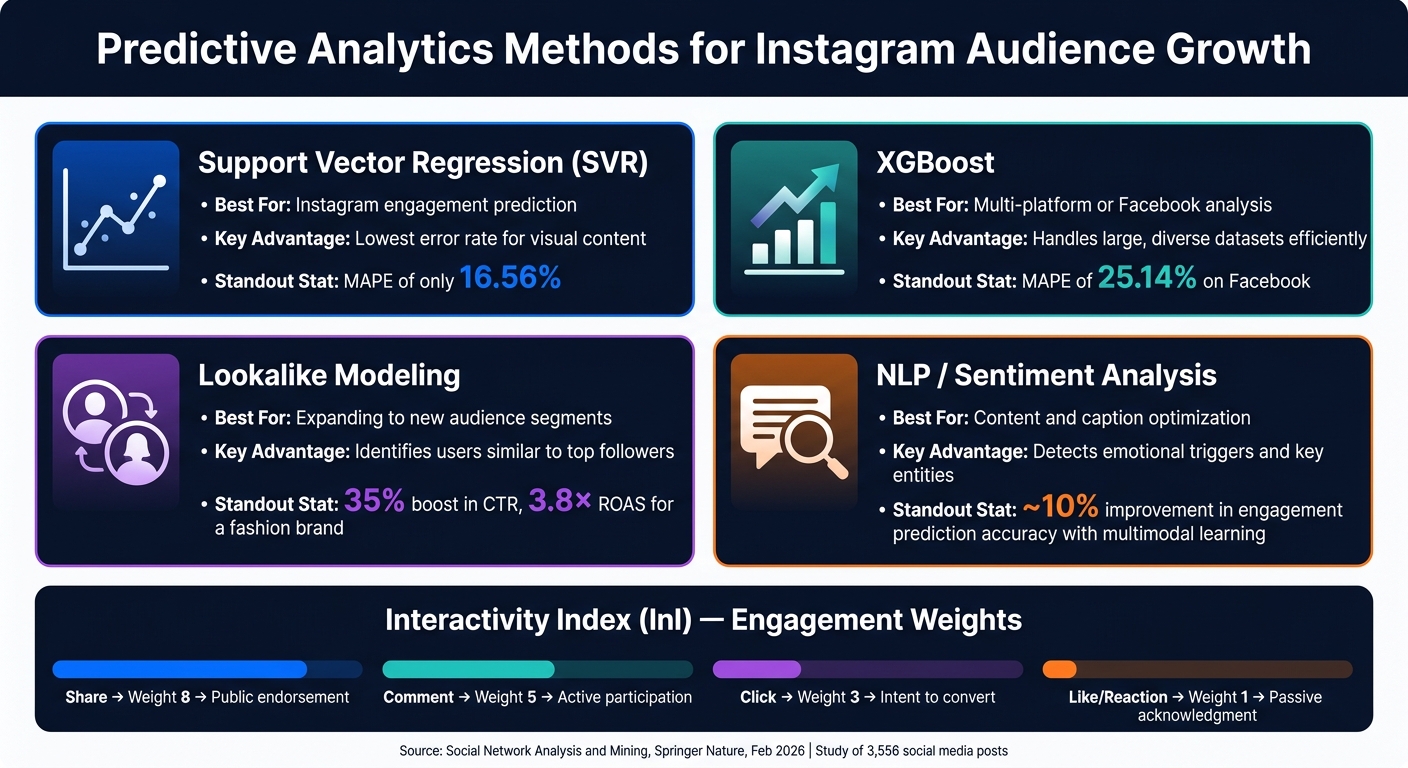
Predictive Analytics Methods for Instagram Audience Growth
A study published in February 2026 in Social Network Analysis and Mining (Springer Nature) highlights how predictive analytics can transform audience engagement strategies. Researchers examined 3,556 social media posts from a prominent Chilean TV channel's morning talk show, applying machine learning models to predict engagement on Instagram and Facebook.
The findings were eye-opening. Support Vector Regression (SVR) achieved a Mean Absolute Percentage Error (MAPE) of just 16.56% when predicting Instagram engagement, offering a level of precision that enables actionable planning. On Facebook, Extreme Gradient Boosting (XGBoost) performed best, though it had a higher error rate of 25.14%.
One standout insight: mentions of specific TV personalities, identified through Named Entity Recognition (NER), proved to be the strongest predictors of high engagement. This suggests that brands can tap into new audiences by tracking which individuals or topics consistently attract attention.
"Accurate prediction is necessary to move audience analytics from descriptive reporting to proactive, strategic planning." - Social Network Analysis and Mining, Springer Nature
These findings set the stage for more precise audience engagement metrics.
The study emphasized that raw engagement numbers alone don’t tell the full story. It introduced the Interactivity Index (InI), a weighted engagement model that assigns different values to interaction types based on the effort and intent behind them:
| Interaction Type | Weight | What It Signals |
|---|---|---|
| Share | 8 | Public endorsement - the highest level of advocacy |
| Comment | 5 | Active participation |
| Click | 3 | Intent to convert |
| Like/Reaction | 1 | Passive acknowledgment |
This system illustrates how a post with 500 shares and 100 likes generates far more meaningful engagement than one with 1,000 likes but no shares. It provides a clearer picture of audience momentum.
The study also highlighted "Best Time to Post" (BTTP) variables, such as day of the week and seasonal trends, as key factors in predicting how well content resonates with new audience segments.
While metrics measure engagement success, understanding predictive methods helps refine strategies for different goals. The research compared several approaches, each suited to specific objectives:
| Method | Best For | Key Advantage | Data Needed |
|---|---|---|---|
| Support Vector Regression (SVR) | Instagram engagement prediction | Lowest error rate for visual content (MAPE 16.56%) | Historical engagement data |
| XGBoost | Multi-platform or Facebook analysis | Efficiently handles large, diverse datasets | Large datasets with varied features |
| Lookalike Modeling | Expanding to new audience segments | Identifies users similar to current top followers | Follower demographics and interests |
| NLP / Sentiment Analysis | Content and caption optimization | Detects emotional triggers and impactful entities | Post captions and comment text |
Each method has its strengths. SVR works best for Instagram-specific predictions, while lookalike modeling excels at finding new audience groups. Often, the most effective strategies combine several methods - for instance, using NLP to fine-tune content and then applying lookalike modeling to target new segments.
"Determining whether an image matches its caption's intent can improve engagement prediction accuracy by nearly 10%." - Social Network Analysis and Mining, Springer Nature
Another key takeaway: multimodal learning - blending text-based signals (like BERT embeddings) with visual data (like ResNet image analysis) - consistently outperformed text-only models. This underscores why Instagram, as a visual-first platform, benefits from tools that evaluate both the message and the imagery.
Relying solely on single-signal targeting, like hashtags or broad demographic categories, often overlooks deeper insights that predictive models can uncover. A more effective strategy combines multiple signals, such as behavioral patterns, location data, interest groups, and engagement trends.
For instance, tools like UpGrow utilize multi-signal filters that include factors like location, age, gender, language, and niche interests. This approach helps identify overlooked audience segments likely to engage with your content. Beta users of UpGrow's Boost™ feature, which uses pattern recognition to identify peak engagement times, have reported impressive results, with monthly follower growth increasing by up to 275%. UpGrow has also served over 55,000 customers and boasts a stellar rating of 4.98/5 from more than 58,000 reviews.
"Ranking models, unlike traditional idempotent request/response backends, produce scores predicting user action... It's important that these scores accurately reflect user interest, as their accuracy is directly correlated to user engagement." - Luke Levis, Sing Sing Ma, and Eduardo Nava, Engineering at Meta
These strategies lay the groundwork for further improvements in profile and content optimization, ultimately driving better engagement.
Once you’ve fine-tuned your audience targeting, the next step is ensuring your profile and content are aligned with Instagram's recommendation algorithms. Predictive models assess whether your profile and posts clearly signal your niche to the platform. Instagram groups accounts into topic clusters based on recent activity, so inconsistent content can lead to misclassification.
Maintaining a consistent theme is critical. Sticking to 2–3 related content pillars helps the algorithm categorize your account correctly, ensuring it reaches the right audience. Rather than focusing solely on likes, prioritize high-intent interactions - such as direct message shares - which the 2026 algorithm values 3–5× more than likes. Using AI-driven tools to optimize your profile - adjusting your bio, visuals, and captions to align with your niche - can further enhance how the algorithm interprets your account.
While predictive analytics offers powerful growth opportunities, it’s not without challenges. For example, a large but disengaged following can hurt your reach. Instagram’s algorithm monitors early engagement - if a post performs poorly in the first 60 minutes, it could suppress its visibility.
Another key issue is data quality. Predictive models lose reliability if the calibration - the balance between predicted and actual user actions - drifts. As Meta's engineers explained:
"If we recommend irrelevant content, user engagement suffers. The model stability metric was designed to make it easy to measure this accuracy and detect inaccuracy at our scale."
For creators and brands, this highlights the importance of using tools that adhere to Instagram's guidelines. Compliant, API-based integrations collect cleaner behavioral data, leading to more accurate predictions. UpGrow’s infrastructure, designed to align with Instagram’s standards, ensures growth efforts don’t introduce errors that could reduce targeting accuracy over time.
This research dives into several analytical methods, including Random Forest models, natural language processing (NLP), cohort analysis, and competitor-targeting frameworks. Data collection tools range from official Instagram Graph API integrations to third-party platforms like Instaloader. However, no single approach fully captures the complexities of audience analytics.
The study highlights systemic challenges that affect predictive accuracy despite robust data inputs. For instance, data latency remains a hurdle - even API-based tools often face a 24–48 hour processing delay. Another issue is the detection of fake activity. Current models can identify advanced bot behavior with around 85–90% accuracy, but this still leaves room for error. The ongoing problem of fake followers adds another layer of difficulty. Compliance also plays a crucial role; tools built on official APIs tend to generate cleaner behavioral data, which not only improves model accuracy but also enhances the predictive capabilities discussed earlier.
On a broader level, the influencer marketing landscape is evolving. Veríssimo Cassange, a programmer at Vec Corporation, pointed out:
"Brands and agencies spend 10x more on established influencers when they could have partnered with emerging talent at 90% lower costs."
This insight highlights the potential for predictive analytics to identify rising influencers early, enabling brands to connect with promising talent before their partnership costs skyrocket.
The findings also emphasize that effective predictive models require a foundation of at least 6–12 months of historical data. This timeframe helps account for seasonal trends and eliminates short-term anomalies. Additionally, the research points to a growing industry trend toward structured, data-focused strategies. These strategies benefit creators and brands that prioritize predictive tools and rely on compliant, API-based integrations.
Predictive analytics uses data like follower count trends, engagement rates, audience demographics, follower quality, and content performance to guide decision-making. By analyzing these factors, it becomes easier to pinpoint new audience segments and uncover growth opportunities on Instagram.
To figure out if you've hit audience saturation, start by keeping an eye on some key metrics. For instance, if your engagement rate (likes, comments, shares) starts dropping even though your follower count stays the same or grows, that could be a red flag. Another clue? If your reach plateaus or shrinks while your followers keep increasing, it might mean you’re struggling to connect with fresh audiences.
Dive into Instagram Insights to analyze demographic and behavioral data. This can help you understand if you're repeatedly engaging the same group instead of expanding your reach. Tools like UpGrow can also be helpful for identifying untapped audience segments and refining your content strategies to break through the saturation wall.
To steer clear of fake or low-quality followers, prioritize quality over quantity. Look for tools designed to analyze engagement rates and verify the authenticity of your audience. These tools can help identify real, active followers while flagging fake accounts. Additionally, using data-driven insights allows you to craft content that resonates with genuine users, ensuring your growth stays natural and meaningful.
Share this post


