
How Micro-Influencers Drive Instagram Growth
Why micro-influencers (10K–100K followers) boost Instagram growth: higher engagement, stronger trust, lower costs, and better ROI for niche campaigns.
Why micro-influencers (10K–100K followers) boost Instagram growth: higher engagement, stronger trust, lower costs, and better ROI for niche campaigns.
Micro-influencers are reshaping Instagram marketing in 2026. These creators, with 10,000–100,000 followers, offer brands a cost-effective way to reach niche audiences while achieving higher engagement rates than mega-influencers. Here's why they matter:
Brands are increasingly partnering with multiple micro-influencers to tap into niche markets, reduce costs, and achieve better results. By focusing on authentic connections and leveraging tools like AI for campaign management, businesses can maximize Instagram growth through these partnerships.
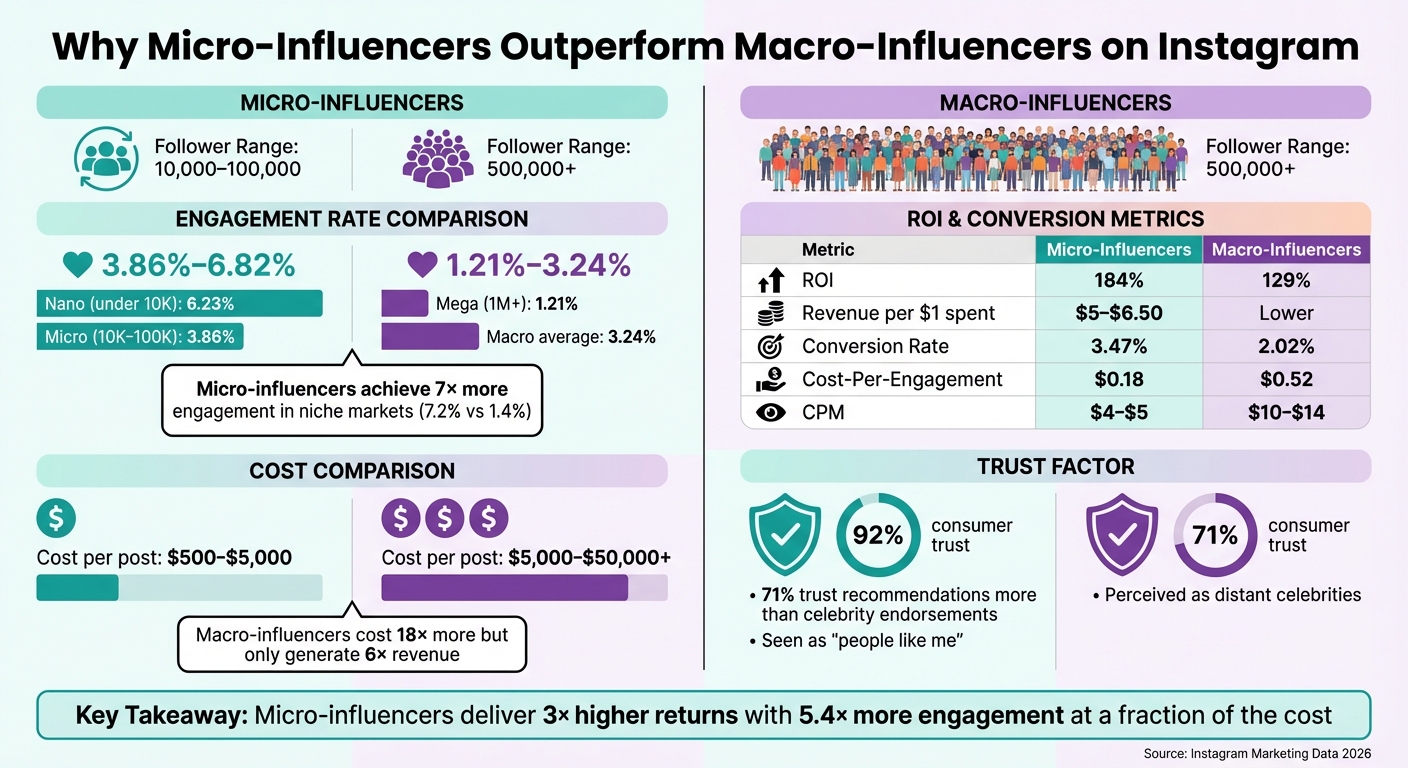
Micro-Influencer vs Macro-Influencer Performance Comparison: Engagement, Cost & ROI
When it comes to social media engagement, size doesn’t always mean strength. In fact, the numbers tell a clear story: as follower counts go up, engagement rates drop. This pattern has been confirmed across various studies on Instagram. For instance, nano-influencers (those with fewer than 10,000 followers) boast an impressive engagement rate of 6.23%. Micro-influencers (10,000 to 100,000 followers) maintain a solid 3.86%. But for mega-influencers (with over 1 million followers), engagement plummets to just 1.21%. That’s a striking difference - nearly five times lower than what nano-influencers achieve.
| Influencer Tier | Follower Count | Instagram engagement metrics |
|---|---|---|
| Nano | Under 10,000 | 6.23% |
| Micro | 10,000–100,000 | 3.86% |
| Mega | Over 1,000,000 | 1.21% |
This data highlights the unique ability of micro-influencers to cultivate authentic, engaging relationships with their audiences.
Why does this happen? It’s all about connection. Smaller influencers often feel more approachable and relatable, making their followers more likely to interact with their content. On the other hand, mega-influencers, with their massive reach, can come across as distant or impersonal. Monica Jungbeck, Global Marketing Manager at Malibu, puts it this way:
"For a global influencer with around 200 million followers, we don't expect the engagement rate to be more than 5%, whereas for smaller influencers we expect that rate to double".
The numbers back this up. Followers of micro-influencers are 3.8× more likely to comment, save, or share their posts compared to those following larger accounts. This level of engagement speaks volumes about the trust and connection smaller creators build with their communities.
But engagement isn’t just about size - it’s also about focus.
Micro-influencers often focus on specific topics, whether it’s sustainable fashion, postpartum fitness, mental health, or B2B SaaS. This specialization helps them build expertise and attract highly engaged audiences. Experts call this the "supergrouping" effect - when an influencer’s tight focus creates a community that’s more likely to act on their recommendations.
The impact of this focus is remarkable. In niche markets, micro-influencers achieve engagement rates of 7.2%, while macro-influencers in the same spaces average only 1.4%. That’s a fivefold advantage for those who cater to specific interests.
Here’s a real-world example: A sustainable fashion brand partnered with 15 eco-conscious micro-influencers. The result? A 348% higher conversion rate and 5.2× more product engagement compared to campaigns with larger influencers.
What makes micro-influencers so effective in niches is their personal connection with followers. They often adopt the same tone as their audience, making their content feel less like an ad and more like advice from a friend. This approach resonates deeply - 71% of consumers trust micro-influencer recommendations more than celebrity endorsements, and 61% say they find information from "people like me" credible.
A great example of this authenticity comes from Olipop’s 2023 TikTok campaign with the Mattison Twins. Instead of a polished ad, the twins created a funny, unscripted skit featuring a Cherry Vanilla Olipop can as a microphone. The result? Over 8 million views. It’s proof that niche audiences respond best to genuine, relatable content.
When it comes to Instagram growth, micro-influencers stand out not just for their engagement but also for their cost-effectiveness. Hiring a micro-influencer (10,000–100,000 followers) typically costs between $500 and $5,000 per post, while macro-influencers (100,000–1 million followers) charge significantly more - ranging from $5,000 to $50,000+. While macro-influencers may generate six times the revenue, their costs are 18 times higher. In contrast, micro-influencers deliver an ROI of 184%, outperforming the 129% ROI seen with macro-influencers, and generate $5–$6.50 for every $1 invested.
Consider this example: A skincare brand ran two campaigns - one featuring 15 nano-influencers at $250 each (totaling $3,750) and another with a single macro-influencer at $8,000. The nano-influencers generated $34,000 in sales, while the macro-influencer's campaign brought in just $12,000. This nearly threefold revenue difference, achieved at less than half the cost, highlights the value of working with multiple smaller influencers. Besides being cost-effective, collaborating with numerous creators also boosts "creative velocity", providing 5–10 reusable assets per partnership, which cuts down on traditional agency production expenses.
Additionally, brands can amplify this content through paid ads, a strategy known as "whitelisting", which can double the return on ad spend. These combined benefits make micro-influencers a smart choice for brands aiming to maximize their marketing dollars. For those looking to scale these results further, using a dedicated Instagram growth service can help automate the discovery and engagement process.
The financial advantages of micro-influencers extend beyond cost savings - they also excel at driving conversions. With an average conversion rate of 3.47%, micro-influencers outperform macro-influencers, whose rate averages 2.02%. They also offer a significantly lower cost-per-engagement, approximately $0.18, compared to $0.52 for macro-influencers - a savings of about 65%.
| Metric | Micro-Influencers (10K–100K) | Macro-Influencers (500K+) |
|---|---|---|
| Engagement Rate | 6.82% | 3.24% |
| Cost-Per-Engagement | $0.18 | $0.52 |
| Conversion Rate | 3.47% | 2.02% |
| Overall ROI | 184% | 129% |
Micro-influencers also deliver competitive CPMs (cost per thousand impressions), typically between $4 and $5, compared to the $10–$14 range for traditional paid media on platforms like Meta and TikTok. Samantha Dilday from Statusphere highlights this cost efficiency:
"Micro-influencers routinely deliver CPMs between $4–$5, often coupled with cost-per-engagements of $0.20–$0.60 - one-tenth the cost of traditional paid campaigns".
A 2025 campaign by a global cosmetics brand further illustrates these advantages. Using the Statusphere platform, the brand activated over 700 micro-influencers on TikTok and Instagram, achieving an 80% increase in social search volume, a 70% boost in Google search queries, 33.9 million engagements, and 18,900 new brand mentions - all while saving 1,700 operational hours. These results demonstrate that micro-influencers are not just cost-effective - they’re also highly impactful when it comes to ROI.
Micro-influencers have a unique ability to inspire trust among their followers. Consider this: 58% of consumers have made a purchase directly because of an influencer's recommendation, and 35% have made between four and six purchases based on influencer content. What sets micro-influencers apart is their perceived credibility - 79% of consumers trust honest reviews, even when they're negative, as they see these reviews as more authentic.
Transparency is at the heart of this trust. 71% of consumers believe that being open about brand partnerships is crucial, while 70% feel misled if a partnership isn't disclosed. Jennifer Santos, Attorney at the National Advertising Division, BBB National Programs, captures this idea perfectly:
"Trust, it turns out, isn't about the presence of a brand deal or relationship, but how openly and honestly that deal or relationship is shared".
The appeal of micro-influencers lies in how followers perceive their intentions. People often believe their recommendations come from genuine experiences and expertise, rather than financial motives or fame. This is why 82% of shoppers actively seek out negative reviews before committing to a purchase - they value raw, unfiltered feedback over polished marketing. However, trust is delicate. Only 5% of consumers fully trust influencer content, and 80% cite a lack of authenticity or transparency as the biggest "trust killer" in influencer marketing.
This genuine connection doesn't just drive sales - it also fuels organic Instagram growth strategies to build your brand. By building trust, micro-influencers lay the groundwork for meaningful relationships with their followers.
Micro-influencers excel at creating a sense of personal connection with their audience. This phenomenon, known as "parasocial interaction", happens when followers see influencers as friends rather than distant celebrities. This dynamic gives micro-influencers a unique edge in persuasion. As Michael Gerlich from SBS Swiss Business School explains:
"When micro-influencers are known to their followers on a personal level, they wield more persuasive power over their followers".
The way micro-influencers communicate plays a big role in fostering these relationships. They often use inclusive and empathetic language in their captions, creating a sense of community. Instead of aggressively promoting products, they seamlessly integrate them into their everyday lives. Nadica Naceva of Influencer Marketing Hub puts it this way:
"When captions emphasize community, encouragement, and genuine empathy, they foster a sense of kinship, transforming followers into engaged participants".
The impact of this approach is profound. For instance, 4 in 10 millennials on YouTube believe their favorite influencer understands them better than their own friends, highlighting the strength of these parasocial bonds.
This personal touch translates into real-world results. Take Audible’s collaboration with micro-influencer Jesse Driftwood as an example. Jesse shared honest and relatable feedback about the service, which resonated deeply with his audience and built trust. When micro-influencers weave products into authentic stories, their smaller but more engaged audiences are far more likely to take action.
Micro-influencers are known for their strong connections with their audience, making them valuable partners for boosting Instagram growth. To get the most out of these collaborations, you need a clear plan - from picking the right influencers to crafting campaigns that feel genuine.
Start by identifying influencers who align with your brand’s values and audience. Engagement rate is more important than follower count. Look for creators with 10,000 to 100,000 followers and engagement rates between 3% and 10%. To calculate engagement, use this formula: (Likes + Comments + Shares) ÷ Followers × 100.
It’s not just about the numbers, though. Relevance is key. A micro-influencer who focuses on a niche like sustainable fashion or B2B SaaS will resonate more with their audience than a generalist with a broader following. Review their recent posts to ensure their style, tone, and values match your brand. Also, check that their audience demographics - such as age, gender, income level, and location - align with your target market.
Be cautious of red flags like sudden follower spikes, generic comments, or an audience that doesn’t match your ideal customer base. While 92% of consumers trust micro-influencers, compared to 71% for macro-influencers, that trust can vanish if the partnership feels fake or forced.
Once you’ve shortlisted influencers who align with your goals, it’s time to create campaigns that allow their authenticity to shine.
After selecting the right partners, let them have creative freedom. Research shows that content performs 2.3× better when micro-influencers control the creative process rather than following rigid scripts. Instead of micromanaging, share your brand story and key messages, then let the influencer decide on the format and tone that will resonate with their audience.
For instance, unscripted campaigns often generate higher engagement because they feel more authentic. This approach works because it respects the influencer’s unique voice, which their followers already trust.
Consider building long-term relationships instead of focusing on one-off posts. Collaborations lasting three to six months help build familiarity and deepen trust with the audience. Use tools like unique discount codes and UTM parameters to track conversions and measure campaign success beyond likes and reach. You can also ask for permission to repurpose influencer content on your own brand channels, which adds social proof and extends the value of the partnership.
Once your campaigns are set, AI tools can simplify management and improve performance tracking.
Platforms like UpGrow offer access to a database of over 300 million verified Instagram influencers across 195+ countries. Their AI-powered search filters help you find influencers by niche, location, and follower tier, while engagement calculators ensure potential partners meet the 2% to 8% engagement rate benchmark.
AI tools also help detect fraud by analyzing follower growth patterns and engagement quality to identify fake accounts and bots. For example, in 2024, Sprout Social used a "center of excellence model" for a B2B influencer campaign that included 32 creators - 28 of whom were micro-influencers. These influencers were integrated into webinars, reports, and social campaigns, resulting in over 4 million impressions, 100,000+ engagements, and 600+ leads. The campaign even won a Shorty Award.
AI platforms streamline campaign management with dashboards that track posting schedules, approvals, and real-time performance metrics. This automation saves time and ensures accurate ROI measurement. Since influencer content delivers 11× higher ROI than traditional digital marketing, using the right tools can help you scale partnerships effectively and achieve meaningful Instagram growth.
Micro-influencers continue to prove their value when it comes to engagement, ROI, and building trust. Unlike larger creators, they connect with their followers on a personal level - being seen as "people like me" rather than untouchable celebrities. This connection delivers tangible results, with brands earning an impressive $6.50 in revenue for every $1 spent on micro-influencer campaigns.
When it comes to cost-effectiveness, micro-influencers shine. They typically charge between $500–$2,000 per post but deliver 5.4× more engagement than mega-influencers. Their highly focused audiences ensure your brand message reaches individuals who genuinely care about your product, rather than a broad, less invested audience.
To make the most of these partnerships, look for creators with an engagement rate of 3%–10% who align with your brand's values. Let them take the reins creatively - data shows that content performs 2.3× better when influencers have the freedom to craft their message instead of sticking to rigid scripts. Use unique codes and UTM parameters to track performance, and consider tools to simplify the process.
Platforms like UpGrow make it easier to find the right influencers, offering access to over 300 million verified Instagram creators. With AI-powered filters, you can search by niche, location, and engagement rate. These tools also help identify fake followers, monitor real-time performance, and scale your influencer campaigns - all while ensuring Instagram-compliant growth.
The numbers speak for themselves: micro-influencers offer a cost-effective, genuine, and impactful strategy to boost your Instagram presence in 2026.
To spot fake followers, pay attention to a few telltale signs. Start with low engagement rates - if an account has thousands of followers but barely any likes or comments, that’s a red flag. Next, check for unnatural audience demographics - for example, an influencer based in the U.S. with most followers from unrelated regions might indicate fake followers. Lastly, look for irregular growth patterns, like sudden spikes in follower count.
Fake accounts often have generic profiles, lack profile pictures, or show minimal activity. To dig deeper, combine manual checks with tools like UpGrow’s Instagram Fake Follower Checker. These tools can analyze audience authenticity, helping you identify inauthentic followers more efficiently.
To measure micro-influencer ROI effectively, prioritize conversions, revenue generated, and measurable customer actions like purchases or sign-ups. Steer clear of vanity metrics - such as likes or follower counts - since they don’t directly indicate business results. By focusing on these actionable data points, you’ll gain a better understanding of how micro-influencers contribute to your Instagram growth strategy.
Collaborating with several micro-influencers - those with follower counts between 10,000 and 100,000 - can often yield better results than partnering with a single influencer. This strategy allows brands to connect with niche audiences, spread diverse messages, and expand their overall reach. Plus, micro-influencers tend to offer stronger engagement rates and a more budget-friendly option, making them a smart choice for driving genuine, trackable growth on Instagram.


%20boost%20Instagram%20growth%3A%20higher%20engagement%2C%20stronger%20trust%2C%20lower%20costs%2C%20and%20better%20ROI%20for%20niche%20campaigns.&image=https://www.upgrow.com/blog-images/assets.seobotai.com/cdn-cgi/image/quality=75,w=1536,h=1024/upgrow.com/69986ebeefc60cc2af089c33-1771601631378.jpg)