
Ultimate Guide to Instagram A/B Testing Tools
Systematic Instagram A/B testing to boost engagement and conversions with one-variable tests, clear metrics, and real-time tools.
Systematic Instagram A/B testing to boost engagement and conversions with one-variable tests, clear metrics, and real-time tools.
4.98 /5 - from 58k reviews
Trusted by 50,000+ creators — get real engagement delivered to your profile in minutes, not days.
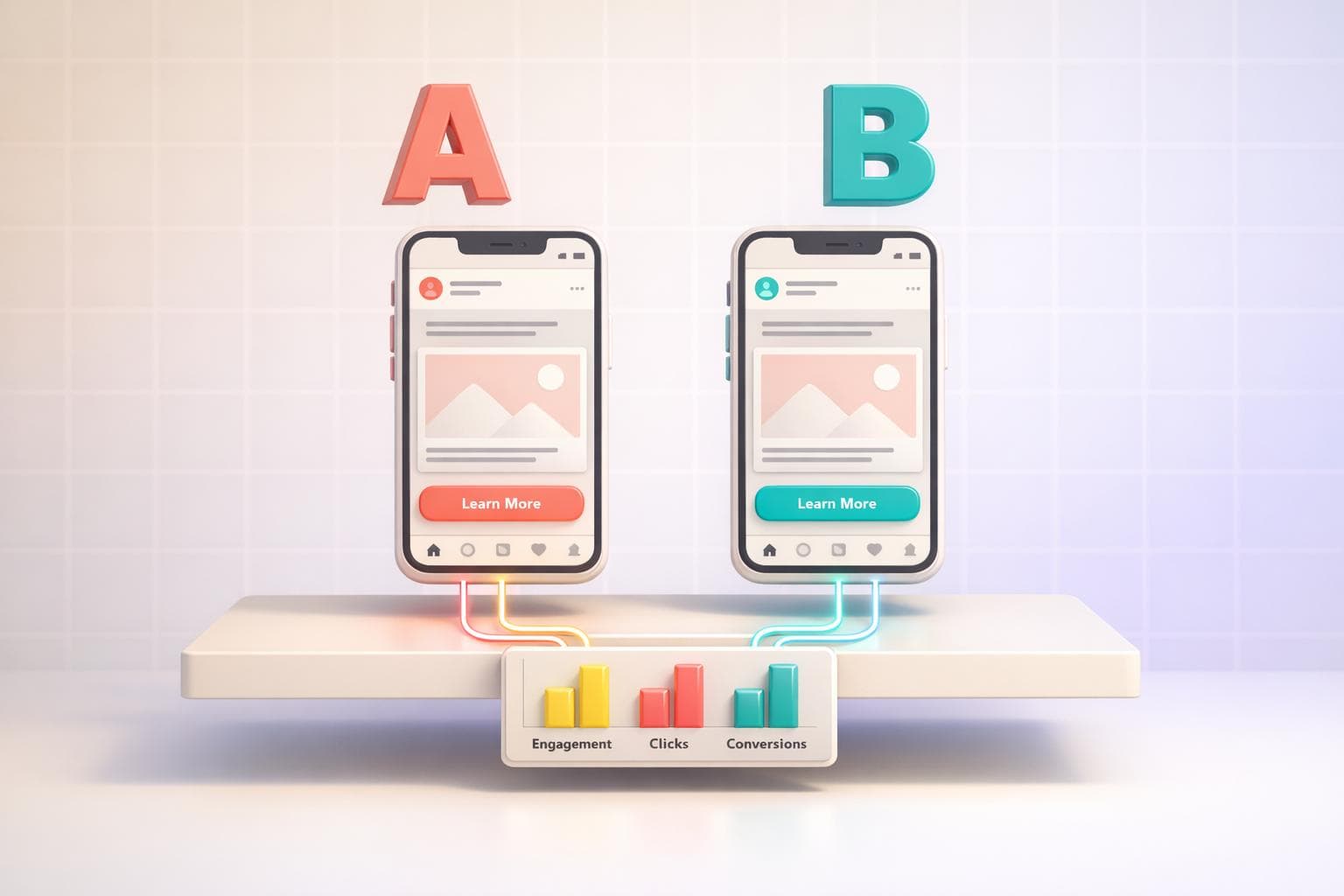
Instagram A/B testing helps you compare two content variations to see what resonates better with your audience. By isolating one variable - like captions, hashtags, or CTAs - you can gather data to refine your strategy. This method is key for improving engagement, especially with Instagram's 2026 algorithm prioritizing saves and shares over likes.
A structured, data-driven approach to A/B testing can boost engagement by up to 50% and conversion rates by 35%. Start small, test one element at a time, and use tools like UpGrow to streamline the process.
At its core, every A/B test involves two key components: the control (Version A, which is your original content) and the variation (Version B, which includes a single change). The idea is to tweak just one element - such as the caption, hook, or call-to-action (CTA) - so you can clearly measure its effect.
Your audience is then divided into two separate groups. Meta's Experiments tool takes care of this automatically, ensuring there's no "audience pollution" - where the same person sees both versions, potentially skewing your results. To keep the test fair, all other factors like budgets, URLs, and schedules must remain consistent, with only the chosen element being different.
The final step? Decide which metrics will define the success of your test.
Once your test is live, the metrics you track should align with your overall goal. For instance:
It’s also important to monitor negative signals. High "Exit" rates or excessive "Forward Taps" can highlight where your audience is losing interest.
The gold standard for evaluating results is statistical significance. A confidence level of 95% ensures your findings aren’t just random noise. To achieve this, you’ll need at least 1,000 impressions per variant. For conversion-focused tests, aim for 100 conversion events per variation before declaring a winner.
"Split testing takes the guesswork out of marketing. It shows you what works and what doesn't, allowing you to make informed decisions that boost performance." - Dan Pantelo, CEO, Marpipe
Once you’ve set your metrics, the next step is determining how long to let the test run.
Getting the timing right is where many people stumble. A useful guideline is the 7-14-30 rule: run your tests for at least 7 days, aim for 14 days as the sweet spot, and avoid going beyond 30 days to prevent creative fatigue from skewing your data.
Running a test for at least 7 days ensures you capture both weekday and weekend behavior, which can often vary. Keep in mind that Meta’s algorithm requires 3–5 days for its learning phase to stabilize delivery. During this period, CPM costs may spike to 2–3 times higher than usual. Resist the temptation to end a test early, even if initial results look promising.
"Run for at least 7 days, aim for 14, and know that Meta's 90% confidence bar is lower than the scientific standard." - Randy Wattilete, Founder, Kirro
One critical rule: never edit a live test during the first 72 hours. Doing so resets the learning phase and invalidates your data entirely.
When it comes to optimizing your Instagram strategy, testing different elements is essential. Here's a closer look at what you can experiment with to make the biggest impact.
Captions and hashtags are key to driving engagement. Start by experimenting with caption length: try short captions (under 100 characters) versus longer ones (150–200 characters) to see which resonates more with your audience. You can also test different tones - compare a formal, professional style with a casual, conversational one to determine which aligns better with your brand's voice and your audience's preferences.
Hashtags are another area to explore. The choice often comes down to reach quality versus reach volume. Broad, popular hashtags may boost impressions, but niche, targeted ones often attract a more relevant audience. Placement matters too - test whether hashtags work better at the end of your caption or in the first comment to see how it affects the post's professionalism and engagement.
"Aligning captions with proven audience preferences, Instagram growth strategies become predictable, scalable, and resistant to guesswork." - Glen Miller, Author, QAInsta
Once captions and hashtags are optimized, you can move on to testing content formats and timing for even greater results.
Not all content formats perform equally. Static images, carousels, and Reels each have their strengths. Carousels often encourage saves and extended engagement, while Reels are great for reaching new audiences. Testing these formats against each other helps you identify what works best for your followers, rather than relying on general trends.
Timing is another crucial factor. While data suggests that Wednesday at 12 p.m. and Thursday between 7–9 a.m. are high-performing times in 2026, your audience might behave differently. Use Instagram's Professional Dashboard to analyze when your followers are most active. To maximize visibility, aim to post 15–30 minutes before peak activity.
Calls-to-action (CTAs) and opening lines can make or break engagement. Small tweaks to CTA wording can have a big impact. For example, compare urgency-driven phrases like "Today only" with value-focused ones like "Get 20% off" to see which motivates your audience more.
The first line of your caption is just as important - it’s your chance to stop the scroll. Test different approaches, such as a direct question versus a bold statement, to see which sparks more comments and interaction. For video content, the first 3 seconds are critical. A hook rate above 35% is strong, while anything below 20% indicates room for improvement. Simple changes, like starting with action verbs such as "Discover" or "Save this," can boost click-through rates without requiring a complete creative overhaul.
Choosing the right Instagram A/B testing tool can save you from wasting time on platforms that don’t deliver meaningful insights. The key is to focus on tools that provide actionable results and go beyond basic metrics.
A top-tier testing tool does more than just count likes and comments - it digs deeper. Metrics like saves, shares, profile visits, website clicks, video completion rates, and follower growth give you a clearer picture of how effective your variations are. These insights are critical for understanding what truly resonates with your audience.
Real-time dashboards are a game-changer, especially for time-sensitive campaigns or frequent posting schedules. They let you see which variation is performing better as it happens. This means you can quickly pause underperforming posts and double down on what’s working instead of waiting days for a report. Plus, having exportable reports helps you document your tests and refine your strategies for future campaigns.
But tracking metrics is only part of the equation - precise audience targeting takes your testing to the next level.
Without audience segmentation, your test results can be misleading. For example, a caption that appeals to a younger audience might not resonate with older, long-time followers. That’s why it’s essential to segment your audience by factors like age, gender, location, language, and interests.
AI targeting can refine this process even more. Instead of relying on guesswork, AI uses behavioral data and filters to pinpoint which group is most likely to engage with a specific variation. Meta’s Advantage+ campaigns have shown how effective this approach can be, reporting 14–30% lower cost-per-result compared to manual targeting. Precision targeting like this can make a noticeable difference in your campaign performance.
After addressing performance and targeting, it’s vital to ensure the tool you choose operates safely and can scale with your needs. Any platform you use should comply with Instagram’s official API, avoid bots or fake engagement, and respect the platform’s rate limits. Automation shortcuts like mass following or spammy comments don’t just skew your test results - they can also put your account at risk of restrictions.
Scalability matters too, especially for agencies or brands handling multiple Instagram profiles. Look for tools that offer features like multi-account management, team roles, and streamlined reporting workflows. This ensures that as your testing efforts grow, they remain efficient rather than becoming a time-consuming burden. Platforms like UpGrow set a strong example, combining AI-powered targeting with expert human oversight, live monitoring, and a fully compliant service designed to support organic growth without compromising account safety.
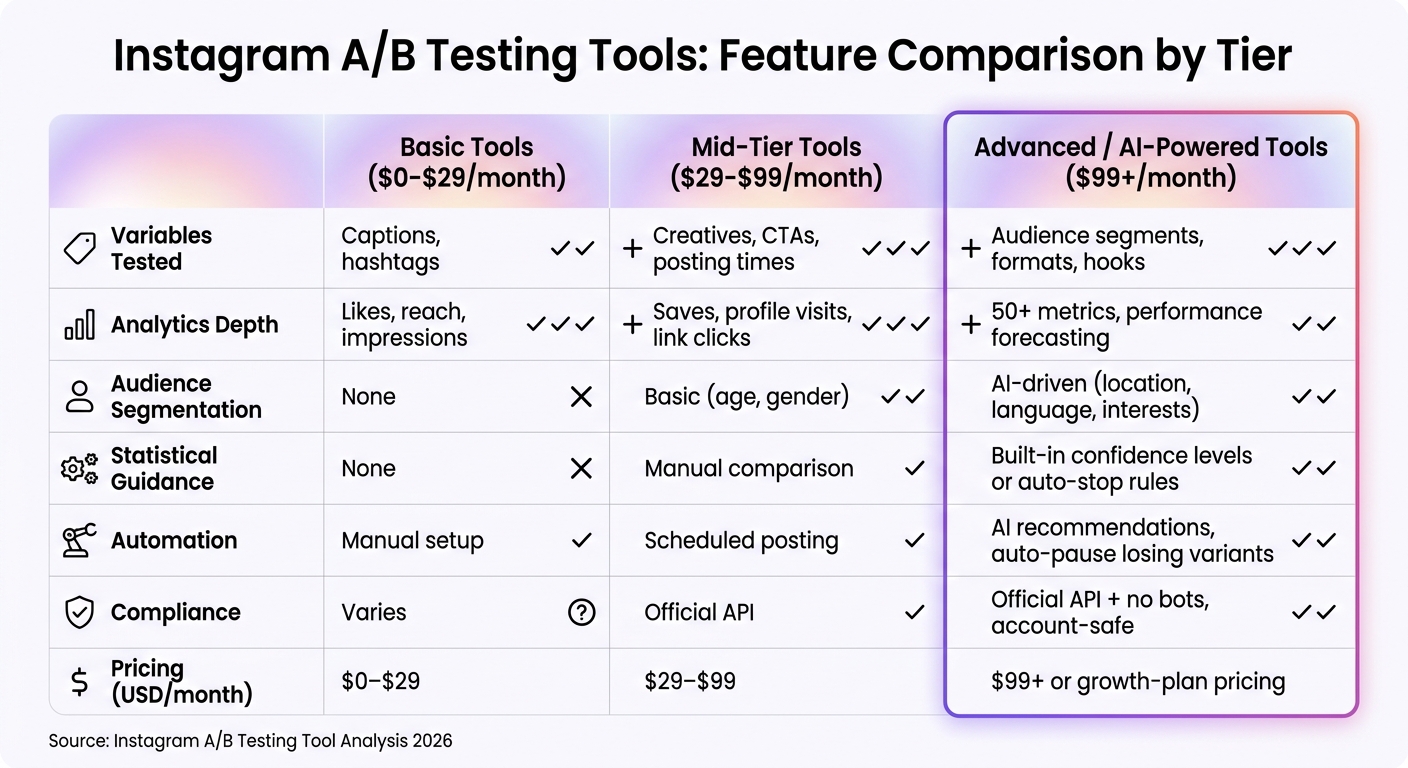
Instagram A/B Testing Tools: Basic vs. Mid-Tier vs. Advanced Features
Choosing the perfect A/B testing tool for Instagram boils down to four practical factors: ease of use, testing scope, analytics depth, and compatibility. These criteria ensure you’re equipped with a tool that simplifies testing while offering meaningful insights.
First, the tool should be easy to use. Look for features like an intuitive dashboard, pre-built templates, and formats tailored for U.S. users (e.g., MM/DD/YYYY dates, 12-hour time, and time zones like Eastern or Pacific). These details make the tool more accessible for your audience and team.
Next, consider the testing scope. A good tool should allow you to test a variety of variables - captions, hashtags, CTAs, thumbnails, posting times, and content formats - across Feed posts, Reels, and Stories. Ideally, it should support running multiple tests simultaneously without creating conflicts.
Analytics depth is another must. The tool should provide detailed metrics for each test variant, such as reach, engagement rates, saves, and link clicks. It should also include a statistical confidence indicator, so you’re not relying on guesswork to declare a winner.
Lastly, ensure the tool integrates seamlessly with Meta’s official API, your scheduling platform, and any analytics tools you’re already using. Compatibility with these systems will save you time and effort in managing your campaigns.
Here’s a quick breakdown of the features you can expect at different tool tiers:
| Capability | Basic Tools | Mid-Tier Tools | Advanced/AI-Powered Tools |
|---|---|---|---|
| Variables Tested | Captions, hashtags | + Creatives, CTAs, posting times | + Audience segments, formats, hooks |
| Analytics Depth | Likes, reach, impressions | + Saves, profile visits, link clicks | + 50+ metrics, performance forecasting |
| Audience Segmentation | None | Basic (age, gender) | AI-driven (location, language, interests) |
| Statistical Guidance | None | Manual comparison | Built-in confidence levels or auto-stop rules |
| Automation | Manual setup | Scheduled posting | AI recommendations, auto-pause losing variants |
| Compliance | Varies | Official API | Official API + no bots, account-safe |
| Pricing (USD/month) | $0–$29 | $29–$99 | $99+ or growth-plan pricing |
This table outlines the progression of features, helping you decide which level matches your needs.
Most A/B testing tools treat testing as a secondary feature. UpGrow, however, takes a different approach - it’s designed entirely around achieving organic growth with a targeted audience, making its test results far more actionable.
UpGrow aligns with the essential criteria discussed earlier, offering advanced analytics and AI-driven targeting. Its smart targeting filters - by location, age, gender, and language - allow you to test content with the audience you actually want to reach. For example, you can target English-speaking women aged 25–34 in the U.S., ensuring cleaner and more relevant data.
The tool’s live analytics dashboard lets you track performance in real time. Whether you’re testing captions, hashtags, or content formats, you can quickly identify what’s working and make adjustments without waiting days for reports. Once a top-performing variation is identified, UpGrow’s Boost™ tool helps amplify your results immediately, driving follower growth. Beta users of Boost™ reported a 275% increase in monthly followers.
UpGrow also includes a viral content library for inspiration when creating test variants, and with over 58,000 reviews and a 4.98/5 rating, it’s clear that users trust its capabilities. Plans start at $39/month, and they even offer a growth guarantee - grow your followers or get your money back. This combination of testing and growth tools makes UpGrow a standout choice for marketers who want everything in one place.
Even the best-laid plans can go awry if you overlook some key principles. These testing errors are surprisingly easy to make, but once you're aware of them, they’re just as easy to sidestep.
One of the biggest pitfalls is tweaking more than one element in a single test. For instance, if you change both the caption and the image, how do you know which one made the difference? As AdStellar explains:
"The cardinal rule of A/B testing is single-variable isolation. If you're testing images, everything else - headline, body copy, call-to-action, audience, placement - stays identical."
This is often referred to as the One Variable Rule. While it may seem like common sense, rushing through updates can lead to muddled results. Focus on testing one element at a time - whether it's the headline, call-to-action (CTA), or visual format. Prioritize high-impact changes, like the opening hook in a video or the overall creative format. Smaller adjustments, like altering font styles, can wait their turn.
Even if your test is set up perfectly, cutting it short can skew your results. Early data often doesn't tell the full story. In fact, tests that run for fewer than 5 days with less than $300 in total spend only identify a clear winner about 60% of the time. That’s no better than flipping a coin.
Timing matters, too. User behavior varies between weekdays and weekends, so a test that only runs from Monday to Wednesday misses important patterns. To get a more accurate picture, run your test for at least 7 days. For campaigns focused on conversions, aim for a 14–28 day window. Giving your test enough time ensures you’re basing decisions on solid data, not fleeting trends.
Just because one version gets more clicks doesn’t mean it’s the winner. To confidently declare a variant as better, you need to hit at least 1,000 impressions per variant and reach a 95% confidence level. This means there’s only a 5% chance the results occurred by random luck. For conversion-focused tests, aim for 20–50 or more conversions per variant.
If your test doesn’t meet the 95% confidence threshold, treat the results as inconclusive. You can either extend the test or try testing a more noticeable change. Acting on weak or unreliable data can drain your budget and throw your strategy off course.
When your test wraps up, don’t rush to conclusions based solely on raw numbers. For instance, just because one variation gets 10% more likes doesn’t mean it’s the better choice. What matters is whether that difference is statistically meaningful. Stick to a 95% confidence level before making decisions, and make sure each variant has at least 1,000 impressions. If your account has around 10,000 followers, aim for 50–100 engagements per variation as a baseline.
The metric you focus on should match your initial goal. In 2026, metrics like saves, shares, and DM sends carry more weight in Instagram’s algorithm than likes. Adam Mosseri, Instagram’s Head, has explained:
"DM sends carry the most weight for reaching people who do not follow you."
To get a clear picture of engagement, use this formula: (likes + comments + saves + shares) ÷ reach × 100. Set a target of at least a 10% relative improvement before deciding on a winning variation. These deeper engagement metrics are more aligned with Instagram’s evolving standards and will give you a better measure of success.
One successful test might feel great, but it won’t create lasting impact on its own. The real value comes from having a system for ongoing testing. A good starting point is to keep a detailed log - something as simple as a spreadsheet - where you track your hypothesis, the variable you tested, the metrics you measured, and the results. This helps you build a knowledge base and avoid retesting ideas you’ve already explored.
When you find a winning variation, take the time to document why it worked instead of just discarding the losing option. Then, tweak one small element for your next test. This cycle - test, learn, refine, and repeat - is what sets accounts that grow steadily apart from those that hit a wall. A practical way to balance testing with proven strategies is the 70/30 rule: dedicate 70% of your posts to content that’s already performed well and 30% to experiments.
"A production system that consistently generates above-average content is a business. Build the system." - The Viral App
By sticking to this workflow, you’ll create a foundation for smarter, more effective Instagram strategies.
Once you’ve established a reliable testing process, you can use your findings to shape broader growth strategies. The real value of A/B testing isn’t in a single winning post - it’s in the patterns and insights you gather over time. Marketers who take a systematic approach to testing often see engagement rates improve by 20–50%. Influencers who use structured testing frameworks report 35% higher conversion rates compared to those who rely on intuition.
Take UrbanFit, a boutique fitness studio in Chicago, as an example. In 2025, they tested two caption styles: one focused on technical benefits (Version A) and another used emotional transformation language (Version B). Version B achieved a 2.8% click-through rate compared to Version A’s 1.7%, leading to a 64% increase in class bookings over just 30 days.
Tools like UpGrow’s real-time analytics dashboard can help you spot trends at scale. These tools give you live insights into which types of content, audiences, and posting habits are driving growth. By integrating these insights into your strategy, you can transform testing results into long-term success.
Looking back at the strategies and data discussed, one thing is clear: Instagram A/B testing delivers results when done right. Over time, these small, focused experiments add up to measurable growth. For example, from March to June 2026, Campground Social ran controlled experiments on five accounts across different niches. By testing one variable at a time over 90 days, they achieved a 2.1x boost in follower growth and a 1.8x increase in engagement rate.
In 2026, the creative aspect - especially the opening hook - proved to be a game-changer. As noted:
"Creative is the new targeting. Your video hook determines who stops scrolling, effectively acting as your targeting filter." - getkoro.app
So, when planning your strategy, focus on the high-impact elements: creative format, the opening hook, and your value proposition. The small stuff can wait.
Now it’s time to put these insights into action. Start testing today. Choose a single variable, create a clear hypothesis, and run your first test this week. Once you find a winning approach, build on it by creating three new variations - adjusting just one element at a time.
For those looking to speed up the process, tools like UpGrow can make a big difference. With features like AI-powered targeting, a real-time analytics dashboard, and 24/7 automated growth, it simplifies Instagram optimization. That way, you can focus on refining your strategy while the platform handles the heavy lifting. UpGrow boasts an impressive 4.98/5 rating from 58,000 reviews.
If hitting 1,000 impressions per variant isn't feasible, shift your focus to total engagements instead. Aim to gather 50–100 meaningful interactions per variant to determine which performs better. Let the test run for 7–14 days to account for weekly trends, and resist the urge to end it early, even if one version appears to be leading. This approach increases the likelihood of obtaining reliable results, even with fewer impressions.
To avoid showing both ad versions to the same followers, use Meta's A/B Testing tool. This feature divides your audience into random, non-overlapping groups, ensuring clean, unbiased results. For organic content, consider using Trial Reels. This allows you to test different versions exclusively with non-followers first, so you can share the top-performing version with your followers later.
When choosing metrics, aim for those that tie directly to your content goals rather than surface-level stats like likes. For example:
Each metric serves a distinct purpose, so align your focus with the outcome you want to achieve.


