
How Real-Time Engagement Prediction Works
How AI predicts user interactions in milliseconds by combining behavior, content features, and real-time context — benefits, limits, and ethics.
How AI predicts user interactions in milliseconds by combining behavior, content features, and real-time context — benefits, limits, and ethics.
4.98 /5 - from 58k reviews
Trusted by 50,000+ creators — get real engagement delivered to your profile in minutes, not days.

Real-time engagement prediction uses AI and machine learning to estimate how users will interact with content - like liking, sharing, or watching a video. These systems analyze user behavior, content features, and real-time context (like time of day or weather) to personalize recommendations. Platforms like Instagram and TikTok rely on these algorithms to curate feeds, boost user activity, and drive revenue.
Key insights:
While these systems are powerful, they face challenges like algorithmic bias, privacy concerns, and the need for constant updates to stay accurate. Despite this, they’re reshaping how creators and brands optimize content using free AI-powered Instagram tools for engagement.
Engagement prediction relies on three main components: machine learning models, data inputs, and predictive analytics. These models range from Deep LSTM (Long Short-Term Memory) networks, which track user behavior over time, to EfficientNetB2V2, used for analyzing visual content, and advanced multivariate models that monitor how content spreads across platforms.
The metric being optimized is just as important as the model itself. Most systems prioritize engagement rate - calculated as total interactions divided by views - over raw interaction numbers. Why? It levels the playing field. For example, a smaller account with 100 views and 20 likes (20% engagement rate) can outperform a larger account with 10,000 views and 500 likes (5% engagement rate).
What truly sets these algorithms apart is their ability to factor in context. They don’t just look at past user behavior; they also consider real-time contextual data, like whether the user is on Wi-Fi or mobile data, the time of day, location, and even local weather conditions. These contextual elements significantly improve the accuracy of predictions.
All these components feed into a meticulous data collection and processing pipeline.
The engagement prediction process typically follows three stages: Candidate Generation (filtering thousands of posts), Ranking and Scoring (predicting the likelihood of engagement), and Filtering and Diversification (ensuring variety and compliance with platform policies).
The data collected can be split into two categories: visible signals and hidden signals. Visible signals include user actions like likes, comments, shares, and saves. Hidden signals, on the other hand, are more subtle, such as how long a user lingers on a post (dwell time), the speed of their scrolling, hover time, or how much of a video they watch. For instance:
Freshness also plays a big role. Content less than 24 hours old gets prioritized in about 73% of social media feeds. On platform X (formerly Twitter), negative interactions can have a huge impact. For example, a single "not interested" click can outweigh the positive signals from 74 likes.
Once this data is collected and scored, it moves into the model training and optimization phase.
Training these models involves processing millions of posts to fine-tune predictions, ensuring fair representation for smaller accounts. For instance, one tool analyzed 1.5 million posts to produce a 0–100 score that predicts how closely a draft post aligns with historically high-performing content.
The process starts with feature engineering, which combines stable features (like user preferences) with real-time data. Two-Tower neural networks are often used to compress user and content features into vectors. The dot product of these vectors helps predict engagement potential.
Meta, for example, uses over 1,000 different models for Instagram recommendations, and the entire process - from app launch to feed display - happens in under 100 milliseconds. Another model, designed to measure emotional responses through reaction speed, achieved an impressive 92% accuracy during testing.
"Watch time is the most informative signal. A 'like' takes a deliberate tap, but watch time captures involuntary interest." – Paras Chopra
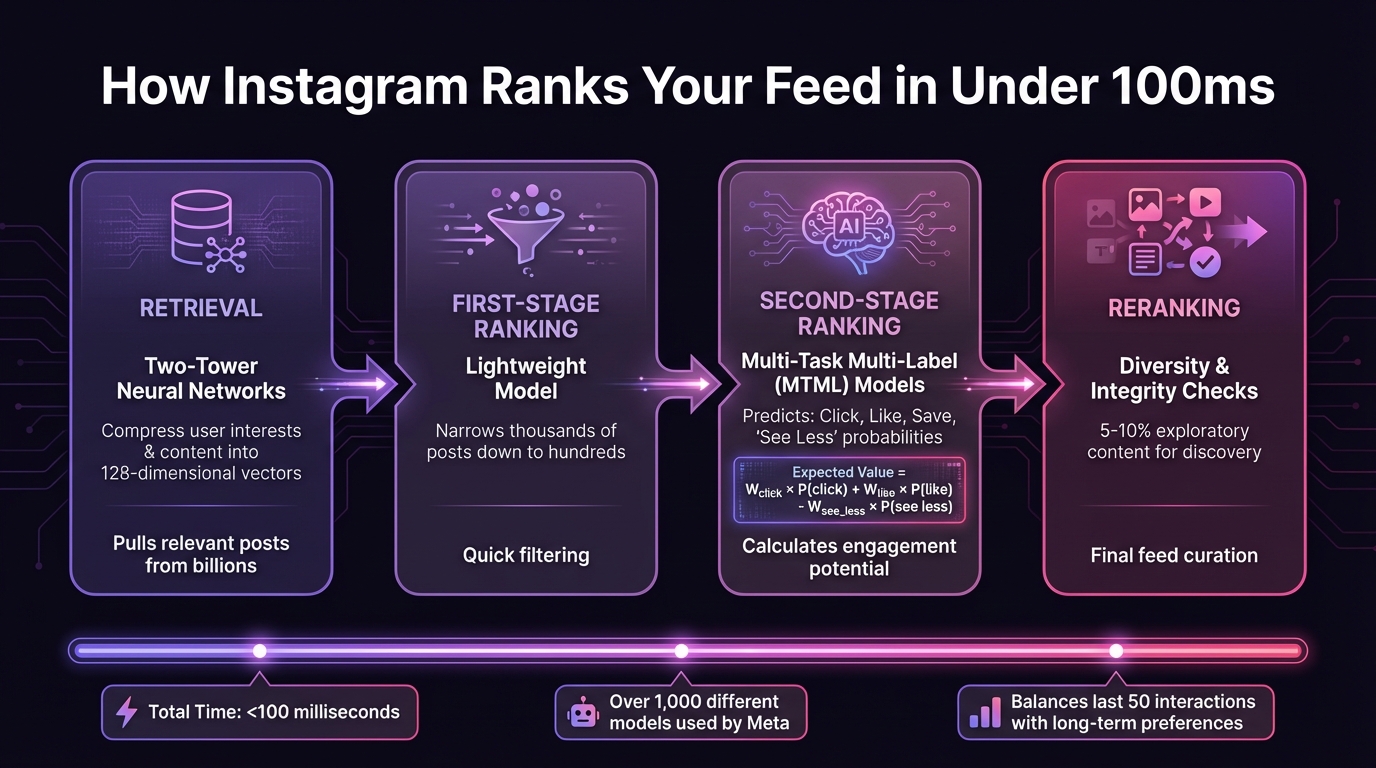
Instagram's 4-Stage Content Ranking Process in Under 100 Milliseconds
Instagram handles billions of posts through a lightning-fast, four-stage process that takes less than 100 milliseconds to complete. Here’s how it works:
The real magic happens in the Second-stage ranking, where Multi-Task Multi-Label (MTML) models predict probabilities for actions like clicking, liking, or marking content as "See Less". These probabilities are combined into an "Expected Value" formula:
Expected Value = W_click * P(click) + W_like * P(like) – W_see_less * P(see less).
Finally, Reranking adds diversity and integrity checks to your feed, ensuring a mix of content while avoiding repetition. About 5–10% of your feed is exploratory, designed to introduce you to new interests.
Instagram’s algorithm adapts quickly, balancing your long-term preferences with your last 50 interactions. If you switch from fitness content to cooking Reels, the system adjusts almost instantly. Different sections of the app prioritize different signals:
In 2026, Instagram introduced Trial Reels, a feature that tests your content with a small group of non-followers to measure its viral potential before showing it to your existing audience. Around the same time, Instagram began emphasizing the Skip Rate metric - if users scroll past your content within seconds, it’s likely to be downranked significantly.
These ranking strategies are the backbone of Instagram’s growth tools, enabling content creators to thrive on the platform.
Instagram’s ranking system has inspired tools like UpGrow, which uses a mix of AI and expert insights to boost organic growth. By analyzing Instagram’s real-time engagement signals, UpGrow identifies accounts that align with your target audience. Filters like location, age, gender, and language help refine this process, while a live dashboard tracks which types of posts are currently favored by the algorithm.
UpGrow focuses on optimizing content to drive high-value engagement actions, particularly Sends Per Reach - a metric that tracks private sharing via Direct Messages. According to Adam Mosseri, Head of Instagram:
"Sends Per Reach: Private sharing (DMs) is now arguably the strongest signal of value".
The service helps create content that encourages more Instagram story views, saves, shares, and extended watch time - metrics Instagram prioritizes. It also provides tools like a viral content library and profile optimization features to ensure your posts align with the latest algorithmic trends.
Since Instagram’s 2026 shift to adaptive AI systems, UpGrow has been continuously updating its strategies to keep accounts visible as the platform evolves. Starting at $39/month, the service even offers a growth guarantee - if you don’t see results, you get your money back.
Real-time engagement prediction has transformed how creators and brands approach content strategy. Instead of relying on guesswork, they can now anticipate how posts might perform before hitting "publish." This allows for smarter decisions, saving time and resources that might otherwise be spent on ineffective content. Tools like UpGrow exemplify this shift, using algorithms to fine-tune Instagram content for maximum impact.
The numbers speak for themselves. Personalized calls-to-action outperform generic ones by a staggering 202%, while AI-driven recommendations can push conversion rates from just 1.02% to as high as 8.57%. Even average order values can leap from $44.41 to over $400, showing how predictive tools boost not just engagement but also revenue. As Algolia puts it:
"Real-time personalization isn't just a luxury - it's becoming a necessity for companies that want to thrive in today's marketplace".
For Instagram creators, these tools are a game-changer, especially when it comes to expanding their reach. Today, over 20% of Instagram feed content comes from accounts users don’t follow, thanks to AI predictions about what will catch their interest. This discovery feature levels the playing field, giving smaller creators a chance to shine if their content scores well on engagement metrics. Instead of focusing solely on follower counts, the system prioritizes engagement rates - measured as total interactions divided by views - helping creators understand what truly resonates.
Contextual factors add another layer of precision. Studies show that incorporating real-time data, like time of day, local weather, or device connectivity, significantly improves predictive accuracy. This means brands can fine-tune their content for specific audiences, ensuring their resources are used effectively to grow on Instagram.
And the impact on businesses is undeniable. Some 91% of consumers are more likely to shop with brands that offer tailored recommendations. Real-time prediction makes this level of personalization scalable, allowing even small businesses to compete with larger players.
However, implementing these systems isn’t without its hurdles. Technical, ethical, and operational challenges can complicate their adoption.
While the benefits are clear, real-time engagement prediction comes with its own set of challenges. The technical requirements alone are daunting. Unlike batch systems that process data overnight, real-time models need to deliver predictions in milliseconds, often while users wait. Achieving such speed demands advanced infrastructure, like Kafka for data streaming and tools like Flink or Spark Streaming for computation. For smaller businesses, building and maintaining such systems can be an uphill battle.
Another issue is algorithmic bias. These systems can fall into "exploitation loops", where they keep recommending already-popular content because that’s what the data suggests. This creates a cycle where less popular content rarely gets a chance to be seen. For example, a traditional A/B test might need over 630,000 samples to achieve 95% confidence, but a bandit algorithm can reach the same confidence level with fewer than 12,000 samples by balancing exploration with exploitation.
Privacy concerns are also front and center. Real-time prediction often involves tracking user actions - every click, hover, or scroll - which raises questions about how this data is stored and used. Thankfully, modern models can achieve high accuracy (an R² of 0.442) by focusing on environmental factors like location and connectivity, reducing the need for extensive behavioral tracking. This approach offers a more privacy-conscious alternative, though some data collection is still necessary.
Transparency is another sticking point. AI systems can be opaque, making it hard to explain why a particular piece of content was recommended or why a model underperformed. As Antonio Grasso, Founder & CEO of dbi.srl, explains:
"Navigating the landscape of AI is a delicate endeavor that requires balancing the remarkable opportunities it presents with the significant ethical concerns it raises".
Finally, there’s the issue of model decay. User preferences and behaviors change over time, which can quickly reduce a model's accuracy. In response, companies like Grubhub have adopted stateful daily retraining, which fine-tunes models using the latest data instead of starting from scratch. This approach has slashed training costs by 45 times while keeping predictions up-to-date. Chip Huyen, a technologist and author, points out:
"Once your infrastructure is set up to do stateful training, the training frequency is just a knob to twist".
Addressing these challenges requires thoughtful system design, regular fairness checks, and a commitment to keeping processes transparent. As these tools continue to shape Instagram strategies and content consumption, striking this balance will be more important than ever.
Real-time engagement prediction has taken a leap forward with the use of context-aware models. These systems use real-time contextual data to predict how users will interact with content - even before they consume it. Research shows that these models explain 44.2% of engagement variance, reducing dependence on extensive behavioral histories.
Unified transformer-based models are now at the forefront of this evolution. Instead of creating separate systems for clicks, shares, or conversions, these models analyze raw user activity across all tasks in one framework. A notable example is Dream11’s implementation of LUMOS in November 2025. This unified model processed 275 billion activity tokens from 250 million users. By identifying patterns, such as how IPL viewing habits from the previous year predicted future engagement, Dream11 saw a 3.15% rise in Daily Active Users and a 4.6% drop in forecasting errors.
Instagram has also embraced these advancements with tools like UpGrow, which combine AI-driven targeting with real-time analytics. These tools adapt to shifting engagement patterns, helping creators and brands achieve organic growth while staying responsive to user behavior.
These breakthroughs set the stage for emerging trends that will further transform engagement prediction.
The next generation of prediction technology is moving toward "foresight prediction." Instead of simply analyzing past behavior, these algorithms aim to anticipate future content dynamics. For example, live-streaming models now use semantic quantization to analyze video segments and predict highlight moments, ensuring users see content at the most impactful time. Researchers from WSDM 2026 explain:
"Since the model lacks access to future content during recommendation, yet user engagement depends on how well subsequent content aligns with their interests, an intuitive solution is to predict future live-streaming content".
Another exciting development is multi-modal feature fusion. This approach combines data from various sources - visuals, audio, and creator information - to predict which content will go viral. In August 2024, researchers studied 100 million Snapchat sessions involving 80,000 users. By incorporating factors like smartphone battery levels, local weather, and time of day into deep LSTM neural networks, they improved predictive accuracy by over 50% compared to models that relied solely on in-app behavior. Heinrich Peters, a Snap Inc. researcher, highlights:
"Context-aware modeling approaches may offer a holistic yet lightweight and potentially privacy-preserving representation of user engagement on online social platforms".
The agentic AI market is another area poised for growth. These autonomous systems manage customer relationships and predict needs in real time. By 2030, this market is expected to grow from $7 billion to $43 billion, with an annual growth rate of 44%. However, challenges remain - by 2028, about 40% of agentic AI projects in customer experience are predicted to fail due to poor data quality. The Association of National Advertisers emphasizes:
"Success will come from navigating advanced AI capabilities without losing the trust, truth, and transparency that define strong brands".
For creators and brands, especially on platforms like Instagram, these advancements mean engagement prediction will become more precise, privacy-conscious, and capable of identifying viral trends before content is even published. However, maintaining high-quality data and integrating human oversight will be essential as these systems continue to evolve, refining how content is optimized and audiences are engaged.
Key indicators for predicting engagement revolve around active user actions like likes, comments, shares, link clicks, and profile visits. One of the most telling metrics is the engagement rate, calculated by dividing total engagements by views. This metric provides insight into how effectively content connects with its audience. Most platforms give more weight to active participation signals - such as replies and conversations - over passive actions. This means genuine user interaction plays a key role in making accurate engagement predictions.
Platforms evaluate and rank content in less than 100 milliseconds, relying on finely-tuned algorithms and advanced machine learning models, including neural networks. These systems rapidly process user data and content attributes to determine relevance and engagement potential. To achieve such speed, they use methods like caching, pre-computation, and specialized hardware or software. This lightning-fast ranking ensures users are presented with relevant content almost instantly, keeping their attention and supporting a smooth, uninterrupted experience on dynamic social media platforms.
Creators can improve engagement while respecting privacy by adopting methods that promote genuine interactions and use aggregated data rather than personal tracking. For instance, AI-driven tools like UpGrow can analyze engagement metrics - such as follower activity patterns and content performance - to fine-tune posting schedules and strategies without compromising user privacy. Prioritizing meaningful interactions, such as comments and shares, not only fosters stronger connections but also works in harmony with platform algorithms, supporting organic growth and increasing visibility.


