
How AI Scales UGC Video Production
AI automates UGC video workflows—scripts, avatars, captions and batch edits—cutting costs and time so brands can produce authentic videos at scale.
AI automates UGC video workflows—scripts, avatars, captions and batch edits—cutting costs and time so brands can produce authentic videos at scale.
4.98 /5 - from 58k reviews
Trusted by 50,000+ creators — get real engagement delivered to your profile in minutes, not days.

AI is transforming the way brands create user-generated content (UGC) videos, making it faster, cheaper, and easier to produce content that resonates with audiences. Traditional UGC production is slow and expensive, but AI tools now automate the entire process - from scripting to editing - allowing businesses to produce dozens of videos in minutes. Here's what you need to know:
AI tools like Creatify, Jasper Chat, and MakeUGC provide features like automated scripts, synthetic avatars, and batch processing, ensuring high output while maintaining a relatable look. However, maintaining authenticity and transparency is key to building trust with your audience. By combining AI production with ethical practices, brands can create scalable, relatable content that drives engagement and conversions.
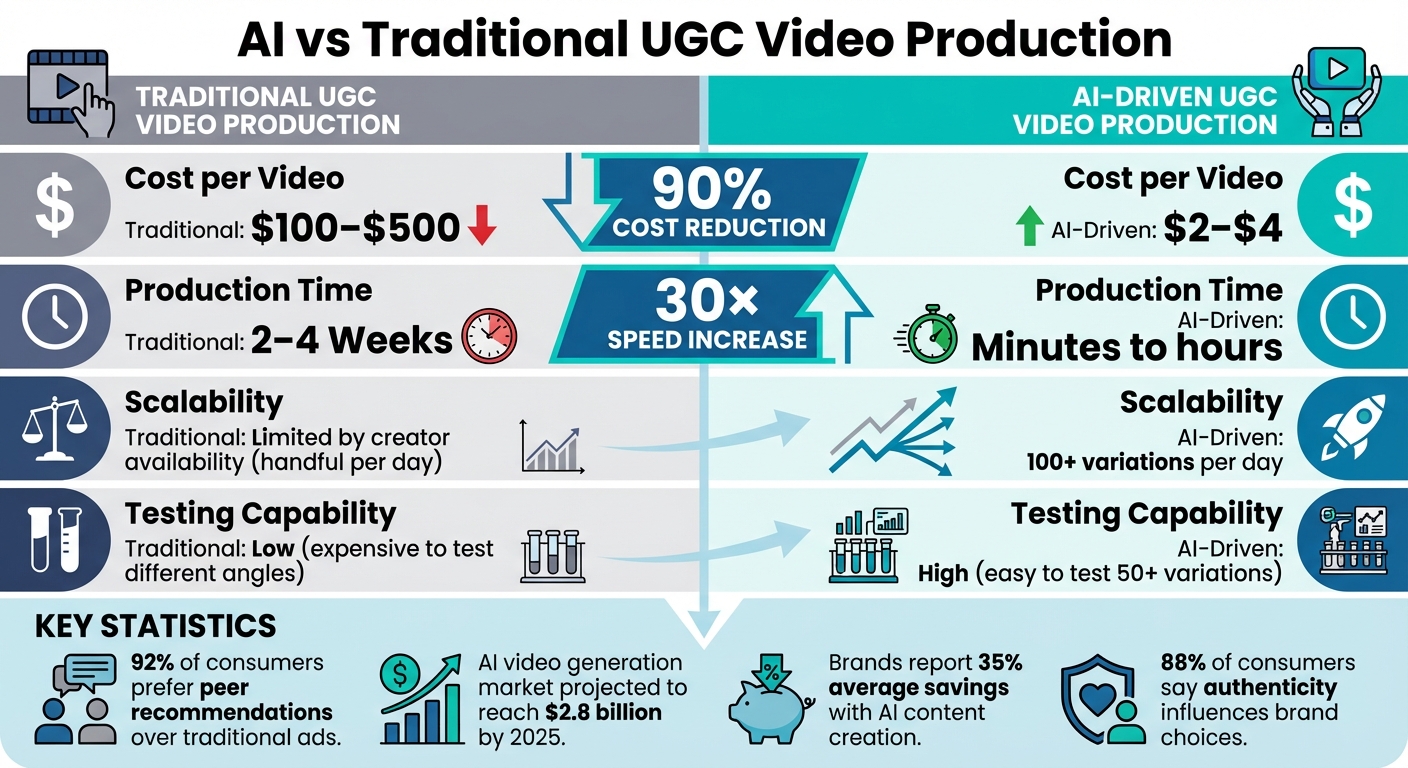
AI vs Traditional UGC Video Production: Cost, Time & Scale Comparison
Scaling user-generated content (UGC) production becomes much more efficient when you integrate AI into your workflow. AI tools can turn raw customer feedback into polished, authentic video content while saving time. These tools help you plan campaigns, create scripts using real customer language, and format videos for platforms like Instagram faster than traditional methods. This streamlined process sets the stage for campaigns that are both targeted and measurable.
Before diving into production, it’s crucial to set clear goals and define how you’ll measure success. For instance:
AI tools can make this process even simpler by tagging your existing assets based on hooks, personas, and tones. This categorization helps you identify what’s already working and plan new content accordingly. Plus, AI allows for continuous testing by generating multiple variations of content for the same goal. This means your strategy is guided by data, not guesswork.
Once your campaign goals are clear, the next step is to transform customer feedback into scripts that feel genuine. UGC works best when it sounds real, so feed actual customer reviews, support tickets, and social media comments into AI script generators. Use phrases directly from customers, like "total game-changer", to preserve their natural voice.
Each script should focus on a specific pain point or transformation story. Start with a hook that interrupts the viewer’s scrolling pattern, such as "I wish I knew this before…" or "Stop doing [wrong thing]." Keep the tone conversational and the pacing natural - reading the script aloud can help ensure it sounds authentic.
AI tools can also speed up your workflow by producing multiple script variations in seconds, giving you more options to test and refine.
When preparing videos for Instagram, stick to a 9:16 aspect ratio with a resolution of 1,080×1,920 pixels. Keep the content between 15 and 60 seconds long, and use AI editors to add auto-captions and dynamic cuts. Many AI platforms now let you batch-render videos in different formats, making it easy to optimize content for Instagram, TikTok, and YouTube without extra manual effort.
To keep viewers engaged, avoid static, talking-head shots that might encourage them to scroll away. If you’re using AI voiceovers, choose a tone that’s conversational or enthusiastic, and include natural pauses or even subtle "um" sounds to make the video feel more genuine. The aim is for your video to blend naturally into users’ feeds, so it feels like authentic content rather than an obvious ad.
AI tools have revolutionized video production, turning tasks that once required hours - or even days - into processes that can be completed in minutes. From generating scripts to creating digital presenters and adding polished effects, these tools aim to produce content that feels relatable while significantly cutting down on both time and expenses. Plus, they integrate smoothly into existing workflows, making production more efficient.
AI-powered script generators take the guesswork out of content creation by analyzing customer data like reviews, support tickets, FAQs, and product descriptions. Instead of relying on stiff corporate speak, these tools pull conversational phrases such as, "Honestly, I was skeptical..." rather than something like, "Our revolutionary formula...". It’s no wonder the AI video generation market is projected to hit $2.8 billion by 2025, showing just how quickly brands are adopting these tools.
One standout feature is URL-to-video scripting. Just paste a product link, and the AI generates 5–10 script variations with different hooks and angles. Tools like Creatify (starting at $49/month for up to 480 videos annually) and Jasper Chat excel in this area. To maximize success, test at least 10 different opening lines to discover what grabs your audience’s attention.
| Tool | Primary Scripting Feature | Best For |
|---|---|---|
| Creatify | URL-to-Video Scripting | Quick product ads from links |
| Jasper Chat | Brand Voice Brainstorming | Maintaining tone and generating ideas |
| ChatGPT | Versatile Text Generation | Writing hooks, captions, and A/B testing |
Before finalizing, always read scripts aloud to ensure they sound natural and engaging.
But scripting is just the start. AI also changes the game by introducing digital presenters.
AI avatars eliminate the logistical headaches of traditional UGC production - no more tracking down creators, shipping products, or waiting weeks for content. These digital humans replicate natural movements and expressions at 24 fps, creating a lifelike presence. You can even tailor avatars to your audience by adjusting age, ethnicity, and appearance - or upload your own footage to create a "digital twin".
While traditional UGC costs between $100 and $500 per video and takes weeks, AI-generated videos cost just $5–$10 per minute and are ready in minutes. Brands using AI for content creation report an average 35% savings compared to traditional methods.
With Batch Mode, you can create dozens of variations in one session, tweaking hooks, avatars, or backgrounds. Platforms like MakeUGC offer plans starting at $39/month for 60 videos, up to $119/month for 240 videos. Meanwhile, tools like Creatify use advanced models to bring full-body expressiveness and natural facial movements to their avatars, making them feel more lifelike.
To maintain authenticity, consider adding small imperfections like slight pauses or "um" sounds. Always disclose the use of AI with simple disclaimers, such as, "This presentation is delivered by a digital avatar". And with support for over 175 languages, these avatars make it easy to create multilingual content - perfect for reaching bilingual audiences in the U.S. with Spanish captions or localized videos.
Captions and visuals are key to boosting engagement, especially on platforms like Instagram. AI-based tools can cut production costs by 90% and speed up workflows by up to 30x compared to manual methods.
AI editors like Captions (Mirage) and Creatify automatically transcribe audio and sync captions to your video timeline. You can customize fonts, colors, and placement to align with your brand, and these tools also offer instant translation for multilingual audiences - a must for connecting with diverse viewers in the U.S..
Mirage, for instance, features a chat-based editor where you can type commands like "add music" or "adjust timing" to make complex edits without navigating a timeline. It also enhances videos by fixing eye contact, removing background noise, and resizing content for different platforms. Similarly, Descript lets you edit video by simply editing the transcript - delete a sentence in the text, and it’s gone from the video.
For dynamic engagement, AI tools can automatically add zoom effects, transitions, and B-roll footage to break up static visuals. Platforms like Opus Clip even analyze long-form content and turn it into vertical shorts with styled captions, perfect for platforms like TikTok or Instagram Reels. In 2025, beauty brand 1MORE used AI-generated UGC-style videos and saw 2.7x more leads compared to their previous static image campaigns.
"AI isn't replacing creative thinking - it's compressing the production bottleneck between idea and execution." - Creatify Team
To capture attention, focus on the first 1–3 seconds with bold visuals or surprising statements to improve "thumb-stop" rates.
Once you’ve nailed down individual AI techniques, the next step is creating repeatable systems that can turn User-Generated Content (UGC) production into a streamlined, high-output process. Instead of crafting videos one by one, templates allow you to produce dozens - or even hundreds - of variations with minimal effort. These systems don’t just save time; they bring consistency to your content and open the door for data-driven improvements.
Reusable templates are a game-changer for standard UGC formats like unboxings, tutorials, testimonials, and lifestyle clips. By standardizing these formats, you avoid starting from scratch every time new content is needed.
Modern AI tools, such as Storyboard 3.0, make this process even easier. They let you plan out key details like scene order, camera angles, and pacing before generating the content. This ensures that even when producing large batches of videos, the visuals remain consistent. A hybrid workflow can make this even more effective: start with a single "base" video featuring a real creator, and then let AI step in to create variations. You can add different angles, alternate hooks, or short edits for A/B testing - all without needing additional shoots.
While human creators might produce just a handful of clips in a day, AI tools can generate over 100 variations in the same time frame. Features like Batch Mode allow you to take a single script and quickly create multiple versions using different avatars or hooks. This is invaluable for A/B testing, as you can let actual performance data guide your decisions instead of relying on guesswork.
The cost savings are just as impressive. Traditional UGC production costs anywhere from $100 to $500 per video and can take 2–4 weeks. In contrast, AI platforms often charge around $49 per month for up to 480 videos annually, translating to just $2–$4 per video. That’s a savings of about 90% in cost and a 30× boost in production speed.
| Feature | Manual UGC Production | AI-Driven Batch Production |
|---|---|---|
| Cost per Video | $100–$500 | ~$2–$4 (via subscription) |
| Production Time | 2–4 weeks | Minutes to hours |
| Scalability | Limited by creator availability | 100+ variations per day |
| Testing Capability | Low (expensive to test angles) | High (easy to test 50+ variations) |
AI tools also simplify multi-format exporting. With just one template, you can instantly resize your content for platforms like TikTok (9:16), Instagram feed posts (1:1), and YouTube (16:9). Localization is another standout feature - AI voice synthesis can transform a high-performing English video into Spanish, French, or German versions without any additional filming. With these tools, you can scale your content while refining it based on analytics.
By combining AI’s speed and cost efficiency with analytics, you can fine-tune your content for maximum impact. Metrics like click-through rates (CTR), thumb-stop rates (how often users stop scrolling in the first 3 seconds), and watch time provide clear insights into what’s working. For example, if videos using "transformation" hooks outperform those with "skeptic" hooks, you can focus on creating more of the former in your next batch.
AI platforms also make it easy to manage your budget. A "kill switch" feature can stop ad spend on underperforming videos once they hit a certain cost threshold (e.g., $50–$100), allowing you to reallocate funds to your best-performing content. Many platforms even integrate directly with ad dashboards on Meta and TikTok, so you can track performance and scale winning videos quickly.
For Instagram growth, pairing AI-generated UGC with precise targeting can significantly boost results. Once you’ve identified your top-performing templates, tools like UpGrow can help you reach the perfect audience with AI-powered targeting and real-time analytics. This creates a feedback loop where your content and audience engagement continuously improve.
Scaling user-generated content (UGC) with AI can be a game-changer, but it comes with a big responsibility: maintaining authenticity. Why? Because 88% of consumers say authenticity influences their brand choices. If your AI-generated content feels staged or insincere, it could harm your brand’s reputation. That’s why authenticity needs to guide every step of the AI production process.
When using AI to generate UGC, the key to authenticity lies in the source material. Instead of creating scripts out of thin air, base your content on real customer reviews, support tickets, and social media comments. This ensures the language and concerns reflected in your AI-generated videos come from actual customer experiences - not just marketing fluff.
To strike the right tone, align customer language with your brand’s voice while keeping a conversational, natural flow. Avoid robotic phrasing or overly polished delivery, as this can signal artificiality. Focus on a soft-sell approach - recommendations and honest opinions rather than hard pitches - because that’s how real users typically share their experiences.
When choosing AI avatars, make sure they resonate with your target audience. Representation matters. By selecting avatars that reflect your audience’s demographics, you create content that feels relatable and inclusive. This alignment strengthens the connection between your brand and its viewers.
Even with advanced AI tools, human oversight is essential. Set up a review process where your team verifies that AI-generated content is accurate, helpful, and consistent with your brand’s values. Transparency is also crucial - use clear disclaimers like, “This presentation is delivered by a digital avatar” to inform viewers.
Additionally, stay compliant with platform policies. Major platforms like Meta, Google, and TikTok have specific rules for AI-generated content. Avoid risky practices like creating fake testimonials or using someone’s likeness without permission - these actions can lead to legal trouble and damage your brand’s credibility.
When scaling AI-generated UGC on Instagram, growing your audience ethically is just as important as creating authentic content. Using bots or buying fake followers may seem like an easy shortcut, but it violates Instagram’s rules and undermines trust. Instead, focus on organic growth strategies that connect you with real people who care about your content.
Platforms like UpGrow combine AI-powered targeting with human expertise to help you grow your account naturally. They use smart filters to reach users who are genuinely interested in your content, while real-time analytics let you track what’s working. This creates a feedback loop: your AI-generated UGC reaches the right audience, their engagement data informs your future content, and your account grows sustainably. Authentic UGC not only boosts engagement but also builds a loyal audience, keeping your Instagram account safe and credible in the process.
AI has revolutionized content creation, turning what used to take weeks of coordination and costly production into a matter of minutes. By slashing costs by 90% and increasing production speed by 30×, brands can now create videos for as little as $2 to $4 each - all while maintaining a relatable, mobile-shot look that resonates with audiences. Features like automated scripting, avatars, and real-time editing come together to create an efficient and ethical workflow for modern UGC production.
But it’s not just about speed and savings. AI also opens the door to scalable testing. Imagine generating multiple hooks, avatars, and language variations, then using performance data to refine your approach. This method has already delivered results - brands like 1MORE saw 2.7x more leads using AI-generated videos compared to static images.
Of course, speed and scale mean little without authenticity. Trust is built through genuine content, and cutting corners risks alienating your audience or violating platform rules. That’s why human oversight is essential. Transparent practices, clear disclosures, and adherence to Instagram’s guidelines ensure your AI-driven strategy remains ethical and effective. When high-quality AI content is paired with thoughtful growth strategies, it creates a system that fosters real connections with your audience.
Looking to elevate your AI-powered UGC on Instagram? UpGrow combines AI targeting with real-time analytics to drive organic growth. Starting at just $39/month, their tools help your content reach the right audience while staying true to your brand’s voice. By blending AI’s production efficiency with ethical growth techniques, you can overcome creative bottlenecks and ensure your message lands where it matters most.
AI keeps the personal touch alive in user-generated content (UGC) videos by closely studying real examples to mimic natural details like lighting, tone, and authentic reactions. By doing so, it creates videos that feel relatable and genuine, thanks to sophisticated algorithms trained on real-world data.
To uphold transparency, ethical measures are integrated into the AI process, including clear labels for AI-generated videos. This ensures a balance between creating content at scale and maintaining trust - delivering engaging material while respecting the audience's expectations.
AI has revolutionized the way brands approach user-generated content (UGC) video production by slashing costs tied to traditional methods. Forget about shelling out for studio rentals, hiring large production crews, covering travel expenses, or spending hours on post-production edits. Conventional video projects typically cost anywhere between $800 and $10,000 per finished minute, with high-end agency work soaring to $5,000 to $20,000 per video. In contrast, AI can achieve similar results at a fraction of the cost, often cutting expenses by an impressive 80% to 90%.
What’s more, AI simplifies the entire production process, making it possible for brands to produce dozens - or even hundreds - of videos on the same budget that would normally fund just one traditional project. This scalability doesn’t just lower the cost per video; it also boosts ROI. With AI, brands can afford to run more campaigns, create personalized content, and experiment with different variations - all without worrying about additional production costs.
AI brings a fresh approach to audience engagement by blending the relatable nature of user-generated content (UGC) with the speed and precision of machine learning. Brands can now create on-brand, relatable videos in no time, sidestepping the hassle of sourcing authentic clips manually. Plus, AI takes personalization to the next level by tailoring videos to match specific languages, locations, and even individual interests, encouraging more likes, comments, and shares.
This quick turnaround in content production means brands can experiment with creative ideas, update their campaigns more often, and keep their content pipeline flowing. The result? Audiences stay intrigued and engaged without feeling overwhelmed by repetitive messaging. AI-powered UGC ensures the content feels real and relevant, transforming casual viewers into dedicated followers who actively engage with the brand.


