
How AI Improves UGC Video Campaigns
AI cuts UGC video costs and time, powers massive scaling, and offers scene-level analytics for faster, data-driven ad testing.
AI cuts UGC video costs and time, powers massive scaling, and offers scene-level analytics for faster, data-driven ad testing.
4.98 /5 - from 58k reviews
Trusted by 50,000+ creators — get real engagement delivered to your profile in minutes, not days.

AI is transforming how brands run UGC (User-Generated Content) video campaigns by addressing the common challenges of cost, time, and scalability. Traditional UGC campaigns are slow and expensive, often taking weeks to produce and costing $150–$500 per video. AI-powered tools, however, allow brands to create hundreds of video variations in under 24 hours for less than $5 per video, while also providing advanced analytics to optimize performance.
Here’s what AI brings to the table:
While traditional methods excel at delivering a human touch, AI-powered campaigns offer unmatched speed and cost-efficiency. The best results often come from combining both approaches: using AI for rapid testing and high-volume production, and reserving manual efforts for content that requires a personal connection.
Manual UGC (User-Generated Content) campaigns rely heavily on human coordination, which can be a slow and inefficient process. Brands often wait for organically tagged or submitted content, but valuable material can easily get lost in hashtags or overlooked entirely.
Manually finding the right creators is like searching for a needle in a haystack. Teams sift through hashtags, brand mentions, and customer submissions, which is both time-consuming and far from precise. Often, creator selection is based on surface-level metrics like follower counts rather than genuine audience alignment. On top of that, brands must personally recruit customers or micro-influencers, followed by lengthy hours spent coordinating briefs and setting expectations.
When it comes to performance data, the lack of integration is a real hurdle. Data and creative assets exist in separate silos, making it nearly impossible to connect specific video moments to campaign results. As Sophia Carter from Uplifted puts it:
Creative sits apart from data; you can't see which moments actually lifted results.
To make matters worse, creatives are often labeled with non-descriptive filenames like "final_v2.mp4", which offers no insight into what worked or why. Analysis typically happens after the campaign budget is spent, leaving brands to rely on reactive guesswork for optimization. This delay means high-performing ads often burn out from overexposure before anyone realizes, quietly driving up costs.
Creating and editing content for manual campaigns is both time-intensive and expensive. Production timelines range from 14 to 21 days, with costs between $150 and $500 per video. Professional testimonials can push costs even higher, from $2,000 to $5,000 per video. Coordinating just 10 videos requires around 15 hours of labor, and unpredictable creator behavior can add even more challenges.
Scaling manual workflows is an uphill battle. Logistics, limited creator availability, and high costs mean brands can only produce a small number of assets each quarter. For instance, working with three micro-influencers might cost $4,500 per month for just 30 assets. As creative fatigue sets in, these slow production cycles fail to refresh top-performing content in time. Adding global localization to the mix can tack on an additional $1,500 to $4,000 and extend timelines by 6 to 8 weeks per video.
These roadblocks highlight the inefficiencies of manual campaigns and set the stage for AI's potential to streamline and scale UGC efforts effectively.
AI-powered UGC campaigns are changing the game by automating almost every step of the process. Instead of waiting weeks for creators to deliver content, brands can now produce dozens of video variations in just minutes. This shift transforms UGC from a slow, reactive strategy into a fast-paced testing tool that feeds modern ad platforms with consistently fresh and diverse creative.
Platforms like Meta and TikTok now rely heavily on creative-led "Broad Targeting", where the content itself helps attract the right audience. AI makes it possible for brands to create the vast amount of niche-specific content this strategy demands. Through libraries of photorealistic avatars, AI can represent a range of ages, ethnicities, and styles. For example, a running shoe brand can feature a marathoner avatar for serious runners and a casual jogger avatar for weekend enthusiasts - all without hiring actors. Additionally, new tools enable real-time personalization by tailoring content to viewer data like demographics and location.
This creative-led strategy not only helps brands scale their campaigns but also improves efficiency. For instance, an e-commerce brand used AI to generate 50 video variations in a month and cut its cost per acquisition by 33%. By combining precise targeting with advanced analytics, brands can optimize their ad spend while staying agile.
AI takes UGC marketing from reactive reporting to proactive decision-making. Advanced platforms now offer a "creative intelligence layer" that tags visuals, audio, and scripts by criteria like persona, tone, and key messaging. This feature allows marketers to search their creative libraries based on strategies such as "problem-solution" or "social proof" without wasting time on manual sorting.
Detailed scene-level analytics make it possible to measure performance metrics like stop rate, hold rate, and ROAS, helping brands identify which hooks or calls to action deliver the best results. For example, a Consumer Packaged Goods brand analyzed over 900 social videos with AI, uncovering consumer flavor preferences in seconds - a task that previously took 15 hours of manual labor. AI can also detect creative fatigue, prompting brands to refresh content before performance dips. Marketers who replace underperforming assets weekly report up to 40% lower customer acquisition costs.
AI eliminates the production bottlenecks that slow down traditional UGC campaigns. Platforms can generate scripts directly from product URLs or descriptions and deliver polished videos in as little as 2 to 10 minutes. The cost? Less than $5 per asset - significantly cheaper than traditional methods. For example, a skincare brand in 2025 shifted from spending $8,000 monthly on micro-influencers to an AI-driven approach, producing four times more video content at 85% lower costs.
Beyond speeding up production, AI automates technical tasks like background replacement, auto-captioning, and filler word removal - tasks that usually require professional editors. It can even localize videos into over 80 languages with natural accents and synchronized lip movements. A B2B SaaS company, for instance, slashed its product launch video localization costs from $30,000 (over 6–8 weeks) to under $500 by creating 15 language versions in a single afternoon.
The combination of advanced targeting, analytics, and content creation leads to unmatched scalability. AI's "Batch Mode" allows brands to produce dozens of variations - different hooks, avatars, or lengths - all at once. Testing 50+ creative versions can cost as little as $50. On average, AI production takes about 16 minutes per video, compared to 69 minutes using traditional methods.
This efficiency supports an "Auto-Pilot" framework, which systematically generates multiple hooks, body scripts, and calls to action for every campaign. The results are impressive: AI-powered UGC can boost engagement by up to 350% on platforms like TikTok, achieve four times higher click-through rates, and reduce cost-per-click by 50%. For Instagram-focused brands, tools like UpGrow provide AI-targeted insights and access to a viral content library, helping marketers quickly identify winning creative styles before scaling up production.
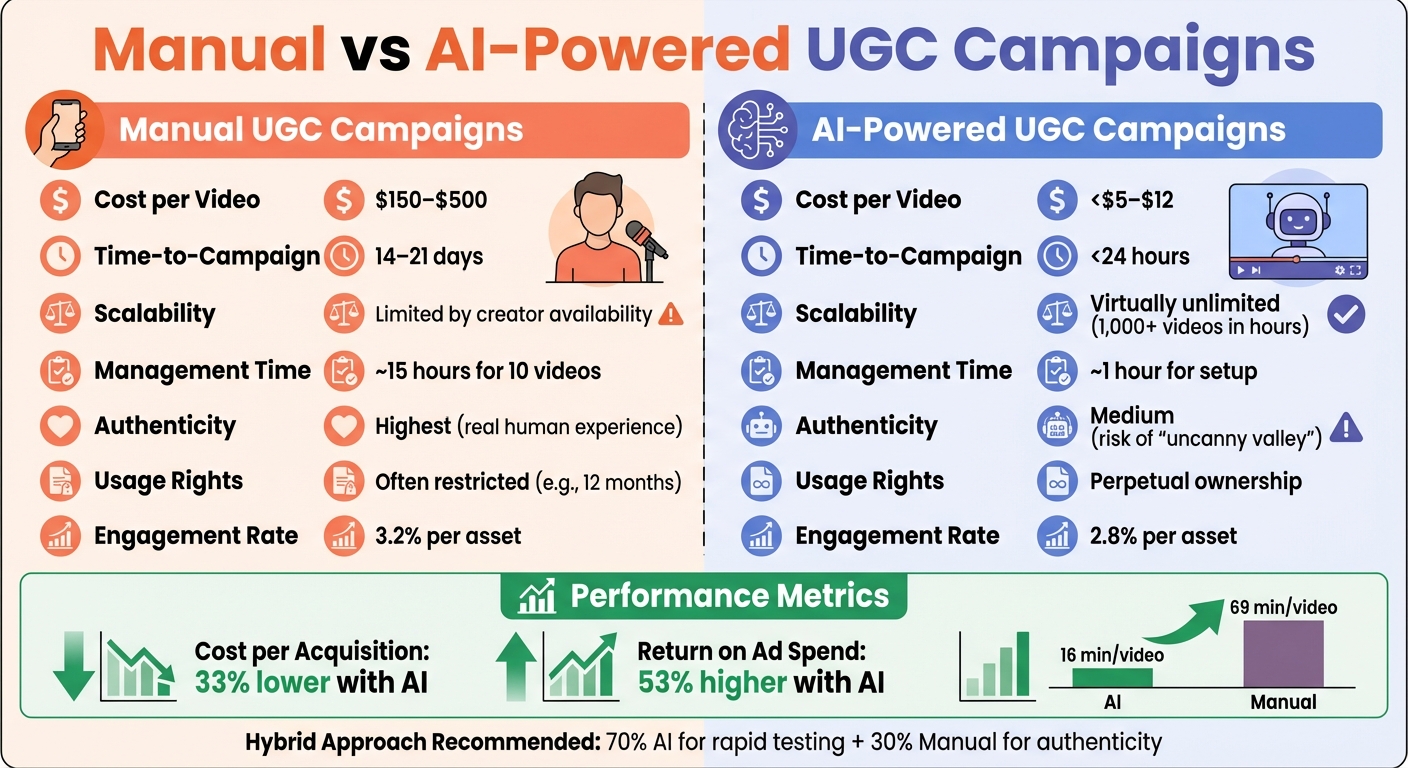
Manual vs AI-Powered UGC Campaigns: Cost, Speed, and Performance Comparison
Manual campaigns emphasize authenticity, but they come with challenges - they're slow, expensive, and require significant effort. On the other hand, AI-driven methods offer faster, more scalable production at a much lower cost, though they may sacrifice some of the natural feel. Traditional user-generated content (UGC) creators provide genuine human experiences that resonate with audiences, but coordinating manual campaigns can be a logistical headache. In contrast, AI-powered approaches can reduce production costs to under $5 per video and cut turnaround times to less than 24 hours.
The main strength of manual methods lies in their authenticity, but scalability remains a hurdle. Factors like creator availability and physical logistics (e.g., shipping products) limit how quickly manual campaigns can grow. AI eliminates these bottlenecks, allowing brands to produce over 1,000 videos in just hours with only about an hour of setup time. However, subtle flaws in AI-rendered content can create an "uncanny valley" effect, potentially eroding viewer trust. As Austin Armstrong, CEO of Syllaby, cautions:
AI UGC for fake testimonials and product reviews is lazy, unethical, and will get you in massive trouble. Nevermind the fact it hurts your brand.
Beyond cost and scalability, performance tracking also sets these methods apart. Manual campaigns often lack consistent performance data, making large-scale A/B testing challenging. AI platforms, on the other hand, offer detailed, scene-level analytics to identify which hooks or calls-to-action drive results. While AI-generated UGC may have slightly lower engagement rates per asset (2.8% versus 3.2% for manual content), its sheer volume advantage translates to a 33% lower cost per acquisition and a 53% higher return on ad spend.
| Metric | Manual UGC Campaign | AI-Powered UGC Campaign |
|---|---|---|
| Cost per Video | $150–$500 | <$5–$12 |
| Time-to-Campaign | 14–21 days | <24 hours |
| Scalability | Limited by creator availability | Virtually unlimited |
| Management Time | ~15 hours for 10 videos | ~1 hour for setup |
| Authenticity | Highest (real human experience) | Medium (risk of "uncanny valley") |
| Usage Rights | Often restricted (e.g., 12 months) | Perpetual ownership |
Given these trade-offs, a hybrid approach often works best. By combining the strengths of both methods, brands can maximize their impact. AI can handle high-volume testing to identify the most effective messaging angles, while manual UGC can be reserved for moments that require a deeper connection with the audience. Leading brands typically allocate around 70% of their creative efforts to AI-driven rapid testing and 30% to manual content for building trust . For Instagram-focused campaigns, tools like UpGrow offer AI-powered insights and access to a library of viral content, enabling marketers to experiment with creative styles before scaling up production.
AI-powered UGC campaigns are reshaping how brands approach marketing by offering precise targeting, predictive analytics to reduce wasted spending, and virtually limitless scalability. As we approach 2026, when creative fatigue is expected to become a major obstacle for ad performance, AI steps in to eliminate the inefficiencies of manual campaigns. Gone are the days of waiting for product shipments or juggling schedules with multiple creators. With AI, brands can generate over 20 video variations per week, ensuring a steady stream of fresh content for algorithms - all while keeping production costs under $5 per video.
Beyond just speeding up production, AI shifts marketing from reactive guesswork to a proactive, data-driven strategy. By analyzing creative elements like hook strength and pacing, AI predicts ad performance before any budget is spent. This approach represents a strategic evolution, combining the precision of AI with the irreplaceable creativity of human input.
The key lies in finding the right balance. Pairing AI's rapid testing capabilities with manually crafted UGC ensures campaigns retain both efficiency and authenticity. For Instagram campaigns, tools like UpGrow are game-changers. They offer AI-powered targeting, access to a vast viral content library, and real-time analytics, allowing marketers to test creative ideas before scaling up production. With features like smart targeting and detailed tracking, UpGrow helps brands identify and amplify the content that resonates most.
High-speed testing is no longer optional - it's essential. Gartner estimates that "by 2026, 80% of advanced creative functions will be automated". This shift ensures brands can maintain engagement and adapt to ever-changing platform algorithms. Those who embrace AI-powered UGC now will enjoy stable engagement rates and reduced acquisition costs, while brands sticking solely to manual methods risk falling behind.
When you need efficiency, scalability, and cost savings, AI is a great choice for generating user-generated content (UGC). It’s especially useful for tasks like testing campaigns or creating large amounts of content quickly. For example, AI can produce videos at a fraction of the time and cost compared to traditional methods.
However, if your goal is to prioritize authenticity, emotional connections, and trust, real creators are the way to go. Their content often resonates more deeply with audiences, leading to higher engagement and better conversion rates.
The best results often come from a hybrid approach - leveraging AI for speed and volume while incorporating real creators for a genuine, relatable touch. This combination allows you to balance efficiency with meaningful audience connections.
To make AI-generated user-generated content (UGC) feel genuine, focus on creating an emotional connection and staying transparent. Use AI as a tool to support real human contributions, not as a substitute for them. Combine AI-generated material with actual user testimonials to keep the content grounded and relatable. Avoid making the content feel overly polished or artificial - authenticity matters. By analyzing real customer feedback and trends, you can ensure the content reflects what resonates with your audience. Striking the right balance between AI and genuine user experiences builds trust and keeps the content feeling real.
When it comes to evaluating AI-driven metrics for UGC ads, the focus is on measuring how well the content performs and contributes to ROI. Key indicators like engagement rates, conversion rates, and reach are essential for understanding how effectively the content connects with audiences and encourages action.
Beyond performance, metrics such as creative refresh rate, time-to-creative, and cost per asset shed light on the efficiency of AI in streamlining content production, testing, and scaling. These insights play a vital role in improving campaign outcomes while keeping costs in check.


