
How AI Helps Small Influencers Find Brand Collaborations
AI lets small influencers ditch manual outreach by automating brand matching, pitch writing, and performance tracking.
AI lets small influencers ditch manual outreach by automating brand matching, pitch writing, and performance tracking.
4.98 /5 - from 58k reviews
Trusted by 50,000+ creators — get real engagement delivered to your profile in minutes, not days.

AI is transforming how smaller influencers collaborate with brands, replacing time-consuming manual work with smarter, faster tools. Here's what you need to know:
With AI, small influencers can focus on creating content while tools handle the technical side, making it easier to stand out and secure partnerships.
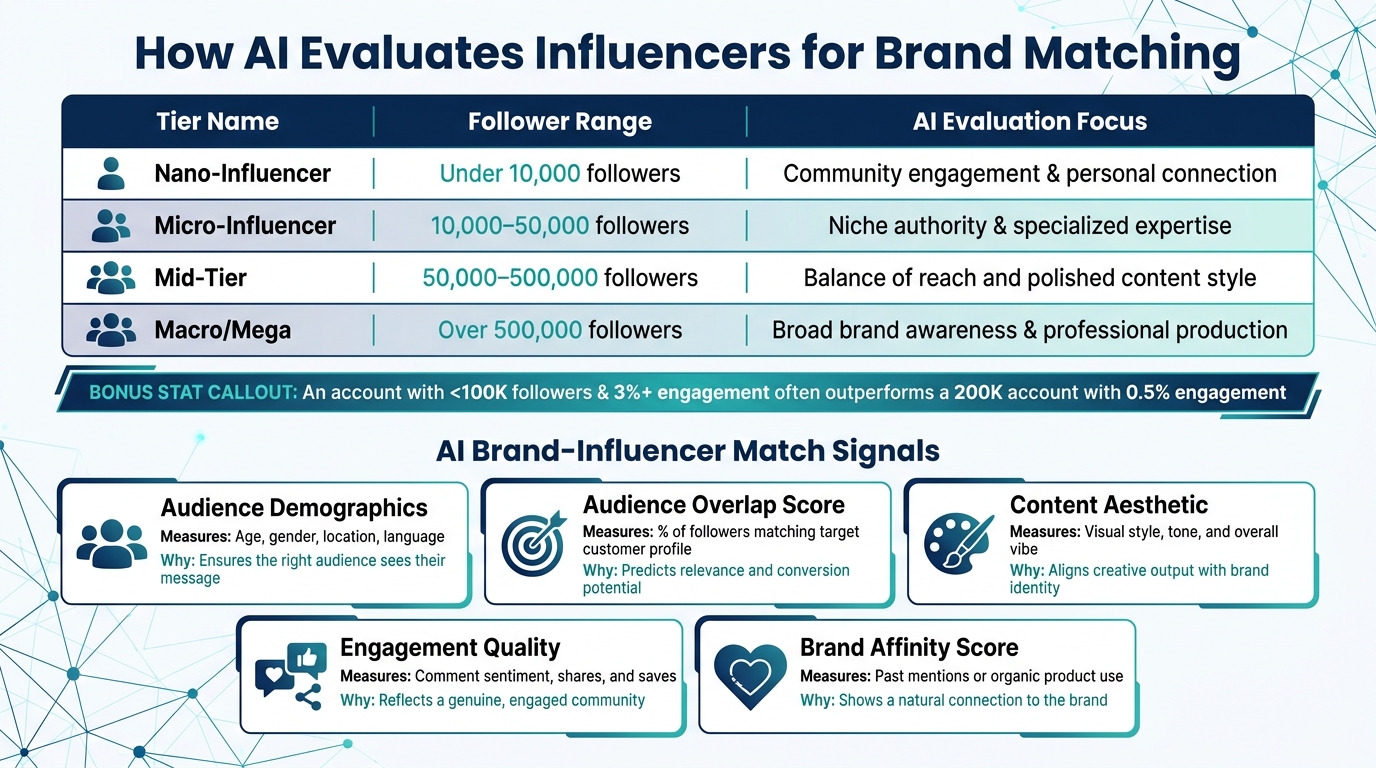
Influencer Tiers: AI Evaluation Metrics & Brand Matching Criteria
AI brand matching transforms your profile into a data-rich portfolio that brands can evaluate objectively. Instead of relying on someone scrolling through your feed, AI dives into your content, audience, and performance metrics to determine if you're a good match - and it does this in record time.
AI looks beyond just follower numbers. It starts by analyzing your bio, captions, and hashtags to identify your niche. For instance, if you post about sustainable skincare, AI tags your profile for brands in that category. Then, it checks your audience demographics - age, gender, location, and language - since brands want influencers whose followers align with their ideal customers.
Next, AI evaluates your profile’s overall vibe by analyzing your visual style and tone. Whether your content feels luxurious, artistic, laid-back, or meme-heavy, these traits help brands decide if you fit their image. It also pulls key essential Instagram metrics like saves, shares, reach, and growth trends, giving brands a clearer sense of your actual influence.
For example, an account with fewer than 100,000 followers and a 3%+ engagement rate often holds more sway than one with 200,000 followers and a 0.5% engagement rate.
| Influencer Category | Follower Range | Evaluation Focus |
|---|---|---|
| Nano-Influencer | Under 10,000 | Community engagement & personal connection |
| Micro-Influencer | 10,000–50,000 | Niche authority & specialized expertise |
| Mid-Tier | 50,000–500,000 | Balance of reach and polished content style |
| Macro/Mega | Over 500,000 | Broad brand awareness & professional production |
Knowing how AI evaluates your profile helps you make smarter decisions to strengthen its appeal.
AI tools don’t just evaluate your profile - they help you improve it. For example, platforms like UpGrow use Smart AI-Targeting to attract followers based on interests, hashtags, location, age, and language. If you’re a beauty creator, you can use these features to build an audience that matches the demographics cosmetics brands are searching for. This makes your profile stand out during brand searches.
Another key focus is authenticity. According to a 2025 HubSpot study, nearly 50% of influencers have fake followers. Tools like UpGrow, which boasts a 4.98/5 rating from over 58,000 reviews, emphasize organic growth. By using niche-specific keywords in your bio and captions, you help AI tools categorize your profile properly, ensuring the right brands discover you.
Once your profile is polished, the next step is zeroing in on brands that align with your audience. This isn’t just about reaching out to companies you admire - it’s about demonstrating, with hard data, that your followers are the ones they want to engage with.
AI plays a crucial role in identifying the perfect match by analyzing audience overlap, content style, and engagement quality.
Audience overlap is where AI shines. It evaluates how closely your followers match a brand’s target demographic - looking at factors like age, location, interests, and even the other accounts they follow. For example, a beauty brand targeting U.S. women aged 18–34 will prioritize influencers whose audience fits that exact profile.
Your content aesthetic is equally important. AI assesses the overall tone and style of your content - whether it’s luxurious, casual, playful, or lifestyle-focused - and compares it to a brand’s image. For instance, a high-end skincare brand likely won’t collaborate with an account that frequently shares memes, even if the demographics align.
Here’s a breakdown of the key signals brands evaluate:
| Signal | What AI Measures | Why Brands Care |
|---|---|---|
| Audience Demographics | Age, gender, location, language | Ensures the right audience sees their message |
| Audience Overlap Score | % of followers matching target customer profile | Predicts relevance and potential for conversions |
| Content Aesthetic | Visual style, tone, and overall vibe | Aligns creative output with brand identity |
| Engagement Quality | Comment sentiment, shares, and saves | Reflects a genuine, engaged community |
| Brand Affinity Score | Past mentions or organic product use | Shows a natural connection to the brand |
Brands also rely on AI to ensure collaborations are safe and that influencer audiences are authentic before moving forward.
AI doesn’t stop at finding the right match - it also ensures the partnership is low-risk. Before a brand commits, AI scans for potential red flags, such as controversial content or unusual engagement patterns. This automated vetting process includes reviewing past posts for sensitive material, flagging irregular posting habits, and analyzing comments to detect bot activity.
One major issue AI flags is fake follower activity. Suspicious growth spikes or generic, emoji-heavy comments can indicate inauthentic engagement. Brands use these tools to filter out influencers with questionable metrics - sometimes before a human even looks at the profile.
Here’s the upside: you can use the same tools to audit your own account. By identifying and addressing red flags in advance, you’ll stand out as a reliable partner. A well-documented, genuine audience is one of the strongest assets you can showcase as a smaller influencer.
Understanding your audience is just the beginning. To make your outreach effective, you need the right tools and a clear plan for identifying which brands deserve your attention.
Think of your outreach materials as a digital portfolio. Before reaching out to any brand, ensure you have four essentials: a polished bio, a media kit, updated audience demographics, and recent performance data.
Your media kit should be concise - 1 to 2 pages at most - and highlight key details about your niche, audience demographics (age, location, interests), and performance metrics like engagement rate, reach, saves, and clicks. Brands are looking for proof, not vague promises. For example, micro-influencers (10,000–100,000 followers) often boast engagement rates between 3% and 8%, which can be a major selling point compared to larger accounts. Make sure to emphasize this.
A rate card is another must-have. Nano-influencers (1,000–10,000 followers) typically charge $100–$500 per post, while micro-influencers can command anywhere from $500 to $3,000 depending on their niche and engagement levels. Having a clear idea of your rates upfront shows professionalism and confidence.
Before pitching, audit your profile with tools like UpGrow’s real-time analytics to ensure your numbers are accurate. Brands increasingly rely on AI tools to detect fake followers and engagement inconsistencies. Addressing any discrepancies beforehand gives you an edge.
Once your materials are ready, you can use AI to pinpoint the brands that align with your audience and content.
With your outreach package prepared, the next step is identifying the right brands to contact. Sending generic pitches to random companies is a quick way to get ignored. Personalized outreach, on the other hand, has a 32% response rate, compared to just 8% for generic templates. The key is relevance, and AI makes finding it easier.
AI tools analyze your audience demographics and content themes to match you with brands whose target customers are similar to your followers. Some platforms even offer "lookalike" matching, which identifies brands that have already partnered with creators in your niche or with a similar aesthetic. Instead of guessing which skincare company might be interested, AI narrows down the options to brands already investing in your type of content.
"AI does not replace relationships in influencer marketing, it removes friction so brands can invest more deeply in the partnerships that actually matter." - Sohaib Ahmed, Senior Digital Marketer
Once you’ve created a shortlist of potential brands, AI writing tools like ChatGPT or Jasper can help you craft personalized pitches. Reference a brand’s recent campaigns or values to make your outreach feel tailored rather than generic. Timing also plays a role. Reaching out on Tuesday through Thursday, between 10–11 AM or 2–3 PM in the brand’s time zone, tends to yield better response rates.
Once a collaboration is live, the real work begins - tracking its performance. A post by itself doesn’t guarantee success; understanding the outcomes is what drives meaningful improvements. AI-powered tracking tools can analyze results 40% faster than manual methods, ensuring every metric contributes to smarter decisions in the future.
It’s not just about likes or follower counts. To truly measure success, focus on these key metrics: reach, engagement rate, saves, clicks, and conversions. For conversions, always rely on unique UTM-tagged links or promo codes tailored to each campaign. This approach provides the most reliable proof that your content directly influenced sales or sign-ups.
Engagement benchmarks help you gauge performance. For instance, in 2025, Instagram Reels averaged a 3–6% engagement rate, while micro-influencers typically achieved 4–8%, compared to the 1–2% average for macro-influencers. Falling within these ranges is a good sign, and AI tools can simplify the process by generating clean, shareable reports automatically.
"The number of companies that run influencer campaigns without basic attribution tracking is staggering. Don't be one of them." - Tiger Tail
Another crucial metric is sentiment analysis. Advanced AI tools can scan comments in real time, helping you understand whether your audience views the partnership positively or negatively. These insights go beyond surface-level data. For example, UpGrow’s live dashboard tracks follower growth and engagement shifts immediately after a sponsored post goes live. This real-time feedback allows you to spot unusual trends - whether it’s a sudden spike or an unexpected drop in engagement.
Tracking metrics isn’t just about proving success; it’s also about refining your strategy for future collaborations. By feeding past campaign data into AI platforms, you can improve brand matching and content recommendations. Over time, this creates a feedback loop: better data informs smarter pitches, leading to stronger partnerships.
Pay attention to what works best. If your Instagram Reels consistently outperform Stories in terms of saves and clicks, highlight that in your future pitches. Content strategist Gitika Chadha emphasizes the importance of this data-driven approach:
"Brands don't just want vibes. They want numbers. AI tools can pull your engagement rate, reach, views, saves, and clicks, and turn them into clean reports and media kits."
AI can even keep your media kit updated with real-time stats after each campaign, ensuring you’re always presenting the most accurate performance metrics. This is especially valuable for ongoing ambassador relationships, which can deliver up to 3.5x higher ROI compared to one-off sponsored posts.
In today’s competitive creator market, connecting with the right brands and securing deals used to require weeks of manual effort. AI has completely shifted that dynamic.
As discussed earlier, AI helps by spotting fake followers, fine-tuning pitches, and tracking performance in real time. These improvements build on each other - better insights lead to stronger pitches, which in turn create better partnerships. This efficient process provides small influencers with tools they can actually use to grow.
"AI won't magically drop brand deals into your DMs while you nap... But AI still removes a lot of boring parts like finding brands that fit you, writing pitches that do not sound like copy-paste, showing you value with real numbers, and catching trends before they burn out." - Gitika Chadha, Content and Social Media Strategist
By taking advantage of these benefits, platforms like UpGrow offer a 24/7 AI-powered growth engine, advanced targeting filters, and a live analytics dashboard. Together, these tools help attract real, engaged followers - the kind that brands actively seek. With a 4.98/5 rating from over 58,000 reviews and trusted by more than 50,000 creators, UpGrow provides a practical solution for small influencers aiming to build a brand-ready profile.
With AI taking care of the tedious tasks, you can focus on your creativity while UpGrow ensures the right brands notice you faster.
AI connects you with brands by examining essential data from your Instagram profile. It looks at your content style, audience demographics, and engagement trends. Additionally, it evaluates your past performance metrics to find brands that fit your niche and appeal to your followers. This approach helps create partnerships that align with your personal style, interests, and capacity to foster genuine engagement.
To get your Instagram profile ready for brand collaborations, UpGrow offers some handy AI tools. Start with the Brand-Influencer Matcher to align your content style and audience with brands that fit your vibe. Use the AI Post Optimizer to fine-tune your posts for better engagement. Lastly, take advantage of UpGrow’s AI-powered analytics to evaluate your audience quality and performance metrics before reaching out to potential partners.
To show how well a sponsored post performs, use tracking links or codes to measure important metrics like website visits, discount code usage, email signups, or app downloads. Compile these results into a polished media kit that highlights key stats such as engagement rate, reach, views, and saves. Tools like UpGrow can make it simple to monitor these metrics in real-time, helping you clearly demonstrate ROI to potential brands.
Share this post


