
Do Free Instagram Schedulers Work for Growth?
Schedulers enable consistency; growth comes from content quality and active engagement.
Schedulers enable consistency; growth comes from content quality and active engagement.
4.98 /5 - from 58k reviews
Trusted by 50,000+ creators — get real engagement delivered to your profile in minutes, not days.

Yes, free Instagram schedulers can help with growth - but they’re not the entire solution. These tools simplify consistent posting, which is crucial for audience engagement and algorithm performance. However, growth depends more on content quality and interaction with your audience than on the scheduler itself.
Free tools like Meta Business Suite are great for maintaining consistency, but pairing them with targeted strategies (e.g., AI tools like UpGrow) can amplify results. Remember, schedulers help with the "when", but success comes from focusing on the "what" and the "who."
Free Instagram schedulers rely on Meta's official Graph API, enabling tools to publish content automatically without needing manual action. If you're using native solutions like the Instagram app or Meta Business Suite, both are cost-free for Business and Creator accounts. For instance, Meta Business Suite allows you to schedule posts up to 75 days in advance and even cross-post to Facebook without additional charges.
Some third-party platforms also offer "Free Forever" plans, letting users manage multiple platforms like LinkedIn, X, and TikTok from a single dashboard. However, these plans often cap users at 10–30 posts per month across 1–3 accounts. Regardless of the platform, the process is straightforward: you draft your content, preview it, pick a time for publishing, and let the scheduler take care of the rest.
While free tools are helpful, they come with notable limitations. Here's a quick breakdown of the differences between Meta Business Suite and third-party free tiers:
| Feature | Meta Business Suite (Free) | Third-Party Free Tiers |
|---|---|---|
| Cost | Always free | Free with restrictions |
| Post limit | 25 per day | ~10–30 per month |
| Platforms | Instagram & Facebook only | Multi-platform |
| Bulk scheduling | Not supported | Rarely supported |
| Analytics | Basic native insights | Limited cross-platform data |
Additionally, some features require manual intervention. For example, interactive Story elements like polls, sliders, countdowns, and question boxes can't be automated. Similarly, tasks like approving collaborative tags or hosting Instagram Live events need real-time action.
Another issue is with auto-scheduled carousels. Around 30–40% of these posts are cropped if the slides have inconsistent aspect ratios, which can lower reach by 15–20%. To avoid this, make sure all media dimensions are standardized before scheduling.
These restrictions highlight how important it is to stick to a consistent posting schedule for better algorithm performance.
Consistency isn't just about staying organized - it signals reliability to Instagram's algorithm. Regular posting helps the platform trust your account, ensuring your content reaches a wider audience. Missing weeks of posts can reduce follower growth by approximately 0.08 standard deviations below the usual rate, often leading to stagnation or even a decline in followers.
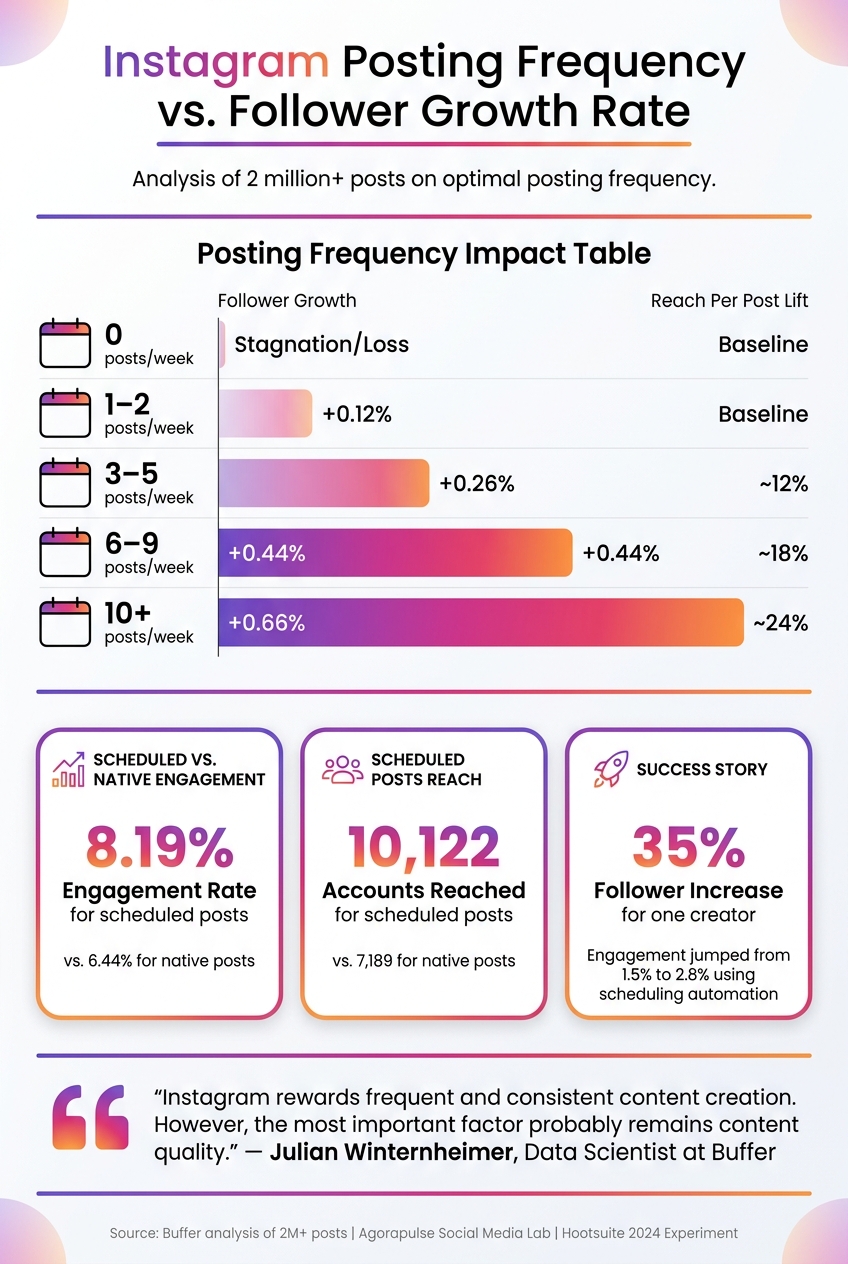
Buffer analyzed over 2 million posts and found a strong link between posting frequency and growth:
| Posting Frequency | Follower Growth Rate Impact | Reach Per Post Lift |
|---|---|---|
| 0 posts/week | Stagnation/Loss | Baseline |
| 1–2 posts/week | +0.12% | Baseline |
| 3–5 posts/week | +0.26% | ~12% |
| 6–9 posts/week | +0.44% | ~18% |
| 10+ posts/week | +0.66% | ~24% |
Julian Winternheimer, a Data Scientist at Buffer, explains:
"Instagram rewards frequent and consistent content creation. However... the most important factor probably remains content quality."
Using schedulers allows you to batch your content creation - like planning a week's posts on Sunday - so you can reduce daily decision-making. That said, scheduling isn't a "set it and forget it" approach. Be ready to engage with comments in the first 30–60 minutes after posting, as this window is crucial for boosting engagement.
Instagram Posting Frequency vs. Follower Growth Rate
The idea that using third-party scheduling tools hurts your reach has been debunked by both research and industry experts. Adam Mosseri, for example, has clarified that reach is determined by content quality and audience interaction - not by how the posts are published. Controlled experiments back this up, showing that scheduled posts often perform better than manually published ones.
One experiment compared native posts with scheduled ones, revealing that scheduled posts had an 8.19% engagement rate, outperforming the 6.44% seen with native posts. Scheduled posts also reached 10,122 accounts, while native posts reached only 7,189. This success is largely due to the ability of schedulers to time posts for when audiences are most active.
The Agorapulse Social Media Lab even emphasized:
"Instagram does not punish 3rd-party publishing tools. It's a myth."
The benefits of scheduling are not just theoretical - they hold up when applied in real-world scenarios. Here are some examples:
"Automating the logistics didn't make me less authentic. It actually freed me up to be more authentic by focusing my energy on creating better content, not just posting it."
These examples highlight how scheduling tools help maintain consistency, which is a key factor in growing engagement.
It’s important to understand that schedulers themselves don’t directly cause growth. Instead, they remove the hassle of manual posting, making it easier to stick to a consistent schedule - something the algorithm rewards. As one expert put it:
"The algorithm doesn't care if a robot pushed the button. It only cares if humans want to look at the result."
However, consistency alone isn’t enough. Accounts that rely solely on schedulers without actively engaging with their audience often see their reach decline. This reinforces the idea that while scheduling tools are helpful, they’re just that - a tool. The real driver of growth lies in creating content that resonates with your audience and keeps them engaged.
Free schedulers can help you stay consistent with posting, but they come with limitations that might hold back your growth.
Free plans often start strong but quickly hit a wall. For example, Later's free plan only allows 5 posts per month, Buffer caps at 10 scheduled posts per channel, and Planoly limits you to 30 uploads per month. If you're aiming to post daily - which research shows can double your reach compared to posting just three times a week - these limits can be a major obstacle.
Another drawback? Free tools often lack personalized timing data. Instead, they rely on generic industry averages that might not align with your audience's habits. Even the best post can flop if it goes live at the wrong time.
Adam Mosseri put it best: "Reach is determined by content quality and audience signals, not publishing surface". Scheduling tools can handle the when, but they can’t improve the what. A poorly crafted post, no matter how perfectly timed, won't outperform engaging, high-quality content.
Some creators focus so much on perfecting their posting schedule that they overlook what really matters - creating content that resonates. On top of that, free schedulers often lack features like visual grid previews. For instance, Meta Business Suite doesn’t offer a grid preview, making it harder to maintain a cohesive aesthetic that could turn profile visitors into followers.
Relying too much on automation can hurt your engagement. The first 30–60 minutes after a post goes live are critical for getting early interactions like comments, saves, and shares. If you’re not actively engaging during this window, the algorithm might see your account as less interactive, potentially limiting your reach.
"Scheduling doesn't mean set-and-forget for engagement. The first 30–60 minutes after a post goes live are often the most algorithmically important." - BrandGhost
This highlights the importance of being present and active. A simple strategy? Set a reminder to check in about five minutes after posting to interact with comments. Similarly, keeping Stories and behind-the-scenes content manual rather than scheduled can help maintain the real-time, human presence that automation can’t replicate.
Ultimately, while scheduling tools are helpful, true growth comes from combining quality content with genuine engagement and thoughtful strategy.
Free schedulers are a solid starting point for building a growth strategy, especially when paired with other methods. While they help streamline consistent posting, their potential grows when integrated into a larger, more strategic approach.
Think of free schedulers as the backbone of your content delivery. For instance, Instagram's native scheduling tool allows Business and Creator accounts to schedule up to 25 posts per day and plan content up to 75 days in advance - all at no cost. By automating your posting, you free up time to focus on engaging with your audience and refining your strategy. As Sprout Social notes:
"Creating Instagram posts last-minute is a recipe for burnout. When you schedule Instagram posts in advance, you can batch your time and be more productive."
Beyond efficiency, batching your content ensures your brand voice stays consistent across posts, making your messaging more cohesive.
While free schedulers help you maintain a steady posting schedule, they don’t guarantee your content will reach the right audience. That’s where UpGrow steps in. UpGrow enhances your efforts by using AI-powered targeting to connect your posts with the right people.
UpGrow’s smart filters - based on factors like location, age, gender, and language - help attract followers who are genuinely interested in your content. Plus, its live dashboard provides real-time analytics, so you can quickly see what works and make adjustments. Starting at $39/month, UpGrow even offers a growth guarantee: if your followers don’t grow, you get your money back.
The synergy is simple: your scheduler ensures consistent content delivery, while UpGrow ensures that content reaches and engages with your ideal audience.
Consistency is just the beginning. To truly grow, use your scheduler’s timing insights alongside targeted analytics. For example, Meta’s "Active Times" feature shows when your audience is most active, allowing you to post at optimal times rather than relying on generic industry averages. While general high-engagement times fall on Tuesdays through Thursdays between 10 a.m. and 4 p.m., your audience may have unique patterns.
Combine this timing data with UpGrow’s performance analytics to monitor trends in follower growth and engagement. By aligning consistent posting with data-driven targeting, you can move beyond guessing and start making decisions based on what’s actually driving results for your account.
Free Instagram schedulers are great for keeping your posting consistent. By automating your posts, they help signal reliability to Instagram’s algorithm, which can boost the initial distribution of your content. As PC Tech Magazine puts it, "Scheduling itself doesn't grow your account - it just makes growth possible."
That said, consistency can only take you so far. Many free plans come with limits, like restricting how many posts you can schedule or offering only basic analytics. Plus, these tools can’t tell you if your content is actually connecting with the right audience. While they ensure your posts go live on time, they don’t guarantee they’ll reach the people who matter most.
To fill in these gaps, tools like UpGrow can be a game-changer. While your scheduler handles timing, UpGrow’s AI focuses on targeting your content to followers who are genuinely interested. Together, they tackle both the "when" and the "who" of Instagram growth.
Think of free schedulers as your foundation - they’re great for keeping things running smoothly. But to turn that steady rhythm into real growth, you’ll need to add tools that focus on engagement and analytics.
To keep your content consistent and professional, schedule high-quality posts like carousels, Reels, and thought-leadership pieces. Don't worry - using scheduling tools won't hurt your post's performance. However, make sure to manually engage with the app during the first 30–60 minutes after your post goes live. This is a crucial period for engagement. Replying to comments and sharing the post to your Stories during this window signals to the algorithm that your content is worth showing to a wider audience.
Instagram’s built-in analytics can help you figure out the best times to post for your audience. Start by heading to your profile and opening the Professional Dashboard or Insights. From there, navigate to the Total Followers section and look for the Most Active Times data. This will show you when your followers are most active, broken down by hour and day.
Want to maximize engagement? Post about 30–60 minutes before your audience’s peak activity. This gives Instagram’s algorithm enough time to index your content and push it to more users.
UpGrow is the tool you need when you're ready to go beyond simple posting and start focusing on real growth. While free schedulers can handle the basics of posting, UpGrow’s AI-driven tools take things further by helping you attract genuine followers through precise targeting and real-time analytics. Pairing UpGrow with your scheduling efforts ensures your content hits the right audience, increases engagement, and drives growth - all while staying 100% compliant with Instagram’s rules.


