
Dynamic Video Customization: AI Use Cases Explained
AI-powered video customization at scale: personalized demos, dynamic retargeting, shoppable videos, real-time localization, and onboarding that boost engagement and conversions.
AI-powered video customization at scale: personalized demos, dynamic retargeting, shoppable videos, real-time localization, and onboarding that boost engagement and conversions.
4.98 /5 - from 58k reviews
Trusted by 50,000+ creators — get real engagement delivered to your profile in minutes, not days.

Dynamic video customization uses AI to create personalized video content tailored to individual viewers. By leveraging data like names, locations, browsing habits, and purchase history, businesses can deliver videos that feel directly relevant to each person. This approach drives higher engagement and conversion rates while reducing production costs.
AI video customization is an efficient way to scale personalized marketing, improve customer retention, and increase sales. Start with one use case, measure results, and expand as needed.
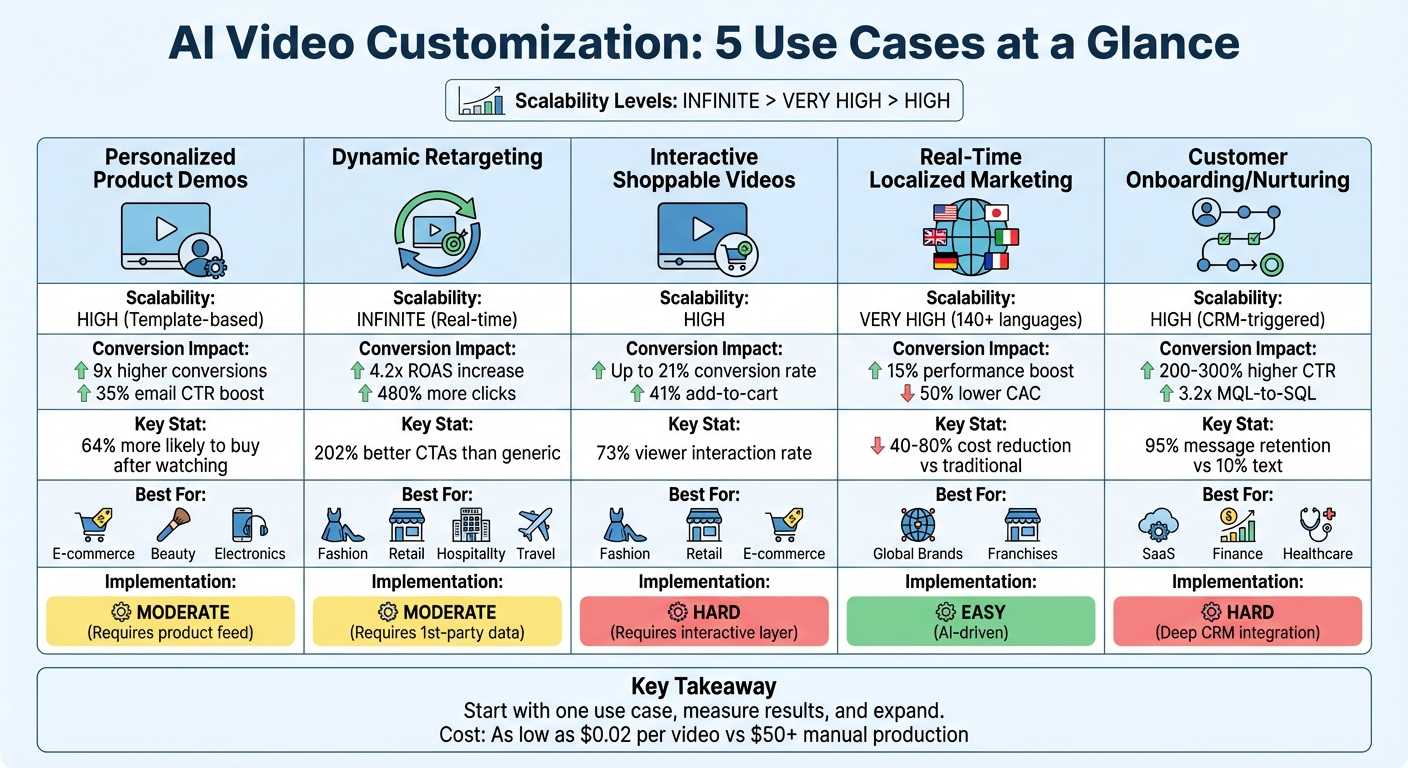
AI Video Customization: 5 Use Cases Performance Comparison
AI has completely reshaped product demos, turning them into highly customized experiences that resonate with individual viewers. Instead of creating a single, generic video, brands can now record once and let AI handle the personalization. This means adding viewer-specific details like names, tailored product recommendations, or even nearby store locations. By pulling data from CRM tools, AI adjusts scripts, visuals, and featured products based on factors like Instagram content ideas, browsing history, past purchases, or location.
This "record once, personalize endlessly" method removes traditional hurdles. AI avatars and voice cloning can generate thousands of unique video messages from a single script without the need for additional filming. For example, when Samsung launched the Galaxy Foldable series, they used AI to create 10,000 unique video variations featuring Bollywood star Alia Bhatt. Each video dynamically included the name of the nearest retail store, leading to 50,000 extra unit sales. Similarly, Cadbury’s AI-driven birthday campaign delivered over 600,000 custom songs and personalized videos. This level of scalability has proven to significantly boost conversions.
Personalized video content doesn’t just scale - it delivers results. 64% of consumers are more likely to buy after watching a personalized video. Brands using this approach have reported up to 9x higher conversions and 10x greater engagement compared to generic content. For instance, Hindustan Unilever used personalized videos featuring actor Arshad Warsi to support small retailers in 2024. The results? A 27% drop in app dormancy, 10% increase in app usage, and 1.5x growth in home deliveries. Similarly, the San Antonio Spurs saw a 35% boost in email click-through rates and 100% average video completion rate with personalized welcome videos for ticket buyers.
The potential for personalized demos spans across industries, with each sector tailoring content to suit its audience. E-commerce platforms, for instance, can show running shoes to one viewer and hiking boots to another, all within the same video framework, based on browsing habits. B2B and SaaS companies can create feature walkthroughs that address specific pain points for a prospect’s industry or company size. Financial services simplify complex data by offering personalized bill explainers or account summaries with savings tips. Real estate agents can produce immersive property tours tailored to a buyer’s preferences.
Getting started is easier than you might think. Begin by integrating your video platform with your CRM to automatically pull customer data into video templates. Focus on key moments like cold outreach, demo follow-ups, and cart abandonment recovery. To ensure consistency, set clear rules for fonts, colors, and tone so your automated videos stay on-brand. As Jordan Kolosey from Spurs Sports & Entertainment shared:
"35% personalized video email click-through rate, total page visitor counts closer to 50% of the original recipient list. It is already clear that the content resonated in a big way".
AI-powered retargeting is transforming the way brands approach video ads, moving away from repetitive, one-size-fits-all content. Using Dynamic Creative Optimization (DCO), these campaigns analyze user behavior in real time to craft personalized video ads instantly. Instead of producing countless individual videos, brands create a single master template tied to their product catalog and customer data. The AI then combines elements dynamically - like displaying the exact sofa someone browsed, adding local weather updates, or including testimonials tailored to their preferences. This ability to assemble video content on the fly sets dynamic retargeting apart from static ad models.
Dynamic retargeting is a game-changer in terms of efficiency. Traditional video production requires separate cycles for each ad variation, but the dynamic model automates this process. With just one template and a data feed, brands can generate countless unique ads. For instance, a leading fashion retailer created thousands of personalized videos from a single template, showcasing items users had browsed. The results? A 4.2× increase in return on ad spend (ROAS) and an 8.1% boost in overall revenue. This mirrors the efficiencies seen in personalized product demonstrations, proving how scalable this approach can be.
Dynamic video campaigns significantly outperform their static counterparts. Personalized calls-to-action (CTAs) in these videos deliver 202% better results than generic ones, and audience engagement jumps by 400%. In one A/B test, dynamic video ads generated 480% more clicks and reduced cost per lead by 280%, even when using the same copy as static ads. Static ads also suffer from diminishing returns - after five views, they can decrease purchase likelihood by 4.1%. Dynamic retargeting avoids this pitfall by using sequential messaging, such as introducing a product on Day 1, sharing a testimonial on Day 3, and presenting an offer on Day 5.
Different industries are leveraging dynamic retargeting to fit their unique customer journeys. For example:
Rolling out dynamic video retargeting is best done in phases:
"away from an acquisition-at-all-costs approach and toward a sustainable model focused on maximizing Customer Lifetime Value (CLTV) through hyper-personalized, value-driven re-engagement" - E-Commerce Founders (2025 Report).
This phased strategy not only simplifies adoption but also sets the stage for future advancements in AI-driven video marketing.
Interactive shoppable videos make it easier than ever for viewers to go from discovering a product to buying it - all without leaving the video. Instead of redirecting customers to a separate checkout page (where many abandon their carts), these videos allow viewers to click on hotspots that follow products throughout the content. Powered by AI, these "sticky hotspots" track moving items, so whether it's a jacket or a piece of furniture, users can click and shop without pausing the video. This eliminates a common frustration: while 89% of consumers say video content influences their buying decisions, traditional videos often require multiple steps to make a purchase. By combining the convenience of dynamic retargeting with an integrated shopping experience, shoppable videos simplify the path to purchase.
The impact of shoppable videos on conversions is hard to ignore. For example, SEFI, an activewear brand on Shopify, used Clipara to implement shoppable videos. The results? Over 20,000 video views with conversion rates reaching 21%. Even more impressive, 41% of viewers added products to their carts, and purchase intent increased significantly. AI-driven videos also keep viewers engaged 2–3 times longer than static product pages, giving brands more opportunities to highlight product features and benefits. A standout example is the Nike x Hypebae campaign, which offered a "choose your journey" interactive experience. Out of all viewers, 73% interacted with the content, averaging four interactions each, while 68% stayed engaged for up to two minutes.
AI has revolutionized the production of shoppable videos, making it feasible for brands with large product catalogs. Traditional video shoots are resource-intensive, but AI now automates much of the process. It can transform static images into dynamic videos, handle shot composition, and adapt content for different markets and languages instantly. For instance, Feiyu Tech, a camera equipment company, used a no-code platform to add shoppable stories and tutorials to their product pages in just 30 minutes. With this technology, brands can create personalized demos for thousands of products in a fraction of the time it used to take.
From fashion to home improvement, shoppable videos are being embraced across industries. Fashion brands can use AI to generate virtual try-on videos, while beauty brands create tutorials where viewers can click to buy products mid-demo. Home improvement retailers provide step-by-step guides where tools and materials are shoppable directly from the video. Platforms like TikTok Shop have also popularized in-app purchases, turning videos into virtual storefronts. Some systems even offer "ask-me-anything" features, allowing customers to type questions and receive relevant video responses instantly.
Integration is straightforward with platforms that sync directly to e-commerce systems like Shopify via APIs, automatically updating product catalogs. To make these videos effective, follow a few key tips: introduce the first interactive hotspot within the first three seconds to grab attention, ensure each clickable moment lasts at least three seconds, and limit the number of highlighted products to two or three per video to avoid overwhelming viewers. Keep products fully visible in the frame, and use a poster frame or voice-over at the start to let viewers know the content is interactive. This seamless blend of video and shopping showcases the potential of AI to reshape personalized marketing.
Real-time localization takes video customization to the next level by tailoring content to fit different markets without the need for reshooting. AI-powered tools make it possible for brands to adapt their videos to customers' native languages while keeping production efficient. The approach? "Shoot once, adapt endlessly." This means capturing clean visuals and modular assets that AI can later tweak for specific regions. Instead of assembling new actors and crews for every locale, AI steps in to handle tasks like replicating voices in over 175 languages, updating packaging and signage, and even syncing lip movements to match translated audio [20,22]. This is a game-changer, especially when you consider that 76% of online shoppers prefer buying products with information in their native language, and 40% will avoid purchases entirely if the website isn’t available in their language.
Traditional localization methods typically take 4–6 weeks per market and require significant resources. AI-driven localization slashes that timeline to just 2–5 days, cutting production costs by 40% to 80%. For example, in 2025, DuPont saved up to $10,000 per training video by leveraging AI localization, eliminating the need for extra shoots and simplifying post-production. Similarly, a Swiss luxury watchmaker refined its "Art of Precision" campaign for Japan in January 2026. Using a human-in-the-loop workflow, they adjusted AI-generated dubs after a cultural consultant flagged the tone as too assertive for Japanese business norms. The result? The final localized video delivered a 45% higher engagement rate compared to subtitled versions. These time and cost efficiencies translate directly into better conversion outcomes.
Localized videos consistently outperform generic ones, boosting performance by up to 15%. In fact, 79% of businesses that invest in localization report revenue growth, with an average increase of 9.2%. Take the example of a Series C SaaS startup that implemented a Minimum Viable Localization (MVL) strategy in late 2025. They translated and dubbed a demo video into Thai, Vietnamese, and Bahasa Indonesia within 48 hours to enter the Southeast Asian market. The results were striking: the Thai market saw a 50% reduction in customer acquisition costs and a 2x increase in conversions, allowing the company to reallocate its budget more effectively. When paired with localized landing pages, these videos can push conversion rates up by as much as 80%.
The applications for real-time localized marketing are vast. Retail brands use AI to create product demos tailored to regional tastes, while SaaS companies deliver multilingual updates directly from their founders [20,22]. Streaming services launch global series with localized trailers, and corporate training teams roll out multilingual content for their workforce efficiently [20,22]. Ubisoft, for instance, ran a dynamic personalized video campaign that customized language, game footage, and player stats for individual users, enhancing relevance and engagement. The key is treating regions like Mexico, Argentina, and Spain as distinct markets with their own cultural nuances rather than lumping them together under a single language.
Modern AI tools make localization straightforward. By shooting wider frames and avoiding hard-coded text in visuals, brands can let AI handle visual swaps and text overlays with ease. AI dubbing tools are also cost-effective, charging less than $200 per video minute compared to the traditional $1,200 per minute. For example, a 2-minute video can be localized into five languages in just 1–2 hours for about $100–$300. To ensure accuracy and cultural sensitivity, include a native speaker review to catch idioms, mispronunciations, or cultural nuances that AI might miss [20,22]. This human-in-the-loop strategy keeps messages authentic while balancing cost and efficiency.
AI-powered video customization is changing the game for customer onboarding and lead nurturing. Instead of using the same one-size-fits-all tutorial, businesses can now send mass-personalized video messages tailored to each recipient. By pulling data directly from your CRM - like a customer's name, company, or industry - these systems create personalized walkthroughs that highlight features relevant to their specific subscription plan or goals. This approach not only minimizes the need for live support but also delivers a personal touch during those crucial early interactions. It builds on earlier personalization strategies, extending their impact to long-term customer engagement.
When it comes to onboarding, personalized video content delivers impressive results. These tailored messages can achieve 200–300% higher click-through rates compared to generic campaigns and boost MQL-to-SQL conversions by 3.2×. In lead nurturing, the impact is equally strong: 64% of consumers are more likely to make a purchase after watching a personalized video. Plus, video as a medium is incredibly effective - viewers retain 95% of the message when delivered via video, compared to just 10% through text. Companies that excel in lead nurturing see 50% more sales-ready leads at a 33% lower cost per lead.
The versatility of dynamic video customization shines across industries, transforming customer onboarding processes.
The key is aligning video content with the customer journey - offering foundational guidance for new users and advanced insights for long-term clients. These strategies highlight how AI personalization adds value throughout the customer lifecycle.
AI-driven onboarding tools make it easier than ever to streamline the customer journey. Modern platforms integrate seamlessly with systems like Salesforce and HubSpot, automatically triggering personalized videos after specific actions, like sign-ups or milestone achievements. Video templates can include dynamic placeholders for names, industries, or other relevant data, ensuring every message feels personal. When CRM data is incomplete, fallback options can ensure a smooth experience with default messaging.
For smaller businesses, simple text-to-video tools can quickly generate branded content from prompts. Larger enterprises often rely on Dynamic Personalization Engines to manage millions of unique video renditions. Economically, this approach shifts costs from expensive, one-off projects - where a standard 60-second B2B video averages $3,185 - to a scalable model where the cost of creating personalized variants becomes negligible. This makes AI customization accessible and cost-effective for businesses of all sizes.
AI video customization offers massive scalability and cost efficiency. For instance, videos can be produced for as little as $0.02, compared to over $50 for manually created ones. Enterprise systems like Idomoo can handle an impressive 3 million concurrent videos per hour. Additionally, these tools support over 140 to 200 languages, eliminating the need for native production teams. The performance benefits are equally compelling - CRM-integrated personalization boosts engagement rates by 35% and improves conversion rates from 2.8% to 4.2%. A standout example is Jewell Unlimited, which used Hour One's AI Video Studio to create 100 training videos in just 4 hours, a task that traditionally took 5 days. These advantages illustrate the transformative potential of AI in video production, but they also come with operational hurdles.
On the flip side, implementing AI video solutions isn't without challenges. High-definition video rendering demands three to five times more bandwidth than static content, often leading to underestimated infrastructure costs. Enterprise-level deployments typically require a team of 4 full-time employees and take 10–14 weeks to launch. Early AI avatar deployments face issues too - about 30% experience training instability that requires manual corrections. Moreover, while AI excels at efficiency, it struggles with nuanced emotional storytelling, an area where human creators still hold the edge. Data privacy is another critical concern; compliance with regulations like GDPR and CCPA is non-negotiable, and over-personalization risks alienating users by feeling overly intrusive.
"The TCO of the traditional model renders at-scale personalization financially prohibitive. It forces a false choice: generic, low-impact content for the masses or hyper-expensive videos for a select few."
– AdVids Warning
Striking the right balance between AI's speed and scale and human oversight for strategic storytelling is essential. Template-based systems currently outperform purely generative AI, with 63% fewer rendering errors and 70% higher success rates in deployment. Adopting a phased approach - starting with basic segments and dynamic images before scaling to full dynamic video - can help manage complexity and keep costs in check. By understanding both the advantages and limitations of AI-powered video customization, businesses can optimize its use across various applications, from personalized demos to dynamic retargeting.
| Use Case | Scalability | Conversion Uplift | Industry Application | Implementation Ease |
|---|---|---|---|---|
| Personalized Product Demos | High (Template-based) | High (35%+) | E-commerce, Beauty, Electronics | Moderate (Requires product feed) |
| Dynamic Retargeting | Infinite (Real-time) | Very High (4.2x ROAS) | Fashion, Retail, Hospitality, Travel | Moderate (Requires 1st-party data) |
| Interactive Shoppable Videos | High | High (3.2x MQL-SQL) | Fashion, Retail, E-commerce, Fintech | Hard (Requires interactive layer) |
| Real-Time Localized Marketing | Very High (140+ languages) | Moderate | Global Brands, Franchises | Easy (AI-driven, but high rendering needs) |
| Customer Onboarding/Nurturing | High (CRM-triggered) | Moderate (200-300% CTR) | SaaS, Finance, Healthcare, Professional Services | Hard (Deep CRM integration) |
AI-driven dynamic video customization has become a powerful tool for businesses, delivering measurable benefits and driving revenue growth. As discussed, combining dynamic video ads with CRM-integrated personalization significantly boosts ROI and conversion rates. These advancements make it clear why investing in this technology is a smart move.
To see immediate results, focus on leveraging your first-party data. With third-party cookies set to disappear by 2026, data like browsing history, purchase records, and behavioral signals will be your most valuable resources. Personalized videos in high-intent scenarios - like cart abandonment or product retargeting - can convert up to 64% of viewers into buyers, offering quick and impactful returns.
For reliability and scalability, template-based systems remain the go-to option. While generative AI holds promise, template-based approaches currently outperform, with 63% fewer rendering errors and 70% higher deployment success rates. A standout example is Mondelez’s #NotJustACadburyAd campaign, which created over 130,000 personalized video variants using this method.
Cost efficiency is another major advantage, making this technology accessible to businesses of all sizes. Personalized videos can cost as little as $0.02 each, compared to the $50 or more required for manual production. Smaller businesses can benefit from plug-and-play platforms for quick implementation, while larger enterprises should opt for SOC 2-compliant solutions to handle massive rendering needs. Deployment timelines typically range from 2–4 weeks for smaller teams to 10–14 weeks for enterprise-scale projects.
In today’s competitive landscape, success hinges on real-time, intelligent personalization. The strategy is straightforward: deliver the right video to the right audience at the right moment. Start small with one impactful use case, measure the results, and then expand systematically across your customer journey.
AI-powered video customization allows for the creation of content that's tailored to match each viewer's unique preferences. This approach grabs attention, keeps viewers engaged longer, and encourages them to interact with the content, resulting in higher retention and deeper engagement.
When businesses provide these personalized and relevant experiences, they often see conversion rates climb - sometimes by as much as 20%. This strategy not only helps build stronger connections with the audience but also delivers clear, measurable results in marketing and e-commerce efforts.
Using AI for video localization can drastically cut costs by simplifying how videos are adapted for different markets. Traditional methods often involve pricey voice actors, recording studios, and time-consuming post-production work. AI, on the other hand, handles tasks like translation, lip-syncing, and adapting content for specific audiences in a fraction of the time - turning what used to take weeks into a process that’s done in minutes.
AI also streamlines workflows by transforming a single master video into versions tailored for multiple regions, eliminating the need for reshoots or complex team coordination. This quicker process not only reduces costs but also speeds up the time it takes to get content to market. The result? Faster revenue generation and a stronger competitive edge. By automating localization, businesses can deliver polished, audience-specific videos without breaking the bank.
To get started with AI-powered personalized videos, businesses should focus on a few essential steps. First, collect and analyze customer data to gain insights into their preferences and behaviors. This information serves as the foundation for creating flexible video templates that can be tailored to individual viewers. Next, set up an AI-driven system to automate the customization process and integrate it smoothly with your existing tools, such as content management and analytics platforms.
Once your system is up and running, keep an eye on key performance metrics like engagement rates, conversions, and customer feedback. These insights will help you fine-tune your strategy over time. Starting with a small pilot project can be an effective way to test your approach, identify what works, and make adjustments before rolling it out on a larger scale. Following these steps can help businesses use AI to deliver video content that feels personal and engaging.
Share this post


