
How Banned Hashtags Affect Engagement
Using banned Instagram hashtags can hide posts, drop engagement, and trigger penalties; choose 3–5 safe, targeted tags to boost visibility.
Using banned Instagram hashtags can hide posts, drop engagement, and trigger penalties; choose 3–5 safe, targeted tags to boost visibility.
4.98 /5 - from 58k reviews
Trusted by 50,000+ creators — get real engagement delivered to your profile in minutes, not days.

Using banned hashtags on Instagram can make your posts invisible to new audiences, kill engagement, and even lead to account penalties like shadowbans. On the other hand, safe hashtags can help your content get discovered, boost visibility, and attract interactions. Here’s a quick breakdown:
Instagram’s AI is now stricter with hashtags. Even common tags like #beautyblogger or #adulting can be banned if misused. Always check a hashtag’s status before posting to avoid penalties. Safe hashtags, used strategically, remain one of the best tools for growing your account.
Using a banned hashtag on Instagram can make your post invisible to anyone who doesn’t already follow you. These posts are blocked from appearing in search results, the Explore page, and hashtag feeds. Even worse, Instagram might delete your entire caption without warning if it contains a banned hashtag.
In February 2024, The Markup conducted an experiment with 70 newly created Instagram accounts to explore hashtag suppression. They posted a mix of nongraphic war imagery (like tanks and destroyed buildings) and everyday photos (pets, plants) using the hashtag #markuptest. The findings were eye-opening: war-related photos were 8.5 times more likely to be hidden. By the end of the study, only 9 of 29 war-related posts showed up on the hashtag page, while 158 out of 172 everyday posts were visible. This shows how even a single restricted hashtag can drastically limit your post’s reach.
"One banned hashtag can quietly sabotage an otherwise brilliant post." - Podcastle
This drop in visibility has a direct effect on engagement metrics.
Banned hashtags cause a sharp decline in engagement metrics, including likes, comments, and shares, because posts that don’t reach new audiences can’t generate interaction.
Instagram has flagged over 60,000 banned hashtags, and many of them might surprise you. Innocent-sounding tags like #adulting, #alone, #besties, and #beautyblogger have been restricted due to spam abuse. During The Markup’s investigation, 8 out of 10 comments designed to trigger spam violations were "shadowbanned" - visible only to the commenter but hidden from everyone else.
These immediate setbacks often lead to longer-lasting consequences.
Repeated use of banned hashtags can lead to algorithmic penalties that linger beyond the affected post. Instagram’s system may flag your account as spammy, making all your future content harder to find. The effects of this shadowban are staggering: hashtag reach drops by 99%, Explore page visibility falls to 0%, new daily followers decrease by 95%, and Story views decline by 75%.
Instagram restricts over 2 million accounts daily, often without notifying users. Recovery from a shadowban usually takes 7 to 14 days of avoiding banned hashtags. In more severe cases, repeated violations can result in temporary restrictions, account suspension, or even permanent bans.
Safe hashtags are a powerful tool for increasing content visibility and boosting engagement on Instagram.
Safe hashtags help Instagram's algorithm categorize your content, making it easier to appear on the Explore page and in search results. Unlike banned hashtags, which can limit your reach, safe hashtags ensure your posts are discoverable by new audiences. For example, hashtags with medium usage (10,000–250,000 uses) can increase reach by 46%, while those in the top 5% of usage velocity can deliver up to 230% more reach. This improved visibility often leads to better engagement.
Using safe hashtags strategically can significantly enhance engagement. A study by SocialRails in January 2026 compared two hashtag strategies for fitness content: one using 30 generic tags (like #fitness, #gym, #love) and another using five targeted hashtags, such as #homeworkoutideas (medium) and #strengthtrainingforwomen (niche). The targeted approach resulted in longer visibility in niche feeds and higher interaction from relevant users. Instagram now suggests using 3–5 relevant hashtags per post. In fact, opting for 7–9 targeted hashtags instead of a large batch of generic ones can increase reach by 22%. Additionally, placing hashtags in captions rather than comments can improve reach by 15–20%. For smaller accounts with fewer than 10,000 followers, focusing on branded and safe hashtags has led to a 32% boost in engagement.
In the long run, consistent use of safe hashtags helps maintain a high-quality account score, which is essential for being featured on the Explore page and search results. Creators who embraced a strategic hashtag approach in 2025 reported growth rates between 200% and 400%. Changing up your safe hashtags with each post instead of reusing the same ones can increase reach by 36%. Updating your bio keywords to align with your hashtag themes can also improve Explore page impressions by 17%. Pairing captions with educational content and safe hashtags has been shown to increase saves and watch time by 21–29%.
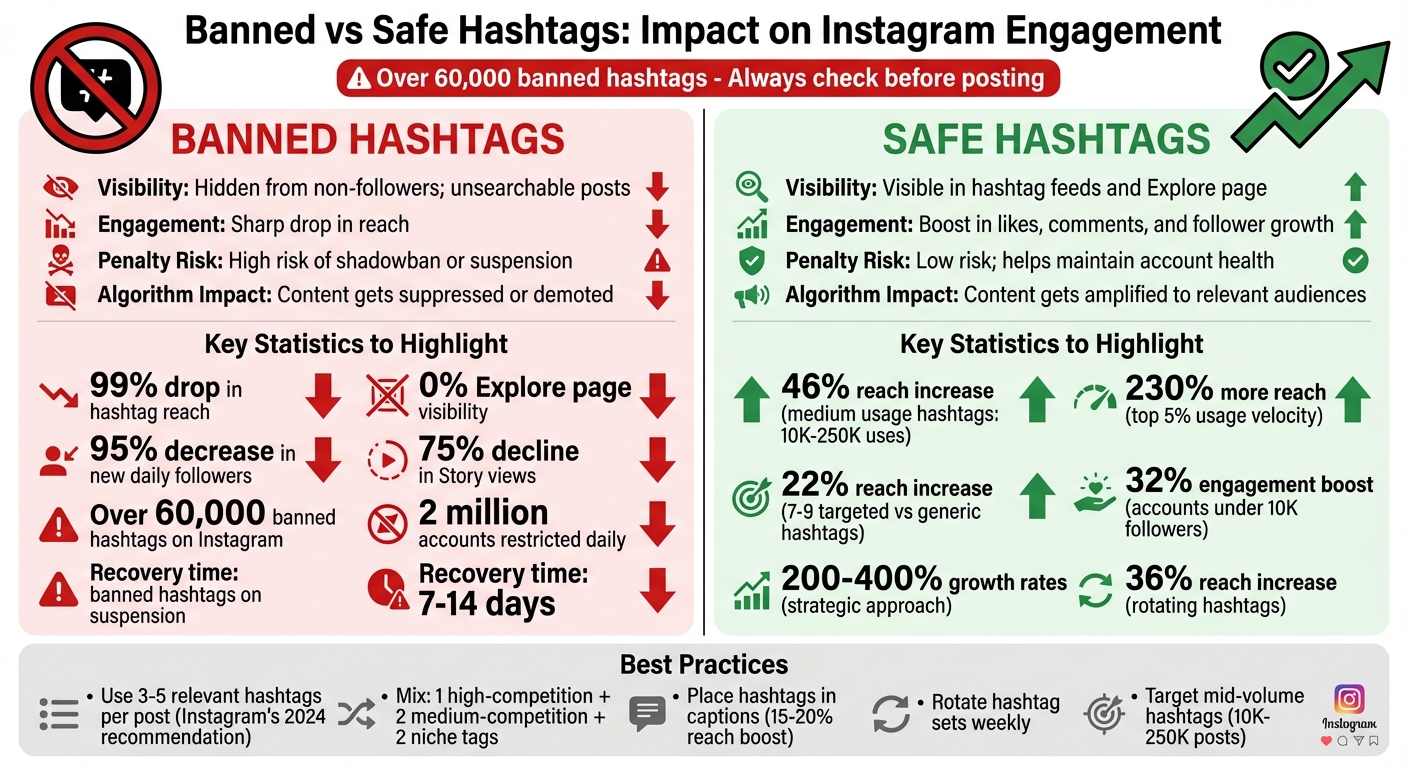
Banned vs Safe Hashtags Impact on Instagram Engagement
Knowing the trade-offs between banned and safe hashtags can make or break your Instagram engagement. The impact of using the wrong hashtags isn't minor - it can seriously hurt your visibility and growth.
When you use banned hashtags, your posts essentially vanish from public view. As Skywork explains, "Using a banned hashtag is like adding a 'do not index' tag to your content in the world of Google - it makes you invisible". The fallout can be harsh, including your account being flagged for spam, shadowbanned, or hit with penalties that limit the reach of your future posts.
On the flip side, safe hashtags are your go-to for boosting organic engagement. They help your posts show up in hashtag feeds and on the Explore page, making it easier to connect with people who care about your content. As Benjamin Chacon from Later puts it, "Instagram hashtags, and a proper hashtag strategy are still one of the best tools for driving engagement on your posts". The main downside? They require consistent effort to research and rotate, but the payoff is sustained growth.
Here’s a quick breakdown of how banned and safe hashtags stack up:
| Feature | Banned Hashtags | Safe Hashtags |
|---|---|---|
| Visibility | Hidden from non-followers; unsearchable posts | Visible in hashtag feeds and Explore page |
| Engagement | Sharp drop in reach | Boost in likes, comments, and follower growth |
| Penalty Risk | High risk of shadowban or suspension | Low risk; helps maintain account health |
| Algorithm Impact | Content gets suppressed or demoted | Content gets amplified to relevant audiences |
The takeaway? Banned hashtags kill your reach, while safe hashtags help you grow. With Instagram reportedly maintaining a list of over 60,000 banned hashtags, it’s crucial to regularly check your tags to avoid unintentionally hurting your posts. This comparison highlights the importance of refining your hashtag strategy to maximize engagement.
Since late 2024, Instagram has recommended using 3–5 highly relevant hashtags instead of the previous 30-tag limit. To improve your reach, aim for a mix of hashtags with varying levels of competition: one high-competition tag (over 1 million posts), two medium-competition tags (100,000–1 million posts), and two niche tags (fewer than 100,000 posts). This targeted approach helps your posts connect with the right audience.
Where you place your hashtags matters, too. Adding hashtags directly in captions can boost your reach by 15–20%. But before using any hashtag, always check its status in Instagram search to ensure it isn’t restricted or banned. If the "Recent" tab is missing or seems limited for a tag, it’s likely unsafe to use.
Variety is also key. Repeatedly using the same hashtags across posts can trigger spam filters, so it's smart to create multiple hashtag sets tailored to your content. For instance, in January 2026, a fitness creator replaced 30 generic hashtags with a focused 5-tag set, leading to better visibility within their niche and higher engagement.
AI tools can make this process even easier. Platforms like UpGrow use advanced AI to find safe, high-performing hashtags based on your niche, audience, and location. Their Boost™ feature has shown impressive results, with beta users reporting a 275% increase in monthly followers.
Banned hashtags can make your content vanish from new audiences, while safe ones help attract engaged followers. Even a single banned tag might lead to a shadowban.
In December 2024, Instagram removed the option to follow hashtags, signaling its move toward AI-driven, content-relevant search. Adam Mosseri, Head of Instagram, clarified that hashtags no longer directly increase reach. This change highlights that while hashtags are still useful for organization, they are no longer the main factor in boosting visibility. A focused hashtag strategy is now more important than ever.
To stay ahead, manually check each hashtag before posting. Look for the "Recent" tab in Instagram search to confirm a tag’s status. Rotate your hashtag sets weekly to avoid spam detection, and prioritize 3–5 niche tags that align closely with your content. Targeting mid-volume hashtags (10,000–250,000 posts) is a smart way to balance discoverability and competition, unlike using overly popular tags like #love.
For added efficiency, automated tools can help. AI-driven platforms like UpGrow simplify finding safe, high-performing hashtags and monitor banned tags continuously. The takeaway? Stick to safe hashtags to maintain trust with Instagram’s algorithm and ensure your content remains visible.
To check if a hashtag is banned on Instagram, search for it directly in the app. If no recent posts appear or you see a message indicating the hashtag is restricted, it’s probably banned. Using such hashtags can hurt your post’s visibility and reduce engagement.
To stay on the safe side, use hashtags that are well-researched, relevant, and align with Instagram’s guidelines. Regularly updating your hashtag strategy helps you maintain reach and steer clear of potential penalties.
Using banned hashtags on Instagram can hurt your account in more ways than one. For starters, your posts might see a drop in visibility, which means fewer people engaging with your content. In some cases, Instagram could even shadowban your account - making it tough for users who don’t already follow you to find your posts.
To keep your account growing and active, steer clear of banned hashtags. Instead, focus on using relevant, audience-focused hashtags that match your content. This way, your posts stay visible while staying within Instagram’s rules.
To increase engagement on Instagram, focus on using hashtags that are relevant, specific, and safe. Start by identifying hashtags that connect directly to your content and your audience's interests. Stay away from overly broad or popular hashtags - they tend to be overcrowded and don't offer much visibility. Instead, go for niche or trending hashtags that speak directly to your followers.
Be mindful of banned hashtags, too. Using restricted hashtags - often flagged due to spam or policy violations - can hurt your post's reach or even result in shadowbanning. To avoid this, regularly check for updated lists of banned hashtags to keep your strategy clean and effective. With careful research and smart hashtag choices, you can grow your engagement naturally and reach the right audience.


