
5 Ways AI Analyzes User Behavior on Instagram
Instagram's AI shapes feeds by tracking engagement, timing, sentiment, and interest groups to predict what users will share and engage with.
Instagram's AI shapes feeds by tracking engagement, timing, sentiment, and interest groups to predict what users will share and engage with.
4.98 /5 - from 58k reviews
Trusted by 50,000+ creators — get real engagement delivered to your profile in minutes, not days.

Instagram uses AI to shape your feed by analyzing how you interact with posts, tracking your activity patterns, and predicting your future preferences. Here's how it works:
Understanding these methods can help creators and businesses optimize their Instagram strategies to reach and engage their target audience effectively.
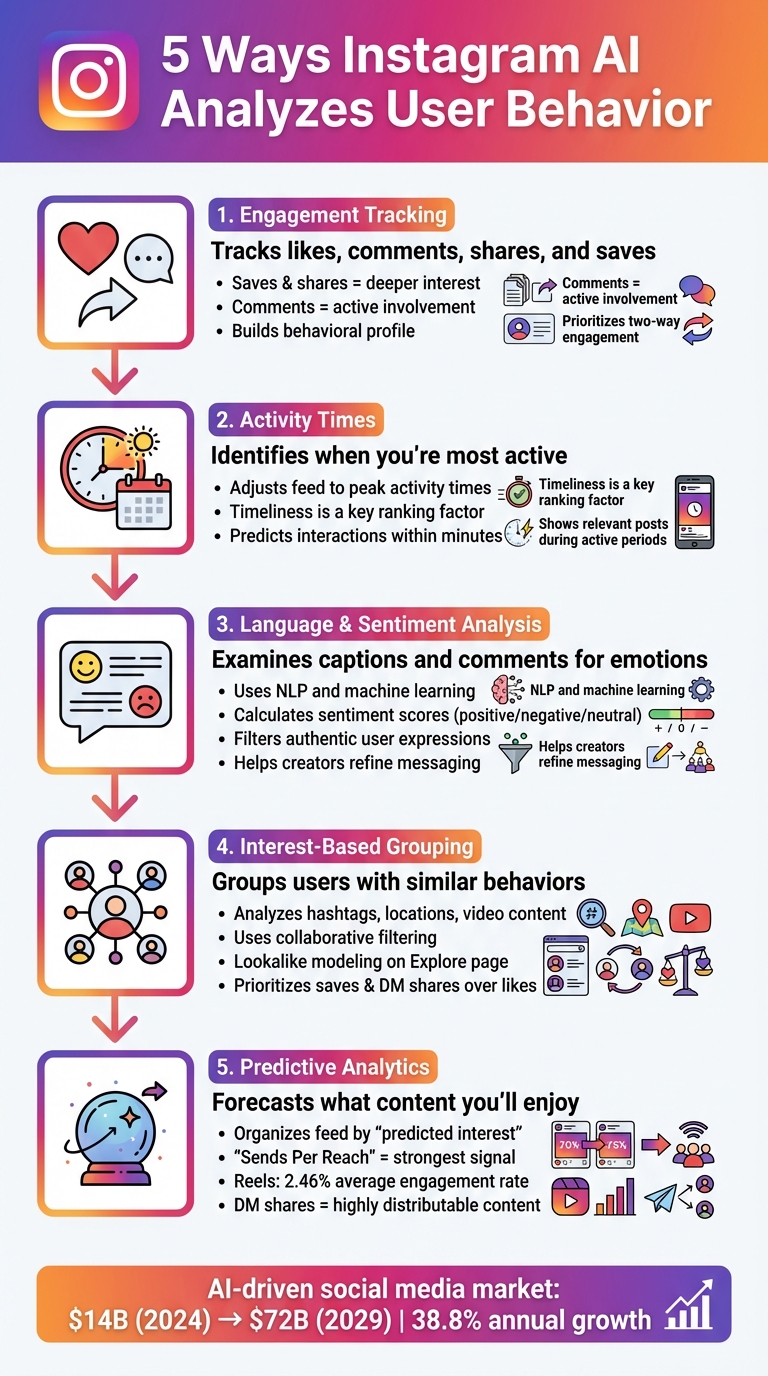
5 Ways Instagram AI Analyzes User Behavior
Instagram uses AI to monitor how users interact with content - whether it’s through likes, comments, shares, saves, or profile visits. Each action carries a different level of importance. For instance, saves and shares suggest a deeper interest compared to a simple like, while comments show active involvement. These varying levels of engagement are used to predict how likely you are to interact with similar content in the future.
The algorithm also studies your previous activity to predict your next move. If you consistently engage with posts from a particular account, Instagram takes it as a cue to show you more from that account - even if you don’t follow them. Essentially, the system builds a behavioral profile based on your interaction history to determine what content will likely catch your attention.
Another layer of analysis focuses on engagement reciprocity. The AI evaluates whether you tend to initiate interactions or mainly respond to others. It also considers whether your audience engages with your content in return. This mutual exchange helps the platform prioritize posts from accounts that generate ongoing two-way engagement.
Timing plays a big role, too. Instagram tracks how quickly you engage with posts after they’re published, as well as which formats - reels, stories, or feed posts - hold your attention the longest. It even keeps tabs on hashtags you follow and stories you watch all the way through. By distinguishing casual scrolling from genuine interest, the platform fine-tunes its content recommendations, helping you see posts that align with your preferences.
For creators and businesses, understanding these engagement patterns is a game-changer. Tools like Instagram Insights can reveal which posts perform best, allowing you to identify trends in content type, design, and even caption style. Services such as UpGrow take it a step further by offering AI-driven targeting and real-time analytics to fine-tune your strategy based on actual engagement data.
Instagram’s AI keeps tabs on your activity patterns, figuring out the best times for you to scroll, like, comment, or share. This data builds a personalized activity profile, helping the platform decide when to show you content that’s most relevant. Essentially, Instagram knows when you're most likely to engage and adjusts your feed accordingly.
One of the Instagram algorithm’s key ranking factors is timeliness. Posts that align with your active times are more likely to appear at the top of your feed. For example, if you tend to check Instagram early in the morning or during the evening, the platform ensures you see posts that match those times. Research even suggests that small shifts in activity can predict interactions within minutes, proving how crucial timing is for engagement.
For creators and brands, understanding this timing is a game-changer. Tools like Instagram Insights provide data on followers’ peak activity times, offering a clear window for posting. Sharing content during these periods boosts the chances of immediate engagement, signaling to the algorithm that your post is relevant and should be promoted further.
Platforms like UpGrow take this a step further with real-time analytics. Their dashboard helps users pinpoint the best posting schedules based on audience behavior, turning timing into a strategic advantage.
Instagram's AI doesn't just count likes and comments - it digs deeper by analyzing the language behind user interactions. Using Natural Language Processing (NLP) and machine learning, the platform conducts opinion mining. This involves examining the emotions and tone in captions, comments, replies, and direct messages to gauge whether users feel positive, negative, or neutral about the content.
The process begins with data cleaning. The AI filters out unnecessary elements like special characters, web links, promotional content, and irrelevant numbers, focusing solely on authentic user expressions. Once the data is cleaned, the algorithm calculates a sentiment score, which provides measurable insights into audience emotions. This approach goes beyond surface-level metrics, uncovering the "why" behind interactions and shedding light on audience preferences, needs, and frustrations.
For creators, sentiment analysis is a game-changer. By monitoring sentiment trends across posts, you can pinpoint the tones and topics that resonate most with your followers. If certain captions spark negative reactions, you’ll know it’s time to tweak your messaging. Many tools also visualize sentiment data by region and demographics, making it easier to understand how different audience groups respond.
A great example is UpGrow, which combines AI-driven sentiment analysis with Instagram analytics. This pairing turns vague audience impressions into clear, actionable insights, helping creators craft content that aligns with how their followers truly feel.
Instagram's AI doesn't just focus on individual users - it looks for patterns across millions of accounts, grouping people with similar interests into communities. This process, called clustering, uses algorithms to analyze shared elements like hashtags, custom location tags, and video content. The result? Your content is more likely to reach people who are genuinely interested, as Instagram recommends posts that align with their preferences.
One way Instagram achieves this is through collaborative filtering. If two users engage with the same posts, the AI links them together and suggests content one user likes to the other. The Explore page takes this concept further with lookalike modeling. For instance, if you follow a chef’s account, the AI identifies similar users and recommends related profiles.
Instagram also employs neural networks and natural language processing (NLP) to dig deeper into user activity and text-based data. This allows the platform to spot patterns and predict what users might enjoy in the future.
For creators, understanding these groupings is key. Instagram’s AI gives more weight to "active" engagement signals - like saves and shares via direct messages - over passive ones like likes. This means content that encourages users to save it, such as tutorials or checklists, shows stronger audience interest in a niche. Additionally, using specific keywords in captions and bios helps the platform’s NLP systems categorize your content accurately, making it easier to connect with the right audience. Relying solely on hashtags is no longer enough.
Tools like UpGrow can help you take advantage of these groupings. By setting filters for location, age, gender, and language, you can zero in on the interest groups most likely to engage with your posts. This turns Instagram’s clustering algorithms into a powerful tool for growing your audience.
Instagram's AI takes a forward-thinking approach by analyzing your past engagement data to predict what content you'll enjoy most. This is how your feed gets organized by "predicted interest." For instance, if you're always watching cooking Reels and saving recipe tutorials, Instagram's algorithm will prioritize showing you similar content. As of 2026, Instagram has streamlined content measurement, using "Views" as the main metric. However, the algorithm places particular emphasis on "Sends Per Reach" - the frequency with which users share content through direct messages. Adam Mosseri, Instagram's Head, highlights the importance of this trend:
"Private sharing (DMs) is now arguably the strongest signal of value. If users are sending your content to friends, the algorithm views it as highly distributable to new audiences".
This predictive approach relies on Instagram's ability to track detailed engagement patterns, including timing, user interaction history, and the type of content. These ranking signals allow the platform to make more accurate predictions about what users will find engaging. To help creators, Instagram Insights provides engagement graphs that reveal these patterns.
A practical example comes from Boston University, which used AI-powered social listening to identify trending topics among students and alumni achievements. By tailoring Instagram Stories to these interests, they achieved a 19.83% increase in Story replies.
To make the most of Instagram's predictive power, it's crucial to provide the algorithm with plenty of data. Regularly monitor your analytics to identify when your audience is most active and align your posts with these peak times. This ensures the algorithm has the freshest data to work with, improving its ability to distribute your content effectively. Pay attention to how different formats perform - Reels, for instance, now average an engagement rate of 2.46% and can last up to three minutes. Consistency in your posting patterns helps the AI refine its predictions, making it more likely that your future content will resonate.
Tools like UpGrow can further simplify this process. Their real-time dashboard leverages predictive analytics to provide detailed insights into how Instagram's AI categorizes your content. By analyzing these insights and tweaking your strategy, you can better align your posts with the algorithm's behavior, giving your content a greater chance of reaching the right audience.
Instagram’s AI is constantly evolving to enhance user engagement. By monitoring activity patterns, analyzing your posting habits and sentiment, grouping you with like-minded users, and predicting your future interests, the platform fine-tunes your feed to keep you engaged. This isn’t just a small-scale effort; the AI-driven social media market is expected to surge from $14 billion to $72 billion by 2029, growing at an annual rate of 38.8%.
For anyone looking to grow on Instagram, understanding these strategies is key. 88% of marketers have seen major improvements using personalized ads, while 86% of consumers say personalization and authenticity influence their choice of brands to follow. The algorithm rewards content that aligns with user behavior trends, and businesses that adapt to these patterns often see tangible results.
However, keeping up with Instagram’s ever-changing algorithm is no small feat. For example, in 2026, the platform shifted its focus to essential Instagram metrics like retention and direct message (DM) shares, making it increasingly difficult to navigate manually. For creators and businesses, this means staying agile and leveraging tools that can decode these changes. As Reflect Digital highlights:
"AI's ability to analyse user behaviour enables marketers to step up their game... resulting in higher engagement rates and increased conversions".
Platforms like UpGrow take this a step further by applying the same AI principles Instagram uses - but for your benefit. With features like AI Smart Search to access over 300 million verified creators and real-time alerts for engagement spikes, UpGrow helps you act on the signals Instagram values most. Using tools like these can ensure your strategy aligns with Instagram’s priorities, such as the 2026 focus on DM shares and user retention.
Instagram’s AI focuses on actions that reflect genuine interest and meaningful interaction. Key activities include liking, commenting, sharing, saving posts, and even sending direct messages. These behaviors indicate that content is relevant and users are actively engaging with it. Additionally, using newer features like broadcast channels can influence how the platform’s AI prioritizes and delivers content. By staying active and interacting consistently, you can improve engagement rates and grow your follower base.
AI-powered tools can analyze your audience's activity patterns, time zones, and engagement behaviors to pinpoint the best times for posting. By predicting when your followers are most active, these tools help ensure your content is shared at the right moment to capture their attention. This approach boosts both the visibility of your posts and the likelihood of meaningful interactions.
"Sends per Reach" tracks the number of individual messages or interactions sent to each unique user who sees your content. This metric matters because it highlights how well your content converts reach into active engagement. By analyzing this, you can fine-tune your strategy to drive stronger results.


