If I want more leads from Instagram Stories, I need a short path: clear CTA, one keyword, one DM reply, up to two qualifying questions, then one next step.
That’s the whole playbook. Views do not mean much on their own, but replies show intent. In this article, I focus on how to turn Story replies into leads by using short DM scripts, simple keyword triggers, light qualification, and clean handoffs to email forms, booking pages, or checkout links.
Here’s the article in plain terms:
- I use one clear Story CTA like “Reply
GUIDE.” - I send a short first DM with one ask, such as an email address.
- I ask no more than two questions to sort people by fit or goal.
- I match each reply type to one DM flow only.
- I move people to the next step fast: form, calendar, checkout, or direct link.
- I track reply rate, DM-to-lead conversion, and Story completion rate.
- I compare results by keyword, offer, and audience segment to see what brings in better leads.
A few numbers matter here. If Story completion drops, people may not even see the CTA. If reply rate is low, the keyword or ask may be weak. If DM-to-lead conversion is low, the chat may be too long. Short flows usually win because each extra step gives people another place to stop.
This article is a practical guide to writing the DMs, setting the triggers, moving leads out of Instagram without friction, and tracking each step so I can do more of what works.
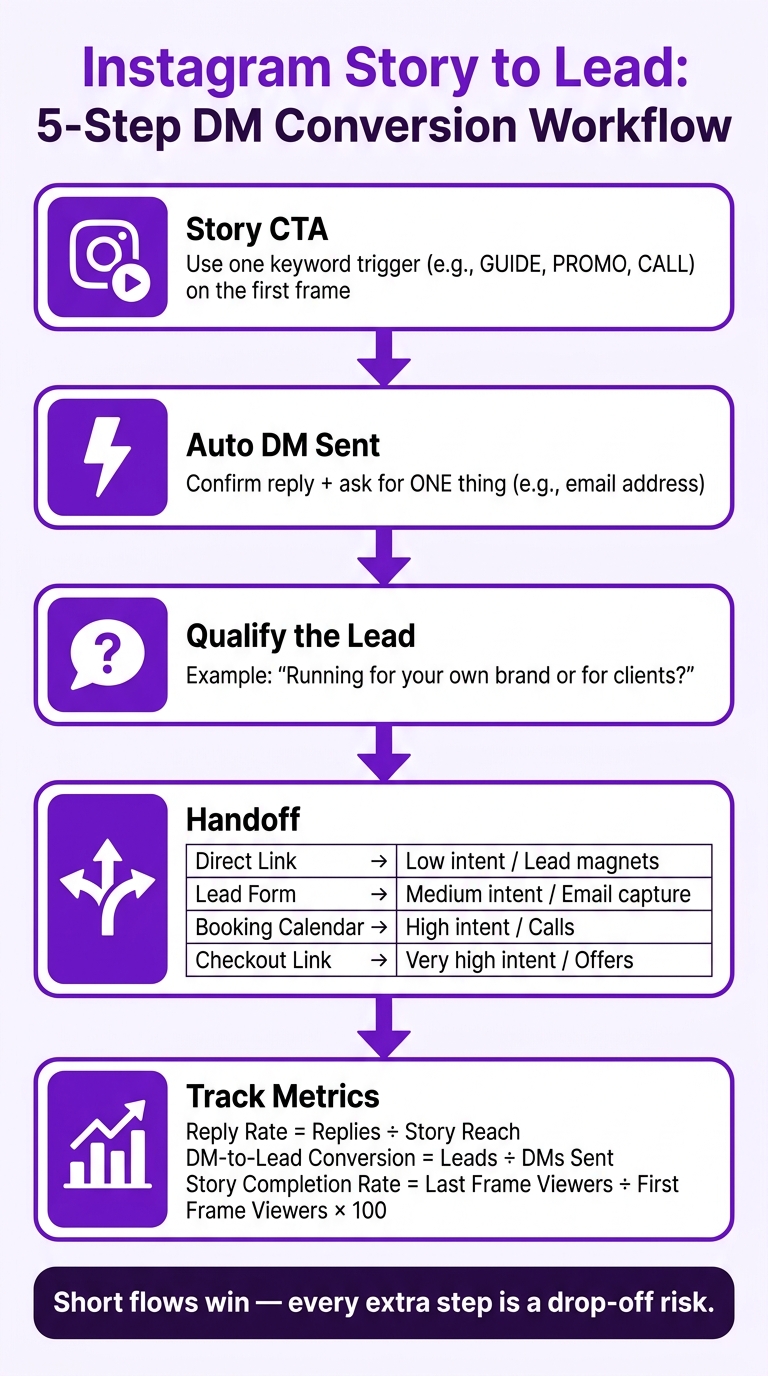
Instagram Story to Lead: The 5-Step DM Conversion Workflow
How I Use Instagram Chatbot to Capture Leads Automatically
sbb-itb-3c55afb
Write DM Templates for Lead Magnets, Quizzes, and Qualification
Use the first DM to confirm the reply and give one next step. Keep the chat in DM at this stage. That helps cut early drop-off. Match the template to the person’s reply before you send them to a form or link.
Lead Magnet DM Templates With One Clear Next Step
For lead magnet replies, stick to a simple formula: one warm line and one ask.
Template: "Hey [Name] - thanks for requesting the [asset]. What's the best email to send it to?"
You can swap in the offer type, like a checklist, ebook, webinar, promo code, or course access, and it’s ready to use. As soon as you get the contact info, send the asset right away. You can automate this process using free Instagram tools designed for lead generation.
Quiz and Poll Reply Templates That Sort Leads by Type
Send each answer into a matching DM flow. For example, a Story poll that asks "Where are you with Instagram growth? Just starting out / Posting consistently already" can split people into two paths.
The beginner gets:
"Perfect starting point - I've got a beginner roadmap for you. Reply with your email and I'll send it over."
The advanced user gets:
"Sounds like you're ready for a deeper strategy. Want me to send the advanced version?"
The reply tells you what happens next: send a beginner flow or move into a deeper qualification path.
Qualifying Questions That Filter Serious Leads
Use the next DM to qualify the lead fast. One or two questions are usually enough. You don’t want the DM to feel like a form.
The best qualifying questions are specific and easy to answer on a phone. For example:
"Quick question - are you running this for your own brand or for clients?"
"What's your main goal right now: more followers, more leads, or more sales?"
Business type and goal are enough to sort most people. Ask two questions max, then send the next step.
Those replies help you decide whether to send a form, a calendar link, or a short follow-up.
Set Up Keyword Triggers and Story Reply Workflows
Once your DM templates are set, connect each Story reply to the right automation. The goal is simple: when someone replies, they should land in the right DM flow without manual work.
Keyword triggers make that happen. If a person types a specific word, the flow starts on its own. That lets you gauge interest right inside Instagram before you send the final offer.
Pick Keywords People Can Type Fast on Mobile
Use short keywords that fit the offer and are easy to type on a phone. Good examples include PROMO, EBOOK, DEMO, GUIDE, JOIN, PRICE, CALL, and YES.
Put the keyword and CTA on the first Story frame. That way, people know what to do right away instead of tapping through and missing the action.
When to Use Any-Reply, Keyword-Only, and Sticker Triggers
The trigger you choose shapes both reply volume and lead quality.
| Trigger Type | Volume | Lead Quality | Best Use Case |
|---|---|---|---|
| Any-Reply | High | Mixed | Broad awareness and simple lead capture |
| Keyword-Only | Moderate | Higher | Lead magnets, booking pages, and qualification |
| Poll or sticker | Moderate | Mixed | Segmentation, quiz flows, and audience sorting |
Any-reply workflows usually bring in the most responses, but some of those replies may come from people with lower intent. Keyword-only triggers often lead to fewer replies, but the people replying tend to be more serious.
Poll and sticker triggers sit somewhere in the middle. They work well when you want to sort people into groups or send them down different paths based on interest.
Match Each Story CTA to the Right DM Path
Each Story CTA should lead to one DM path. Keep it clean. If the Story asks people to reply with a keyword, that keyword should send them into the matching template.
For example, a lead magnet Story can ask for a keyword, collect an email, and then send the asset. Simple flows are easier to track, which matters a lot when you're trying to see which keyword and which Story bring in the most leads.
Once the path is locked in, move the lead to the lightest handoff possible.
Move Leads From DM to Forms, Booking Pages, and CRM
After the DM reply comes in, the goal changes. Now it's about turning interest into a clear next step.
That jump matters more than people think. If the handoff feels smooth, the lead moves forward. If it feels clunky or vague, they disappear.
Pick the Right Handoff: Form, Calendar, Checkout, or Email Capture
Send people to the next step based on what they want: a free download, a call, a checkout page, or a form. The DM should do just enough filtering to point the lead in the right direction. And before you drop a link, get their contact details.
| Handoff Method | Speed | Intent Level | Best Use Case |
|---|---|---|---|
| Direct DM Link | Instant | Low | Lead magnets (PDFs, Google Drive links) |
| Lead Form | Fast | Medium | Email capture, newsletter signups |
| Booking Calendar | Slower | High | Discovery calls, consultations |
| Checkout Link | Medium | Very High | Limited-time discounts, low-cost offers |
Cut Drop-Off With Short Forms and a Clear Value Promise
Keep the form short. For most lead magnet handoffs, first name and email are enough. If the next step is a call, add details like business type or preferred call time only when they help you get ready.
The form should also make the value plain. A direct promise usually beats a bland sign-up headline. You can also add a short privacy line like "No spam. Unsubscribe anytime." to ease doubts.
Plan Follow-Up DMs and CRM Tagging for Non-Submitters
If someone starts the form but doesn't finish, send one follow-up DM. That's often enough.
Tag each lead by Story and keyword so you can see which reply brought them in.
Once this handoff is set up, track which stories and keywords lead to the most conversions.
Track Story-to-DM Conversion and Improve Results
Once the handoff is live, tracking shows where leads drop off. That matters because a small snag in the Story, DM, or follow-up can quietly cut results.
Measure Reply Rate, DM-to-Lead Conversion, and Story Completion
- Reply Rate = Replies ÷ Story Reach
- DM-to-Lead Conversion = Leads Captured ÷ DMs Sent
- Story Completion Rate = Last-Frame Viewers ÷ First-Frame Viewers × 100
Low reply rate usually means the CTA or keyword is unclear or annoying to type. Low DM-to-lead conversion usually means the flow is too long, too clunky, or asks for too much too soon.
Review Results by Keyword, Offer, and Audience Segment
After you have the numbers, compare them by keyword, offer, and audience segment. Those tags make it easier to see which paths bring in better lead quality. Segment reporting shows which audience, offer, and keyword combination converts best.
This is where patterns start to show. One keyword may get more DMs but weaker leads. Another offer may pull fewer replies but better-fit prospects. When you look at performance side by side, it gets a lot easier to spot what's worth pushing and what needs work.
Conclusion: Keep the Workflow Short, Track Every Step, and Scale What Works
A clear Story CTA starts the process. A short DM keeps momentum. A few qualifying questions help filter intent, and the right handoff closes the loop.
Then scale the path with the highest reply-to-lead rate.
FAQs
What’s the best keyword to use in a Story CTA?
The best keyword is short, clear, and easy to remember. It should also match your offer right away.
Good examples include PROMO, EBOOK, DEMO, WIN, LINK, PRICE, and GUIDE.
A simple, specific word makes it easier for followers to take action. It also helps your automation trigger the right reply. Make sure the keyword appears clearly in your Story.
How many DM questions should I ask before sending a link?
There’s no fixed number. The aim is to qualify the lead and give them a reason to care before you send the link.
A short conversation is usually enough. Ask for a few key details, like their name or email address, then explain what the offer includes and why it matters. That small extra step helps screen out low-priority inquiries and guides high-intent users to your sales page.
Which metrics matter most for Story reply lead generation?
Focus on funnel metrics that tie Story engagement to revenue.
The main ones to track are reply rate, lead rate, sale rate, revenue per DM, average order value, and response time.
These numbers show what happens after someone watches your Story. Did they reply? Did that reply turn into a lead? Did that lead turn into a sale? That’s the path that matters.
You should also keep an eye on Story analytics such as:
- Reach
- Sticker or link taps
- Exit rates
Those metrics help you spot where people lose interest before they ever enter the DM funnel. If reach is solid but replies are low, the issue may be the offer or call to action. If exits spike on one frame, that’s a clue viewers are dropping off before taking the next step.