15 Meme Reel Templates
15 reusable meme Reel templates with hooks, audio tips, and metrics to drive reach, saves, and shares.
Most Reel memes work for one of three goals: reach, saves, or shares. I’d use these 15 templates after you learn how to make Reels by matching the format to the goal, then keeping the first 1–2 seconds strong, the hook at 5–10 words, and the text out of the bottom 20–25% of the screen.
Here’s the short version:
- Contrast & Transformation templates use a clear before/after shift
- Reaction & Commentary templates lean on facial response, opinion, or timing
- Scenario & Relatability templates turn common moments into jokes people want to send
- Text-Led & Social Proof templates let proof, numbers, and short text carry the Reel
A few points stand out fast:
- Viewers often decide in 1–2 seconds if they’ll keep watching
- About 40% of Reel viewers watch without sound
- Personal-style posts can drive 238% more comments
- A 2%+ save rate is solid, and 3%+ is strong
Quick comparison
| Category | What drives the Reel | Best use |
|---|---|---|
| Contrast & Transformation | Visual change | Reach, saves, shares |
| Reaction & Commentary | Face, timing, opinion | Shares, comments, reach |
| Scenario & Relatability | Familiar situation | Shares, reach |
| Text-Led & Social Proof | Proof, stats, short text | Saves, shares, reach |
If I were using this list, I’d pick 2–3 formats, run them for 4–6 weeks, and track saves and shares per 1,000 views. That gives me a simple system instead of starting from scratch every time.
sbb-itb-3c55afb
How to Use These Meme Reel Templates Strategically
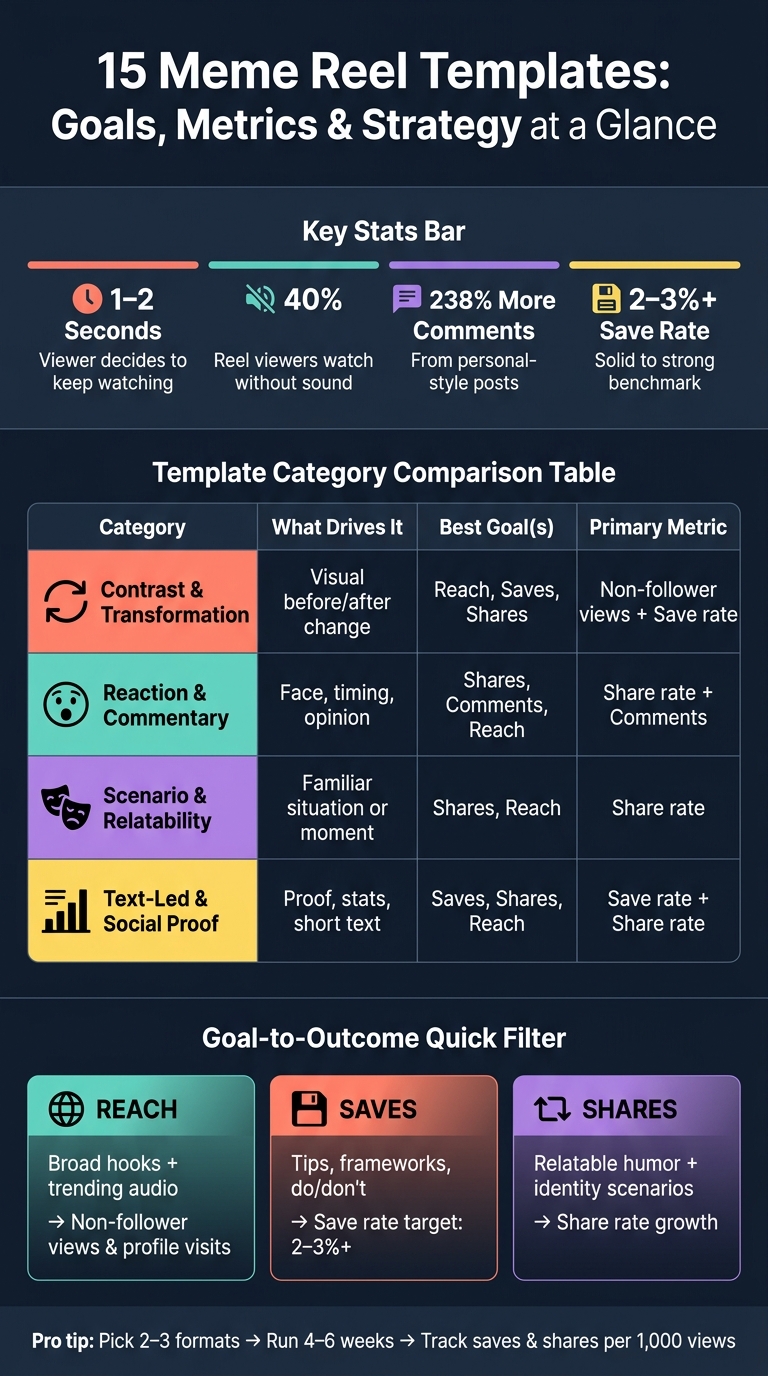
15 Meme Reel Templates: Goals, Metrics & Strategy at a Glance
Pick each template based on the result you want: use reach for discovery, saves for useful frameworks, and shares for relatable humor. Once that goal is clear, look at the hook and pacing next.
Put a bold 5–10 word hook in the upper center of frame 1. Check it on a phone, and keep it away from the bottom 20–25% of the screen. Most people decide in the first 1–2 seconds if they’ll keep watching, so your opening has to do the hard work.
Audio plays a different role depending on the goal. For reach, trending audio can help distribution, mainly when the punchline lands on a beat drop or lyric switch. For saves, keep the audio low so people who rewatch for the info have time to read. For shares, audio can be the joke - familiar sounds, dialogues, or songs come with built-in meaning, which makes sharing feel like joining the meme. In those cases, the text needs to move in step with the audio.
The same template can work for creators, brands, and agencies. What changes is the angle. Creators usually lead with POV and niche language. Brands make the product the payoff. Agencies set fonts, safe zones, and angle libraries ahead of time, then match each client's pain points to the right template.
| Outcome | Instagram metrics | Best for |
|---|---|---|
| Reach | Non-follower views, profile visits | Broad hooks, trending audio, new audience growth |
| Saves | Save rate | Tips, frameworks, "do/don't" comparisons |
| Shares | Share rate | Relatable humor, identity-driven scenarios |
Use this filter as you move into the 15 templates below.
1. Contrast & Transformation
The before/after meme reel starts with a messy, annoying, or flat-out frustrating "before", then snaps to a satisfying "after." That contrast tells the story almost by itself. Your cut needs to make the change feel obvious. And the nice part? You can swap the "before" and "after" for almost anything - content, products, systems, or day-to-day workflows. It travels well across topics.
Call out the struggle right away in the first frame. Something like "POV: Your content before you fixed your hooks" works well in bold text at the top. The "before" should be easy to read in a second and funny enough to stop the scroll. If that first moment lands, the reveal does the heavy lifting.
A hard cut on the beat drop usually works best. Let the buildup carry the "before", then use the drop for the reveal. If you're aiming for saves, add a short 3-step bridge between the two states. Also, test it on mute. If the contrast doesn't make sense without sound, the reel probably needs work.
Keep the text layout clean:
- 1–2 short lines per frame
- High-contrast colors
- Nothing important near the bottom edge, where Instagram's UI can cover it
Use this format when the visual shift should drive reach, saves, or create viral Instagram Reels.
| Goal | What to emphasize | Audio approach |
|---|---|---|
| Reach | Strong visual contrast, exaggerated "before" | Trending audio with a clear beat drop |
| Saves | 3-step bridge between states | Low-key audio; let text carry the story |
| Shares | Relatable, POV-style humor | Meme audio viewers already connect with glow-ups |
If the joke leans less on change and more on a face, expression, or one killer line, move to reaction-led templates.
2. Reaction & Commentary
Use this format when the joke lands through your reaction, not a visual switch. The idea is simple: react to a common mistake, a daily annoyance, or a viral moment, and let your face or text do the work.
Set it up with a main clip or background meme, then add your reaction as a face cam or on-screen text. Start with one hook line that frames the situation, like "Client: We just need a quick logo". After that, let the reaction hit: a deadpan stare, a slow clap, or a stunned look.
Keep the frame top-heavy, with the reaction front and center. Keep CTA text light. This format tends to pull more engagement and comments than non-reaction short-form videos, so it's a strong pick when you want comments and shares.
Match the audio to the mood. Go with dramatic swells, sarcastic clips, or meme audio people already know.
| Goal | Hook style | Audio approach |
|---|---|---|
| Reach | Broad, relatable situation ("POV: The client wants it by EOD") | Trending audio with a strong emotional tone |
| Shares | A frustration or opinion people want to send to a friend or coworker | Punchy, memeable sound bite |
| Saves | Reaction + brief caption tip or mini framework | Calmer audio; let the caption carry the value |
You’ll see different groups use this in different ways:
- Creators lean on deadpan POVs
- Brands focus on customer pain points
- Agencies batch reusable reaction faces and caption lines
Keep the reel between 7–12 seconds, and show the strongest reaction by second 2 or 3. Add a short CTA on-screen or in the caption, like "Tag a coworker" or "Send this to your team."
If the humor depends on the full scene, move to Scenario & Relatability.
3. Scenario & Relatability
The "Shared Moment" Meme Reel
Use this template when the joke is built into the situation itself, not your face or delivery. You’re dropping people into a moment they know all too well and letting them do the rest.
The best version of this starts with a specific, slightly exposed scenario. Not the polished win. The mistake. The awkward miss. The thing you did before you knew better. That’s what tends to land, because people don’t just see it - they recognize themselves in it.
Specific, vulnerable scenarios hit harder than polished wins: show the mistake before the fix.
Write the on-screen text the way people talk. Keep it natural, plain, and easy to read. Personal content drives 238% more comments, and adding a simple question or proven Instagram caption ideas can push replies even more.
The pacing matters too. Start low-key. Let the setup breathe for a second. Then hit the punchline with a beat switch.
| Goal | Hook approach | Audio style |
|---|---|---|
| Reach | Text-led setup or visual hook in the first 2 seconds | Low-energy intro, then a stronger beat at the punchline |
| Shares | Hyper-specific scenario that feels instantly familiar | Audio that supports the punchline without overpowering it |
| Saves | Scenario plus extra context in the caption | Calm, minimal audio so the text stays readable on muted playback |
Use this when the setup is the joke. If the scene needs a clearer takeaway, move into text-led templates.
4. Text-Led & Social Proof
The "Receipt" Meme Reel
When the joke leans on proof, stop building the Reel around scenes. Let the text do the heavy lifting, and use the background clip to set the mood.
Start with a proof hook in the first frame, and keep it under 10 words. Something like "Proof this works" or "From 1,200 to 18,500 followers in 60 days." works well. About 40% of viewers watch Reels without sound, so the text needs to tell the whole story by itself. That’s why creators lean on their own numbers, brands show customer results, and agencies turn client wins into slides they can reuse.
In the middle frames, show the numbers, add a testimonial, and include a before-and-after stat. This is the part that gets saves and shares. Then end with a clear CTA like "Save this" or "grow your audience" in a contrasting color block.
Use the table below to line up the proof format with your goal.
| Goal | Hook style | Audio fit |
|---|---|---|
| Reach | Bold claim or surprising metric in frame one | Trending meme sound that matches the emotional tone |
| Saves | Step-by-step proof breakdown across frames | Subtle background music, low volume |
| Shares | Relatable result that viewers want to pass along | Trending upbeat audio |
One last check: test it on mute. If the proof is still easy to read and the CTA still lands, it’s ready to post.
Conclusion
These 15 meme Reel templates fall into four groups, and each one is made to be reused. In most cases, you only need to swap the hook, on-screen text, or audio.
Once you have the format dialed in, focus on the goal that matters most to increase engagement on Instagram. Go for reach if you want curiosity. Aim for saves if you want utility. Push for shares if you want relatability.
Try 2–3 templates that match your tone and run them for 4–6 weeks. Then track saves and shares per 1,000 views, and put more effort into the formats that beat the rest - for creators, brands, and agencies alike. A save rate above 2% is solid, and above 3% is strong. After that, turn your top performers into your default Reel system.
FAQs
How do I choose the right meme Reel template for my goal?
First, define your goal: awareness, trust, or conversion.
Then look at high-performing Reels in your niche. Pay attention to the format, the hook style, and the engagement patterns you can reuse. You're not copying. You're studying what gets people to stop scrolling and watch.
Next, match the template to that goal.
- For awareness, use showcases, unboxings, or transformations
- For trust, use day-in-the-life clips or voiceovers
- For conversion, use problem-solution videos, demos, or testimonials
Keep the structure simple: hook, body, and one final CTA.
What makes a strong hook in the first two seconds?
A strong hook stops the scroll in the first 1 to 3 seconds. It grabs attention fast and shows the payoff right away.
Keep it short. In most cases, 5 to 8 words is enough.
Use bold, high-contrast text on the first frame, especially for people watching without sound. And get to the point fast: show the product, the problem, or the result right away.
A good hook can lean on:
- a problem
- curiosity
- a contrarian fact
The main thing is simple: make the first moment clear and hard to ignore.
How can I tell if a Reel is better for saves or shares?
Check your Instagram Professional Dashboard insights. Saves usually mean the Reel has lasting value, like a tutorial or something people want to come back to later. Shares - especially in DMs - usually mean it feels deeply relatable or hits an emotion hard, whether that’s humor, awe, or empathy.
For a better read on performance, compare saves and shares against reach instead of looking at raw views alone.