Instagram vs TikTok Engagement for Creators
Compare how TikTok retention vs Instagram saves/DMs drive creator growth and which metrics to track for reach or depth.

If I want reach, I should watch TikTok retention first. If I want stronger audience action, I should watch Instagram saves and DM shares first.
That’s the short answer.
Here’s the plain-English breakdown:
-
TikTok pushes videos based on watch behavior
- completion rate
- average watch time
- rewatches
- shares
- favorites
-
Instagram pushes posts and Reels based on intent
- DM shares
- saves
- comment replies
- profile visits
- Reels watch time
A few numbers stand out:
- On TikTok, short videos often need around 70% completion to spread further
- For clips under 15 seconds, top posts can hit 100%+ average watch time
- A TikTok rewatch rate of 15%–20%+ can point to strong upside
- On Instagram, DM shares and saves often matter more than likes for reach and follows
So if I had to boil it down:
- TikTok = attention first
- Instagram = intent first
- Likes matter least on both
- Shares, saves, replies, and watch time matter more
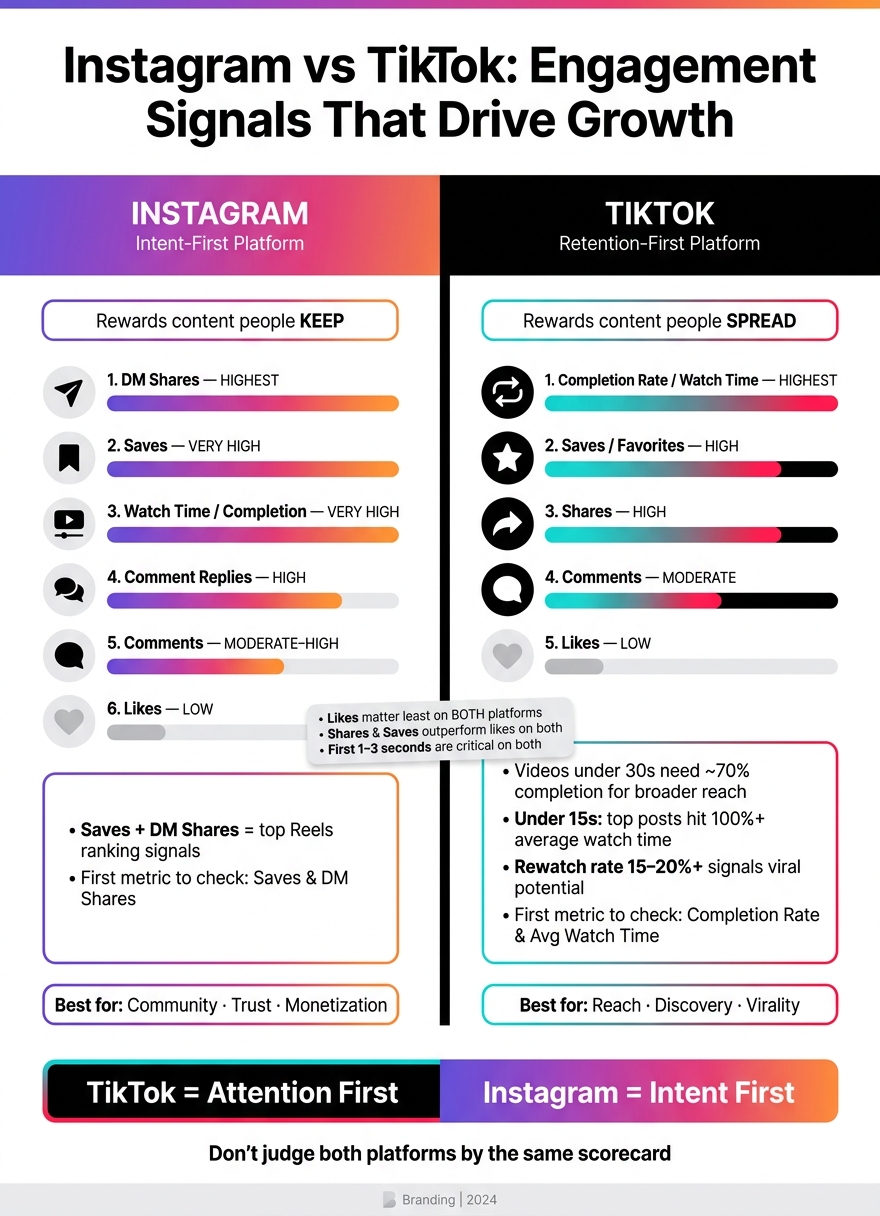
Instagram vs TikTok: Engagement Signals That Actually Drive Growth
Instagram Reels vs TikTok: What Works Best for Your Goal
sbb-itb-3c55afb
Quick Comparison
| Criteria | TikTok | |
|---|---|---|
| Main ranking lean | Intent | Retention |
| Top signals | DM shares, saves, watch time | Completion rate, watch time, rewatches |
| Role of likes | Low | Low |
| Role of comments | More about relationship depth | More about thread activity |
| Best for | Community, trust, follow-through | Reach, discovery, spread |
| First metric I’d check | Saves and DM shares | Completion rate and average watch time |
If I’m posting on both, I shouldn’t judge them by the same scorecard. The same video can do well on one app and stall on the other because each platform reads engagement in a different way. This article explains which signals matter most, what they mean, and what I’d track first.
Instagram Engagement Signals That Matter Most
Instagram ranks engagement based on intent. At the top are DM shares, followed by saves, meaningful comments and replies, profile visits, and likes at the bottom. In plain English: Instagram gives more weight to actions that show real interest, not just quick taps. That’s why it works so well for intent-driven engagement.
How Instagram weighs likes, comments, shares, saves, and replies
Saves and DM shares are the strongest signals. A save tells Instagram that someone wants to come back to the post later. A DM share says something even stronger: this is worth sending to another person. Both can help Instagram push your content into Explore and show it to people who don’t already follow you.
Comments and replies matter too, but they sit a bit lower. They tend to signal relationship strength, especially when the comment is specific, longer, or part of an actual back-and-forth. A real conversation in the comments tells Instagram there’s a connection here. Likes, on the other hand, are light signals. They still matter, but mostly as a quick check on whether current followers are into what they’re seeing. They do far less for new reach or long-term discovery.
Why watch time and replays matter for Reels
For Reels, retention metrics do the heavy lifting. Watch average watch time, completion rate, and rewatches. If plays are higher than reach, people are watching the Reel more than once. That’s usually a good sign.
But retention alone isn’t the whole story. The strongest Reels pair solid watch behavior with follow-up actions like saves, DM shares, and follows. When a Reel gets both attention and action, Instagram tends to favor it because it’s sending off several strong quality signals at once.
The first second does a lot of work. If the opening falls flat, people scroll. Tight cuts, on-screen text that hints at what’s coming, and a payoff at the end all help keep viewers watching. Step-by-step tutorials and before-and-after transformations often do well here because they not only hold attention, but also earn saves from people who want to come back later.
What Instagram creators should optimize first
If your goal is steady growth instead of random spikes, focus on DM shares and saves first. Make content people want to keep:
- checklists
- how-tos
- infographics
- frameworks
That kind of post has a better shot at being bookmarked and passed along.
For Reels, track average watch time and completion rate every week. Then look for patterns. Which formats keep people watching longer? Which ones get shared? Which ones get saved? That’s where the signal is.
Meaningful comment threads come next. They’re not the top metric, but they still matter. Questions, opinion prompts, and interactive Story stickers can help move people from passive scrolling to actual participation. And when that happens, Instagram gets a stronger relationship signal tied to your account.
TikTok rewards many of the same actions, but it leans more heavily on completion and looping.
TikTok Engagement Signals That Matter Most
TikTok’s For You Page (FYP) looks at watch behavior first. In plain English, that means completion rate and watch time do the heavy lifting when TikTok decides whether to show a video to more people.
A small account can beat a big one if its video holds attention during that first audience test. That’s why the first 1–3 seconds can make or break a post.
How TikTok weighs likes, comments, shares, saves, and replies
If a video gets past that first test, TikTok then looks at interaction signals in this order: saves/favorites > shares > comments > likes.
Here’s the logic behind that order:
- Saves matter most because they hint that people want to come back to the video later.
- Shares come next because they help the video reach new viewers beyond your current audience.
- Comments beat likes because they spark discussion and keep people in the app longer. Active comment threads can help extend reach past the first 6–12 hours.
- Likes still help, but they carry the least weight of the four.
Why completion rate and looping drive TikTok reach
Completion rate is TikTok’s main quality filter. Videos under 30 seconds usually need about 70% completion to earn broader distribution.
For clips under 15 seconds, strong posts often get average watch time above 100% of the video length. That means viewers are watching again, not just once.
A rewatch rate of 15–20% or higher is also a strong sign that a video has viral potential.
What TikTok creators should optimize first
Start with the opening. The first 1–3 seconds do most of the work. A strong hook can stop the scroll and set up better completion.
That hook might be:
- a surprising visual
- a direct value promise
- a tension-building question
After that, pacing matters. Cut dead space, remove slow intros, and keep the video centered on one idea.
If you want more saves and shares, make posts people want to keep or pass along. Step-by-step tutorials, quick-reference tips, and niche relatable moments often drive better save and share rates than passive entertainment by itself.
A simple CTA like save this for later can help push that action, as long as you use it lightly so it doesn’t hurt completion.
The main numbers to watch are completion rate, average watch time, rewatch rate, saves, and shares. Likes and raw view counts matter less. So when you check performance, look at retention first, then engagement actions.
Next, compare these signals side by side with Instagram’s engagement model.
Instagram vs TikTok: How Each Platform Handles Engagement Actions
Instagram and TikTok track many of the same actions. But they don't reward them in the same way. Instagram leans toward intent. TikTok leans toward retention. That's the clearest way to think about it.
Here's how each platform tends to weigh those signals:
| Engagement Action | Instagram Weight | TikTok Weight | Primary Effect on Growth |
|---|---|---|---|
| Likes | Low (baseline signal) | Low (baseline signal) | Basic engagement-rate lift |
| Comments | Moderate–High (relationship depth) | Moderate (thread momentum) | Audience loyalty / FYP momentum |
| Comment replies | High (relationship strength signal) | Moderate (thread depth) | Follower retention / more visibility |
| Private shares/sends | Highest (top Reels signal) | High (strong positive signal) | Non-follower reach / virality |
| Saves / Favorites | Very High (future utility signal) | High (revisit value) | Follows / repeat reach |
| Watch time / Completion | Very High (Reels quality filter) | Highest (primary FYP gate) | Discovery / distribution expansion |
Likes, comments, and replies compared
Likes are the weakest signal on both platforms. They help at the surface level, but they don't carry much force on their own. Instagram puts more weight on sends and watch time than on likes.
Comments and replies tell a more useful story. On Instagram, they act as a relationship-strength signal. If the same accounts keep interacting, Instagram takes that as a sign that the content should show up more often and more prominently over time.
TikTok looks at comments a bit differently. What matters most is when a comment turns into an active thread. That back-and-forth can help extend reach and keep people in the app longer, which gives the post more momentum.
Shares, saves, and private intent signals compared
This is where the split between the platforms becomes the most obvious.
On Instagram, private shares are the top ranking signal for Reels, and saves also send a strong high-intent message. In plain English, if someone sends your Reel to a friend or saves it for later, Instagram reads that as a strong sign that the post matters. Those actions can also lead to more profile visits and follows.
On TikTok, shares and favorites matter too, but the platform leans more toward broad redistribution than private connection-building. So a video with strong share velocity can still spread across a big FYP audience even if favorites stay modest.
Put simply: Instagram rewards content people keep. TikTok rewards content people spread.
Watch time and completion compared
TikTok treats completion rate as its main quality gate. If people watch to the end, that's a strong sign the video deserves more distribution. And because each loop counts as another completion, looping can help stack that signal.
Instagram also weighs watch time heavily, especially for Reels. But retention tends to work best when it's paired with saves and shares, not by itself.
The next section turns these differences into the Instagram metrics and TikTok data points creators should track first.
Key Takeaways for Creators Deciding What to Prioritize
When you compare the signals side by side, the next step is simple: decide what to track first. TikTok leans toward reach. Instagram leans toward depth. That split should shape the metrics you pay attention to first.
Top metrics to track for faster creator growth
Your goal should drive your metrics.
If you want reach and new audience discovery, TikTok’s numbers matter more. If you want community, trust, and long-term monetization, Instagram’s intent signals deserve more attention.
Match the metric to the result you want.
| Goal | Platform | Metrics to Track First |
|---|---|---|
| Reach & virality | TikTok | Completion rate, average watch time, shares, favorites |
| Community & depth | Saves, DM shares, Story replies, Reels watch time |
On TikTok, completion rate and average watch time should be the first numbers you check. Replays and looping behavior can also point to strong interest.
On Instagram, saves and DM shares matter most. Those signals tell Instagram that your content has enough value or relevance for someone to revisit it or send it privately. It’s smart to track weekly saves, DM shares, Reel watch time, and comment quality.
TikTok helps people find you. Instagram helps turn that attention into deeper engagement.
FAQs
Why can the same video perform differently on Instagram and TikTok?
The same video can land very differently on Instagram and TikTok because each platform ranks and distributes content in its own way.
TikTok is more discovery-first. It tends to reward watch time, completion rate, and strong early engagement. Instagram is more follower-first. It puts more weight on audience relationships, follower engagement, saves, shares, and comments.
Style plays a part too. TikTok often rewards raw, trend-driven content. Instagram, on the other hand, usually leans toward more polished visuals.
What should I track first if I post the same content on both platforms?
Start with saves and shares. These are the strongest signals for distribution, and they matter more than public likes.
On Instagram, they help support long-term reach. On TikTok, watch watch time and completion rate too, since they shape early distribution. Tracking these metrics shows what clicks on each platform.
How do I improve saves, shares, and watch time without hurting retention?
Focus on content people can use again later, and make the first three seconds count. Lead with a bold visual hook and clear on-screen text, because a lot of people watch Reels with the sound off.
If you want more saves and shares, give people something worth coming back to or sending to a friend. Think tutorials, checklists, and practical tips they can use right away.
A few things help here:
- Add a clear call to action
- Reply to comments in the first 60 minutes
- Skip low-quality or watermarked reposts