
Is It Worth Buying Instagram Followers for Business in 2026?
Buying followers only helps in narrow cases—small, real-account boosts for credibility; fake or large buys usually hurt engagement, ads, and trust.
Buying followers only helps in narrow cases—small, real-account boosts for credibility; fake or large buys usually hurt engagement, ads, and trust.
4.98 /5 - from 58k reviews
Trusted by 50,000+ creators — get real engagement delivered to your profile in minutes, not days.
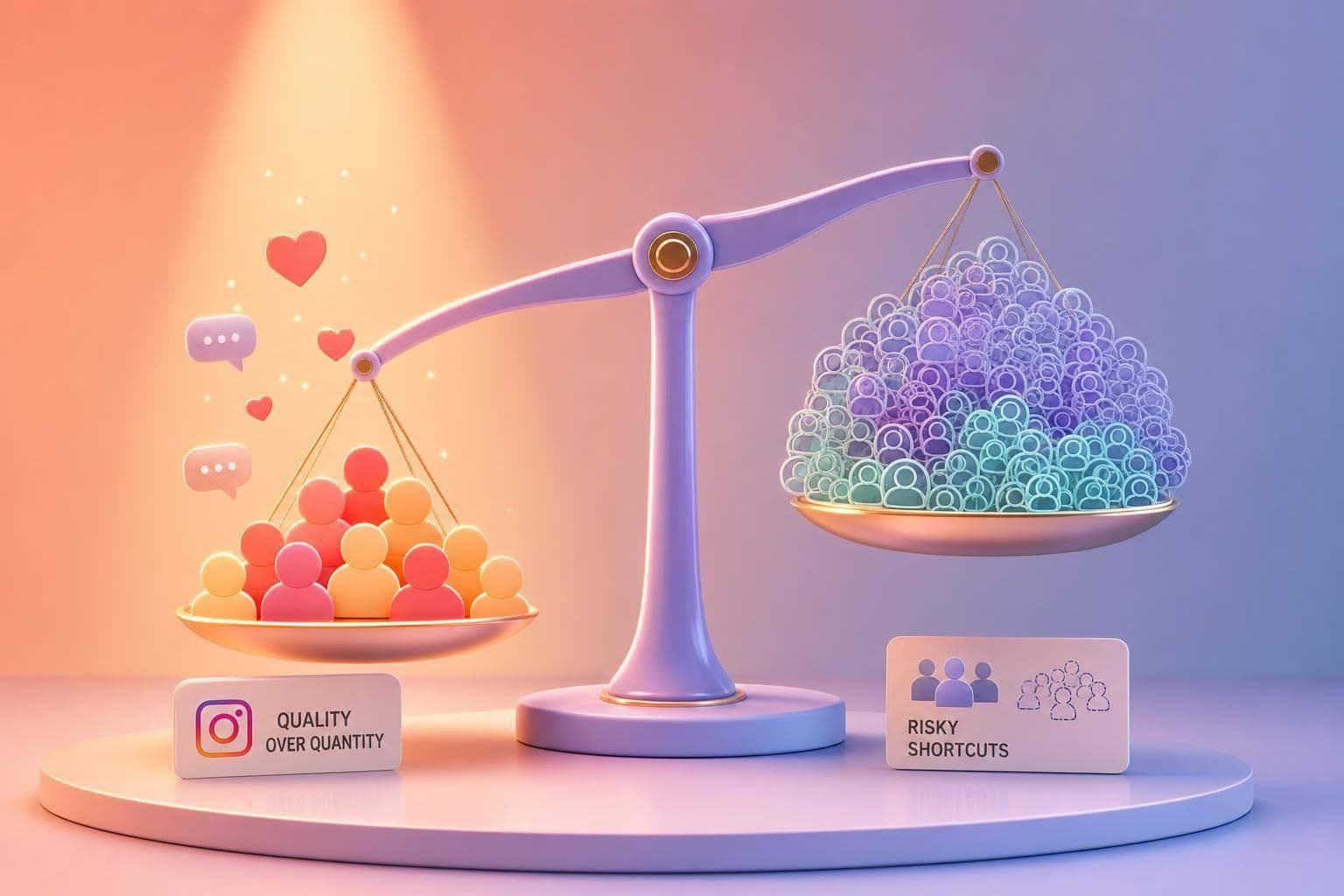
Yes - but only in a small set of cases. If I buy real-account followers in a small, gradual amount to help a weak-looking profile get past a social-proof gap, it can help. If I buy fake followers, or add too many too fast, it usually hurts engagement, ad targeting, and partner trust.
Here’s the short version:
Put simply: I’d only do it for a clear business reason, not just to make the number look bigger. If the follower bump does not improve profile-to-follow conversion, traffic quality, or revenue, then it is just a vanity cost.
| Option | Cost | Main upside | Main risk | Best use |
|---|---|---|---|---|
| Fake followers | $5–$15 per 1,000 | Fast count bump | Weak engagement, bad ad data, audit risk | Almost never |
| Real-account followers | $25–$150+ per 1,000 | Social-proof support | Can still look off if overdone | Small cold-start boost |
| AI-supported organic growth | From $39/month | Better engagement and long-term value | Slower results | Most businesses |
My takeaway: buying followers is only worth a look when the amount is small, the accounts are real, and the page is already set up to turn attention into business results. Otherwise, I’m paying for a number that can make performance worse.
A higher follower count can boost social proof. But on its own, it almost never improves engagement, qualified traffic, or revenue. The better question is simple: does the bump change profile-visit-to-follow conversion, qualified traffic, or revenue? If not, the number on the page doesn't mean much.
First impressions on Instagram happen fast. If a profile has a low follower count, some visitors leave before they even read a caption. That doesn't always mean the content is weak. Sometimes the account just looks unproven.
When an account crosses a familiar threshold, it can feel more established at a glance. That's the part that matters. The lift only counts if it changes how people judge the profile in those first few seconds. And in some cases, follower count has direct business value too. Thresholds like 5,000 followers can unlock specific brand-deal programs, which gives the number a commercial use beyond appearance.
This is where most follower purchases fall apart. Follower count is a signal, not a business result. If the added followers are silent or fake, they can weaken engagement signals, cut reach, and make analytics harder to trust. In plain English: the account may look bigger while performing worse.
That's why this tactic only fits narrow cases.
The conditional yes applies in one situation: when a business uses a small, proportionate number of real accounts to close a credibility gap while a real Instagram marketing strategy is already running. Think of it as support, not growth. For that to work, the accounts need to look legitimate, the increase should happen gradually, and the profile should be audit-ready, with a clear bio and enough strong posts to feel established.
The next section breaks down the few cases where buying followers can help, and where it tends to backfire.
Buying followers usually isn’t worth the money. At best, it can patch a small credibility gap. It does not work as a growth plan. The main issue isn’t whether follower count matters. It’s whether a small bump helps enough to make the spend make sense.
People judge profiles fast, often within a few seconds. A very low follower count can kill trust before someone even reads the caption. That doesn’t always mean the content is bad. Sometimes the account just looks untested.
A small boost can help, but only if the content is already good and the profile feels real. That’s the narrow window where buying followers may do some good. Past that point, the key is telling apart a business use case from plain vanity spending.
These cases are limited. But they have one thing in common: the follower count helps support a clear business milestone.
The type of follower matters a lot. Higher-quality purchased followers - accounts with profile pictures, bios, and post history - can act as a social-proof layer without instantly hurting the profile’s credibility.
Low-quality bots are much easier to spot. They can also lead to purges or lower reach. Real accounts carry less risk than obvious bots, but even then, an inflated follower count on a thin profile can backfire. Instead of building trust, it makes the account look off.
That’s the line where buying followers stops helping and starts doing damage, which the next section covers.
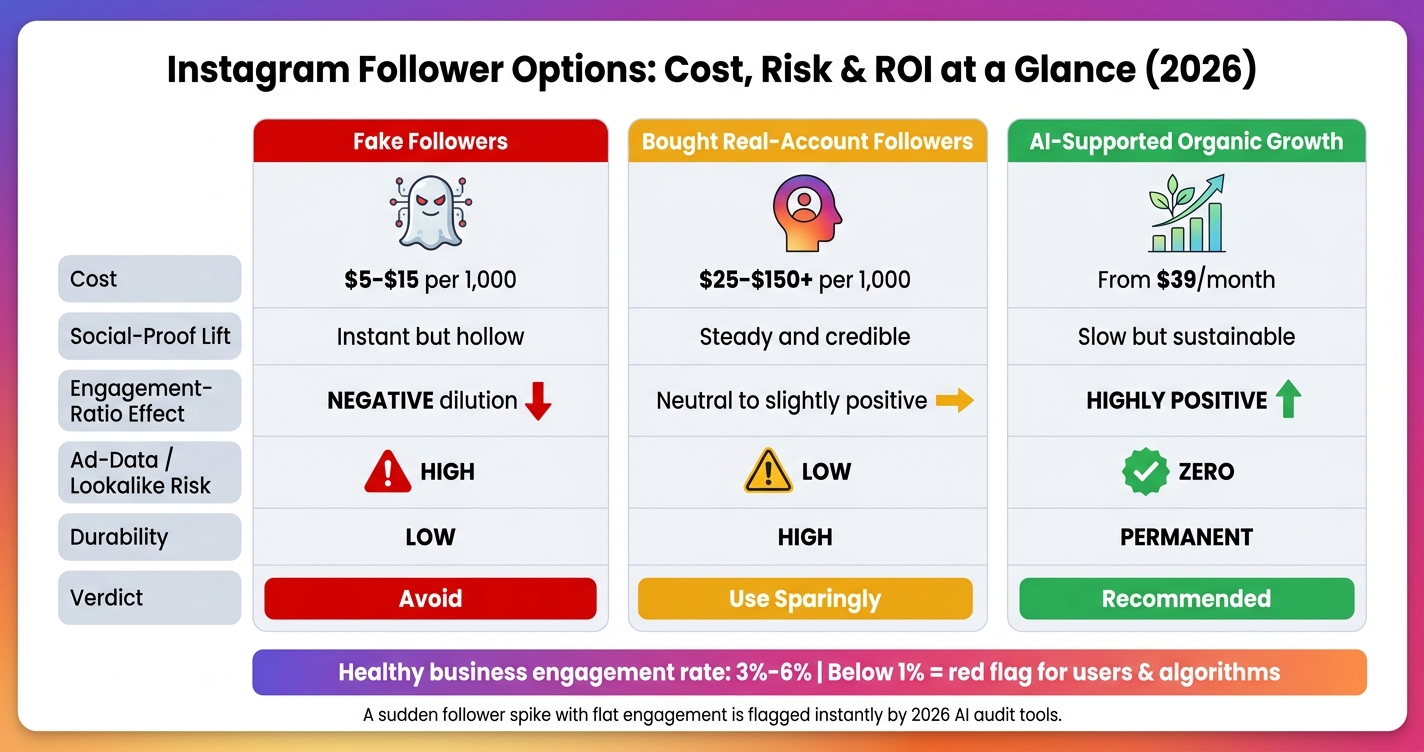
Buying Instagram Followers: Fake vs. Real vs. Organic Growth (2026)
Buying followers turns into a bad trade pretty fast when your business relies on clean data, paid ads, or trust from partners. The damage stacks up across engagement, account reviews, and ad targeting. At that point, follower growth stops looking like social proof and starts looking like a problem, highlighting the pros and cons of Instagram growth services.
Fake followers push your follower count up without adding likes, saves, or shares. So your engagement rate drops, and your reach can drop with it. In 2026, a healthy engagement rate for most business accounts sits between 3% and 6%. Fall below 1%, and that’s a red flag for both users and algorithms.
That low ratio doesn’t just make your profile look off. It also makes outside review a lot tougher.
Agencies and brand partners check accounts closely. By 2026, AI-powered audit tools can flag odd growth patterns and low-quality audience segments in seconds. A sudden spike in followers with flat engagement is easy to spot, and that gap can cost you partnerships, sponsorships, or trust inside your own company. On top of that, FTC scrutiny around deceptive marketing practices adds compliance risk.
The biggest hit often shows up when paid traffic depends on clean audience data.
Fake followers can skew Meta Pixel data and push lookalike targeting toward the wrong audience. If your followers don’t match your target market, region-specific campaigns can underperform by 20% to 40%. If you’re spending actual dollars on Instagram and Facebook ads, that’s a direct hit to ROI.
The main issue isn't whether you should buy followers. It's what has to be in place for that spend to earn anything back.
Buying followers only makes sense when a few things are true at the same time: the accounts are real, the bump is small, and the profile can turn added attention into business results. In that case, the upside is social proof with visitors, partners, and ad systems.
Before you spend a dollar, look at what extra attention could turn into. Track profile visits, follow conversion, website clicks, and DMs before and after any purchase.
If your bio is vague or your posts don't explain what you sell, more followers won't solve that. More traffic to a weak profile is like sending people to a store with no sign on the door. If profile-visit-to-follow conversion doesn't improve, the spend didn't work.
If the account is brand new, give it 60–90 days of organic content history first. A small boost can help a low-count page get past the credibility gap, but only when the increase stays close to your normal growth pace and arrives gradually instead of all at once.
A jump that dwarfs the account's recent history looks off to users and brand partners. It can also trip Instagram's AI detection systems.
Content matters just as much. Have enough strong posts live to make the profile look solid before any follower boost. Instagram usually shows new posts to a small initial segment before it sends them farther. If that first group is mostly inactive purchased accounts, your posts can fail that first test and stop getting pushed to the Explore page.
This side-by-side view shows why fake followers usually fall apart as a business investment, even when the price looks low at first.
| Fake followers | Bought Real-Account Followers | AI-supported organic growth | |
|---|---|---|---|
| Upfront Cost | Very low ($5–$15 per 1,000) | Moderate to high ($25–$150+ per 1,000) | Starts at $39/month |
| Social-Proof Lift | Instant but hollow | Steady and credible | Slow but sustainable |
| Engagement-Ratio Effect | Negative dilution | Neutral to slightly positive | Highly positive |
| Ad-Data / Lookalike Risk | High | Low | Zero |
| Durability | Low | High | Permanent |
Fake followers have the lowest upfront cost and the most downstream risk, especially if you're running Meta ads. Buying Instagram followers from real accounts (the only defensible-ROI version) sits in the middle. It can help you clear a credibility threshold without wrecking your engagement ratio or ad data, if the amount is proportionate and the content is already in place.
For the full picture on risks and trade-offs, see the honest truth about buying followers and the deeper breakdown in buying followers vs organic growth.
For businesses that want follower growth without fake-account risk, a real-account growth system is the safer ROI play.
Last updated: July 2026
Usually, no.
Purchased followers are often bots or inactive accounts. That means they don't engage with your content, and they don't help you reach actual customers.
At best, buying followers can give a new account a short-term bump in social proof. But that comes with a catch: a high follower count paired with weak engagement can look off.
And that can lead to problems like:
Yes. Buying followers can hurt your Meta ad performance because Meta’s algorithm learns from how people behave. If bots or fake accounts are part of that audience, the system picks up bad signals. That can lead to ads being shown to lower-quality profiles, while costs go up and conversions drop.
It can also weaken lookalike audiences. If Meta builds those audiences from fake data, targeting gets less accurate and ad spend is more likely to go to waste.
There’s no magic number. It depends on your niche and your account history.
If you’re a new business, the main goal is to get past that empty-account look, not chase a vanity metric. Keep your follower count in line with your current size, avoid sudden jumps that more than double it all at once, and make sure your profile already has the basics in place: a clear bio, a profile photo, and 9 to 12 high-quality posts.
Yes - for long-term ROI, organic growth is the better play.
Buying followers can give you a short-term social proof bump. On the surface, that may look good. But organic growth builds a loyal, active audience that leads to real engagement, steadier sales, and word-of-mouth.
It also supports natural interaction signals. Fake followers do the opposite: they can water down engagement and skew your Meta ad data, pixel performance, and lookalike audiences.


