Instagram AI Targeting Case Studies: ROI
Niche targeting and drift checks drove better Instagram AI ROI—track qualified followers, engagement, and cost per lead.

More followers did not mean better ROI in these cases. From what I saw, the best setup used tight niche targeting, location checks, and drift tracking. The weak setups either pulled in the wrong people or missed growth claims.
If you want the short version, here it is:
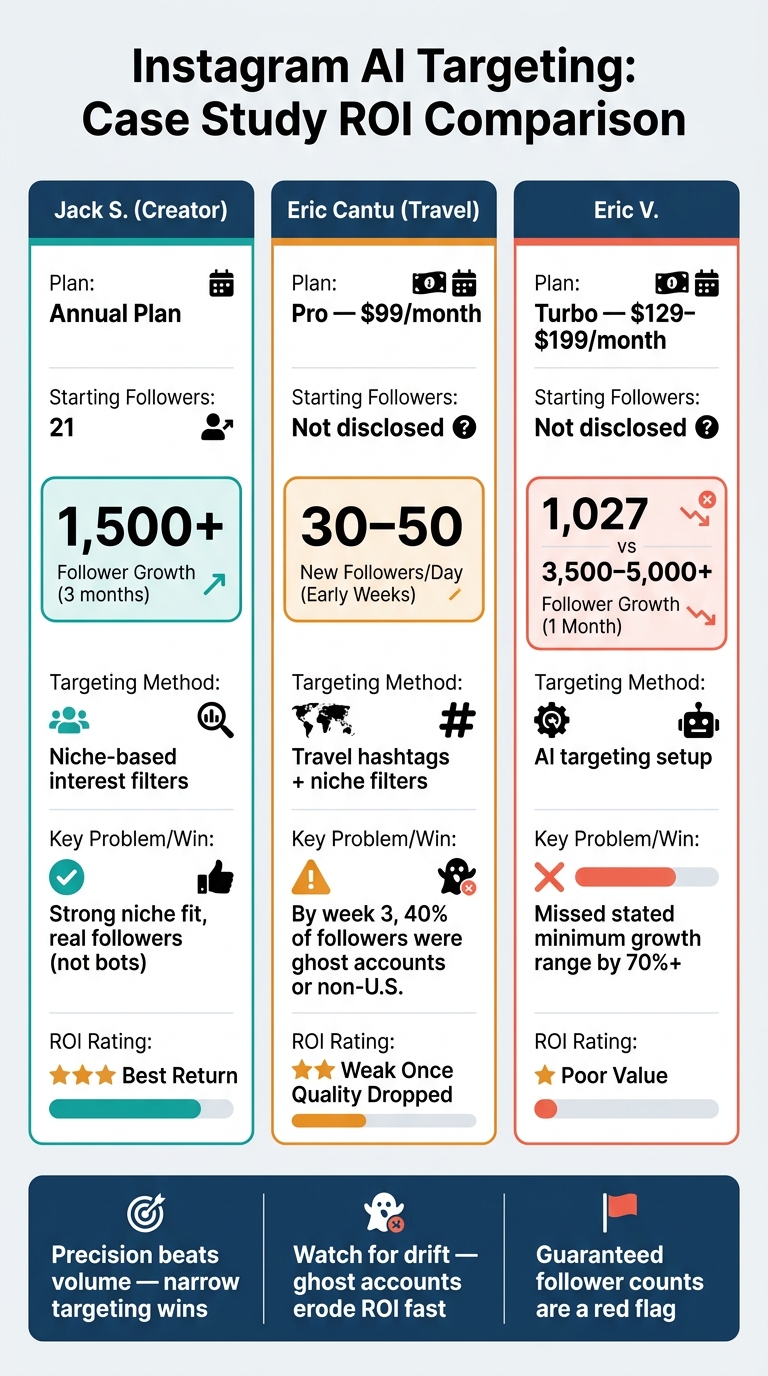
- Jack S. got the best outcome: 1,500+ followers in 3 months from a tiny base of 21 followers, with a better audience fit.
- Eric Cantu saw early growth of 30–50 followers a day, but by week 3, 40% of new followers were ghost accounts or from outside the U.S.
- Eric V. paid for a Turbo tier at $129/month and got 1,027 followers in one month, far below the stated 3,500–5,000+ range.
- The main lesson: raw follower growth can hide poor audience fit.
- If I were judging these campaigns, I’d watch cost per qualified follower, engagement, and lead fit before I cared about follower totals.
This review also compares the inputs behind those results: location, age, gender, language, interest clusters, and profile-based filters. And the pattern was simple: interest and profile signals did more than broad demographic filters.
Quick Comparison
| Case | Spend / Plan | Growth Result | Main Problem or Win | ROI Read |
|---|---|---|---|---|
| Jack S. | Annual plan | 1,500+ in 3 months | Strong niche fit | Best return in this set |
| Eric Cantu | Pro, $99/month | 30–50/day early | 40% ghost or off-region by week 3 | Weak once quality dropped |
| Eric V. | Turbo, $129/month | 1,027 in 1 month | Missed stated growth range | Poor value for the claim |
Bottom line: if you want AI for Instagram marketing to pay off, I’d keep the audience narrow, check for drift often, and treat fixed follower promises as a warning sign.
Instagram AI Targeting: Case Study ROI Comparison
Case Study Snapshot: Goals, Baselines, and Results
These cases show how AI targeting played out across different budgets and starting points. And in this set, audience quality mattered more than raw follower count.
| Account | Baseline Followers | Campaign Goal | Targeting Inputs | Plan | Follower Growth | Result |
|---|---|---|---|---|---|---|
| Jack S. (Creator) | 21 | Build a genuine niche audience | Niche-based targeting | Annual plan | Over 1,500 followers in 3 months | Real followers, not bots |
| Eric Cantu (Travel) | Not disclosed | U.S.-based travel growth | Travel hashtags and niche filters | Pro ($99/mo) | 30–50 new followers per day in the early weeks | By week 3, 40% of new followers were ghost accounts or non-U.S. followers, and engagement dropped |
| Eric V. | Not disclosed | 3,500–5,000+ followers per month | AI targeting setup | Turbo ($129/mo) | 1,027 followers in one month | Fell short of the promised minimum growth range |
Jack S. started with just 21 followers and saw the best mix of growth and audience fit. He added over 1,500 followers in three months, and the key detail is that they were reported as real followers, not bots. That’s a big deal. A smaller, on-topic audience usually beats a pile of random accounts.
Eric Cantu had a different goal: U.S.-based travel growth. The setup used travel hashtags and niche filters, and the early numbers looked solid at 30–50 new followers per day. But by week 3, things drifted. 40% of new followers were ghost accounts or non-U.S. followers, and engagement fell with them. So while growth showed up on paper, audience match started to slip.
Eric V. went in with the biggest monthly growth target: 3,500–5,000+ followers on the Turbo plan priced at $129 per month. The account gained 1,027 followers in one month, which sounds decent at first glance. But it still missed the plan’s promised minimum range.
Put side by side, the pattern is pretty clear: Jack S. posted the strongest quality growth, Eric Cantu picked up followers but lost targeting accuracy by week 3, and Eric V. didn’t hit the Turbo plan’s stated growth range.
The next section breaks down which targeting inputs - location, demographics, interests, and profile signals - separated the strongest cases from the weakest.
sbb-itb-3c55afb
Which Targeting Inputs Produced Better Results
The snapshot showed which campaigns won. This section gets into why they won.
Across the cases, one trend stood out: interest and profile signals beat broad demographic filters.
Location, Age, Gender, and Language Filters
Location targeting was the easiest signal to break. The issue wasn't location targeting by itself. The issue was drift.
If drift wasn't watched closely, location accuracy started to slip. So the main control point wasn't the location filter alone. It was active drift monitoring.
Age, gender, and language filters helped narrow the audience. But on their own, they didn't produce higher-quality results.
Interest Clusters, Behavior, and Profile-Based Filters
Interest and niche filters drove the strongest qualified growth because they lined up with the content from the first touch.
Then profile optimization did its job after the click or visit. Once those users arrived, a better profile helped turn visits into followers. Put simply, interest signals worked best as the entry point for qualified growth, while profile setup acted as the conversion layer on top.
Where UpGrow Fits Into AI Targeting
UpGrow automates the same filter categories that produced better results in these cases: location, age, gender, language, interests, and niches. It also pairs those inputs with real-time analytics and 24/7 drift monitoring to help keep targeting accuracy from slipping over time.
Next comes the cost and ROI breakdown behind these targeting differences.
Cost, Follower Growth, and ROI by Targeting Setup
Cost Per Follower and Cost Per Lead
ROI in these cases had less to do with the monthly fee and more to do with how many of those new followers were actually a fit.
Take the Pro plan case at $99/month. Early on, follower volume looked decent. But that early bump hid a quality problem. By week three, more than 40% of new followers were ghost accounts or outside the target region. So while the raw cost per follower seemed lower, the true cost per qualified follower was much worse.
Direct lead data are too thin to calculate a clean cost-per-lead figure. Because of that, audience quality is the clearest ROI signal here. Put simply, follower quality tells you more than spend alone.
Qualified Follower Growth vs. Raw Follower Growth
In the Turbo plan case at $129/month, the service claimed it would deliver 3,500–5,000+ followers per month. It actually delivered 1,027.
That gap matters. Big promises can make growth look stronger on paper than it is in practice.
The best early performance came from tighter niche filters, especially when the audience lined up closely with the account’s content focus. But even in those cases, quality often slipped after the first few weeks. So raw follower growth wasn’t a solid signal by itself. Qualified follower growth gave a much better read on whether the setup was paying off.
Which Targeting Setup Delivered the Best Return
The best return came from a setup that combined:
- niche and interest filters
- location controls
- drift monitoring
That mix kept more of the budget pointed at relevant accounts and cut down the share of off-target followers.
Spend level by itself didn’t drive return. Targeting precision did. And that’s the pattern running through all of these cases: ROI got better when targeting stayed narrow, relevant, and watched closely.
Conclusion: What the Case Studies Show About Instagram AI Targeting ROI
Across these cases, one theme stands out: precision beats volume.
Broad targeting can lift raw follower numbers, sure. But there’s a catch. It often drags down engagement and sends lead quality in the wrong direction. In one audit, more than 40% of new followers were ghost accounts or came from countries the brand wasn’t trying to reach.
The strongest accounts didn’t just use narrow targeting. They also kept checking for drift. Once those checks slowed down or stopped, relevance dropped and engagement slipped with it.
Key Takeaways for Instagram Growth Teams
Track cost per lead first. Follower count looks good on the surface, but it doesn’t tell you much by itself. Cost per lead gives a better read on whether your targeting setup is driving actual business results.
Audit follower quality on a regular basis. Don’t wait for engagement to fall off a cliff. Use audience audit tools to catch ghost accounts and location mismatches early, before they start hurting performance.
Treat guaranteed follower ranges as a warning sign. If a service promises an exact monthly follower total, that’s a red flag. Healthy Instagram growth doesn’t move in neat, fixed numbers, and those guarantees can point to low-quality automation.
Start with the narrowest target set, then scale only after quality holds. Begin at the lowest tier and check follower quality before you spend more. If targeting stays on point, scale up. If it doesn’t, you’ve kept the downside in check.
FAQs
How do I measure a qualified follower?
Don’t get stuck on follower count alone. Fit and interaction matter more. A qualified follower looks like your brand’s target customer and shows real interest by liking, commenting on, and sharing your posts.
An AI-powered dashboard can help you watch the numbers that count, like engagement, click-through rates, and audience details such as age, location, and interests. Tools like UpGrow can help you reach the right audience and keep tabs on how actively people engage with your content.
How often should I check for audience drift?
Check for audience drift continuously with real-time analytics and alerts.
Review key metrics every day - net follower change, engagement rate, and demographic mix - so you can spot shifts in audience behavior early and adjust targeting or content before performance starts to slip.
Which targeting filters matter most for ROI?
The targeting filters that matter most for ROI are location, age, gender, language, and interests. These settings shape how precise your audience is and how strong the engagement tends to be.
UpGrow puts extra focus on these filters to reach the users most likely to engage and follow. From there, it uses real-time analytics to check which audience segments are driving better campaign performance and ROI.