
Instagram AI Growth: Local Targeting Tips
AI-driven local targeting on Instagram turns location, behavior, and timing into measurable foot traffic and higher engagement.
AI-driven local targeting on Instagram turns location, behavior, and timing into measurable foot traffic and higher engagement.
4.98 /5 - from 58k reviews
Trusted by 50,000+ creators — get real engagement delivered to your profile in minutes, not days.
AI has transformed Instagram into a hyper-focused platform for local businesses. By analyzing user behavior, movement patterns, and engagement trends, AI enables businesses to target the right audience at the perfect time. Here’s what you need to know:
For example, a fitness studio can target users within a 5-mile radius who follow yoga influencers, while a coffee shop can reference nearby landmarks in ads. Campaigns like these not only improve engagement but also drive foot traffic and sales.
The takeaway? AI-powered local targeting isn’t just about proximity; it’s about delivering personalized, relevant content that resonates with your audience. Whether you’re a small business or a local influencer, leveraging these tools can maximize your Instagram growth.
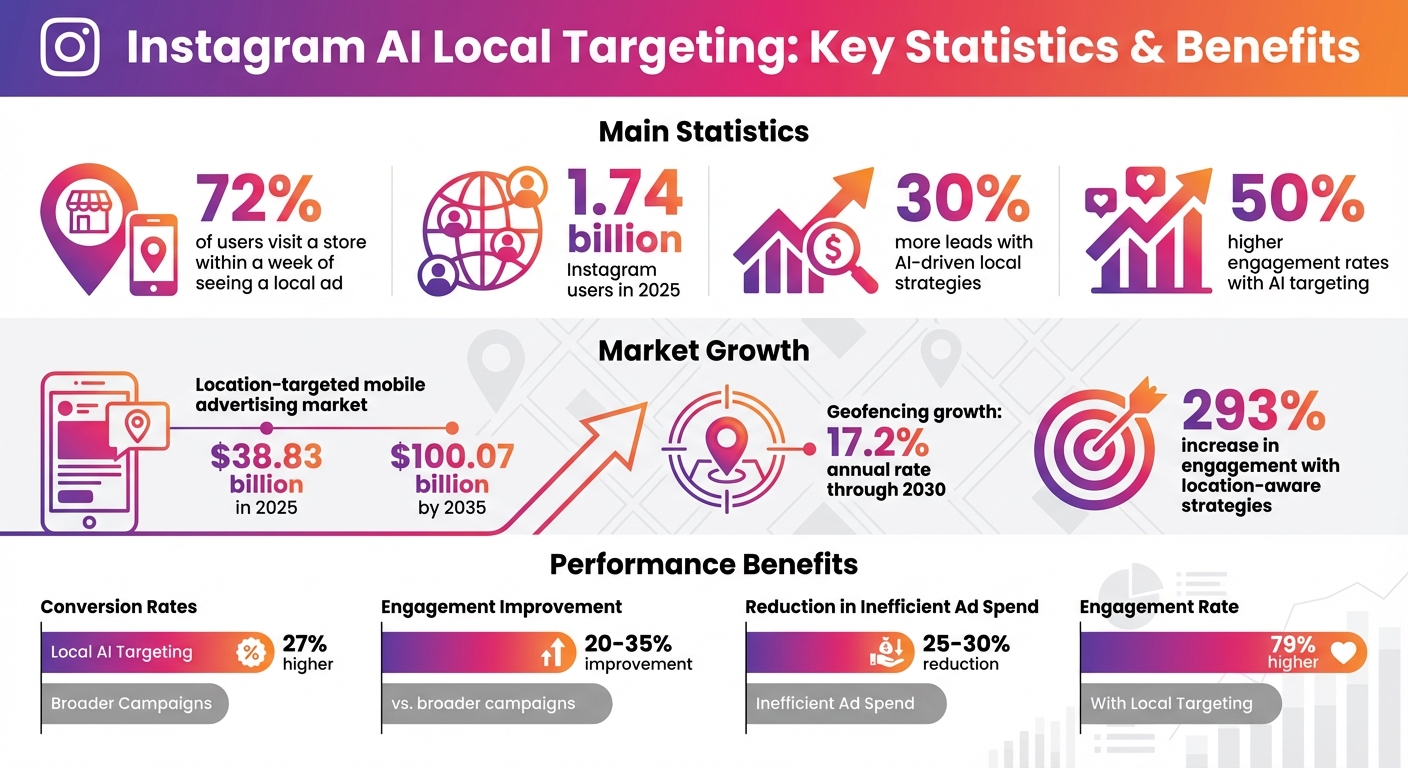
Instagram AI Local Targeting Statistics and Benefits 2025
AI has taken local targeting on Instagram to a whole new level by analyzing more than just ZIP codes. Modern algorithms dig into audience behavior, such as movement patterns, visit frequency, and even walking speed, to pinpoint the best moments to deliver content. For instance, someone casually browsing shops receives different messaging than a commuter rushing to grab coffee.
AI also factors in device performance, ensuring users on older phones or slower connections get lighter, faster-loading content to keep them engaged. This level of detail allows for highly accurate audience segmentation, which has reshaped advertising strategies.
"In 2026, 'local' acts more like a rhythm than a location." - USpaceNetwork
This refined targeting is transforming results. The global location-targeted mobile advertising market is expected to grow from $38.83 billion in 2025 to $100.07 billion by 2035. Geofencing alone is projected to see a 17.2% annual growth rate through 2030. Campaigns using location-aware strategies see a 293% increase in engagement compared to generic messaging.
AI uses a mix of data to identify and connect with local audiences. By analyzing consistent Name, Address, and Phone (NAP) data alongside GPS coordinates, it verifies legitimate business locations. Behavioral segmentation builds profiles based on past location data, grouping users like coffee shop regulars or frequent flyers - even if they’re not currently at those spots.
Lookalike modeling takes this a step further by creating "Local Lookalike Audiences." This technique identifies new users in a specific area who share traits with existing customers. For example, a gym in Austin, Texas, could target people within a 10-mile radius who visit fitness centers, engage with health-related content, or shop for workout gear.
Geofencing adds another layer by triggering actions when users enter a virtual boundary around a specific location. This isn’t just about proximity - it’s about matching intent. Generative AI processes structured data like LocalBusiness schema and on-page content to connect businesses with users searching for specific services, such as a "24/7 emergency plumber in Dallas". Timing also matters: someone searching at 2:00 a.m. has different needs than someone browsing at noon.
Real-world examples highlight the impact. Pita Pit ran a BOGO campaign targeting a 2-mile radius around stores, generating over 367,000 ad views and significant in-store redemptions. Similarly, Shorter University used program-specific Instagram ads within a 150-mile radius of its campus, leading to 115 qualifying leads and a 17% increase in enrollments. These strategies help businesses connect with high-intent local audiences, driving Instagram growth. This is a critical step for brands looking to grow a new Instagram audience from scratch.
AI doesn’t stop at location - it fine-tunes content delivery by layering demographic and contextual filters. For instance, a fitness studio could target women aged 25–40 within a 5-mile radius who speak English and follow yoga influencers. This level of precision creates hyper-targeted audience segments.
The Miami Tourism Board combined geofencing with customized video content for different traveler profiles, delivering ads when travelers arrived at airports. This approach resulted in 73 high-quality leads and 1,085 landing page visits.
AI also personalizes creative elements using local context. Instead of generic messaging, ads can feature local landmarks, neighborhood names, or even regional slang. For example, a coffee shop in Brooklyn might reference Prospect Park in its ads, while targeting Manhattan residents with mentions of local subway stations.
Language targeting ensures content resonates with diverse audiences. In multilingual cities like Los Angeles or Houston, AI can deliver Spanish-language ads to Hispanic audiences and English ads to others within the same area. This turns local targeting into a more personalized and culturally aware experience.
AI's formula for success in 2026 combines Location + Context + Timing + Behavior + Sentiment. These filters help businesses refine their audience, reducing wasted impressions and focusing on high-converting neighborhoods. For example, businesses can exclude ZIP codes with low performance and allocate budgets to areas that drive results. This precision ensures every ad impression reaches the right local audience, boosting Instagram growth and engagement.
Local AI targeting delivers results you can measure. Businesses using this approach report up to 27% higher conversion rates, while geotargeting improves engagement by 20–35% compared to broader campaigns. Why does this work? When content speaks directly to someone's surroundings, it grabs their attention. And this attention pays off - 72% of users who see a local business ad visit the physical store within a week.
It’s also a smarter way to spend your ad budget. Geographic targeting helps businesses cut inefficient ad spend by 25–30%, focusing only on high-intent, local audiences rather than wasting impressions on users who are unlikely to engage. Instead of casting a wide net, AI ensures your resources go where they matter most.
People connect better with content that feels personal to their location. For example, a boutique in New York City ran Instagram Story ads targeting users within a 3-mile radius and referenced a nearby street fair. The result? A 22% increase in physical store visits compared to the previous month.
Platforms like Instagram reward this kind of local relevance. Their algorithms use geotags, engagement patterns from nearby accounts, and city-specific keywords to determine what content resonates in a region. When businesses create what experts call "local density" - a concentrated group of engaged followers in one area - their content gets shown to similar users nearby. A neighborhood salon saw this in action by optimizing its profile with city-specific keywords and AI-driven local content. Within just 35 days, their target city jumped from the #6 to the #2 spot in audience insights, average save rates climbed from 1.9% to 5.4%, and DMs for bookings increased by 63%.
"The algorithm doesn't think in 'follower count.' It thinks in relevance. Build tight, real clusters of local engagement and your content gets algorithmic distribution you can't buy." - BulkyFans
Optimized local profiles also convert better. Businesses with strong local profiles achieve a profile-visit-to-follow conversion rate of 25% to 40%, far higher than accounts with scattered geographic audiences. Why? Because local content eliminates the "not available in my area" friction that often causes users to lose interest. This kind of engagement not only boosts followers but also lays the groundwork for better conversion rates.
The benefits of local relevance don’t stop at engagement - they extend to conversions, too. Take FitLife Gym, for example. By combining a 10-mile radius targeting strategy with interest-based filters and local video promotions, they achieved a 50% increase in engagement and a 40% rise in new memberships. The secret? Aligning location with user intent - targeting those who lived nearby and were already interested in fitness.
A local car wash in Los Angeles used a similar strategy, focusing on a 3-mile radius and featuring images of local landmarks alongside an offer for free pick-up services. Over five months, this campaign delivered a steady 30% monthly lead increase. The key was messaging that felt personal and relevant, rather than generic.
"Local ads win because they reduce the biggest conversion killer: irrelevance." - Putta Srujan, AdSpyder
Consumer habits back this up. 84% of people search for local businesses daily, and 71% expect personalized content. For local businesses, "personalized" often means geographically relevant details. Meeting these expectations pays off - customers are 2.7 times more likely to view a business as reputable when it has a complete, locally optimized profile. This boost in reputation, combined with AI's ability to target high-intent users, creates a powerful cycle that drives both online engagement and real-world results.
UpGrow combines patented AI technology with expert insights to deliver hyper-focused, location-specific audience growth. This approach has helped over 55,000 Instagram users grow their followings organically, earning an impressive 4.98/5 rating from more than 58,000 reviews. Unlike one-size-fits-all growth tools, UpGrow’s AI hones in on local users who are genuinely interested in your niche, offering a smarter way to expand your reach.
With UpGrow, you can set detailed filters for location, age, gender, language, interests, and hashtags. For example, a yoga studio in Austin could target users within a 10-mile radius who engage with wellness content and follow local fitness influencers. The AI works tirelessly to engage with active users that match these criteria, ensuring your efforts are both precise and effective. If you’re exploring new markets, the AI Smart Search tool provides access to over 300 million verified creator profiles across more than 195 countries, making it easy to find and collaborate with local influencers for region-specific campaigns.
The Boost™ tool takes things up a notch by using pattern recognition to maximize engagement during peak activity hours. Early users reported a 275% increase in monthly followers thanks to the AI’s ability to identify when local audiences are most active and amplify content at just the right moments. The tool also sends real-time alerts when your content shows signs of going viral, triggering automated boosts to extend its reach. This feature is particularly valuable for local businesses running time-sensitive promotions, ensuring their content gets noticed when it matters most.
UpGrow doesn’t stop at targeting and engagement - it also provides in-depth analytics to fine-tune your campaigns. The live dashboard delivers real-time insights into follower growth, engagement rates, and audience demographics, along with detailed PDF reports that break down performance by location. Beyond standard metrics, the analytics identify behavioral patterns, such as which local users frequently save your posts or engage with similar creators in your niche. This data helps businesses refine their strategies, adjusting filters to focus on what’s driving real results. Plus, UpGrow integrates seamlessly with platforms like Hootsuite, Buffer, Shopify, and WooCommerce, allowing you to track how Instagram activity translates into website visits and sales within specific geographic areas.
When it comes to targeting strategies, the choice between local and broad approaches often boils down to where your business generates its revenue. For businesses that thrive on foot traffic - like restaurants, gyms, or salons - local targeting tends to deliver more focused results, leading to higher intent and quicker conversions.
On the other hand, broad targeting works better for businesses aiming to build global brand awareness or for e-commerce brands that aren’t tied to a specific location. If you're selling digital products or shipping internationally, reaching a wider audience makes sense. However, for local businesses, broad targeting can rack up costs by displaying ads to people who are unlikely to visit your physical location. For example, a car wash in Los Angeles switched to targeting a 3-mile radius in 2024 and saw a 30% monthly increase in leads over five months.
"If you're running a local business... broad targeting is expensive noise. The fastest way to improve performance is to make your ads feel 'made for here.'" (perhaps by creating a custom location) – Putta Srujan, AdSpyder
Platforms like Instagram reward local density, meaning a high concentration of followers in a specific area. By fostering clusters of local engagement, the algorithm identifies your content as relevant to the region and promotes it to other nearby users organically. Broad targeting, however, can dilute this effect by scattering engagement across larger, less focused areas.
| Feature | Local Targeting | Broad Targeting |
|---|---|---|
| Primary Goal | Foot traffic, local leads, conversions | Brand awareness, global reach |
| Engagement Rate | High (79% higher on average) | Moderate to low (often diluted) |
| Acquisition Cost | Lower (efficient spend on high-intent users) | Higher (risk of wasted impressions) |
| Retention | High (builds local community density) | Lower (followers may lack local relevance) |
| Creative Strategy | Local landmarks, slang, regional offers | Generic messaging, global trends |
| Ideal For | Restaurants, gyms, salons, local clinics | E-commerce, SaaS, global consumer brands |
Understanding these differences highlights why your targeting strategy should align with your business goals. Next, we’ll dive into best practices for leveraging local AI targeting effectively.
To make the most of AI's targeting capabilities for local campaigns, it's essential to follow some proven strategies. Start by defining a 1–10 mile radius around your business in Meta Ads Manager. Then, refine your targeting by choosing the right location behavior. For instance, select "living in" for services like gyms or salons, or "recently in" for businesses aimed at tourists.
The real advantage comes from combining location with interest and demographic filters. Take this example: in 2024, a local car wash implemented a 3-mile radius strategy, focusing on serviceable neighborhoods. The result? A 30% monthly increase in leads over five months. Additionally, use the "Exclude Location" feature to avoid spending your budget on areas outside your service range. From there, you can fine-tune your audience with custom layers tailored to your local market.
Custom audiences allow you to turn broad location targeting into a more precise strategy. Start by uploading CRM data or website visitor information via Meta Pixel to create a base audience. Next, build lookalike audiences limited to your geographic area to find new users who resemble your best local customers.
To refine further, layer your audiences with filters like age, gender, language, and interests. For example, targeting "gym enthusiasts" within a 10-mile radius is far more effective than casting a wide net. A great case study comes from Shorter University in 2024. By targeting a 150-mile radius with program-specific ads, they generated 115 qualified leads and boosted student enrollment by 17%.
For businesses targeting specific income groups or lifestyle clusters, ZIP or postal code targeting can offer neighborhood-level precision. Once your custom audiences are set, keep a close eye on real-time analytics to ensure your strategy is on track.
Live dashboards are invaluable for identifying which neighborhoods are converting and which are just generating impressions. Pay attention to your click-through rate (CTR) for each neighborhood - low CTR often indicates weak messaging or poor targeting. If leads are coming from the wrong areas, narrow your geo-clusters and use exclusions to refine your reach.
Check Instagram Insights regularly, especially the "Top Cities" metric. Your target city should rank in the top three audience locations within 60 days. If it doesn’t, you may be attracting the wrong followers or your content may lack local relevance. For example, the Miami Tourism Board used geofencing around airports and tourist hotspots in 2024, tracking performance in real-time. Their efforts generated 73 high-quality leads and 1,085 landing page visits.
Finally, use offline event tracking tools from Meta to link digital ad performance with actual foot traffic. This data helps you understand which campaigns drive real-world visits, not just online engagement. Combining engagement and retargeting strategies has been shown to deliver up to 45% higher return on ad spend for local businesses. By monitoring zone-specific conversion data daily, you can ensure your campaigns are hitting the mark.
Metrics take the guesswork out of local growth strategies, giving you clear insights into what's working. For local AI targeting, local density is a key metric - it measures how concentrated your followers and engagers are in your target area. A higher local density signals Instagram's algorithm to push your content to more nearby users organically.
To track this, check the "Top Cities" section in Instagram Insights every week. Ideally, your target city should rank in the top three within 30 to 60 days. If it doesn’t, your audience may be too spread out to deliver strong local results. For example, a neighborhood salon with 1,800 followers optimized its profile with city-specific keywords and posted Reels featuring local landmarks. Within 35 days, their target city jumped from #6 to #2 in Insights. Their save rate climbed from 1.9% to 5.4%, and booking inquiries via DM increased by 63%.
Beyond follower numbers, interaction depth is crucial. Track metrics like saves, shares, and direct messages from local users - these show genuine local interest. For Reels, aim for a save rate of 4% to 8% and a share rate between 1% and 3% of total viewers. Interactive Story stickers, like polls or question boxes, should generate a reply rate of 3% to 10% to confirm you're connecting with your local audience. These metrics help refine your local strategy.
AI can help target local audiences effectively, but you need to monitor how well your optimized profile converts visitors into loyal followers. If you've optimized with city-specific keywords, you should see a conversion rate of 25%–40% from profile visits to followers. This shows that a smaller, locally focused audience can drive higher engagement.
Track geo-zone conversions by measuring click-through rates (CTR) and cost per click (CPC) for specific neighborhoods or ZIP codes. For instance, Pita Pit used a 2-mile radius targeting strategy and lookalike audiences to promote a BOGO deal. The result? Over 367,000 ad views and high in-store redemption rates. Focus your efforts on areas with strong conversion rates and exclude zones that underperform.
While conversion rates are important, overall engagement offers a broader view of how effective your content is, which is why following proven Instagram growth tips is essential for long-term reach.
Engagement rate is calculated as:
(Total Interactions / Total Impressions) × 100.
On Instagram, the average engagement rate is about 2.88%. However, local businesses with under 10,000 followers should aim higher - between 3.5% and 8%.
"The algorithm doesn't think in 'follower count.' It thinks in relevance. Build tight, real clusters of local engagement and your content gets algorithmic distribution you can't buy." - BulkyFans
For physical businesses, offline event tracking through Meta can connect your digital ad performance to actual foot traffic. This is especially important since a majority of users visit physical stores within a week of engaging online. Offline tracking helps you measure how well your digital efforts drive in-person visits. Additionally, track the percentage of leads coming from within your service area versus "wrong-location" leads to ensure your targeting remains precise.
AI-powered local targeting transforms Instagram growth into a precise and effective strategy. Instead of casting a wide net, AI uses location data, behavioral insights, and real-time context to connect you with followers who genuinely care about your content.
"In 2026, 'local' acts more like a rhythm than a location".
This technology doesn’t just map coordinates - it identifies the perfect moments when users are most likely to engage, tailoring messages to fit local nuances. It can even pinpoint critical decision-making windows as short as 20 minutes. By integrating these advanced techniques, local relevance becomes the backbone of Instagram growth, turning the platform into a direct channel for driving foot traffic and fostering community connections.
UpGrow harnesses this precision with its cutting-edge tools, delivering dependable results since 2016. With location targeting in over 195 countries, access to 300 million verified creator profiles, and Smart AI-Targeting that filters by location, age, gender, and language, UpGrow eliminates the guesswork from local campaigns. Their Boost™ tool accelerates follower growth, while real-time analytics provide insights to refine your strategy - all without risking shadowbans or fake followers.
Whether you're a local business aiming to engage nearby users or a restaurant looking to attract diners in your area, UpGrow’s data-driven approach delivers proven outcomes. With an impressive 4.98/5-star rating from over 58,000 reviews and plans starting at just $39/month, their growth guarantee ensures that hyper-local targeting can turn your Instagram presence into tangible, measurable results.
When targeting users near your location, it’s smart to focus on a small, specific area within about 5 miles. This approach helps you connect with people who are most likely to engage with your business. Start by identifying how close your ideal customer typically is, then fine-tune the radius based on how your campaign performs.
If you notice low costs and strong results, you can slowly expand the area to reach more people. On the flip side, if performance isn’t meeting expectations, narrowing the radius can help ensure your ads are seen by the most relevant audience. Keep a close eye on your metrics and adjust as needed to get the best return on your investment.
To measure real ROI from Instagram using AI-powered targeting, focus on metrics that connect directly to engagement and conversions in your local area. Look at key indicators like foot traffic growth, local interactions (such as likes, comments, and shares), and location-specific conversions like store visits or phone calls.
Leverage tools to track audience growth in your target regions, monitor responses to geotags, and analyze the performance of localized ads. When you combine these insights with conversion data, you’ll get a clear understanding of how Instagram impacts your bottom line.
UpGrow leverages AI-driven geo-targeting and smart location-based strategies to help expand your local Instagram audience in a safe and effective way. By honing in on specific regions, connecting with local influencers, and adhering to privacy guidelines, it prioritizes organic growth. These methods boost local interaction and attract genuine followers who are truly engaged.


