
How Food Creators Price CPG Brand Partnerships
Price CPG deals by scope, not follower count; itemize production, posting, usage rights and exclusivity.
Price CPG deals by scope, not follower count; itemize production, posting, usage rights and exclusivity.
4.98 /5 - from 58k reviews
Trusted by 50,000+ creators — get real engagement delivered to your profile in minutes, not days.

Most food creators underprice CPG deals when they quote from follower count alone. I’d price these partnerships by scope first: the asset, the work behind it, the rights, and any exclusivity. That matters because a recipe Reel with testing, styling, filming, and edits is not the same job as a three-frame Story mention.
Here’s the short version:
One stat stands out: content with usage rights averaged 39% more than content without them - $307 vs. $221. That’s a plain reminder that licensing is a separate paid item, not something to throw in.
If I were setting a rate, I’d start with the workload, back it up with recent Instagram data, add any hard costs like ingredients or props, and then list every extra right on its own line. That keeps the quote simple, clear, and much harder to undercut.
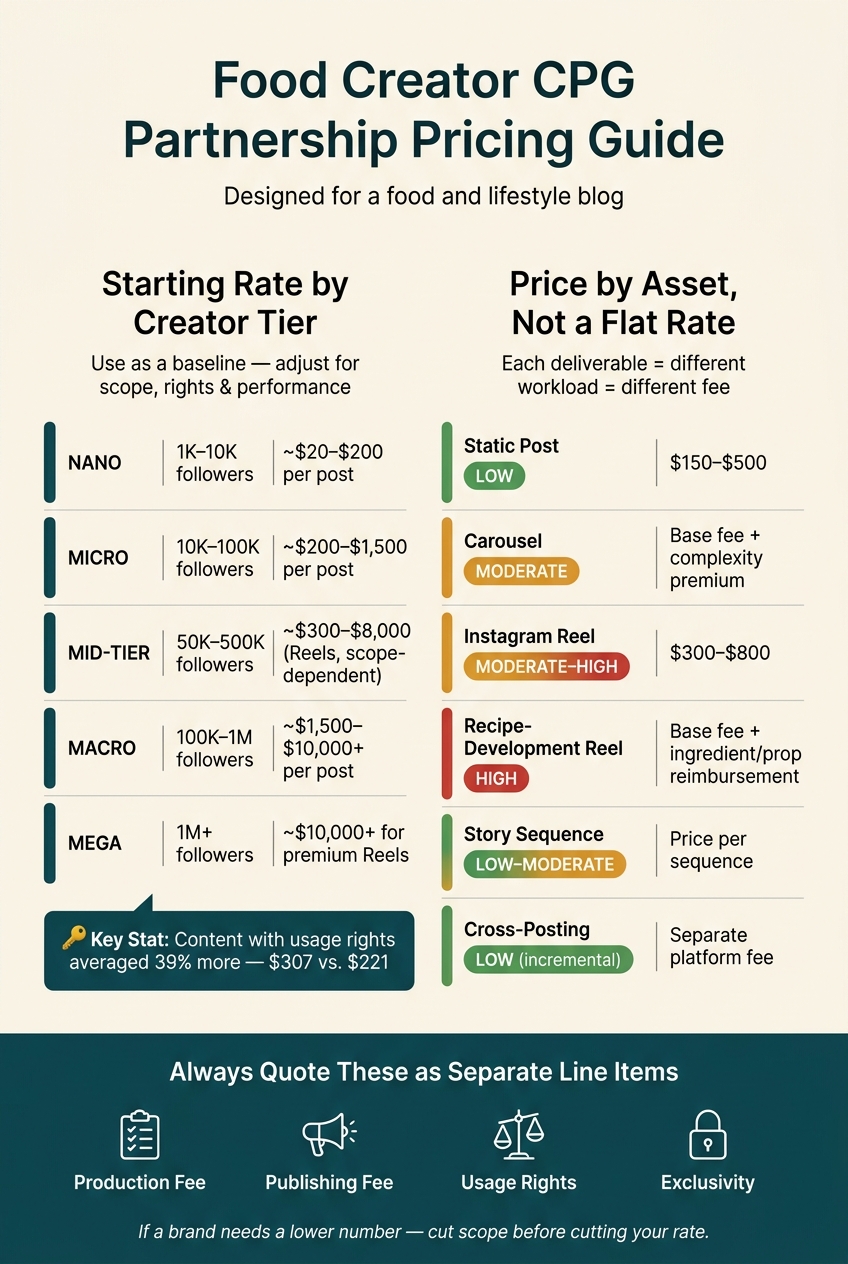
Food Creator Pricing Tiers: CPG Brand Partnership Rate Guide
Before you put a price on anything, write down exactly what the brand wants. That step turns a fuzzy inquiry into a quote you can actually use. The same Reel can mean very different workloads. One project might involve building a recipe from scratch, buying ingredients, styling the food, filming, and editing. Another might use brand-supplied product and need far less production work. Scope comes first. Pricing comes after.
Be specific about each asset. “One Instagram post” is too vague to mean much. Spell it out instead: one 45-second Reel, a three-frame Story set, and 10 edited stills for brand use. Each one takes its own planning, filming, editing, and publishing time.
Then break out the production tasks under those assets. Recipe testing, ingredient purchases, styling, props, filming, editing, and copywriting are all billable. If the brand is sending product, confirm how much they're sending and when it will arrive. If you're buying ingredients yourself, that cost should appear in the quote either as a clearly labeled reimbursable expense or inside a production fee. For example: $1,200 creative production fee + $85 ingredient and prop reimbursement, receipts provided. If it costs you time or money, it belongs in the quote.
Get the full brief before you quote. You need all of it: required tags, hashtags, link stickers, CTAs, on-screen text, and disclosures. Some food brands also need certain product claims, such as nutrition, allergen, or performance language, to go through brand or legal approval before filming starts.
A 48–72-hour review window works well, along with a set revision limit, often two to three rounds, plus a clear fee for anything beyond that. Holiday and seasonal campaigns can get tight fast. If a brand wants testing, filming, and delivery packed into a short, high-demand window, adding a 25% rush premium for delivery in fewer than seven calendar days is reasonable, as long as the turnaround and premium are agreed to ahead of time.
Once the scope is set, you can price based on audience quality and deliverable type.
Base partnership fee = creative production + publishing + included revisions
Everything else should be listed on its own line item: organic reposting on the brand's channels, website placement, paid advertising, whitelisting, raw footage, and exclusivity. Use this scope sheet to set the base fee, then adjust for audience fit, rights, and exclusivity.
Follower count helps you place yourself in a pricing tier. But it should not decide the full quote on its own.
A creator with 18,000 highly relevant U.S. followers and steady Reel performance can often charge more than someone with 40,000 followers who rarely gets views, comments, or saves. That gap matters. Brands don't just pay for audience size. They pay for the odds that the right people will notice the post and act on it.
Before you send a quote, check Instagram Insights from your last 8–12 similar posts. Look at median Reel views, Story views, saves, shares, comments, profile visits, and link clicks. Use the median, not the average. If one Reel took off, treat that as bonus upside, not your normal baseline.
If your results keep landing above what creators in your tier usually see, that can support a premium of about 20%–50% over the standard tier rate.
Use the ranges below as starting points only. Final quotes shift based on scope, rights, and audience quality.
| Creator tier | Follower range | Starting rate range (USD) | Why a quote may move |
|---|---|---|---|
| Nano | 1,000–10,000 | ~$20–$200 per standard post | Strong saves or specialty expertise |
| Micro | 10,000–100,000 | ~$200–$1,500 per standard post | Strong median Reel views, U.S.-based followers, tightly matched food niche |
| Mid-tier | ~50,000–500,000 | ~$300–$8,000 for Reels, depending on scope | Original recipes, proven conversions, usage rights, or exclusivity |
| Macro | 100,000–1 million | ~$1,500–$10,000 per standard post; often $2,500–$10,000+ for larger integrations | Broad U.S. reach, strong brand safety, multi-asset packages |
| Mega | 1 million+ | Often $10,000+ for premium Reels or major integrations | Reach, talent demand, production, licensing, and campaign complexity |
Once you know your tier, adjust from there based on fit and buying intent.
A smaller audience that lines up well with the product can be worth more than a bigger, general audience. That's especially true in CPG.
Family-meal creators make sense for pantry staples and frozen foods. Baking creators fit flour, chocolate, and extracts. Meal-prep creators pair well with packaged proteins, grains, and sauces. Allergy-friendly and specialty-diet creators can carry real weight when a product has diet-specific claims.
That extra fee should come from proof, not guesswork. Strong saves, buy-now comments, and past coupon-code use can show purchase intent. For grocery and packaged-food campaigns, save rate can be a useful signal because when someone saves a recipe, they're often planning to cook it later and shop for the ingredients. Audience location also matters. If a retail brand sells in the United States, U.S.-based followers usually matter more than a larger overseas audience.
Then comes the next step: price the asset itself, not your account as one flat product.
A static product shot and a recipe Reel are two very different jobs.
One may need styling, one image, a caption, and a single revision. The other can include concept work, recipe testing, grocery runs, cooking, food styling, filming, editing, captions, audio, and back-and-forth review rounds. If you charge the same flat rate for both, you're likely underpricing the heavier lift.
Industry references put food-and-beverage micro-creator feed posts around $150–$500 and Reels around $300–$800, though quotes still change based on scope and rights.
| Asset type | Production workload | Items to define upfront | Pricing treatment |
|---|---|---|---|
| Static post | Low to moderate | Product styling, one image, caption, tagging, one revision | Base asset fee; add production expenses or extra revisions separately |
| Carousel | Moderate | Multiple images or slides, copy, graphic treatment, accessibility text | Base fee plus complexity premium |
| Instagram Reel | Moderate to high | Concept, filming, editing, captions, audio, product integration, one or two revisions | Base fee plus complexity premium |
| Recipe-development Reel | High | Original recipe ideation, testing, ingredients, food styling, filming, editing, final recipe details | Base fee plus ingredient and prop reimbursement |
| Story sequence | Low to moderate | Number of frames, links, stickers, talking points, live posting, screenshots of metrics | Price per sequence; add fees for link tracking or multiple CTAs |
| Cross-posting | Low incremental workload, added distribution value | Adaptation and publication on TikTok, Facebook, or Pinterest | Separate platform fee; never assume it is included |
| Reporting | Low to moderate | Reach, views, clicks, saves, shares, and audience response | Include basic reporting only if defined; charge separately for custom analysis |
A simple way to handle this is to set a base asset rate, then add ingredient reimbursement, usage rights, and exclusivity as separate line items. After that, build your package from those asset rates and discount only the bundle, not each line item.
Once you set the asset price, price the rights attached to it too.
Treat the content, the post, and the license as three separate things. Creation pays for making the asset. Posting pays for publishing it on your feed. Usage pays for reuse somewhere else. In plain English, that means permission to use the asset off your feed. Define those rights before you send a quote.
| Right type | What it permits | Typical term to negotiate | Separate fee? |
|---|---|---|---|
| Organic reposting | Brand reposts the published content on its owned social accounts | 30–90 days | Sometimes included for limited reposting; charge separately for extended use |
| Paid brand advertising | Brand runs the asset from its own advertising account | 30–90 days per flight | Yes; roughly 20%–50% of the base fee for limited terms, 50%–100% for longer terms |
| Whitelisting | Brand runs paid ads through your account | 30 days per flight, renewable | Yes; benchmarks commonly range from about $250 to $1,500 per month |
| Website or email use | Brand displays the content on its website, landing pages, or email marketing | 3–12 months | Yes |
| Retail or product-page use | Brand uses the asset on e-commerce listings, retailer pages, packaging support, or sales materials | 3–12 months or a defined campaign period | Yes |
| Perpetual commercial use | Brand may use the content indefinitely across broad media | Avoid by default; if accepted, define media and territory precisely | Yes - quote a separate commercial buyout |
For every license, spell out the channel, what the brand can do, how long it can do it, the territory, editing rights, and whether the brand can sublicense the content.
Here’s what that can look like in practice: one recipe video and one story set for $2,000, with organic publication included; brand-owned social use for 90 days at $500; and paid advertising rights for 30 days at $750. That setup stops a brand from treating a one-time post like it comes with unlimited commercial use. Industry guidance often puts limited usage at about 20%–50% of the base fee, while broader or longer-term use can land at 50%–100% or more.
Whitelisting should always sit on its own line item. When a brand advertises through your account and identity, that brings a different level of value and risk.
Next comes the cost of keeping competitors out.
Vague exclusivity is where deals can go sideways. “No competing food brands” sounds simple, but it’s far too broad. A tighter restriction works better, like no sponsored posts for refrigerated plant-based dips or spreads from Brand X or Brand Y for 30 days after the final post. That’s specific, easier to price, and easier to enforce. A blanket food exclusivity clause could shut you out of income from snacks, beverages, cookware, meal kits, supplements, or grocery retailers.
When you price exclusivity, look at three things:
Benchmarks vary, but a fair starting point is roughly 5%–25% above the base fee for a 30-day narrow-category restriction, 25%–50% for 90 days, and 30%–100% or more for six to 12 months depending on how broad the category is. So you might quote 30-day narrow-category exclusivity at +10%, or 90-day exclusivity across snacks and nearby refrigerated foods at +40%.
Also, spell out the look-back period before the campaign starts and the tail period after the last post. That detail matters. A 30-day post-campaign blackout can block a competing deal that was already in the pipeline. That lost opportunity has a dollar amount attached to it.
Once rights are priced, you can turn the offer into something cleaner.
A simple three-tier rate card works well: standalone assets, bundles, and recurring partnerships.
Only discount the parts where you save time or effort. If you’re booking multiple shoots in one session, getting one creative direction approved, or working on a repeating schedule, there’s a real efficiency there. That’s fine to reflect in the price. But don’t roll usage or exclusivity into the bundle. If the bundle hides licensing, you’re cutting into future revenue.
Each bundle should clearly list the deliverables, publishing dates, recipe-testing allowance, revision rounds, included organic usage, paid-usage term, whitelisting fee, exclusivity fee, payment schedule, cancellation terms, and late-change fees.
For example, you might price a recipe video at $1,500, a story set at $400, and a still image at $300, plus 90-day brand-owned social use at $600, 30-day paid advertising at $375, and exclusivity at $300. The bundle price for the three content assets could be $2,000 instead of $2,200, with usage, paid advertising, and exclusivity still listed separately.
A rate card built this way also helps during renewal talks. When the license term ends, the brand either removes the content from the licensed placements or pays a new fee. Put renewal terms into every agreement.
Before you send a number to a CPG brand, look at your last 30–90 days of performance. Pull the data from Instagram Insights and your recent sponsored posts.
Keep the proof simple. Show your median Reel reach, save rate, and audience location. Use median Reel views, not averages, so one viral post doesn't throw off your rate.
If you have results from past sponsored posts, add two or three relevant examples. For each one, include the deliverable, date, reach or views, engagement actions, and clicks or conversions if you have them. You can also add a short note on what happened, like retailer interest or strong comment sentiment.
Once your numbers support the rate, make sure every paid element is listed on its own. Price usage rights and exclusivity separately, because each placement changes what the asset is worth.
| Quote element | What to verify |
|---|---|
| Creation fee | Covers concept, recipe testing, filming, editing, captions, and final files |
| Publishing fee | Each Reel, feed post, carousel, or Story sequence posted to your account |
| Named deliverables | Exact asset count, format, length, tags, links, mentions, and posting dates |
| Revision limit | Number of included rounds; fee for added changes |
| Expenses | Ingredients, props, travel, shipping, studio costs, or rush production |
| Paid-ad rights | Boosting, whitelisting, partnership ads, audience targeting, edits, and duration |
| Website or retail rights | Specific placements, duration, and territory |
| Exclusivity | Restricted product category, geographic market, start date, end date, and compensation |
| Payment terms | Deposit amount, invoice timing, net-15 or net-30, late-payment policy |
| Cancellation terms | Kill fee, reimbursement for nonrefundable expenses, payment for completed work |
Set a floor price based on labor, ingredients, travel, and licensing before you offer any discount. Do that math before the quote goes out, not after.
If the brand wants a lower price, cut scope before you cut the rate. A plain response can work well: at $1,500, the package includes one edited Reel, one Story set, one revision, and 30 days of organic brand use, with paid media, website placement, and category exclusivity quoted separately. That keeps the discussion tied to deliverables and rights, not vague back-and-forth.
Use the checklist above to support the quote line by line. A defensible quote spells out the exact deliverables, rights, costs, and terms - clear details are what help a rate card stand up in a negotiation.
Start with a follower-based baseline of $0.01–$0.03 per follower for a static feed post. Then adjust that number based on engagement rate, content quality, and niche fit.
Price each deliverable separately. A Reel, for example, can cost 1.5x–3x more than a single-photo post.
Don’t bundle usage rights into the base fee. Keep them as a separate line item. For instance, you might add 15%–25% for 30-day paid social usage. Put those same line items on your rate card too, so you don’t end up undercharging.
Charge usage rights as separate add-ons. Your base fee pays for making the content, not for a brand to reuse it in other ways.
So if a company wants permission to use your content beyond a standard organic post, charge more. That extra usage has its own price.
Typical add-ons include:
Be specific in your agreement. Spell out the channels, time period, and geographic limits. If those details are fuzzy, that's where problems usually start.
Charge price exclusivity as a separate add-on to your base fee, not as part of your content deliverables. If a client wants exclusivity, they’re paying for more than content - they’re paying for the work you can’t take from other brands.
A 30-day category exclusivity clause usually adds 20% to 35% to your base fee. A 90-day term often adds 50% to 75%.
Be specific about the terms:
If those details stay vague, the clause can drift far beyond what you meant to agree to.


