Branded Content Policies and FTC Rules Compared
Instagram’s Paid Partnership tag isn't enough — add clear #ad or #sponsored disclosures to meet FTC rules.
If you post sponsored content on Instagram, you need to follow two sets of rules: Instagram’s platform rules and the FTC’s legal rules. And yes - you can follow one and still fail the other.
Here’s the short version: Instagram wants you to use the Paid Partnership label when there is an exchange of value. The FTC wants you to make the ad relationship plain to people, often with clear wording like #ad or #sponsored. Using Instagram’s tag alone may not be enough.
If I had to boil the article down to a few points, it would be this:
-
Instagram and the FTC do different jobs
- Instagram enforces in-app labeling and ad setup rules
- The FTC enforces U.S. ad disclosure law
-
The trigger is not the same
- Instagram: usually an exchange of value
- FTC: any material connection, including pay, gifts, affiliate links, jobs, ownership, family ties, or close personal ties
-
Format matters
- Feed posts: disclosure should appear before the “more” cut
- Stories: disclosure should be on every sponsored frame
- Reels: use on-screen text, and spoken disclosure if needed
- Lives: disclose more than once
-
Some risk is platform-side, some is legal
- Instagram may reject ads, limit reach, or remove content
- The FTC may send warning letters, investigate, or seek civil penalties
-
Regulated topics need extra care
- Alcohol, supplements, financial products, and gaming may need manual age limits
- Those limits may need to be set again for the ad version
A fact that stands out: the FTC says the person posting the content is still responsible for making disclosures clear, even when a platform has its own disclosure tool. So the safe move is simple: use Instagram’s branded content tool and add a plain-language FTC disclosure when a material connection exists.
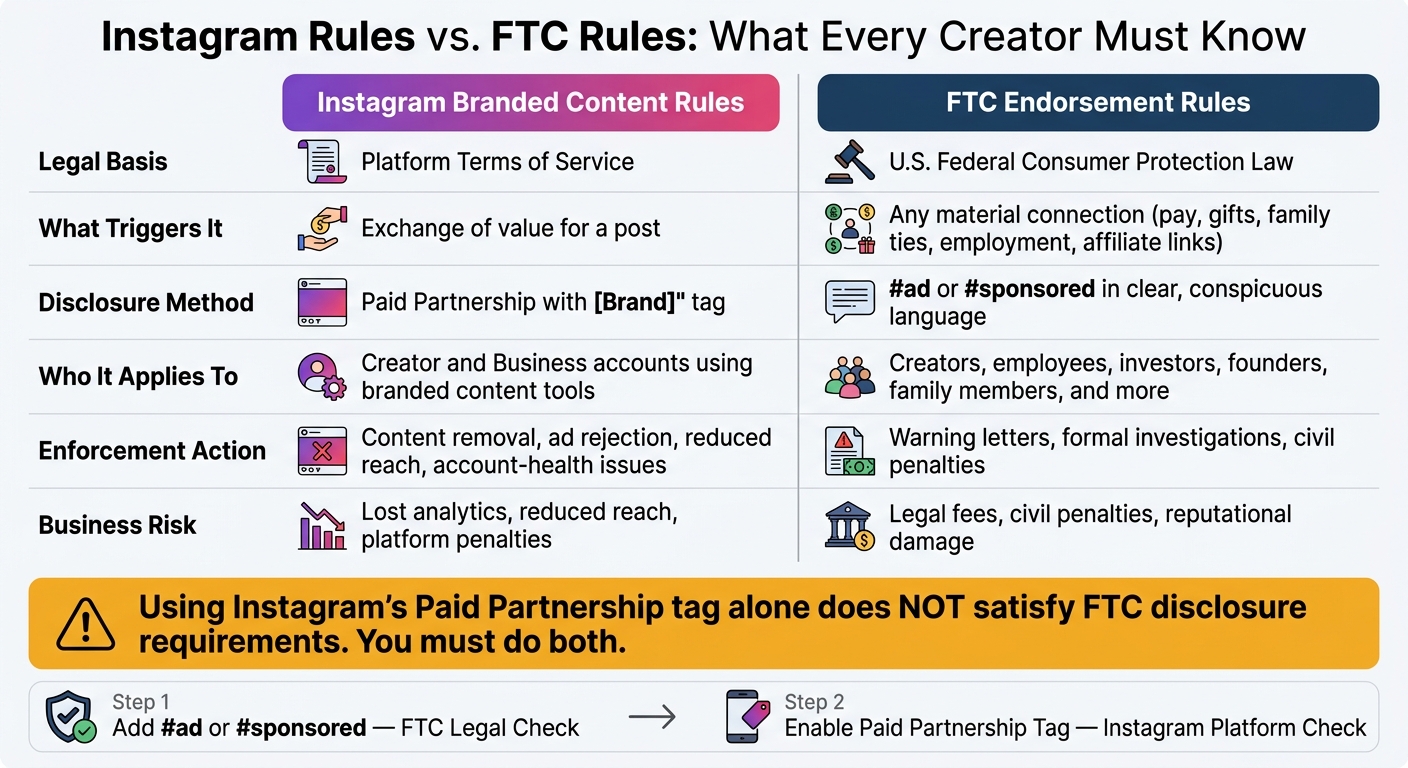
Instagram Branded Content Rules vs. FTC Endorsement Rules: Key Differences
HOW TO DISCLOSE A BRAND PARTNERSHIP AS A CREATOR | DO I NEED TO USE THE PAID PARTNERSHIP LABEL?
sbb-itb-3c55afb
Quick Comparison
| Check | Instagram Rules | FTC Rules |
|---|---|---|
| Main purpose | Platform labeling | Legal ad disclosure |
| What triggers it | Exchange of value | Material connection |
| Common disclosure | Paid Partnership tag | #ad or #sponsored |
| Who it can apply to | Creator/Business accounts using branded content tools | Creators, employees, founders, investors, family members, and more |
| Main risk | Content limits, ad rejection, reach loss | Warning letters, investigations, civil penalties |
I’d treat this as a two-step review: legal disclosure first, platform setup second. That’s the clearest way to cut down mistakes before anything goes live.
Instagram Branded Content Policies: What the Platform Requires
Instagram has its own rules for branded content, and they sit on top of FTC rules, not in place of them. If a creator or publisher gets cash or anything else of value from a business partner, Instagram says the platform’s native branded content tools must be used. That includes noncash compensation too. So the Instagram rule is about what the platform requires, while the FTC rule is a separate layer and reaches even more situations.
When Instagram Requires the Branded Content Tool
The Paid Partnership label is required, not optional. Instagram says creators and publishers must tag business partners with the native branded content tool whenever there’s an exchange of value. Also, only Creator and Business accounts can use this tool.
The tool can be used across:
- Feed posts
- Stories
- Reels
- Instagram Lives
Once a partner is tagged, that business can see insights. For Stories, those metrics stay available for 14 days.
Category Restrictions, Format Limits, and Partnership Ad Rules
Instagram doesn’t allow every kind of content to use branded content tools. The platform can limit or block monetization for posts tied to misinformation, graphic imagery, or repetitive static-image loops. In regulated categories like alcohol, supplements, financial products, and gaming, creators have to manually add audience restrictions and set a minimum age, such as 18+, before the post goes live.
If a brand wants to turn a creator’s post into a Branded Content Ad, there’s an extra step. The creator has to switch on Allow business partner to promote. After that, the brand must request ad creation access in Settings > Business > Branded Content.
One detail matters a lot here: age restrictions from the organic post do not automatically move over to the ad version. They have to be checked and set again at the ad set level.
| Instagram Requirement | Who It Applies To | Practical Impact for Marketers |
|---|---|---|
| Paid Partnership Label | Creator and Business accounts receiving value | Required for transparency and shared insights |
| Age-Gating (Manual) | Regulated categories (alcohol, supplements, financial products, gaming) | Helps keep content from reaching minors; must be re-set for Branded Content Ads |
| Manual Tag Approval | Business/brand accounts | Prevents unauthorized accounts from tagging the brand as a partner |
| No product catalog feeds | Branded Content Ads | Marketers must use manual image and video uploads; automated product catalogs are not supported |
These are Instagram’s platform rules only. FTC disclosure duties still apply on top of them.
FTC Endorsement Rules: What U.S. Law Requires
Instagram has its own in-app labeling rules. The FTC has the legal rules, and those rules apply whenever there’s a material connection, whether or not Instagram flags the post or the Paid Partnership label appears. In plain English, the legal issue isn’t whether Instagram shows a tag. It’s whether people can clearly tell they’re looking at an endorsement.
"When there exists a connection between the endorser and the seller of the advertised product that might materially affect the weight or credibility of the endorsement... such connection must be fully disclosed."
Material Connections That Must Be Disclosed
A material connection covers more than many marketers think. Money is the most obvious example, but it’s not the only one. Free products, gifted services, affiliate commissions, working for the brand, ownership or investor status, and family ties or close personal friendships can all count.
That also means non-cash compensation still counts. If someone got something of value, the FTC may still expect a disclosure. And this rule doesn’t expire after one sponsored post. If the relationship still exists, the disclosure should appear again. An older paid post does not cover a later unpaid one.
How Disclosures Should Appear on Posts, Reels, Stories, and Lives
The FTC says disclosures must be clear and conspicuous, which means people should be able to notice and understand them before they engage. The FTC also says not to lean on a platform’s built-in disclosure tool by itself:
"Don't assume that using a platform's disclosure tool is sufficient... The ultimate responsibility for making clear disclosures is yours."
Use #ad or #sponsored. Skip fuzzy labels like #sp, #spon, #collab, or #ambassador.
The rule stays the same across formats, but the placement shifts a bit:
| Content Format | Compliant Disclosure Placement | Common Mistakes to Avoid |
|---|---|---|
| Feed Posts | Within the first 3 lines of the caption, before the "...more" link | Burying #ad in a hashtag cloud or at the bottom of the caption |
| Stories | High-contrast text on every branded frame | Disclosing only on the first slide or relying solely on a verbal mention |
| Reels / Video | On-screen text overlay and a verbal disclosure | Relying on caption-only disclosure or low-visibility text placement |
| Instagram Live | Repeated spoken disclosures and a pinned comment or on-screen overlay | Disclosing only once at the start |
Next, compare where Instagram’s platform rules and FTC rules line up - and where they split.
Instagram Rules vs. FTC Rules: Where They Overlap and Where They Do Not
Instagram checks whether you used its built-in label. The FTC checks whether people can plainly tell there's a paid or connected relationship. That's the big divide.
So yes, a post can meet Instagram's labeling rule and still break FTC rules. In plain English: a platform tag isn't always enough. Sometimes a brand needs the Instagram label and a separate ad disclosure.
What One System Covers That the Other Does Not
The FTC looks at relationships that Instagram's branded content tool may not catch. Instagram's tool does not cover every material connection the FTC says must be disclosed. That can include employees, investors, and personal relationships, even when those ties do not fit neatly inside Instagram's tool.
The FTC also applies across formats and account types. If there's a material connection, it may need a disclosure, whether the post comes from a creator, employee, founder, or brand account.
Different Enforcement Paths and Business Risk
The enforcement paths are different, and that matters. Instagram can remove content, reject ads, or limit reach. The FTC can send warning letters, open formal investigations, and pursue civil penalties.
That means Instagram compliance does not satisfy FTC disclosure rules on its own. Brands need to use both sets of rules together in the checklist below.
| Feature | Instagram Branded Content Rules | FTC Endorsement Rules |
|---|---|---|
| Legal Basis | Platform terms of service | U.S. federal consumer protection law |
| Primary Trigger | Exchange of value for a post | Any material connection, including money, gifts, family, or employment |
| Disclosure Method | Paid partnership with [Brand] tag |
Clear and conspicuous language such as #ad or #sponsored |
| Scope of Relationships | Active brand/creator partnerships | Employees, investors, family members, and free products or gifts |
| Enforcement Path | Content removal, ad rejection, reach limits, or account-health issues | Warning letters, investigations, and civil penalties |
| Business Risk | Reduced reach, lost analytics, or account-health issues | Legal fees, civil penalties, and reputational damage |
A Unified Compliance Workflow for Marketers, Creators, and Agencies
Instagram and FTC compliance are two separate checks. You need to pass both before anything goes live.
The simplest way to handle it is to use one pre-post workflow that covers each side. Since the rules are split, your process should be split too: start with legal review, then finish the platform label and approval steps.
A Pre-Post Checklist That Satisfies Both Instagram and the FTC
This checklist lays out each step, the rule tied to it, and who should handle it.
| Step | Requirement | Review Owner |
|---|---|---|
| 1. Connection Audit | FTC: Identify any material connection - pay, gifts, services, or professional ties | Legal/Compliance Officer |
| 2. Written Disclosure | FTC: Add #ad or #sponsored before the "More" cutoff - not buried in hashtags |
Legal/Compliance Officer |
| 3. Platform Labeling | Instagram: Use the "Paid Partnership" label in Advanced Settings; approve the creator tag request in Branded Content settings | Creator / Brand Manager |
| 4. Claim Verification | Both: All product claims must be truthful, substantiated, and follow Community Guidelines | Brand / Legal |
A couple of points matter here.
- Treat gifted products and affiliate links as material connections and disclose them.
- For Stories, use visible on-screen disclosure on every frame.
Conclusion: Platform Compliance Is Not the Same as Legal Compliance
Instagram's rules cover platform labeling and partner approvals. The FTC's rules cover legally required disclosure under U.S. consumer protection law.
Using the Paid Partnership label satisfies Instagram. It does not automatically satisfy the FTC.
So split the work clearly. Platform steps should go to the creator or social media manager. Legal steps should go through a compliance officer. If both checks pass, publish.
FAQs
Do I need both the Paid Partnership tag and #ad?
Yes. Use both.
Instagram’s Paid Partnership label helps meet platform rules, but the FTC says platform tools alone may not be enough.
Add a clear text disclosure like #ad or #sponsored at the start of the caption, or place it on the image or video so people see it right away.
What counts as a material connection under FTC rules?
Under FTC rules, a material connection is any link between an endorser and a brand that could change how people see the endorsement, especially when that link isn't something the audience would normally expect.
That can include:
- Payments
- Free products or gifts
- Exchanged services
- Professional or personal ties
If you're not sure whether a connection counts, the FTC says it's best to disclose it.
Who is responsible if a disclosure is missing or unclear?
The FTC can hold both the influencer and the brand responsible when disclosures are missing or hard to understand.
That means influencers can't pass that legal duty off to brands or platforms. And brands aren't off the hook either. If someone is posting on a brand's behalf, the brand can still be held accountable for that content.
The FTC also expects brands to have a reasonable monitoring program in place to help make sure their partners follow endorsement guidelines.