
AI Caption Subscriptions: Monthly vs Credits
Compare monthly subscriptions vs credit billing for AI captions to choose the best fit for steady, bursty, or light posting.
Compare monthly subscriptions vs credit billing for AI captions to choose the best fit for steady, bursty, or light posting.
4.98 /5 - from 58k reviews
Trusted by 50,000+ creators — get real engagement delivered to your profile in minutes, not days.

If you post often, a monthly plan usually costs less. If you post off and on, credits usually waste less money. That’s the short answer.
I’d choose based on how often you post, budget control, rollover rules, and what happens when limits hit. The article points to a common split: monthly plans often start around $49/month, many entry tiers stay under $99/month, and some plans still cap AI captions at just 15 to 30 per month.
Here’s the simple breakdown:
The best option isn’t the cheapest sticker price. It’s the one that matches how you work month to month.
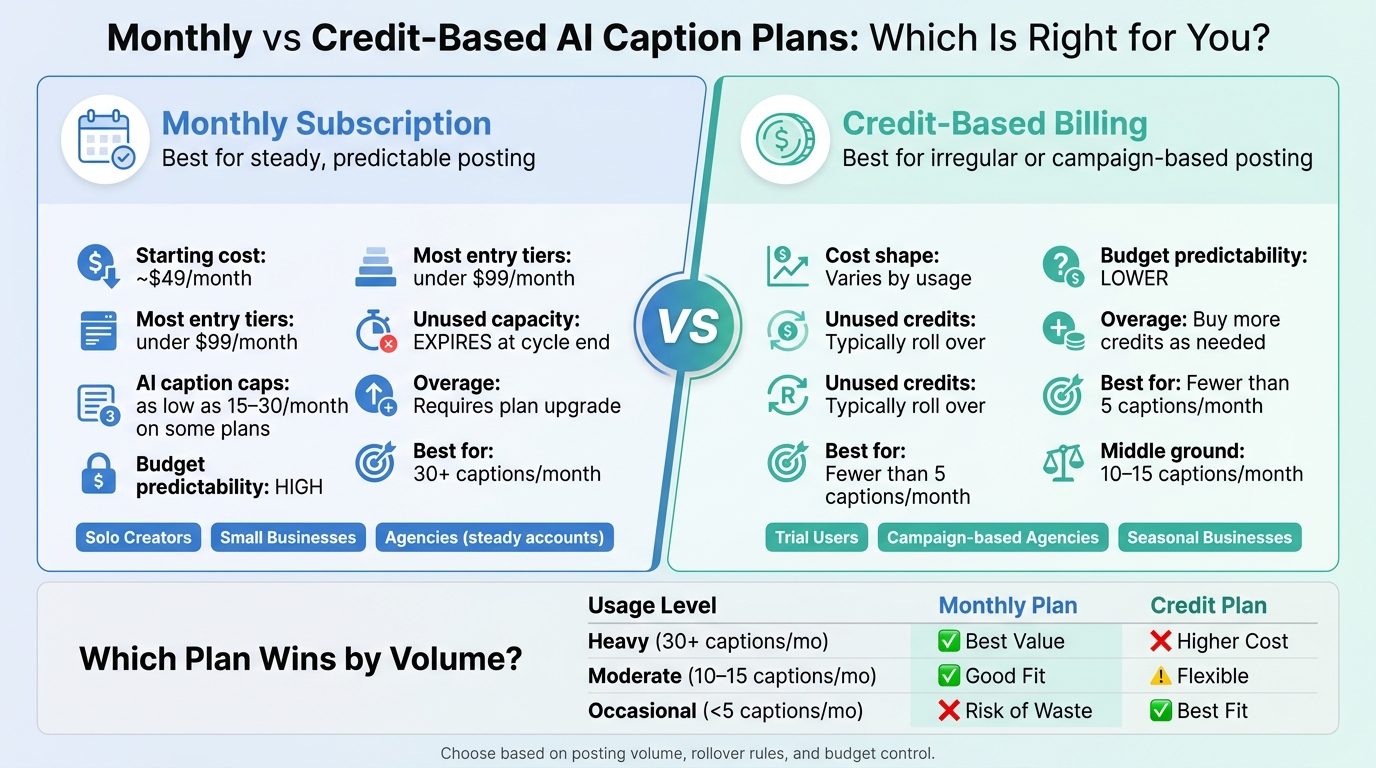
Monthly vs Credit-Based AI Caption Plans: Which Is Right for You?
| Criteria | Monthly Subscription | Credit-Based Billing |
|---|---|---|
| Best for | Steady posting | Irregular posting |
| Typical cost shape | Fixed monthly fee | Spend changes by usage |
| Budget predictability | High | Lower |
| Unused allowance | Often expires monthly | May roll over or stay until used |
| Heavy usage | Often lower cost per caption | Can get expensive |
| Light usage | Can mean paying for unused room | Usually lower spend |
| When you hit limits | May need a plan upgrade | Need to buy more credits |
| Best users | Solo creators, small businesses, some agencies | Trial users, campaign bursts, some agencies |
If I were deciding, I’d start with one question: Will I use this tool every week, or only when campaigns spike? That answer usually makes the choice clear. If you're still testing the waters, you can experiment with free AI tools before committing to a paid plan.
A monthly subscription gives you one fixed charge instead of surprise fees popping up halfway through the month. That makes your spend easier to forecast and your budget a lot easier to manage.
A flat monthly rate works best when your posting schedule stays pretty steady. You pay once, generate captions throughout the month, and do the same thing again next month.
The catch is simple: if you hit a slow month, take a vacation, or pause to shift products, you still pay the full rate even if usage drops. Entry-level plans usually start at about $49/month, and most tools put their starting tier below $99/month. But when posting volume goes up and down, credit-based billing can shift the math.
The bigger issue usually isn't the monthly fee. It's the limit hiding behind it.
"Unlimited" often doesn't mean unlimited in the plain-English sense. It usually comes with fair-use limits that can slow down or restrict heavy usage once you go past what the provider sees as normal use. On top of that, AI caption generation is often capped separately from the main service.
That matters because some higher-tier plans still limit AI-generated captions to 15 or 30 per month. Hit that cap, and the usual next step is upgrading to a higher tier.
Monthly plans tend to work best for:
If your usage jumps around from month to month, credit plans handle that pattern in a different way.
Credit-based billing means you pay when you use the tool. You buy credits as needed, which makes it easier to line up spend with actual activity. That works well for creators who batch content or post in short bursts instead of sticking to the same volume every week. When output swings from week to week, credits often make more sense.
A credit doesn’t mean the same thing in every tool. It might cover one caption request, one feature, or one token-based action. In some tools, one generation request can give you five distinct caption options.
That’s why the credit unit matters more than the headline price. A plan might look cheap at first glance, but the real cost comes down to what each credit actually buys you.
Some credit plans let you roll unused credits into the next billing period.
That sounds simple, but it can make a big difference. If your workload comes in waves, rollover rules can help smooth out spend from one month to the next.
Credit plans tend to work best for light or uneven usage. If you don’t generate captions often, credits may cost less than paying a monthly fee. Agencies can also do well with this setup during launch weeks, seasonal campaigns, and one-off content tests, since they can avoid paying for higher monthly capacity during slower periods.
There’s a catch, though: costs can climb fast if you generate captions often.
Credits also make sense for trial users and test campaigns. Pay-as-you-go pricing gives you room to check caption quality and see whether the workflow fits your team, without locking into the 1- to 3-month minimums that can come with higher-tier plans.
Next, compare how monthly and credit plans differ on cost, rollover, and overage risk.
The right billing model comes down to one thing: how often you generate captions. If you create them on a steady schedule, monthly plans usually make more sense. If your workload jumps around, credits are often the safer bet.
Put simply, monthly billing works best for steady posting. Credit-based billing works best when some months are busy and others are quiet.
If you generate captions on a regular basis, a monthly plan usually brings the lower cost per caption once volume goes up.
| Usage Level | Monthly Plan Fit | Credit-Based Fit |
|---|---|---|
| Heavy (30+ captions/mo) | Best value; lowest per-caption cost | Higher cost; no volume discount |
| Moderate (10–15 captions/mo) | Good fit for standard tiers | Flexible if your workload fluctuates |
| Occasional (fewer than 5/mo) | Risk of paying for unused capacity | Best fit; pay only when needed |
That sounds straightforward, but there’s a catch: the sticker price isn’t the whole story. Rollover rules can change what you end up paying.
Monthly allowances reset each billing cycle, and unused capacity expires. So if you only use part of what you paid for, the rest disappears when the cycle ends.
Credit balances usually stay available until you spend them, which gives you more room during slower months. That’s the upside. The downside is easy to see too: when work spikes, each extra use adds to the bill instead of falling under one flat fee.
| Feature | Monthly Subscription | Credit-Based Billing |
|---|---|---|
| Unused capacity | Expires at cycle end; no rollover | Typically remains until used |
| Cost predictability | High; fixed recurring fee | Lower; varies by usage |
| If you hit the limit | Extra use usually requires an upgrade | Requires additional top-ups |
| Underuse risk | High | Low |
So this isn’t just about price. It’s also about how much room you want in your budget and how often your workflow changes.
Solo creators who post on a steady rhythm often do well with a simple monthly plan. A fixed fee makes budgeting easier when captions are part of the weekly workflow.
Small businesses with set content calendars often get good use from mid-tier monthly plans, especially when those plans include features like AI profile optimization and competitor analysis.
Agencies managing more than one account often need tools built for client work, such as live analytics and easier account management across campaigns.
| User Type | Best Fit | Key Reason |
|---|---|---|
| Solo Creator | Monthly | Simple budgeting; consistent output |
| Small Business | Monthly | Predictable overhead; useful optimization features |
| Agency | Monthly or Credit | Multi-account flexibility; usage varies by campaign |
Monthly plans work best when you use ChatGPT for Instagram to create captions at a steady pace. Credit-based billing makes more sense when usage comes in waves or around specific campaigns.
Use these four questions to line up the billing model with your workload:
A monthly plan makes sense if you post on a steady schedule and need steady support, not just one-off help. It’s a strong fit for regular educational posts, product launches, or campaigns aimed at new demographics.
If you’re running A/B tests and need 1,000 to 5,000 impressions per variation over 7 to 30 days, a monthly plan gives you continued access to analytics and AI optimization.
Check whether unused credits expire at the end of each billing cycle or carry into the next month. Also confirm if there’s a limit on how many credits you can stack and how long carried-over credits stay usable.
Pay close attention to what happens if you downgrade or cancel. Some plans wipe out rolled-over credits in those cases, which can change the long-term value of a credit-based plan in a big way.
If you hit your AI caption limit before your monthly billing cycle ends, you won't be able to generate more AI-powered posts until your next billing period begins.
Your access resets on its own each month. To avoid interruptions, keep an eye on your usage in the dashboard or upgrade your plan if you often go over your monthly allowance.


