
How to Find the Best Instagram Hashtags
Use 3–5 targeted hashtags, mix niche and popular tags, research with free tools, and track performance to boost Instagram reach and engagement.
Use 3–5 targeted hashtags, mix niche and popular tags, research with free tools, and track performance to boost Instagram reach and engagement.
4.98 /5 - from 58k reviews
Trusted by 50,000+ creators — get real engagement delivered to your profile in minutes, not days.

To make your Instagram posts reach more people, hashtags are key. They help connect your content with the right audience, boost engagement, and increase visibility. Here’s a quick breakdown of what you need to know:
Start with a mix of hashtags that align with your content, audience, and goals. Regularly update and test your strategy to stay effective.
Not all hashtags serve the same purpose. In fact, different types of hashtags play distinct roles in crafting a targeted Instagram strategy. Whether you're aiming to build your brand, connect with niche audiences, or ride the wave of viral trends, each category offers unique opportunities to boost engagement. Here’s a closer look at the key types:
Branded hashtags are like your business’s personal stamp on Instagram. These tags often feature your company name, product names, or even a catchy tagline. Think of them as a rallying point for your followers, allowing them to engage with your brand in a more interactive way.
What makes branded hashtags powerful is their dual purpose. Not only do they promote your brand, but they also create a central hub for user-generated content. For example, REI’s #OptOutside encourages customers to share their outdoor adventures, which the company can then repost to amplify their community-driven message.
Some businesses also use branded hashtags to highlight their workplace culture, such as #LifeAtLater, which can attract potential employees. To make the most of your branded hashtag, prominently display it in your Instagram bio and pair it with a clear call-to-action. Combining branded tags with other types of hashtags ensures a broader and more effective reach.
Niche hashtags are your gateway to reaching highly specific audiences. These tags, such as #VeganRecipes or #CraftBeerLover, often have fewer than 100,000 posts, making them ideal for connecting with people who are genuinely interested in your content.
Unlike trending hashtags, which can bury your post within minutes, niche hashtags offer longevity. Posts tagged with niche hashtags can remain discoverable for days or even weeks. As Drew McWhirter, Creative Marketing Lead at Anh and Chi, explains:
"In a digital world full of content, hashtags are our way of narrowing it down and reaching the right people."
For the best results, aim for hashtags with post volumes between 10,000 and 200,000. This range provides enough visibility without overwhelming competition. If you’re a local business, consider location-specific niche tags, like #ChiEats or #GlutenFreeChicago, to connect with nearby customers who are actively searching for what you offer.
Once you’ve established your brand presence and found your niche, trending hashtags can help you gain global exposure. These tags often tie into viral moments, news events, or universally popular topics. For instance, #love boasts over 2.1 billion posts, while #photooftheday remains a go-to for massive reach.
However, using trending hashtags effectively is all about timing. High-volume tags (those with over 1 million posts) keep your content visible in the "Recent" section for just 5–10 minutes. To make an impact, you need to jump on trends early.
For a balanced strategy, use trending hashtags sparingly - primarily for brand awareness. A proven formula for success involves mixing one high-competition hashtag with two medium-competition tags (100,000–1 million posts) and two niche hashtags. This approach ensures a well-rounded reach that doesn’t rely solely on the fleeting nature of trending tags.
Now that you’re familiar with the different types of hashtags, it’s time to dive into finding the right ones for your content. This step is crucial for shaping your strategy and growing your reach on Instagram. The good news? You don’t need fancy tools to get started. Instagram itself has some excellent built-in features, and there are plenty of free resources to help you uncover high-performing hashtags. If you’re ready to take it up a notch, advanced analytics tools can turn your hashtag strategy into a data-driven powerhouse. This research phase connects the dots between understanding hashtags and using them effectively to boost your visibility.
Instagram makes hashtag research straightforward with its built-in tools. Start by typing a keyword into the search bar and selecting the "Tags" tab. This will display a list of related hashtags along with their total post volume, giving you a sense of how competitive each one is.
You’ll also notice Instagram’s autocomplete feature suggesting popular hashtags as you type in the search bar or your post caption. On the mobile app, tapping on a hashtag page reveals a "Related" bar at the top, which showcases similar hashtags within the same niche.
Take some time to explore the Top Posts on each hashtag page. This can give you a feel for the engagement levels and help you decide whether your content has the potential to rank for that tag. If you’re a local business, try searching for location-based keywords to connect with customers in your area.
If you’re looking to speed up the process, there are plenty of free tools that can help. Platforms like Buffer and Hootsuite offer AI-powered hashtag generators that analyze your post description or keywords to recommend relevant tags. These tools are great for building a balanced mix of hashtags quickly.
Tailwind’s Hashtag Finder is another handy option. It suggests hashtags in real time as you type your caption, using a color-coded system to indicate each tag’s competitiveness - categories include Niche, Good, Best, or Competitive. Tools like Inflact and Predis.ai go a step further by allowing you to upload an image or paste a URL. Their AI analyzes the visual content to generate targeted hashtags.
Peg Fitzpatrick, co-author of The Art of Social Media, shares this advice:
"A smart move is to use a variety of hashtags: one or two very popular (with millions of results), a group of targeted hashtags that are popular with 100,000 or more search results, and some that aren't as popular."
This approach, often called the "stair step" strategy, balances reach and discoverability. For example, hashtags with 10 million posts can push your content out of the "latest posts" section in just a few minutes. Adding niche hashtags helps your content stay visible longer.
Ready to take your hashtag game to the next level? Advanced analytics tools offer detailed insights that go far beyond Instagram’s native features. While Instagram’s Insights only show aggregated "Impressions from Hashtags", these tools track metrics like reach, impressions, and engagement for individual hashtags. This allows you to pinpoint which tags are driving results.
Sprout Social, for instance, includes sentiment analysis powered by Natural Language Processing (NLP). It categorizes hashtag conversations as positive, neutral, or negative, giving you a better understanding of how your audience perceives your content. Iconosquare is another great tool, offering competitor analysis so you can see which hashtags your rivals are ranking for and identify gaps you can fill. For location-specific campaigns, Brandwatch provides regional geotagging and in-depth competitive analysis.
These tools also help you avoid common pitfalls. For example, they can check if a hashtag has been shadowbanned or deactivated by Instagram for spam-related reasons. If a hashtag page has no Top Posts or a hidden feed, using it might hurt your reach. Many platforms offer free trials - Sprout Social gives you 30 days to test its features, and Iconosquare provides a free Instagram Audit tool. These insights are invaluable for refining your hashtag strategy and ensuring your efforts are paying off in the long run.
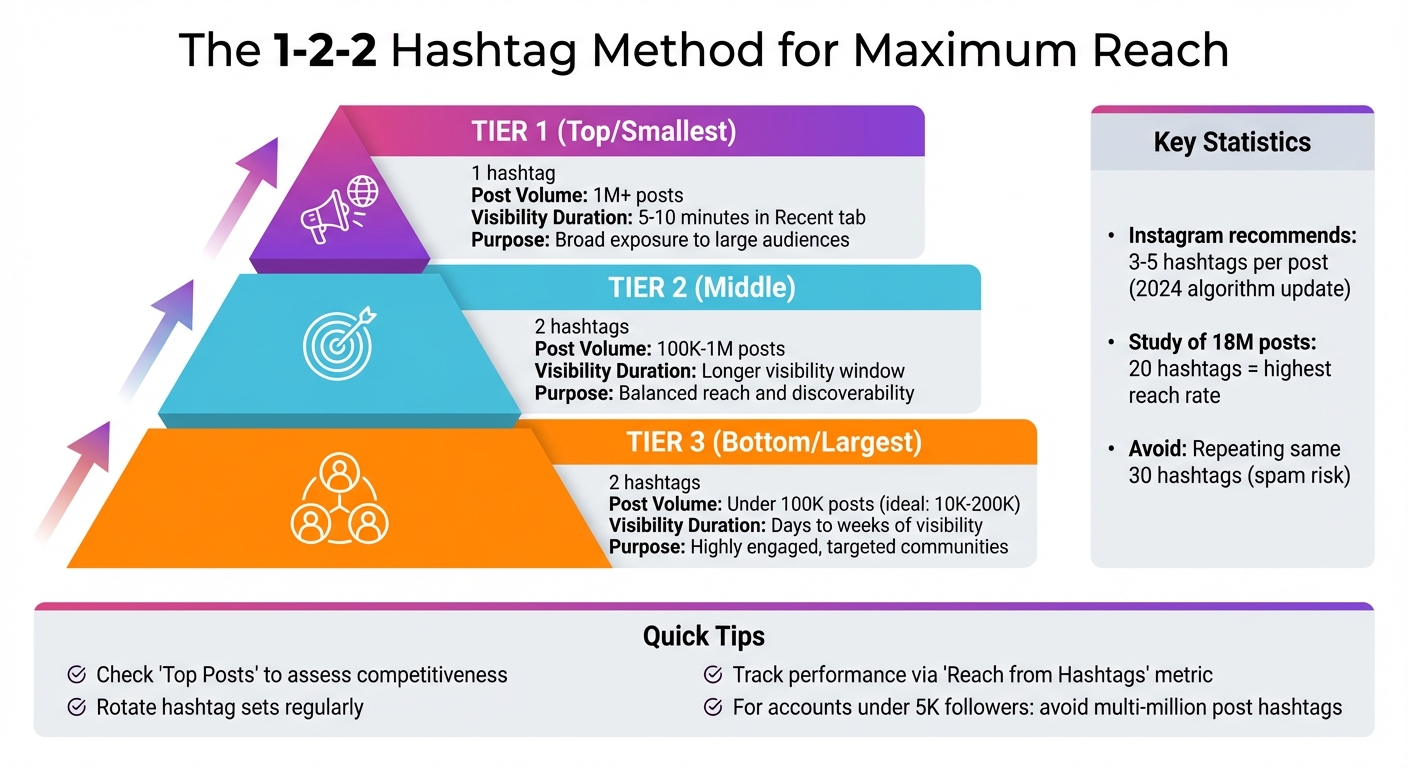
Instagram Hashtag Strategy: The 1-2-2 Method for Optimal Reach
Once you've done your research, it's time to fine-tune your hashtags for better reach and engagement. The goal isn't to overload your posts with 30 random tags and hope for the best. Instead, focus on selecting hashtags that are both relevant and impactful. By creating reusable hashtag sets, you can save time while keeping your content discoverable.
The best hashtag strategy involves a tiered approach that balances broad exposure with targeted precision. High-volume hashtags (those with over 1 million posts) can put your content in front of large audiences, but they move so quickly that your post might only stay visible in the "Recent" tab for a few minutes. On the other hand, niche hashtags (under 100,000 posts) offer longer visibility and connect you with smaller, highly engaged communities.
Try the 1-2-2 method: use 1 high-competition tag (1M+ posts), 2 medium-competition tags (100K-1M posts), and 2 niche tags (under 100K posts). For example, SocialRails adopted this approach in January 2026 and saw improved audience targeting and longer visibility in niche feeds compared to their old strategy of using 30 generic hashtags.
When choosing hashtags, check the "Top Posts" section to assess competitiveness. Look for hashtags where the top-performing content has engagement levels similar to yours - this is where you're more likely to rank.
There's ongoing debate about the ideal number of hashtags. An analysis of over 18 million Instagram posts found that using 20 hashtags resulted in the highest average reach rate. However, Instagram's 2024 algorithm update recommends sticking to 3-5 hashtags per post, as fewer, more relevant tags help the platform categorize your content more accurately.
"The method to my hashtag madness lies in the range of specificity... I steer clear from hashtags that have very few posts because they are incredibly niche and won't help to expose our content to larger audiences." – Drew McWhirter, Creative Marketing Lead at Anh and Chi
Once you've selected your hashtags, the next step is to track their performance.
After choosing your hashtags, it's essential to monitor how well they're working. If you have an Instagram Business or Creator account, you can use Instagram Insights to check this. Open any post, tap "View Insights", and scroll to the "Impressions" section to see how many views came "From Hashtags". This will help you determine whether your hashtags are delivering results.
Pay attention to the difference between reach (unique accounts that saw your post) and impressions (total views, including repeat views). A high impressions-to-reach ratio indicates strong engagement, as it means people are coming back to view your content multiple times. You can calculate engagement using the formula: (Likes + Comments) ÷ (Total Followers × 100).
While Instagram only provides aggregate data, third-party tools like Sprout Social (30-day free trial) or BrandMentions (7-day free trial) can offer deeper insights, including performance of individual hashtags and sentiment analysis.
A/B testing is another valuable tactic. Create 2-3 different hashtag sets and rotate them across similar posts to see which ones drive better reach and engagement. Check your results at intervals - 30 minutes, 60 minutes, and 12 hours after posting - to understand how long your content remains relevant in each hashtag feed.
To streamline your process, build reusable hashtag sets based on content themes. Think of these sets as your hashtag "libraries". For example, you might have one set for educational content, another for product launches, and a third for behind-the-scenes posts.
A well-rounded hashtag set typically includes a mix of:
For example, Sweaty Betty combines trending tags like #GlobalRunningDay with their branded hashtag #IAmASweatyBetty to build community, resulting in posts that garner thousands of likes.
When building your sets, aim for hashtags with post volumes between 10,000 and 200,000. This "middle ground" offers a good balance between discoverability and competition. If your account has fewer than 5,000 followers, avoid hashtags with millions of posts, as they're too crowded for smaller accounts to gain traction.
Save these curated lists in a social media management tool or even a simple notes app. This allows you to quickly copy and paste them with slight adjustments for each post. While hashtags in captions can improve reach, keep your posts visually clean.
Rotate your sets regularly. Reusing the same 30 hashtags on every post can trigger Instagram's algorithm to flag your content as spam, potentially leading to a shadowban where your posts no longer appear in hashtag searches.
"Fewer, more specific hashtags signal to Instagram exactly who should see your content, resulting in better targeting and engagement." – SocialRails team
Switching up your hashtag sets periodically keeps your strategy fresh and effective.
Keeping tabs on your hashtag strategy is an ongoing process. While Instagram's built-in tools are a great place to start, understanding which metrics to focus on - and knowing when to tweak your approach - can make a big difference in your growth. Here's how to use Instagram Insights to track your hashtag performance effectively.
If you’re using an Instagram Business or Creator account, you have access to Instagram Insights, which provides basic analytics for hashtags. To get started, tap the "View Insights" button under any post and scroll to the Impressions section. Here, you’ll find the "From Hashtags" metric, which shows how many people found your post through your hashtags.
It’s worth noting that Instagram only shows combined data for all hashtags used on a post - you won’t get a breakdown for each individual tag. To dig deeper, track metrics like reach (unique users who saw your post), impressions (total views), and engagement (likes, comments, shares, and saves). By comparing these numbers across posts, you can start to see which hashtag combinations are driving the best results.
Regularly reviewing these metrics can help you identify which hashtags are hitting the mark and which ones might need to be swapped out. Once you’ve gotten comfortable with Instagram’s native analytics, you can explore more advanced tools for a deeper dive into your hashtag performance.
Once you’ve mastered the basics with Instagram Insights, you might consider stepping up to advanced tools for a more detailed look at your hashtag strategy. Free tools often cover essentials like reach and engagement, but premium platforms bring extra features like individual hashtag tracking, real-time updates, and custom reports.
The choice between free and paid tools depends on your account size and goals. If you’re just starting out, Instagram’s native analytics should suffice. As your account grows, you might want to invest in a tool like UpGrow, which offers an AI-powered dashboard with real-time analytics to fine-tune your hashtag strategy and boost organic growth.
Consistently tracking your analytics helps you figure out which hashtags resonate with your audience. By refining your strategy over time, you can ensure your efforts lead to meaningful engagement and growth.
Finding effective Instagram hashtags is an ongoing process that requires research and fine-tuning. With Instagram's algorithm now favoring 3–5 highly relevant hashtags over a large number of less focused ones, quality matters more than quantity.
A balanced hashtag strategy can help you gain traction. As Peg Fitzpatrick advises: "A smart move is to use a variety of hashtags: one or two very popular (with millions of results), a group of targeted hashtags that are popular with 100,000 or more search results, and some that aren't as popular". Mixing high-competition tags with medium and niche-specific ones can give your posts the momentum they need.
It’s also crucial to regularly update and check your hashtags to avoid bans and maintain strong performance. Keep an eye on your "Reach from Hashtags" metric to gauge their effectiveness. For added efficiency, advanced tools like UpGrow can simplify this process. UpGrow combines AI-powered targeting with real-time analytics, helping you refine your hashtag strategy while staying Instagram-compliant.
Balancing a mix of popular and niche hashtags is a smart way to connect with both broad audiences and specific communities. To make the most of your hashtag strategy, try combining different types of tags in a thoughtful way:
Switch up your hashtag sets regularly to keep your reach fresh - using the same tags repeatedly can limit your visibility. For a more efficient approach, tools like UpGrow can analyze your content and suggest the best hashtag combinations to maximize engagement and exposure.
If you're searching for free tools to find effective Instagram hashtags, here are some solid options worth exploring:
These tools are a great way to expand your Instagram reach without spending a dime, helping you grow your profile naturally.
To gauge the effectiveness of your Instagram hashtags, start by leveraging tools like Instagram Insights or specialized third-party analytics platforms designed for hashtag tracking. These tools can provide valuable data on metrics such as reach, impressions, likes, comments, and saves tied to each hashtag.
Zero in on the metrics that match your specific goals. If you're aiming to grow your audience, pay close attention to reach and impressions. On the other hand, if engagement is your priority, focus on likes and comments. Make it a habit to review your hashtag performance regularly - whether weekly or monthly - to spot patterns. Identify which hashtags consistently deliver strong results and keep them in your mix. Adjust your strategy as needed to ensure it continues to resonate with your audience's preferences.


