
Ultimate Guide to AI UGC for Influencer Collabs
AI-generated UGC lets brands scale Instagram influencer content—cutting costs, speeding production, and boosting authentic engagement while staying compliant.
AI-generated UGC lets brands scale Instagram influencer content—cutting costs, speeding production, and boosting authentic engagement while staying compliant.
4.98 /5 - from 58k reviews
Trusted by 50,000+ creators — get real engagement delivered to your profile in minutes, not days.
AI-generated user-generated content (AI UGC) is reshaping influencer marketing by offering faster, more cost-effective ways to create Instagram content. Instead of relying on human influencers for every piece of content, brands can use lifelike avatars and synthetic media to produce engaging videos and images at scale. Here's a quick breakdown of what this means for your campaigns:
AI UGC is a game-changer for Instagram campaigns, combining efficiency with high-quality visuals. With the right tools and strategies, you can scale your content production while keeping it engaging and relevant.
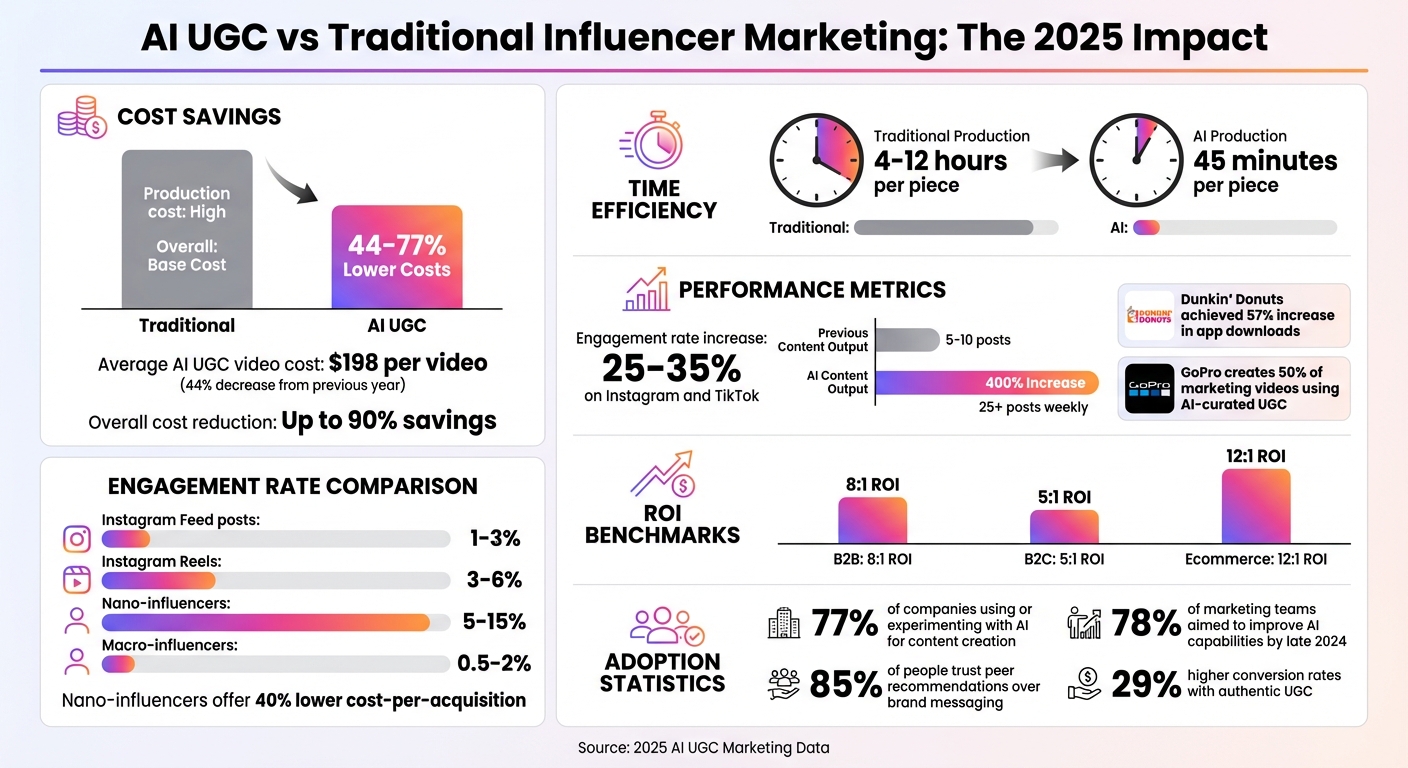
AI UGC vs Traditional Influencer Marketing: Cost and Performance Comparison 2025
Careful planning is the backbone of any successful campaign. Start by setting clear objectives - whether your focus is on boosting brand awareness, driving conversions, increasing app downloads, or improving engagement rates. Take Dunkin' Donuts as an example. In 2025, they launched an AI-powered UGC contest aimed at increasing mobile app downloads. By using location-specific prompts, they achieved a 57% increase in downloads. This success came from aligning their AI UGC efforts with a specific, measurable goal. These objectives guide every step of the planning process.
To track success, focus on AI-specific KPIs, such as content velocity, engagement growth, and authenticity ratings. Establish benchmarks like target cost-per-acquisition and content production speed. AI-generated UGC can significantly reduce costs - by 44-77% - and cut production time from 4–12 hours to just 45 minutes. To hit these targets, use precise prompt engineering. For instance, you might specify: “Gen Z female lifestyle influencer reacting enthusiastically to a sustainable skincare routine”.
Before diving into content creation, make sure you’ve segmented your audience. Tailoring messages to specific demographics ensures your AI-generated content connects with the right people. Focus on crafting hooks, angles, and calls-to-action that deliver measurable results. This approach helps you create repeatable templates that generate high returns on investment.
"The breakthrough isn't just in cost savings. It's in the ability to maintain authentic engagement at scale." – Single Grain
Keep an eye on creative fatigue by monitoring how often content is published and how well it performs. If you notice a decline in ROI, rotate intros or hooks to keep things fresh. Centralize all AI-generated clips, tags, and performance data so your team can quickly iterate on what works. Modern AI tools even allow you to analyze performance at the clip level, measuring metrics like "stop rate", "first-3s hold", and "ROAS" to identify which visual or audio elements resonate most. Once your goals are clear, focus on finding influencers who align with your target audience.
With your goals and audience segments defined, selecting the right influencers becomes key. Decide on the type of content that fits your campaign: AIGC (fully synthetic characters), AI-UGC (human avatars or digital twins), or traditional UGC (human-created). Choose AI actors or digital twins based on key demographics - like age, gender, and location - to reflect your brand’s ideal customer profile. A hybrid approach often works best: use traditional influencers for top-of-funnel awareness and AI-generated UGC for scalable social proof that drives conversions.
To maintain authenticity, ensure your scripts mirror real customer language. Rotate AI actors regularly to keep the content feeling fresh and genuine. For example, a Shopify beauty store boosted its weekly content output from 5 to 25 posts - a 400% increase - by leveraging AI video generation tools. This cut production time from 4 hours to 45 minutes and reduced costs by 65%. Similarly, GoPro now creates 50% of its marketing videos using AI-curated UGC, doubling their content production without adding human resources.
Once your content strategy and influencer roles are in place, make sure everything complies with ethical and regulatory standards. Always label AI-generated content so audiences are aware, and follow platform-specific guidelines on sites like Instagram and TikTok. If you're using AI-UGC with real human avatars or digital twins, obtain explicit consent to use any individual's likeness. Proper consent agreements protect your brand and the individuals involved.
AI should amplify genuine customer stories. Ensure your AI-generated personas reflect the diversity of your customer base to avoid generic representations that could alienate audiences. Use a multi-layer review system: let AI handle technical compliance while human oversight ensures the content aligns with your brand and feels authentic. Keep in mind that 85% of people trust peer recommendations over brand messaging, and UGC campaigns typically see 29% higher conversion rates when the content is perceived as authentic.
Once you've ensured transparency and compliance, the next step is to integrate AI tools into a workflow that complements the influencer's personal style. Today, 77% of companies are already using or experimenting with AI for content creation. A well-structured workflow allows AI to handle repetitive tasks while influencers focus on adding their unique flair and personality to the final product.
A practical approach involves five key stages: strategy and planning, ideation and research, content creation and editing, scheduling and publishing, and performance tracking. For instance, between March and May 2025, the Averi Team used this workflow to produce over 100 pieces of content in just 60 days. By combining AI for initial drafts with human editors to fine-tune tone and style, they achieved a 340% increase in organic traffic and a 220% rise in newsletter signups. AI can kickstart the process with drafts and ideas, but influencers should have the final say to ensure the content feels genuine. To make this work, define clear steps for creating content briefs that align AI outputs with your creative goals.
A solid content brief is the backbone of any successful AI-assisted campaign. These briefs should include specific prompts to guide both AI tools and influencers. For photos, you might use a formula like: FRAME + ACTION/EXPRESSION + CLOTHING + WHERE/BACKGROUND + LIGHT + CAMERA + TONE/FINISH. For videos, try: SHOT SIZE + LIGHTING + CAMERA ANGLE/EFFECT + CAMERA MOVEMENT + VISUAL EFFECTS + CHARACTER EMOTION. These concise, 18–40 word prompts emphasize critical details like lighting and mood, cutting down on revision time.
Visual storyboarding can also streamline the process. Use AI image generators to create mockups or concept previews, giving influencers a clear picture of your vision before production begins. This reduces back-and-forth communication and speeds up approvals. For example, well-crafted briefs can significantly lower production costs and timelines.
Provide AI-generated first-draft captions and scripts as a starting point but encourage influencers to tweak them to match their personal style. Adding their own slang, filler words, or anecdotes ensures the content feels authentic. It's also wise to include "forbidden use cases" in your briefs, such as fabricating testimonials, providing medical or legal advice, or creating deepfakes. These guidelines protect your brand while keeping content ethical.
AI tools can take care of repetitive tasks, saving time and maintaining quality. The key is knowing which tools to use at each stage of the workflow. For brainstorming and outlining, tools like ChatGPT or Averi AI can help create audience personas and keyword clusters. When it comes to scripting and editing, platforms like Writesonic or Grammarly can polish drafts by eliminating filler, jargon, or passive voice. For visuals and video editing, tools like Canva, Leonardo, or CapCut provide professional-quality results. Finally, scheduling tools like Buffer or Zapier can handle distribution seamlessly.
To keep everything consistent, store your brand assets - like tone guidelines, audience profiles, and visual standards - in a centralized "Brand Core" library. Use a status-based tracking system with labels like "AI Drafted", "Human Reviewed", and "Legal Approved" to manage the production pipeline and ensure quality control. For example, the telehealth platform Wyndly used AI workflows to increase their content output by 5x and boost organic web traffic by 20x.
"The point is not to create 'AI content.' It is to create better content, at higher velocity, with less grunt work." – Montana Thomas, Quick Sprout
However, AI workflows aren't a "set-it-and-forget-it" solution. They need oversight to ensure the content aligns with your brand and feels authentic. By late 2024, 78% of marketing teams aimed to improve their AI capabilities, acknowledging that the best results come from combining AI efficiency with human creativity. Once you've streamlined your production process, focus on clarifying rights and approvals to protect your content assets.
It's essential to negotiate clear licensing agreements that outline platform usage, duration, and geographic rights. Ensure you maintain written documentation for consent revocation to comply with GDPR guidelines. Be specific about whether the content will be used for organic social media, paid ads, or traditional media like billboards. Keep in mind that broader usage rights often come with higher costs, so clarify your intentions upfront.
City Beauty, for example, created 3,000 unique pieces of influencer content over two years by using content templates that included usage rights for repurposing assets across campaigns.
To stay ahead of platform compliance and build audience trust, label all AI-generated or AI-enhanced influencer content clearly. Platforms like TikTok and Instagram are increasingly enforcing strict disclosure rules to prevent demonetization or content removal. Being transparent about AI use while featuring real customer stories is becoming a best practice for brands that want to maintain credibility. This approach ensures your campaigns remain compliant as platform policies evolve.
Now that your workflows and approvals are ready, it’s time to launch your campaign. This is where AI truly shines, offering faster production and lower costs while scaling content creation. The trick is to align AI’s capabilities with Instagram’s native formats while keeping that genuine, human touch that drives engagement. Let’s dive into how AI can tailor content for Instagram’s unique styles and formats.
Instagram favors specific content types, and AI tools can help you optimize each format for better results. For example, AI can craft attention-grabbing hooks, pick trending audio for Reels, and add interactive elements to Stories. Carousel posts? AI can generate product comparisons or step-by-step guides that flow seamlessly.
The key to high-performing AI content lies in precise prompts. Instead of vague instructions, go for something like: "Gen Z female lifestyle influencer reacting enthusiastically to a sustainable skincare routine, vertical format, natural lighting". This level of detail ensures the output matches your brand’s look and feel.
Cost efficiency is another major advantage. AI-generated UGC videos now average $198 per video - a 44% drop in production costs compared to last year. Brands leveraging AI can cut content creation expenses by up to 90%, with production times shrinking from 4–12 hours to just 45 minutes per piece. The results? A 25–35% boost in engagement rates on platforms like Instagram and TikTok by 2025.
"The breakthrough isn't just in cost savings. It's in the ability to maintain authentic engagement at scale. AI-powered UGC filtering delivered a 25-35% lift in engagement rates for brands on TikTok and Instagram in 2025, proving that technology can enhance rather than replace human connection." – Single Grain
Once your AI-generated content is live, amplification is the next step, and that’s where UpGrow comes in. This tool takes your campaign further with advanced targeting, insights into viral content trends, and real-time analytics.
UpGrow allows you to filter audiences by factors like location, age, gender, and language, ensuring your content reaches those most likely to engage. Its viral content library highlights proven formats and trending styles, making it easier to identify what works best in your niche. Plus, the real-time analytics dashboard helps you track metrics like follower growth and engagement rates, so you can tweak your strategy as needed. For instance, if a particular AI-generated Reel performs well, you can create similar variations using the same prompts and visual themes.
The Boost™ tool is another game-changer, accelerating follower growth during key campaign moments. It ensures maximum visibility when influencer collaborations go live, all while adhering to Instagram’s guidelines. With UpGrow managing amplification, you can focus on refining your content strategy.
AI’s ability to scale content is a huge advantage, but it comes with a challenge: maintaining authenticity. The solution? A hybrid approach that combines AI efficiency with human oversight to ensure your content stays aligned with your brand and resonates with your audience.
For example, you can use AI to create multiple variations of a single piece - adjusting backgrounds, lighting, or influencer expressions - and then have your team select the most genuine-looking options. This method can increase weekly output from 5–10 pieces to 25 or more, representing a 400% boost.
Transparency is also essential when scaling. Clearly labeling AI-generated or AI-enhanced content helps build trust, especially as Instagram tightens its disclosure rules. Brands that acknowledge their use of AI while sharing real customer stories tend to perform better. Looking ahead, by 2026, predictive analytics will allow campaigns to adapt content in real time based on audience behavior, making transparency even more critical.
Tracking performance is the backbone of any successful AI-driven user-generated content (UGC) campaign. Yet, 73% of marketers admit they struggle to measure influencer performance accurately. Fortunately, AI-powered analytics tools make this process easier, delivering precise metrics that help you make smarter decisions and refine your campaigns effectively.
The first step is to focus on the right metrics. Engagement rate is a critical indicator. For context, Instagram Feed posts in 2026 average engagement rates of 1–3%, while Reels tend to perform better at 3–6%. Nano-influencers, who are often more affordable, achieve engagement rates of 5–15% and offer a 40% lower cost-per-acquisition compared to macro-influencers, whose rates typically range from 0.5–2%.
Beyond engagement, keep an eye on business-driven metrics like conversions, customer lifetime value, and brand sentiment. For return on investment (ROI), aim for benchmarks like 8:1 in B2B, 5:1 in B2C, and 12:1 in ecommerce. Defining these KPIs before launching your campaign will help you evaluate success objectively, avoiding the temptation to justify subpar results later.
AI analytics tools bring clarity to campaign performance with real-time data. Platforms like UpGrow offer live dashboards that track follower growth, engagement rates, and audience quality, enabling quick adjustments to capitalize on trends.
One standout feature of UpGrow is its Fake Follower Checker, which ensures an influencer’s audience is authentic rather than inflated by bots. This means your budget targets real people who are likely to engage with your brand. Another helpful tool is predictive ROI scoring, which uses historical data to forecast campaign performance with 75–85% accuracy. This feature allows you to assess potential financial outcomes before committing to collaborations.
To maximize efficiency, use audience overlap analysis when working with multiple influencers. This tool prevents you from paying to reach the same audience twice. Additionally, AI tools can monitor brand sentiment by analyzing mentions - whether they’re positive, negative, or neutral - giving you a clearer picture of how your campaign is being received. With access to these insights, you can develop strategies that are not only successful but also repeatable.
Once you identify what drives success, document it. A playbook should include your influencer selection criteria, content approval workflows, and performance benchmarks. This will help you build a streamlined process for future campaigns while preserving valuable insights.
For example, if a prompt like "Gen Z female lifestyle influencer reacting enthusiastically to a sustainable skincare routine" generates high engagement, save that exact phrasing for future use. Refine your prompts through A/B testing to identify content that resonates best.
Track which formats perform better - Reels often outperform Feed posts - and allocate more resources to those formats. By recording these strategies and results, you can transform isolated successes into consistent wins, creating a blueprint for ongoing success.
AI-generated UGC is revolutionizing Instagram influencer campaigns, delivering massive improvements in content output, cost savings, and audience engagement. What used to take weeks and cost thousands of dollars per piece can now be accomplished in hours at a fraction of the price.
"The breakthrough isn't just in cost savings. It's in the ability to maintain authentic engagement at scale." - Single Grain
But the benefits go beyond short-term efficiencies. AI-generated UGC offers a solid foundation for long-term growth. Success stories highlight strategies driven by data - like location-targeted campaigns that boost app downloads or AI-curated content that doubles marketing output without requiring bigger teams.
UpGrow takes these advantages further by combining real-time analytics with targeted amplification. Using AI-powered filters for location, age, gender, and language, your campaigns reach the audiences most likely to engage. A live dashboard tracks key metrics like follower growth, engagement rates, and audience quality, while the Fake Follower Checker ensures influencer authenticity. This blend of advanced AI and human creativity sets the stage for Instagram success.
The future of Instagram marketing lies in balancing authenticity with scale. AI tools handle high-volume content creation, while human oversight ensures brand alignment and sensitivity to audience preferences. By staying transparent, testing different approaches, and learning from each iteration, your strategy becomes stronger with every campaign.
Whether you're just starting with AI UGC or scaling an existing program, the tools you need are already available. By 2026, the most successful brands on Instagram won’t necessarily be the ones with the deepest pockets - they’ll be the ones using AI to create smarter, faster, and more effective campaigns.
To keep AI-generated user-generated content (UGC) authentic, brands should focus on enhancing actual customer stories instead of inventing new ones. Transparency is key - clearly label any content created with AI to maintain trust with your audience. Incorporate real user data to personalize the content and ensure it aligns with the tone and style of genuine customer voices. This strategy makes the content feel relatable and trustworthy while still benefiting from AI's capabilities.
Disclosing AI-generated content is essential for maintaining trust and adhering to U.S. regulations. Make sure your disclosure is clear, easy to find, and positioned close to the AI-generated material. For instance, you could include a label like "This post was created with AI" directly above a caption or video. Use plain, straightforward language - avoid hidden hashtags or overly technical terms that might confuse the audience.
Stick to platform-specific rules, such as using tags like #AIgenerated or utilizing built-in tools designed for disclosure. The FTC also emphasizes that disclosures must be visible before users scroll past the content. Be transparent about the extent of AI involvement - for example, you might write, "The script was AI-written, but visuals were created by a human." It's also a good idea to keep records of your disclosures in case you need to demonstrate compliance.
Consistency is crucial. Use the same level of transparency across all platforms, and be prepared to update your disclosures if your content creation process evolves. This ensures your audience can easily distinguish between human-created and AI-generated material, reinforcing trust and credibility.
AI-generated user content (AI UGC) is changing how brands connect with influencers by replacing guesswork with solid data. Using AI, brands can analyze audience behavior, trending hashtags, and visual trends to pinpoint influencers whose followers match their campaign goals. Key factors like age, gender, location, and even purchase intent are considered, making it easier to find the right fit. This smarter approach cuts down on mismatched partnerships and streamlines the selection process, saving time and delivering better outcomes.
AI UGC also takes collaboration to the next level. Brands can create sample content tailored to an influencer's unique style, experiment with creative ideas, and monitor performance in real time. Tools like smart filters and live analytics allow marketers to tweak strategies as needed, keeping campaigns flexible and focused on results. By combining precise influencer matching with data-driven content creation, AI UGC has become a game-changer for modern influencer marketing.


