
How Chatbots Personalize Instagram Shopping Experiences
AI chatbots turn Instagram DMs into predictive, conversational shopping that boosts engagement and triples conversion rates.
AI chatbots turn Instagram DMs into predictive, conversational shopping that boosts engagement and triples conversion rates.
4.98 /5 - from 58k reviews
Trusted by 50,000+ creators — get real engagement delivered to your profile in minutes, not days.
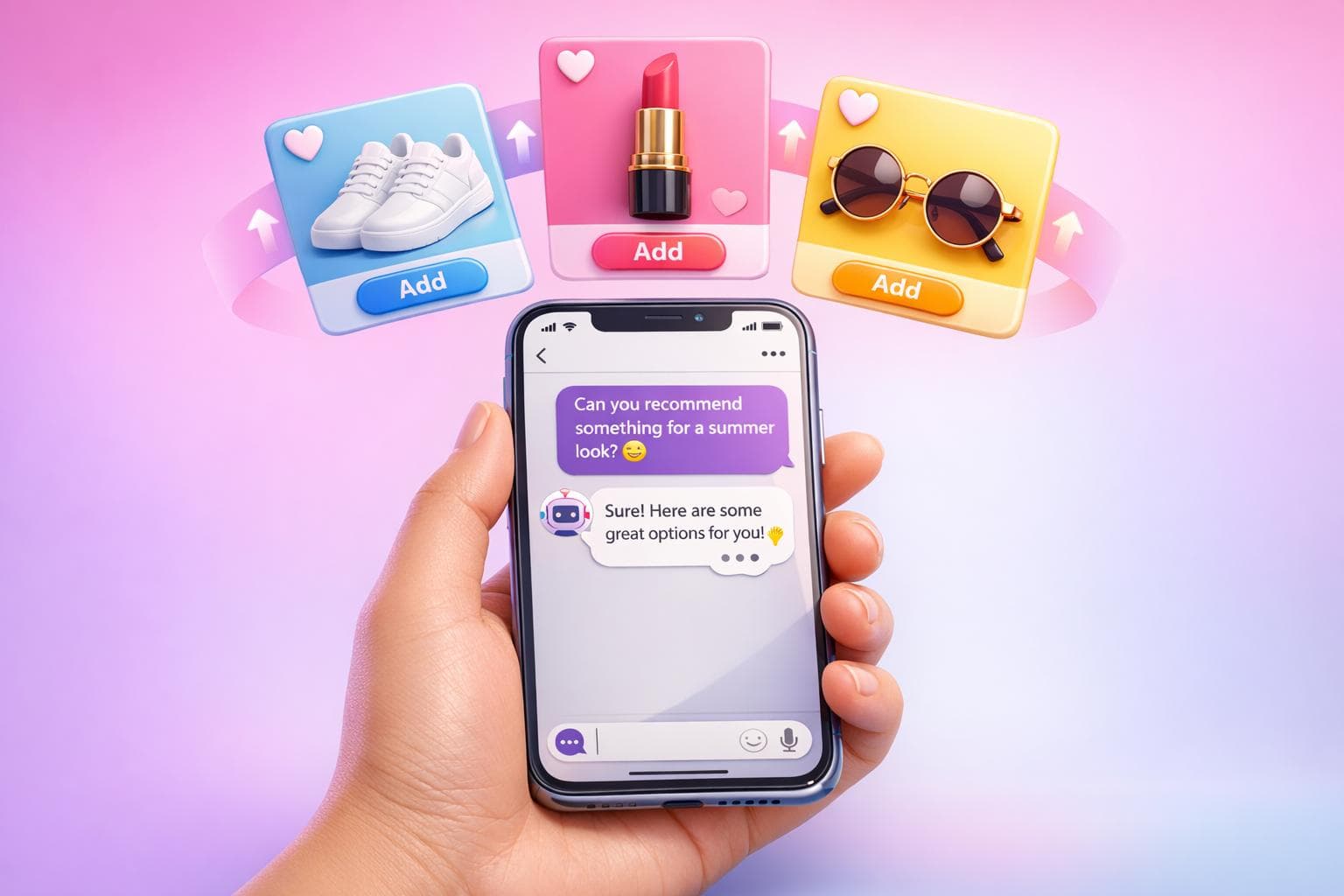
Chatbots are transforming Instagram into more than just a social platform - it’s now a powerful shopping tool. With over 150 million users messaging businesses monthly, AI-powered chatbots are reshaping how brands interact with customers through advanced automation. These bots deliver tailored recommendations, streamline purchases, and boost sales, all through direct messages (DMs).
Key Takeaways:
For example, brands like Tatcha and GlowSkin have seen significant revenue boosts using Instagram chatbots. These bots act as virtual shopping assistants, offering quick, personalized responses that keep customers engaged and satisfied.
As AI evolves, Instagram shopping is shifting toward predictive, conversational commerce, making it easier for users to discover and buy products instantly.
Personalization on Instagram goes beyond simply showing users a product they clicked on once. It’s about moving away from generic, cookie-cutter responses to creating interactions that feel tailored and relevant. On this platform, chatbots are designed to respond based on the context, occasion, and even potential budget behind a query - not just the keywords used. For example, if someone asks, "What should I wear to a summer wedding?", the bot understands the event and provides suggestions that match the scenario. This approach makes Instagram shopping feel less like browsing a catalog and more like having a personalized shopping assistant.
Why does this matter? Because 70% of Instagram users actively engage with the platform's shopping features. These users expect experiences that cater to their individual preferences - not just a random assortment of products.
So, how does chatbot personalization actually work? It’s all about creating dynamic, user-specific interactions that boost both engagement and Instagram sales. For instance, a chatbot might recognize a returning customer and greet them by referencing their last purchase. It could suggest a product that complements items already in their cart or adapt its tone and recommendations based on the user’s location or language.
Here’s a great example: In April 2026, luxury skincare brand Tatcha used AI-driven conversations in Instagram DMs to provide personalized product recommendations and help users build skincare routines. The results? A 3x increase in conversion rates, with these AI-powered chats contributing to 11.4% of the brand’s total site revenue. This isn’t just a bot answering basic questions - it’s functioning like a knowledgeable sales associate. Brands can achieve this level of sophistication by integrating ChatGPT for Instagram to handle complex customer inquiries.
Chatbots don’t rely on guesswork. They pull from various layers of user data to make every interaction feel tailored. Here’s a breakdown of the key data types they use:
| Data Type | What It Includes | How It's Used |
|---|---|---|
| Behavioral | Pages browsed, filters applied, products viewed | Understands what the user is currently interested in |
| Historical | Past purchases, loyalty program data, cart contents | Suggests reorders, complementary products, or sizes |
| Demographic | Age, language, general location | Adjusts tone, currency, and product relevance |
| Contextual | Device type, time of day, stated occasion | Provides recommendations suited to the moment |
| Social Graph | Followed accounts, liked posts, friends' activity | Aligns suggestions with personal tastes and social proof |
For users who haven’t logged in or shared much data, chatbots rely on real-time session behavior - like clicks or time spent on a product - to guide their responses. The more data they have, the sharper their recommendations.
Chatbots on Instagram engage users across multiple touchpoints, including DMs, Story replies, Shopping tabs, and comment-triggered flows. For instance, a brand might post a Reel with a caption like "Comment SHOP to get the link." When someone comments, they receive an automated DM that kicks off a personalized shopping experience. From there, the chatbot can ask qualifying questions, recommend products, and even complete the checkout process - all within the app.
Meta is also experimenting with "Shopping Mode," a conversational feature within its AI interface that curates visual feeds and provides real-time styling advice. Another feature, "Shop the Look," uses AI-powered visual recognition to identify products in posts by creators and automatically attach shopping links - eliminating the need for manual tagging. Essentially, the entire shopping process - from discovery to purchase - is being streamlined into a single, seamless conversation thread.
The seamless shopping experiences discussed earlier rely on a combination of AI techniques working together behind the scenes. Each method addresses a specific aspect of personalization, creating a cohesive and tailored user experience. Let’s break down the AI methods - recommendation systems, NLP, and reinforcement learning - that make this possible.
Every chatbot relies on a recommendation engine to suggest relevant products. These systems analyze behavioral data, purchase history, and stated preferences to predict what a user might want. Two popular approaches are collaborative filtering (suggesting products based on what similar users liked) and vector embeddings (matching products to queries by understanding their semantic meaning).
Modern systems work in real time. For example, if a user adds a jacket to their cart during a conversation, the chatbot instantly updates its next suggestion - offering a matching scarf or complementary boots. Advanced models like Meta's Muse Spark take this even further by processing images. A user could upload a photo of an outfit they admire, and the AI would analyze its fabric, cut, and color to find similar items in a product catalog. Retailers implementing this level of personalization report revenue increases of 10–15%.
Natural language processing (NLP) allows chatbots to genuinely understand what users are saying, beyond just spotting keywords. Traditional rule-based bots struggle with casual language or typos like "sumthing for dry skin lol", but NLP-powered systems can interpret the true intent: finding a product for dry skin.
"AI agents understand context and intent, generating dynamic responses. Rule-based bots match keywords to pre-written messages." - Vytas, Founder, CreatorFlow
NLP also enables chatbots to learn from user interactions. If a user casually mentions "eco-friendly materials" or "sensitive skin", the chatbot stores this information and incorporates it into future recommendations. Large Language Models (LLMs) enhance this process by supporting over 50 languages without requiring manual translation - a huge advantage for brands targeting diverse U.S. audiences. By accurately interpreting user language, chatbots create a more personalized shopping experience, even on platforms like Instagram.
Reinforcement learning lets chatbots refine their recommendations based on user feedback. Over time, they adjust suggestions to improve metrics like order value and revenue. For example, in Q1 2025, GlowSkin, a DTC skincare brand, introduced a Llama-powered chatbot. This upgrade reduced response times from 6 minutes to 2 seconds and boosted the average order value by 28%, increasing it from $54 to $69. This continuous learning process ensures chatbots consistently improve their personalization efforts. Businesses that excel in this area often see a 1.7x growth in revenue and a 2.3x increase in customer lifetime value.
| AI Method | What It Does |
|---|---|
| Collaborative Filtering | Suggests products based on behaviors of similar users |
| Vector Embeddings | Matches products to queries by understanding meaning, not just keywords |
| NLP / NLU | Interprets intent, handles typos, and captures user preferences |
| Reinforcement Learning | Improves recommendations by learning from user interactions |
| Retrieval-Augmented Generation (RAG) | Fetches real-time product data from indexed catalogs for accurate responses |
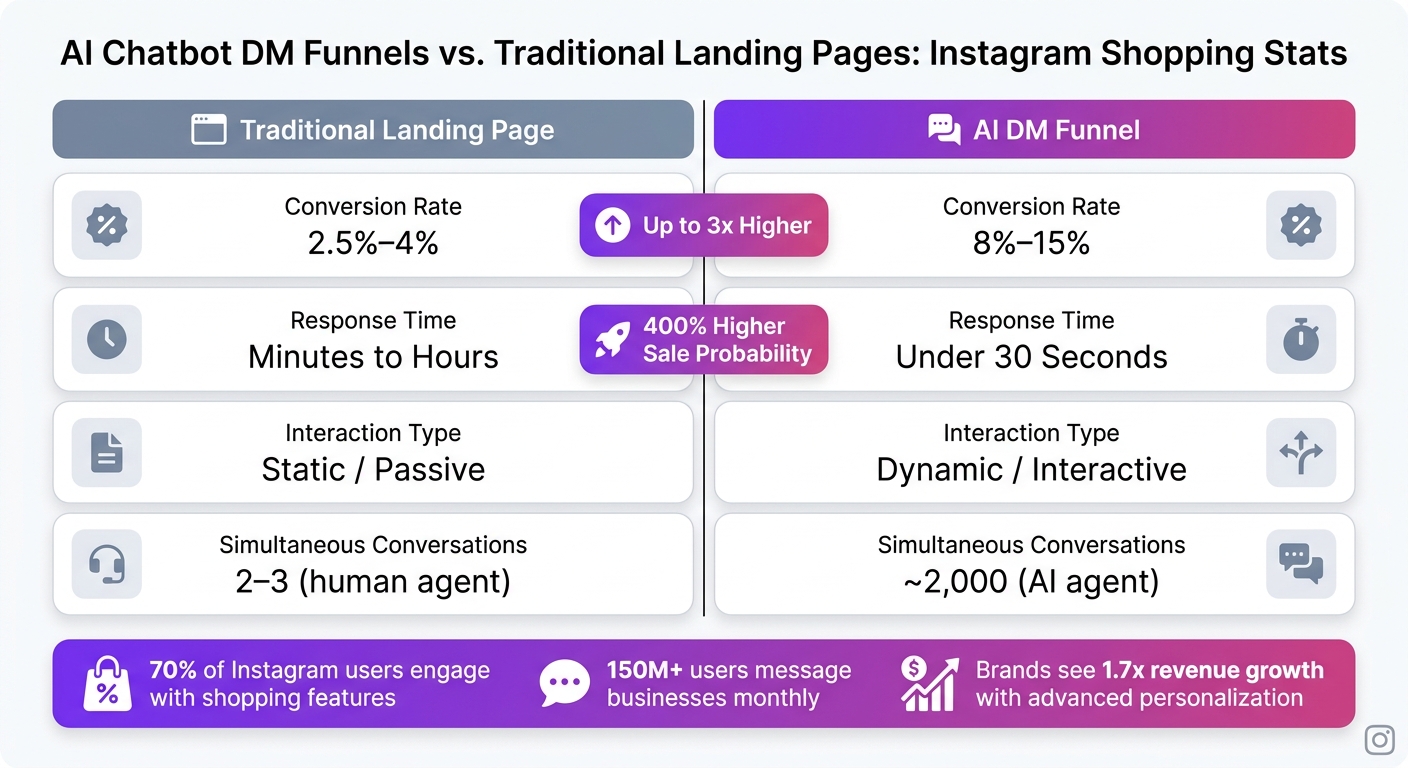
AI Chatbot DM Funnels vs. Traditional Landing Pages: Instagram Shopping Stats
The AI strategies and Instagram post optimization discussed earlier have a direct impact on shopping habits. Research from 2026 provides clear evidence of how personalized chatbots influence engagement, sales, and customer satisfaction. Brands can also analyze competitor strategies using an Instagram ads spy tool to see how others integrate these bots. Let’s dive into how these factors shape engagement and sales performance on Instagram.
A staggering 70% of Instagram users actively interact with shopping features. This engagement grows even stronger when personalized AI chatbots join the conversation. Unlike human agents who can manage just two or three chats at a time, a single AI agent can handle around 2,000 conversations simultaneously. Even more impressive? When responses are delivered within 30 seconds, the chance of a sale skyrockets by 400%. These capabilities allow brands to deliver tailored, real-time interactions at scale, 24/7.
Quick responses don’t just keep users engaged - they also lead to higher sales. The difference between traditional sales funnels and AI-powered direct messaging (DM) funnels is striking:
| Metric | Traditional Landing Page | AI DM Funnel |
|---|---|---|
| Conversion Rate | 2.5%–4% | 8%–15% |
| Response Time | Minutes to hours | Under 30 seconds |
| Interaction Type | Static / passive | Dynamic / interactive |
AI-assisted conversations through DMs deliver conversion rates up to three times higher than traditional methods. Brands are seeing tangible results: Victoria Beckham Beauty reported a 20% increase in average order value after implementing AI-driven product recommendations in social messaging. Meanwhile, Sephora’s AI assistant, which helps with beauty queries and visual searches, boosted total customer interactions by 40% and increased direct sales through social platforms by 25%.
The numbers tell one part of the story, but customer sentiment also highlights the value of these personalized interactions. Research from February 2026 shows that chatbot features like interactivity, accessibility, and entertainment enhance satisfaction. Many shoppers value convenience and enjoyment over privacy concerns when using e-commerce chatbots. However, transparency is key - 54% of users want to be informed when they’re speaking with AI instead of a human.
Trust can erode when AI recommendations feel unverified. For example, Meta’s February 2026 test of its "Shop the Look" feature, which automatically linked products to creator posts, sparked criticism. Influencers like Julia Berolzheimer opposed the feature, arguing that the AI linked to items they hadn’t reviewed or endorsed.
Personalization with chatbots begins with accurate, first-party data. Instagram DMs are an excellent platform for collecting this data directly from users. Instead of relying on external forms or third-party tools, brands can program chatbots to ask simple, conversational questions. For instance, a skincare brand could ask about a customer's skin type, budget, or goals before recommending products. This method, known as zero-party data collection, allows brands to build personalized profiles without creating unnecessary hurdles for users.
Take GlowSkin, a direct-to-consumer skincare brand, as an example. In Q1 2025, they implemented a Meta chatbot trained on 1,400 FAQ pairs and 350 ingredient descriptions. By integrating upsell logic - like suggesting Moisturizer B whenever customers added Serum A to their cart - they increased their average order value (AOV) by 28% and reduced response times by a staggering 99%. The key to this success? Structured data.
For effective chatbot implementation, brands should follow these steps:
By collecting and managing data responsibly, brands can create tailored user experiences that align with consumer expectations in the U.S.
In the U.S., fast and seamless responses are critical for driving conversions. With social commerce sales in the country expected to surpass $100 billion by 2026, it's essential to design chatbot flows that cater to this demand for efficiency.
One highly effective approach is the comment-to-DM funnel. Here’s how it works: A user comments a keyword like "SHOP" or "WANT" on a post, and the chatbot immediately initiates a personalized DM conversation. This eliminates the need for "link in bio" redirects, which often cause users to drop off. Research shows that each additional click in a shopping journey can slash conversion rates by over 50%. Instead of overwhelming users with an entire product catalog, the chatbot asks one or two targeted questions - like size, budget, or intended use - and then presents a curated list of three options. This strategy helps reduce decision fatigue, a common reason for cart abandonment in the U.S.
Transparency is another crucial element. According to recent data, 54% of consumers prefer to know when they’re interacting with AI. A simple introduction like "Hi! I'm [Brand Name]'s AI assistant" sets the right expectations while emphasizing speed and efficiency.
"Transparency isn't a hurdle; it's a conversion booster. When users know they are talking to a highly efficient AI, their expectations for speed are met." - Stormy AI
Even the most advanced chatbot won’t deliver results without the right audience. If your Instagram followers don’t match your target market, personalization efforts will fall flat. That’s where UpGrow comes in.
UpGrow specializes in building a relevant Instagram audience using patented AI targeting. It filters users by factors like location, age, gender, and language, ensuring that U.S.-based brands attract followers who are actual potential buyers - not just passive accounts. When these engaged followers comment on posts and trigger a comment-to-DM funnel, the chatbot starts the conversation with warm leads who are already interested.
In addition to audience growth, UpGrow offers profile optimization tools to enhance your Instagram presence. From cleaning up your bio to improving visuals, these tools help establish credibility before a single DM is sent. Plans start at $39/month and include a growth guarantee, along with a free trial.
AI chatbots have already made a noticeable impact on Instagram shopping, improving conversion rates and speeding up how quickly customers get answers. But the future holds even bigger shifts, thanks to the next generation of AI tools.
A key development on the horizon is agentic commerce - where AI takes on shopping tasks autonomously. Meta is already working on tools like "Hatch", an AI system designed to go beyond simply answering questions. It can research products, address customer concerns, and even complete purchases directly within Instagram DMs. As Mark Zuckerberg explained:
"Meta's new agentic shopping tools would allow people to find just the right, very specific set of products from the businesses in our catalog."
This marks a shift from personalized recommendations to fully autonomous shopping experiences.
By January 2026, studies showed that 41% of consumers were using AI platforms for product discovery, with 33% even replacing traditional search methods entirely. This highlights a growing preference for natural language-based product catalogs.
However, challenges remain. Recent criticism over unverified automatic product links shows how quickly trust can erode when automation lacks transparency. The brands that focus on accurate product data, seamless checkout experiences, and clear communication about AI usage will likely stand out from competitors relying on shortcuts.
As mentioned earlier, personalized interactions and instant responses are reshaping Instagram shopping. The platform is moving from simple browsing toward predictive, conversational commerce. Brands that prioritize using an Instagram growth service to build the right audience, maintaining reliable data, and adopting transparent AI practices will be better positioned to thrive as agentic checkout becomes mainstream.
"2025 marked a decisive shift... shoppers began asking AI instead of typing keywords. In 2026, shopping will turn predictive and culturally aware." - Dani Nadel, President of Feedvisor
Instagram chatbots gather information like user location, inferred gender, and the context of their interactions to create personalized product recommendations. They also tap into product catalog details - such as brand, price, and merchant information - to ensure suggestions match user preferences.
Comment-to-DM funnels are a powerful way to increase conversions on Instagram Shop. They work by turning public comments into private, one-on-one conversations. This approach allows businesses to quickly answer customer questions, share product links directly, and even guide users toward making instant purchases. By simplifying the buying process and offering personalized assistance, these funnels make it much easier to convert interest into sales.
Brands can create personalized chatbot experiences while respecting privacy by being upfront about how they collect data, securing clear user consent, and offering options for users to set preferences or opt out entirely. It's also crucial to adhere to regulations like GDPR by avoiding extensive long-term profiling and instead prioritizing session-based personalization when appropriate.


